


What is the Variable Reluctance Market Size and Growth Rate?
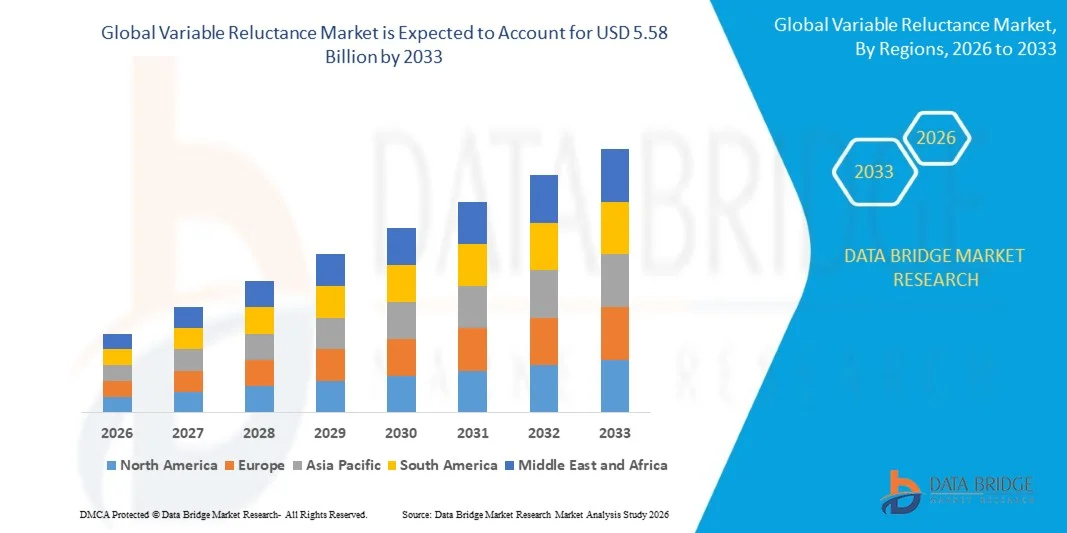
- As per Data Bridge Market Research analysis the variable reluctance market was valued at USD 3.96 billion in 2025 and is projected to reach USD 5.58 billion by 2033, growing at a CAGR of 4.40% from 2026 to 2033.
- The market is experiencing steady growth driven by the increasing adoption of industrial automation, rising demand for precision motion control systems, and expanding use of variable reluctance motors and sensors across automotive, consumer electronics, telecommunications, and medical equipment applications.
- The growing emphasis on energy-efficient motor technologies, advancements in automation and robotics, and increasing investments in electric mobility and smart manufacturing are encouraging manufacturers to adopt variable reluctance technologies, supporting improved performance, reliability, and cost-effective operation across diverse end-use industries.
Market Size & Forecast
- Market Value (2025): USD 3.96 Billion
- Expected Market Value (2033): USD 5.58 Billion
- Forecast CAGR (2026–2033): 4.40%
- Leading Region in 2025: North America
- Fastest Growing Region: Asia-Pacific
What are the Major Takeaways of the Variable Reluctance Market?
- North America dominated the variable reluctance market with the largest revenue share in 2025, supported by increasing investments in industrial automation, advanced manufacturing, and energy-efficient motor technologies.
- The Asia-Pacific variable reluctance market is expected to witness the fastest growth rate from 2026 to 2033, supported by rapid industrialization, increasing investments in factory automation, and expanding electric vehicle production across China, Japan, South Korea, and India.
- The single stack variable reluctance motor segment held the largest market revenue share in 2025 driven by its simple construction, cost-effectiveness, and widespread adoption across industrial automation, office equipment, and consumer electronics applications.
- The multi stack variable reluctance motor segment is expected to witness the fastest growth during the forecast period from 2026 to 2033 driven by increasing demand for high-torque and precision motion control solutions across industrial automation, medical equipment, and advanced manufacturing applications.
- The industrial automation segment held the largest market revenue share in 2025 driven by the growing deployment of robotics, CNC machinery, factory automation systems, and precision motion control equipment. Increasing investments in smart manufacturing and energy-efficient motor technologies continue to strengthen demand across industrial facilities.
- The automotive OEMs segment is expected to witness the fastest growth during the forecast period from 2026 to 2033 driven by increasing vehicle electrification, rising adoption of advanced electric drive systems, and growing integration of intelligent motion control technologies.
Report Scope and Variable Reluctance Market Segmentation
|
Attributes |
Variable Reluctance Key Market Insights |
|
Segments Covered |
|
|
Countries Covered |
North America
Europe
Asia-Pacific
Middle East and Africa
South America
|
|
Key Market Players |
|
|
Market Opportunities |
|
|
Value Added Data Infosets |
In addition to the insights on market scenarios such as market value, growth rate, segmentation, geographical coverage, and major players, the market reports curated by the Data Bridge Market Research also include in-depth expert analysis, geographically represented company-wise production and capacity, network layouts of distributors and partners, detailed and updated price trend analysis and deficit analysis of supply chain and demand. |
What is the Key Trend in the Variable Reluctance Market?
- The variable reluctance market is witnessing a strong shift toward rare-earth-free switched reluctance motor (SRM) technologies, as manufacturers seek cost-effective, energy-efficient alternatives to permanent magnet motors for industrial automation, electric mobility, and HVAC applications.
- For instance, Nidec continues to expand its U.S. MOTORS Switched Reluctance Motors portfolio, highlighting rare-earth-free motor solutions paired with SR Drives for demanding industrial applications such as pumps, compressors, conveyors, and high-speed fans, enabling higher efficiency and lower lifecycle costs.
- Advances in sensorless motor control, torque ripple reduction, and intelligent drive electronics are improving the efficiency, reliability, and commercial viability of variable reluctance motors across precision motion-control applications.
- For instance, in May 2025, researchers published a neural network-based current reshaping technique for switched reluctance motors that significantly reduces torque ripple, supporting smoother operation in industrial and automotive applications.
- As industries continue to prioritize energy-efficient, rare-earth-independent motor technologies with improved digital control capabilities, the adoption of variable reluctance motors is expected to accelerate across manufacturing, automotive, and renewable energy applications.
What are the Key Drivers of the Variable Reluctance Market?
- The growing adoption of industrial automation, robotics, and electric mobility is significantly increasing demand for variable reluctance motors that offer high efficiency, robust construction, and independence from rare-earth permanent magnets.
- For instance, in January 2025, Nidec's SynR Synchronous Reluctance Motor and switched reluctance motor portfolio are designed to improve energy efficiency while reducing dependence on rare-earth materials, supporting industrial decarbonization initiatives.
- Manufacturers are increasingly investing in advanced control algorithms, sensorless operation, and intelligent motor drives to enhance performance, reduce maintenance requirements, and improve operational efficiency across industrial and automotive applications.
- For instance, in March 2025, researchers published a full-speed sensorless control system for synchronous reluctance motors that improves rotor position estimation and operational accuracy under magnetic saturation, enabling more reliable industrial motor performance.
- As industries continue transitioning toward energy-efficient motor systems and smart manufacturing, variable reluctance technologies are expected to witness sustained adoption across industrial automation, automotive, and renewable energy sectors.
Which Factors are Challenging the Growth of the Variable Reluctance Market?
- Variable reluctance motors continue to face challenges related to torque ripple, acoustic noise, vibration, and the need for sophisticated electronic controllers, particularly in high-precision motion-control applications.
- These technical limitations can increase system complexity and restrict adoption in applications requiring ultra-smooth motion, precise positioning, or premium user experience.
- For instance, in May 2025, researchers developed an enhanced adaptive sliding mode control strategy specifically to reduce torque ripple in switched reluctance motor drives, highlighting that torque ripple remains a major engineering challenge requiring advanced control techniques.
- The need for advanced power electronics, complex control algorithms, and specialized motor drive systems continues to increase implementation costs and engineering complexity, particularly for small and medium-sized manufacturers.
- These technical barriers may slow broader commercial adoption despite the technology's advantages in efficiency, durability, and rare-earth-free operation.
How is the Variable Reluctance Market Segmented?
The market is segmented on the basis of motor type, application, and end user.
- By Motor Type
On the basis of motor type, the variable reluctance market is segmented into single stack variable reluctance motor and multi stack variable reluctance motor. The single stack variable reluctance motor segment held the largest market revenue share in 2025 driven by its simple construction, cost-effectiveness, and widespread adoption across industrial automation, office equipment, and consumer electronics applications. These motors are preferred due to their reliable performance, ease of maintenance, and efficient operation under moderate torque requirements.
The multi stack variable reluctance motor segment is expected to witness the fastest growth during the forecast period from 2026 to 2033 driven by increasing demand for high-torque and precision motion control solutions across industrial automation, medical equipment, and advanced manufacturing applications. Their ability to deliver improved torque output, higher efficiency, and enhanced performance is supporting wider adoption in next-generation motion control systems.
- By Application
On the basis of application, the variable reluctance market is segmented into automotive, industrial automation, consumer electronics, telecommunication equipment, office equipment, medical equipment, renewable energy, and others. The industrial automation segment held the largest market revenue share in 2025 driven by the growing deployment of robotics, CNC machinery, factory automation systems, and precision motion control equipment. Increasing investments in smart manufacturing and energy-efficient motor technologies continue to strengthen demand across industrial facilities.
The renewable energy segment is expected to witness the fastest growth during the forecast period from 2026 to 2033 driven by rising investments in clean energy infrastructure and increasing adoption of energy-efficient motor technologies in wind power systems, solar tracking equipment, and other sustainable energy applications. Advancements in power electronics and intelligent motor control are further supporting market expansion.
- By End User
On the basis of end user, the variable reluctance market is segmented into automotive OEMs, industrial manufacturers, electronics companies, and R&D institutions. The industrial manufacturers segment held the largest market revenue share in 2025 driven by the extensive use of variable reluctance motors in automated production lines, material handling systems, and precision manufacturing equipment. The growing focus on improving operational efficiency, productivity, and energy savings continues to support segment growth.
The automotive OEMs segment is expected to witness the fastest growth during the forecast period from 2026 to 2033 driven by increasing vehicle electrification, rising adoption of advanced electric drive systems, and growing integration of intelligent motion control technologies. Expanding investments in electric vehicles and next-generation automotive components are creating new opportunities for variable reluctance motor technologies.
Which Region Holds the Largest Share of the Variable Reluctance Market?
North America Variable Reluctance Market Insight
North America dominated the variable reluctance market with the largest revenue share in 2025, supported by increasing investments in industrial automation, advanced manufacturing, and energy-efficient motor technologies.
The region benefits from the widespread adoption of motion control systems across automotive, aerospace, healthcare, and industrial manufacturing sectors. The presence of leading automation companies, continuous technological innovation, and growing demand for high-performance electric motor solutions continue to strengthen the market across industrial and commercial applications.
U.S. Variable Reluctance Market Insight
The U.S. variable reluctance market captured the largest revenue share in 2025 within North America, fueled by the rapid adoption of Industry 4.0 technologies, industrial robotics, and advanced manufacturing systems. Manufacturers are increasingly deploying variable reluctance motors in automated production lines, electric vehicles, and precision motion control applications to improve operational efficiency and reduce energy consumption. The country's strong industrial base, technological leadership, and increasing investments in factory automation continue to support market expansion.
Europe Variable Reluctance Market Insight
The Europe variable reluctance market is expected to witness significant growth from 2026 to 2033, supported by stringent energy efficiency regulations and the growing transition toward sustainable manufacturing technologies. Rising investments in industrial automation, electric mobility, and renewable energy systems are increasing the demand for high-efficiency motor technologies. The region's strong focus on industrial modernization and carbon reduction initiatives continues to accelerate the adoption of variable reluctance motors.
U.K. Variable Reluctance Market Insight
The U.K. variable reluctance market is expected to witness significant growth from 2026 to 2033, driven by increasing adoption of smart manufacturing technologies, industrial automation, and electrified transportation systems. Growing investments in advanced engineering, robotics, and research activities are encouraging the deployment of energy-efficient motion control solutions. The country's focus on industrial innovation and sustainable manufacturing is expected to continue supporting market growth.
Germany Variable Reluctance Market Insight
The Germany variable reluctance market is expected to witness significant growth from 2026 to 2033, fueled by its well-established automotive, industrial automation, and machinery manufacturing sectors. The country's emphasis on Industry 4.0, precision engineering, and energy-efficient production systems is accelerating the adoption of advanced variable reluctance motor technologies. Increasing investments in factory automation and electric mobility further strengthen long-term market opportunities.
Asia-Pacific Variable Reluctance Market Insight
The Asia-Pacific variable reluctance market is expected to witness the fastest growth rate from 2026 to 2033, supported by rapid industrialization, increasing investments in factory automation, and expanding electric vehicle production across China, Japan, South Korea, and India. The region's growing electronics manufacturing industry, rising demand for energy-efficient motion control technologies, and favorable government initiatives promoting advanced manufacturing are accelerating market growth. The expanding presence of global motor manufacturers and increasing adoption of smart manufacturing technologies continue to create significant opportunities across the region.
Japan Variable Reluctance Market Insight
The Japan variable reluctance market is expected to witness the fastest growth rate from 2026 to 2033 due to the country's leadership in precision motor manufacturing, robotics, and industrial automation technologies. The growing demand for high-performance motion control systems, combined with increasing investments in energy-efficient industrial equipment and next-generation manufacturing technologies, is supporting market expansion. Japan's strong presence of global motor manufacturers and continuous innovation in electromechanical systems further drives the adoption of variable reluctance technologies.
China Variable Reluctance Market Insight
The China variable reluctance market is expected to witness the fastest growth rate from 2026 to 2033, attributed to rapid industrialization, expanding electric vehicle manufacturing, and increasing investments in smart factories and industrial automation. China continues to strengthen its position as a global manufacturing hub for electric motors, industrial machinery, and electronics, while government initiatives supporting intelligent manufacturing and energy-efficient technologies are accelerating the adoption of variable reluctance motors across diverse end-use industries.
Which are the Top Companies in Variable Reluctance Market?
The variable reluctance industry is primarily led by well-established companies, including:
- Nidec Corporation (Japan)
- MinebeaMitsumi Inc. (Japan)
- Shinano Kenshi Co., Ltd. (Japan)
- MOONS' Industries (China)
- SANYO DENKI CO., LTD. (Japan)
- Oriental Motor Co., Ltd. (Japan)
- Tamagawa Seiki Co., Ltd. (Japan)
- Changzhou Fulling Motor Co., Ltd. (China)
- Nanotec Electronic GmbH & Co. KG (Germany)
- AMETEK, Inc. (U.S.)
- Sonceboz SA (Switzerland)
- Phytron GmbH (Germany)
- ABB Ltd. (Switzerland)
- Siemens AG (Germany)
- Parker Hannifin Corporation (U.S.)
What are Latest Developments in Variable Reluctance Market?
- In January 2025, Nidec Corporation expanded its portfolio of energy-efficient switched reluctance and synchronous reluctance motor solutions at AHR Expo 2025, introducing advanced motor technologies designed for HVAC, industrial automation, and pump applications. The launch reflects the growing industry focus on rare-earth-free, high-efficiency motor solutions that support decarbonization and lower operating costs.
- In November 2024, ABB Ltd. strengthened its industrial motion portfolio by highlighting advanced high-efficiency motor and drive solutions for smart manufacturing and energy optimization, supporting the increasing adoption of intelligent motion control technologies across manufacturing, process industries, and infrastructure applications.

- Interactive Data Analysis Dashboard
- Company Analysis Dashboard for high growth potential opportunities
- Research Analyst Access for customization & queries
- Competitor Analysis with Interactive dashboard
- Latest News, Updates & Trend analysis
- Harness the Power of Benchmark Analysis for Comprehensive Competitor Tracking
Global Variable Reluctance Market, Supply Chain Analysis and Ecosystem Framework
To support market growth and help clients navigate the impact of geopolitical shifts, DBMR has integrated in-depth supply chain analysis into its Global Variable Reluctance Market research reports. This addition empowers clients to respond effectively to global changes affecting their industries. The supply chain analysis section includes detailed insights such as Global Variable Reluctance Market consumption and production by country, price trend analysis, the impact of tariffs and geopolitical developments, and import and export trends by country and HSN code. It also highlights major suppliers with data on production capacity and company profiles, as well as key importers and exporters. In addition to research, DBMR offers specialized supply chain consulting services backed by over a decade of experience, providing solutions like supplier discovery, supplier risk assessment, price trend analysis, impact evaluation of inflation and trade route changes, and comprehensive market trend analysis.
Data collection and base year analysis are done using data collection modules with large sample sizes. The stage includes obtaining market information or related data through various sources and strategies. It includes examining and planning all the data acquired from the past in advance. It likewise envelops the examination of information inconsistencies seen across different information sources. The market data is analysed and estimated using market statistical and coherent models. Also, market share analysis and key trend analysis are the major success factors in the market report. To know more, please request an analyst call or drop down your inquiry.
The key research methodology used by DBMR research team is data triangulation which involves data mining, analysis of the impact of data variables on the market and primary (industry expert) validation. Data models include Vendor Positioning Grid, Market Time Line Analysis, Market Overview and Guide, Company Positioning Grid, Patent Analysis, Pricing Analysis, Company Market Share Analysis, Standards of Measurement, Global versus Regional and Vendor Share Analysis. To know more about the research methodology, drop in an inquiry to speak to our industry experts.
Data Bridge Market Research is a leader in advanced formative research. We take pride in servicing our existing and new customers with data and analysis that match and suits their goal. The report can be customized to include price trend analysis of target brands understanding the market for additional countries (ask for the list of countries), clinical trial results data, literature review, refurbished market and product base analysis. Market analysis of target competitors can be analyzed from technology-based analysis to market portfolio strategies. We can add as many competitors that you require data about in the format and data style you are looking for. Our team of analysts can also provide you data in crude raw excel files pivot tables (Fact book) or can assist you in creating presentations from the data sets available in the report.













