


What is the Vascular Access Devices Market Size and Growth Rate?
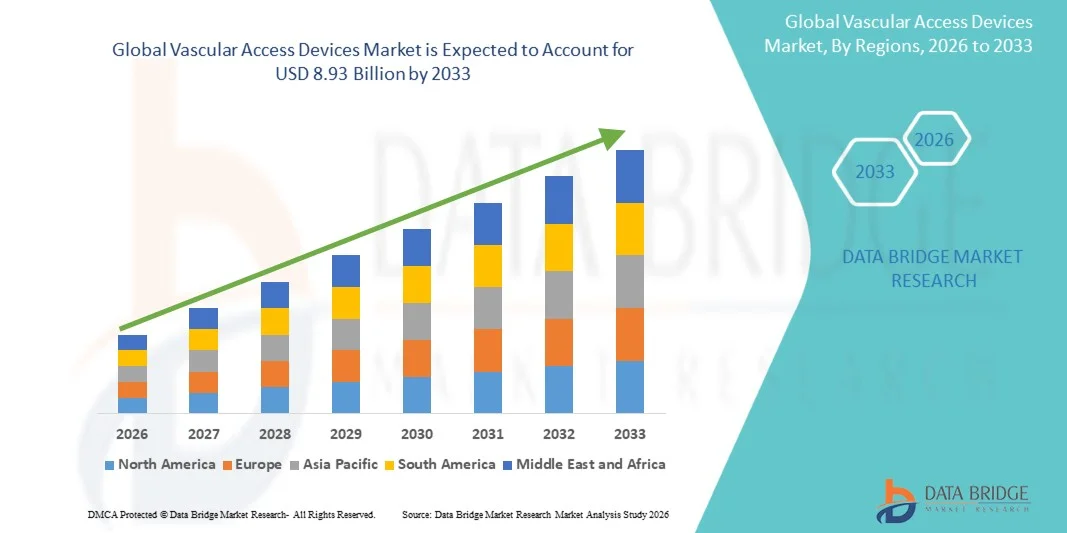
- As per Data Bridge Market Research Analysis the global vascular access devices market size was valued at USD 5.20 billion in 2025and is expected to reach USD 8.93 billion by 2033, at a CAGR of 7.00% during the forecast period
- The market growth is largely fueled by the rising prevalence of chronic diseases such as cancer, kidney disorders, and cardiovascular conditions, along with increasing demand for long-term intravenous therapies, leading to greater adoption of vascular access devices in hospitals, clinics, and homecare settings. Advancements in catheter materials, insertion techniques, and infection control technologies are further supporting market expansion
- Furthermore, growing preference for minimally invasive and long-term drug delivery solutions, coupled with increasing use of chemotherapy, parenteral nutrition, and hemodialysis treatments, is strengthening the adoption of vascular access devices. These converging factors are accelerating the uptake of Vascular Access Devices solutions, thereby significantly boosting the industry's growth
Market Size & Forecast
- Global Market Value (2025): USD 5.20 billion
- Expected Market Value (2033): USD 8.93 billion
- Forecast CAGR (2026–2033): 7.00%
Vascular Access Devices Market Analysis
- Vascular Access Devices, including peripheral intravenous catheters, central venous catheters, peripherally inserted central catheters (PICC lines), and implantable ports, are increasingly vital components of modern healthcare delivery systems in hospitals, specialty clinics, and homecare settings due to their essential role in facilitating long-term intravenous therapy, medication delivery, and blood sampling
- The escalating demand for Vascular Access Devices is primarily fueled by the rising prevalence of chronic diseases such as cancer, kidney failure, and cardiovascular disorders, along with increasing use of chemotherapy, parenteral nutrition, and long-term antibiotic therapies, which collectively require reliable and safe vascular access solutions
- North America dominated vascular access devices market with the largest revenue share of 38.90% in 2025, supported by advanced healthcare infrastructure, high adoption of minimally invasive procedures, strong presence of leading medical device manufacturers, and increasing hospitalization rates for chronic disease management, with the U.S. witnessing substantial utilization in intensive care units, oncology, and dialysis centers
- Asia-Pacific is expected to be the fastest growing region in the Vascular Access Devices market during the forecast period due to rising healthcare expenditure, increasing burden of chronic diseases, expanding hospital infrastructure, and growing awareness of advanced intravenous therapy solutions across countries such as China, India, and Japan
- The Intravenous segment held the largest market revenue share of 78.9% in 2025, driven by its extensive use in hospitals and clinical settings for rapid drug delivery, fluid administration, and emergency treatment
Report Scope and Vascular Access Devices Market Segmentation
|
Attributes |
Vascular Access Devices Key Market Insights |
|
Segments Covered |
|
|
Countries Covered |
North America
Europe
Asia-Pacific
Middle East and Africa
South America
|
|
Key Market Players |
|
|
Market Opportunities |
|
|
Value Added Data Infosets |
|
What is the Key Trend in the Vascular Access Devices Market?
“Advancements in Minimally Invasive Techniques and Catheter-Based Care Delivery”
- A significant and accelerating trend in the global Vascular Access Devices market is the increasing adoption of advanced catheter technologies, antimicrobial coatings, and image-guided insertion techniques that improve safety, reduce complications, and enhance patient comfort in both acute and long-term care settings
- These innovations are supporting more efficient vascular access management across hospitals, ICUs, and home healthcare environments
- For instance, healthcare institutions are increasingly using peripherally inserted central catheters (PICCs) and advanced central venous catheters developed by companies such as Becton Dickinson and B. Braun Melsungen AG to improve long-term intravenous therapy outcomes and reduce infection risks
- The adoption of ultrasound-guided insertion techniques is significantly improving first-attempt success rates, reducing patient discomfort, and minimizing complications such as arterial puncture or catheter misplacement
- Growing use of antimicrobial and antithrombogenic catheter coatings is helping reduce catheter-related bloodstream infections (CRBSIs), which remain a major clinical concern in intensive care and oncology settings
- Expansion of home infusion therapy and outpatient care services is increasing demand for user-friendly vascular access devices that enable safe long-term drug administration outside hospital environments
- This trend toward safer, image-guided, and infection-resistant vascular access solutions is reshaping expectations for intravenous therapy and long-term patient care management
Vascular Access Devices Market Dynamics
Driver
“Rising Burden of Chronic Diseases and Expanding Demand for Long-Term Intravenous Therapies”
- The increasing prevalence of chronic diseases such as cancer, kidney disorders, and cardiovascular conditions is a major driver for the growth of the Vascular Access Devices market, as these conditions often require repeated or long-term intravenous treatments
- For instance, oncology patients undergoing chemotherapy frequently rely on implanted ports and PICC lines manufactured by companies such as Becton Dickinson and Teleflex Incorporated for safe and sustained drug delivery
- The growing number of hospitalizations requiring intensive care support is further increasing demand for central venous catheters and peripheral IV access devices
- Expansion of dialysis treatments for end-stage renal disease patients is also significantly contributing to sustained use of vascular access systems globally
- In addition, the shift toward outpatient infusion therapy and home-based care is boosting demand for reliable and easy-to-manage vascular access solutions
Restraint/Challenge
“Risk of Catheter-Related Infections, Procedural Complications, and High Device Maintenance Requirements”
- One of the major challenges in the Vascular Access Devices market is the risk of catheter-related bloodstream infections and other complications such as thrombosis, occlusion, and mechanical failure
- For instance, improper catheter insertion or prolonged use without adequate maintenance can lead to serious infections, increasing patient morbidity and extending hospital stays
- The need for skilled healthcare professionals to ensure proper insertion, maintenance, and monitoring of vascular access devices creates operational challenges, particularly in resource-limited healthcare settings
- Regular replacement protocols, sterile handling requirements, and device maintenance add to overall treatment complexity and healthcare costs
- Addressing these challenges through improved clinical training, enhanced infection control protocols, and development of next-generation low-risk catheter technologies will be essential for sustained market growth
Vascular Access Devices Market Scope
The market is segmented on the basis of type, mode of insertion, application, and end user.
- By Type
On the basis of type, the Vascular Access Devices market is segmented into Central Vascular Access Devices, Peripheral Vascular Access Devices, and Accessories. The Peripheral Vascular Access Devices segment dominated the largest market revenue share of 54.6% in 2025, driven by their widespread use in routine hospital procedures such as drug delivery, fluid administration, and blood sampling. Peripheral devices are preferred due to ease of insertion, lower complication risk, and cost-effectiveness compared to central devices. Rising hospital admissions and increasing surgical procedures are significantly boosting demand. Growing prevalence of chronic diseases requiring repeated intravenous therapy is also supporting adoption. Technological advancements in catheter materials and safety features are further improving usability. Expanding emergency care and critical care services globally is contributing to segment dominance. Hospitals and clinics widely prefer peripheral access for short-term treatments. Increasing outpatient procedures also support growth. Overall, Peripheral Vascular Access Devices remain the dominant segment in 2025.
The Central Vascular Access Devices segment is expected to witness the fastest growth rate of 9.8% CAGR from 2026 to 2033, driven by increasing use in long-term therapies such as chemotherapy, parenteral nutrition, and intensive care treatments. Central devices provide reliable access for patients requiring prolonged intravenous therapy. Rising incidence of cancer and critical illnesses is significantly boosting demand. Expansion of oncology and ICU infrastructure is supporting adoption. Technological advancements such as antimicrobial-coated catheters are reducing infection risks. Growing preference for long-term vascular access solutions is also driving growth. Increasing hospital investments in advanced critical care equipment further support adoption. Improved clinical guidelines for central line usage are strengthening utilization. Rising number of complex surgical procedures is another key factor. These factors collectively make Central Vascular Access Devices the fastest-growing type segment.
- By Mode of Insertion
On the basis of mode of insertion, the Vascular Access Devices market is segmented into Intravenous and Subcutaneous. The Intravenous segment held the largest market revenue share of 78.9% in 2025, driven by its extensive use in hospitals and clinical settings for rapid drug delivery, fluid administration, and emergency treatment. Intravenous access is the standard method for vascular access in acute care settings. Increasing surgical procedures and hospital admissions are significantly supporting demand. Rising prevalence of chronic diseases requiring regular IV therapy is further boosting growth. Hospitals prefer intravenous insertion due to faster drug absorption and immediate therapeutic effect. Technological improvements in catheter design and safety mechanisms are enhancing efficiency. Expansion of emergency and critical care units globally is contributing to segment dominance. High usage in chemotherapy and antibiotic administration further strengthens demand. Overall, intravenous mode remains the primary method of vascular access.
The Subcutaneous segment is expected to witness the fastest growth rate of 10.5% CAGR from 2026 to 2033, driven by increasing adoption of long-term drug delivery systems such as insulin administration and biologic therapies. Subcutaneous access offers improved patient comfort and reduced infection risk compared to intravenous methods. Growing prevalence of diabetes and chronic autoimmune diseases is significantly boosting demand. Advancements in drug delivery technologies are enhancing efficiency and safety. Increasing use of wearable infusion devices is further supporting adoption. Homecare treatment trends are driving preference for subcutaneous administration. Rising awareness of minimally invasive therapies is also contributing to growth. Pharmaceutical innovations in biologics are expanding usage. Improved patient compliance makes this mode highly favorable. These factors position Subcutaneous insertion as the fastest-growing segment.
- By Application
On the basis of application, the Vascular Access Devices market is segmented into Drug Administration, Fluid and Nutrition Administration, Blood Transfusion, and Diagnostics and Testing. The Drug Administration segment accounted for the largest market revenue share of 41.7% in 2025, driven by high usage of vascular access devices for intravenous delivery of antibiotics, chemotherapy drugs, pain management medications, and chronic disease treatments. Increasing burden of cancer, infections, and cardiovascular diseases is significantly boosting demand. Hospitals rely heavily on vascular access for efficient and controlled drug delivery. Rising surgical procedures and emergency care cases further support growth. Expanding oncology and ICU admissions are key contributors. Technological advancements in infusion systems are improving safety and precision. Growing elderly population requiring long-term medication also drives usage. Strong clinical dependence on IV drug administration reinforces segment dominance. Overall, drug delivery remains the primary application of vascular access devices.
The Diagnostics and Testing segment is expected to witness the fastest growth rate of 11.2% CAGR from 2026 to 2033, driven by increasing demand for blood sampling, laboratory testing, and real-time patient monitoring. Rising prevalence of chronic diseases requiring frequent diagnostic evaluation is boosting adoption. Hospitals and diagnostic centers increasingly rely on vascular access devices for efficient sample collection. Technological advancements in minimally invasive sampling methods are improving patient comfort. Growth in preventive healthcare and routine screening programs is also supporting demand. Expansion of diagnostic laboratories globally is further accelerating usage. Increasing use in critical care monitoring strengthens growth. Rising awareness of early disease detection is contributing significantly. Integration of point-of-care testing systems is also enhancing adoption. These factors collectively make Diagnostics and Testing the fastest-growing application segment.
- By End User
On the basis of end user, the Vascular Access Devices market is segmented into Hospitals, Clinics and Ambulatory Care Centers, and Others. The Hospitals segment dominated the largest market revenue share of 62.8% in 2025, driven by high patient inflow, advanced healthcare infrastructure, and extensive use of vascular access devices in surgeries, emergency care, and critical care units. Hospitals are the primary centers for intravenous therapies and long-term treatment procedures. Increasing hospitalization rates due to chronic diseases are significantly boosting demand. Availability of skilled healthcare professionals ensures safe device usage. Rising investments in hospital infrastructure further strengthen adoption. Hospitals also manage complex cases requiring central and peripheral access devices. Strong procurement systems support large-scale usage. Expansion of ICU and oncology departments is contributing to growth. Overall, hospitals remain the dominant end-user segment.
The Clinics and Ambulatory Care Centers segment is expected to witness the fastest growth rate of 10.9% CAGR from 2026 to 2033, driven by increasing shift toward outpatient care and minimally invasive treatment procedures. These centers offer cost-effective and convenient access to vascular procedures. Rising preference for day-care surgeries and outpatient treatments is boosting demand. Technological advancements in portable vascular access systems are supporting adoption. Increasing prevalence of chronic diseases requiring regular therapy is also driving growth. Expansion of ambulatory surgical centers globally is further accelerating usage. Growing patient preference for shorter hospital stays supports segment expansion. Improved reimbursement policies for outpatient care are enhancing accessibility. Rising healthcare decentralization trends are also contributing significantly. These factors collectively make Clinics and Ambulatory Care Centers the fastest-growing end-user segment.
Vascular Access Devices Market Regional Analysis
- North America dominated the vascular access devices market with the largest revenue share of 38.90% in 2025, supported by advanced healthcare infrastructure, high adoption of minimally invasive procedures, strong presence of leading medical device manufacturers, and increasing hospitalization rates for chronic disease management. The region benefits from well-established hospital networks, high procedural volumes in critical care settings, and strong integration of advanced vascular access technologies in routine clinical practice
- Healthcare providers in the region highly prioritize safety, efficiency, and infection control in vascular access procedures, leading to increased use of central venous catheters, peripheral intravenous catheters, peripherally inserted central catheters (PICCs), and implantable ports. Growing demand for long-term intravenous therapy in oncology, dialysis, and intensive care units is further driving market expansion
- This widespread adoption is further supported by favorable reimbursement policies, strong clinical training standards, and continuous innovation in catheter materials and insertion techniques, establishing North America as a leading region for vascular access device utilization
U.S. Vascular Access Devices Market Insight
The U.S. vascular access devices market captured the largest revenue share within North America in 2025, driven by substantial utilization in intensive care units, oncology departments, dialysis centers, and emergency care settings. The country shows strong demand for advanced intravenous therapy solutions due to rising prevalence of chronic diseases such as cancer, kidney failure, and cardiovascular conditions. Hospitals and specialty clinics are increasingly adopting ultrasound-guided catheter insertion techniques, antimicrobial-coated catheters, and safety-engineered vascular access devices to reduce infection risks and improve procedural outcomes. Continuous innovation and high procedural volumes are further propelling market growth in the U.S.
Europe Vascular Access Devices Market Insight
The Europe vascular access devices market is projected to expand at a substantial CAGR throughout the forecast period, primarily driven by increasing burden of chronic diseases, strong public healthcare systems, and rising adoption of advanced intravenous therapies. The region is witnessing growing demand for safe and efficient vascular access solutions across hospitals, outpatient care centers, and home healthcare settings. Emphasis on infection prevention protocols and minimally invasive treatment approaches is contributing significantly to market expansion across Europe.
U.K. Vascular Access Devices Market Insight
The U.K. Vascular access devices market is anticipated to grow at a noteworthy CAGR during the forecast period, supported by rising hospitalization rates and increasing demand for long-term intravenous therapy. Hospitals under the National Health Service (NHS) are increasingly adopting advanced catheter systems for oncology treatment, dialysis, and critical care. Growing focus on patient safety, infection control, and improved clinical outcomes is further stimulating market growth in the U.K.
Germany Vascular Access Devices Market Insight
The Germany vascular access devices market is expected to expand at a considerable CAGR during the forecast period, fueled by advanced hospital infrastructure, strong adoption of minimally invasive procedures, and high standards of clinical care. Germany’s healthcare system emphasizes precision, safety, and efficiency in vascular access management. Increasing use of technologically advanced catheters, along with integration of imaging-guided insertion techniques, is supporting market growth across acute and chronic care settings.
Asia-Pacific Vascular Access Devices Market Insight
The Asia-Pacific vascular access devices market is poised to grow at the fastest CAGR during the forecast period, driven by rising healthcare expenditure, increasing burden of chronic diseases, expanding hospital infrastructure, and growing awareness of advanced intravenous therapy solutions across countries such as China, India, and Japan. The region is witnessing rapid expansion of tertiary care hospitals, dialysis centers, and oncology treatment facilities. Government initiatives to strengthen healthcare systems and improve access to advanced medical devices are further accelerating market growth.
Japan Vascular Access Devices Market Insight
The Japan vascular access devices market is gaining momentum due to the country’s aging population, advanced healthcare infrastructure, and strong focus on chronic disease management. Japanese hospitals increasingly rely on vascular access devices for long-term therapies, particularly in dialysis and oncology care. High adoption of minimally invasive techniques and strict infection control practices are supporting steady market growth.
China Vascular Access Devices Market Insight
The China vascular access devices market accounted for the largest market revenue share in Asia Pacific in 2025, attributed to rapid hospital expansion, rising prevalence of chronic diseases, and increasing adoption of advanced intravenous therapy solutions. China is witnessing strong growth in oncology, critical care, and renal care services, leading to higher demand for vascular access devices. Expanding healthcare infrastructure, along with government support for modernizing hospital systems, is significantly propelling the market in the country.
Which are the Top Companies in Vascular Access Devices Market?
The Vascular Access Devices industry is primarily led by well-established companies, including:
- BD (U.S.)
- B. Braun SE (Germany)
- Teleflex Incorporated (U.S.)
- Medtronic plc (Ireland)
- Edwards Lifesciences Corporation (U.S.)
- Smiths Medical (U.K.)
- ICU Medical, Inc. (U.S.)
- Terumo Corporation (Japan)
- Nipro Corporation (Japan)
- Fresenius SE & Co. KGaA (Germany)
- AngioDynamics, Inc. (U.S.)
- Merit Medical Systems, Inc. (U.S.)
- Cook Medical (U.S.)
- Vygon SA (France)
- Baxter International Inc. (U.S.)
- Cardinal Health, Inc. (U.S.)
- R. Bard (BD subsidiary) (U.S.)
- Abbott Laboratories (U.S.)
- CONMED Corporation (U.S.)
- Lepu Medical Technology (China)
Latest Developments in Global Vascular Access Devices Market
- In November 2021, Zylox-Tonbridge Medical Technology announced a strategic collaboration with Guangdong Hicicare Science to develop and commercialize advanced vascular guidewire systems in China, aimed at improving peripheral and neurovascular intervention procedures and expanding access to minimally invasive vascular technologies
- In November 2023, Becton Dickinson (BD) launched the SiteRite 9 Ultrasound System, an advanced vascular access guidance platform designed to improve accuracy and efficiency in placing PICCs, central venous catheters, and IV lines, strengthening ultrasound-assisted vascular access procedures in hospitals
- In November 2024, Xeltis received FDA Breakthrough Device designation for its aXess vascular access conduit, a bioengineered vessel designed to create a long-term dialysis access solution, and announced the first patient enrollment in its U.S. pivotal clinical trial, marking a major step in regenerative vascular access technology
- In March 2024, healthcare systems globally increased adoption of ultrasound-guided vascular access techniques, integrating real-time imaging systems into routine catheter placement procedures to reduce complications such as pneumothorax and catheter misplacement
- In May 2025, global hospitals and ambulatory care centers increased procurement of central venous catheters (CVCs), peripherally inserted central catheters (PICCs), and dialysis access devices, reflecting growing demand for long-term intravenous therapies in cancer, renal disease, and critical care patients

- Interactive Data Analysis Dashboard
- Company Analysis Dashboard for high growth potential opportunities
- Research Analyst Access for customization & queries
- Competitor Analysis with Interactive dashboard
- Latest News, Updates & Trend analysis
- Harness the Power of Benchmark Analysis for Comprehensive Competitor Tracking
Data collection and base year analysis are done using data collection modules with large sample sizes. The stage includes obtaining market information or related data through various sources and strategies. It includes examining and planning all the data acquired from the past in advance. It likewise envelops the examination of information inconsistencies seen across different information sources. The market data is analysed and estimated using market statistical and coherent models. Also, market share analysis and key trend analysis are the major success factors in the market report. To know more, please request an analyst call or drop down your inquiry.
The key research methodology used by DBMR research team is data triangulation which involves data mining, analysis of the impact of data variables on the market and primary (industry expert) validation. Data models include Vendor Positioning Grid, Market Time Line Analysis, Market Overview and Guide, Company Positioning Grid, Patent Analysis, Pricing Analysis, Company Market Share Analysis, Standards of Measurement, Global versus Regional and Vendor Share Analysis. To know more about the research methodology, drop in an inquiry to speak to our industry experts.
Data Bridge Market Research is a leader in advanced formative research. We take pride in servicing our existing and new customers with data and analysis that match and suits their goal. The report can be customized to include price trend analysis of target brands understanding the market for additional countries (ask for the list of countries), clinical trial results data, literature review, refurbished market and product base analysis. Market analysis of target competitors can be analyzed from technology-based analysis to market portfolio strategies. We can add as many competitors that you require data about in the format and data style you are looking for. Our team of analysts can also provide you data in crude raw excel files pivot tables (Fact book) or can assist you in creating presentations from the data sets available in the report.













