


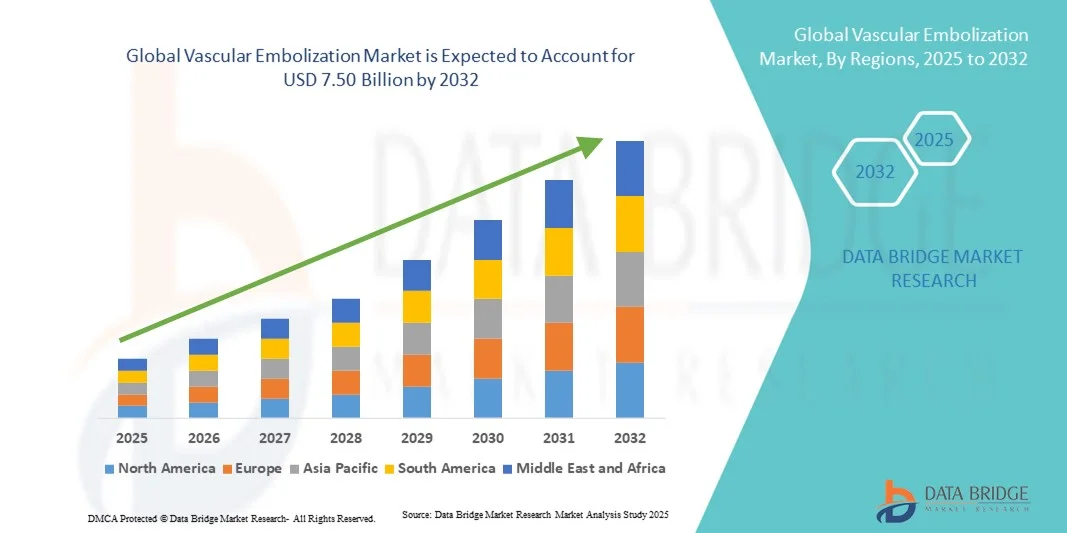
Vascular Embolization Market Size
- The global vascular embolization market size was valued at USD 3.63 billion in 2024 and is expected to reach USD 7.50 billion by 2032, at a CAGR of 9.50% during the forecast period
- The market growth is largely fueled by the growing adoption of minimally invasive procedures, increasing prevalence of cardiovascular diseases, and advancements in catheter-based technologies, leading to higher utilization of Vascular Embolization solutions in hospitals and specialty clinics
- Furthermore, rising demand for targeted and efficient treatment options for aneurysms, arteriovenous malformations, and tumors is driving the adoption of Vascular Embolization devices. Increasing awareness among healthcare providers and patients about the benefits of embolization procedures, including reduced recovery times and lower complication rates compared to open surgeries, is significantly boosting the industry's growth
Vascular Embolization Market Analysis
- Vascular embolization procedures, providing minimally invasive therapeutic solutions for a variety of vascular conditions, are becoming increasingly vital in modern healthcare due to their effectiveness, reduced recovery times, and ability to target specific blood vessels with precision, making them essential in both hospital and interventional radiology settings
- The escalating demand for vascular embolization procedures is primarily driven by the rising prevalence of cardiovascular diseases, increasing adoption of minimally invasive therapies, and growing awareness among patients and healthcare providers regarding the benefits of embolization over traditional surgical interventions
- North America dominated the vascular embolization market with the largest revenue share of 44% in 2024, supported by a well-established healthcare infrastructure, high adoption of interventional radiology procedures, and a strong presence of leading market players. The U.S. accounted for the majority of this revenue, fueled by advanced hospital networks, growing prevalence of vascular disorders, and supportive insurance reimbursement policies
- Asia-Pacific is expected to be the fastest-growing region in the vascular embolization market during the forecast period, projected to expand at a CAGR from 2025 to 2032, driven by rapid urbanization, increasing healthcare investments, rising disposable incomes, and expanding awareness of minimally invasive cardiovascular treatments in countries such as China and India
- The Coiling Devices segment dominated the vascular embolization market with the largest revenue share of 46.8% in 2024, owing to its established efficacy in occluding aneurysms, arteriovenous malformations, and other vascular malformations
Report Scope and Vascular Embolization Market Segmentation
|
Attributes |
Vascular Embolization Key Market Insights |
|
Segments Covered |
|
|
Countries Covered |
North America
Europe
Asia-Pacific
Middle East and Africa
South America
|
|
Key Market Players |
|
|
Market Opportunities |
|
|
Value Added Data Infosets |
In addition to the insights on market scenarios such as market value, growth rate, segmentation, geographical coverage, and major players, the market reports curated by the Data Bridge Market Research also include in-depth expert analysis, pricing analysis, brand share analysis, consumer survey, demography analysis, supply chain analysis, value chain analysis, raw material/consumables overview, vendor selection criteria, PESTLE Analysis, Porter Analysis, and regulatory framework. |
Vascular Embolization Market Trends
Enhanced Convenience and Clinical Precision in Vascular Embolization
- A significant and accelerating trend in the global vascular embolization market is the increasing adoption of advanced imaging technologies and computer-assisted navigation systems, which are significantly enhancing the precision, safety, and efficiency of embolization procedures
- For instance, modern digital subtraction angiography (DSA) systems and 3D imaging tools allow interventional radiologists to visualize target vessels with exceptional clarity, facilitating accurate catheter placement and embolic material delivery. Similarly, newer microcatheter designs improve maneuverability in complex vascular anatomies, ensuring minimally invasive interventions with better patient outcomes
- Integration with procedural planning software enables clinicians to simulate embolization paths, optimize embolic agent selection, and predict post-procedural effects, improving procedural success rates and reducing complications. In addition, navigation-assisted systems support real-time adjustments during interventions, enhancing the safety of high-risk cases
- The trend towards more precise, controlled, and less invasive embolization procedures is transforming clinical workflows, enabling faster recovery, shorter hospital stays, and reduced overall treatment costs. Hospitals and specialized interventional centers are increasingly investing in these systems to enhance patient care and procedural efficiency
- Consequently, leading companies in the Vascular Embolization space are focusing on developing next-generation microcatheters, embolic materials, and imaging-integrated platforms that provide greater control and predictability during procedures
- The demand for embolization solutions that combine clinical precision, safety, and efficiency is growing rapidly across both hospital and outpatient interventional settings, as healthcare providers increasingly prioritize minimally invasive and outcome-driven therapies
Vascular Embolization Market Dynamics
Driver
Growing Need Due to Rising Prevalence of Vascular Disorders and Minimally Invasive Procedures
- The increasing prevalence of vascular disorders such as aneurysms, arteriovenous malformations, and tumors, coupled with the rising preference for minimally invasive procedures, is a significant driver for the heightened demand for Vascular Embolization solutions
- For instance, in April 2024, Boston Scientific announced the launch of its next-generation microcatheter system, designed to improve precision and safety in embolization procedures. Such advancements by leading companies are expected to drive the Vascular Embolization market growth during the forecast period
- As healthcare providers prioritize patient safety and procedural efficacy, embolization devices offer features such as improved navigation, controlled embolic agent delivery, and real-time imaging support, providing a compelling upgrade over traditional surgical interventions
- Furthermore, the growing emphasis on outpatient interventional radiology and minimally invasive therapies is making Vascular Embolization an integral part of modern clinical practice, supporting faster patient recovery and reduced hospital stays
- The ability to treat complex vascular conditions with precision, minimize complications, and shorten procedural time is driving adoption in both hospitals and specialized clinics. The trend towards minimally invasive treatment options and the increasing availability of user-friendly embolization devices further contributes to market growth
Restraint/Challenge
High Device Costs, Limited Skilled Professionals, and Clinical Risks
- The high cost of advanced Vascular Embolization devices, such as microcatheters, embolic agents, and imaging-integrated platforms, poses a significant challenge to broader market adoption, particularly in developing regions with budget constraints
- The technical complexity of embolization procedures requires specialized training for interventional radiologists and supporting staff, limiting accessibility in smaller hospitals and clinics
- Potential clinical risks and complications, such as non-target embolization, vessel injury, or post-procedural infections, make some healthcare providers cautious about widespread adoption
- Addressing these challenges through targeted training programs, hospital partnerships, and educational initiatives is crucial to expanding adoption and building clinical confidence in Vascular Embolization procedures
- While device prices are gradually decreasing due to technological advancements and economies of scale, high-end embolization systems with integrated imaging and advanced navigation capabilities remain a significant investment
- Inadequate reimbursement policies or insurance coverage in certain regions can slow adoption, particularly for newer or premium embolization devices
- The lack of standardization in procedural protocols across hospitals and clinics may lead to variability in outcomes, creating hesitancy among healthcare providers
- Overcoming these barriers through cost optimization, enhanced training, standardized clinical guidelines, and increased awareness of clinical benefits will be vital for sustained market growth, particularly in emerging economies and regions with expanding healthcare infrastructure
- In addition, logistical challenges such as the supply chain management of embolic agents, sterility maintenance, and device availability in remote areas can further restrict market expansion
Vascular Embolization Market Scope
The market is segmented on the basis of embolization technique, application, and end user.
- By Embolization Technique
On the basis of embolization technique, the vascular embolization market is segmented into coiling devices and non-coiling devices. The Coiling Devices segment dominated the market with the largest revenue share of 46.8% in 2024, owing to its established efficacy in occluding aneurysms, arteriovenous malformations, and other vascular malformations. Coiling devices are preferred by interventional radiologists and neurosurgeons because they offer precision targeting, minimal invasiveness, and reduced complications during procedures. Hospitals and specialty clinics prioritize coiling devices due to proven clinical outcomes, repeatability across multiple cases, and compatibility with advanced imaging systems. The segment’s market growth is further reinforced by continuous product innovations, extensive training programs, and increasing procedural adoption in mature markets. Patients benefit from shorter recovery times and lower procedural risks, which further drives demand.
The Non-Coiling Devices segment is expected to witness the fastest CAGR of 18.5% from 2025 to 2032, supported by rising adoption of alternative embolization methods such as liquid embolics, microspheres, and plug-based systems. Non-coiling devices are increasingly employed in oncology, peripheral vascular interventions, and emergency care, providing precise occlusion and enhanced patient safety. Technological advancements, growing awareness among healthcare providers, and the expanding minimally invasive procedure market contribute to rapid adoption. Emerging markets with expanding hospital networks and specialty clinics are particularly driving the uptake of non-coiling devices.
- By Application
On the basis of application, the vascular embolization market is segmented into peripheral vascular diseases, oncology, neurology, urology, and others. The Oncology segment dominated with a revenue share of 42.5% in 2024, driven by rising prevalence of liver, kidney, and prostate cancers worldwide. Embolization is widely utilized for tumor devascularization and targeted therapy, which reduces the need for open surgeries and improves patient recovery. Hospitals and interventional radiology centers adopt embolization as a key part of multimodal cancer treatment protocols. Technological advancements, integration with imaging systems, and favorable clinical outcomes reinforce dominance. Training programs, standardized procedural guidelines, and increasing cancer awareness contribute to consistent demand growth in this segment.
The Peripheral Vascular Diseases segment is expected to witness the fastest CAGR of 19.2% from 2025 to 2032, propelled by the growing incidence of arterial stenosis, aneurysms, and AVMs globally. Patients and physicians are increasingly preferring minimally invasive approaches due to reduced recovery time and lower procedural risks. The expansion of diagnostic imaging infrastructure, better patient awareness, and government initiatives supporting advanced vascular treatments are further driving the adoption of embolization procedures. Emerging economies are experiencing higher growth due to improved access to healthcare services and procedural affordability.
- By End User
On the basis of end user, the vascular embolization market is segmented into hospitals, specialty clinics, ambulatory surgical centers, and diagnostic centers. The Hospitals segment dominated with the largest revenue share of 51.3% in 2024, owing to advanced infrastructure, presence of skilled interventional radiologists, and availability of state-of-the-art imaging and procedural equipment. Hospitals offer comprehensive embolization services for oncology, neurology, urology, and peripheral vascular indications, which ensures a higher procedural volume. The strong integration of embolization procedures within standard treatment protocols, coupled with established patient trust and insurance coverage, supports market dominance. Continuous technological upgrades and collaborations with device manufacturers further reinforce hospital adoption.
The Specialty Clinics segment is expected to witness the fastest CAGR of 20.1% from 2025 to 2032, driven by the growing prevalence of outpatient care centers and dedicated interventional radiology clinics. These clinics provide targeted embolization services, catering to patients seeking minimally invasive procedures with quicker recovery times. Factors such as cost-effectiveness, procedure-specific specialization, technological support from device manufacturers, and expanding awareness among physicians accelerate adoption. The convenience offered to patients, combined with focused service offerings, makes specialty clinics a rapidly growing segment in the market.
Vascular Embolization Market Regional Analysis
- North America dominated the vascular embolization market with the largest revenue share of 44% in 2024, supported by a well-established healthcare infrastructure, high adoption of interventional radiology procedures, and a strong presence of leading market players.
- The region’s healthcare systems emphasize minimally invasive treatments, which drives the adoption of vascular embolization procedures. Moreover, increasing awareness among physicians and patients about the advantages of embolization techniques over traditional surgical interventions contributes to steady growth.
- Continuous R&D and strategic collaborations between medical device manufacturers and hospitals also support innovation in the region. Regulatory approvals and reimbursement frameworks for embolization procedures accelerate adoption. Collectively, these factors make North America the most prominent market globally
U.S. Vascular Embolization Market Insight
The U.S. vascular embolization market captured the largest revenue share in North America in 2024, reflecting the country’s advanced healthcare ecosystem. High prevalence of vascular diseases, such as aneurysms, fibroids, and arteriovenous malformations, drives the demand for embolization procedures. Hospitals and specialty clinics increasingly prefer minimally invasive treatments due to reduced recovery times and improved patient outcomes. Supportive insurance coverage and favorable reimbursement policies for interventional radiology procedures also enhance market penetration. Furthermore, the integration of advanced imaging modalities, such as DSA (Digital Subtraction Angiography) and CT-guided navigation, ensures precise delivery of embolic agents, attracting more healthcare providers to adopt these solutions. Increasing patient awareness of the safety and efficacy of embolization procedures contributes to growth. In addition, ongoing clinical studies and collaborations between hospitals and device manufacturers strengthen the adoption of novel embolization materials and devices. The robust healthcare infrastructure in metropolitan regions further facilitates market expansion.
Europe Vascular Embolization Market Insight
The Europe vascular embolization market is projected to expand at a substantial CAGR during the forecast period, primarily driven by the increasing prevalence of vascular disorders, growing geriatric population, and high adoption of minimally invasive interventions. Countries such as Germany, France, and Italy are investing in advanced interventional radiology facilities to meet rising demand. Regulatory support, reimbursement schemes, and growing clinical awareness of embolization benefits over conventional surgical procedures contribute to adoption. Increasing urbanization and the expansion of private healthcare facilities further encourage the use of embolization techniques. Innovations in embolic materials and catheter designs improve procedural efficiency and patient safety, strengthening the market. In addition, cross-border collaborations between hospitals and leading medical device manufacturers support technology transfer and skill development.
U.K. Vascular Embolization Market Insight
The U.K. vascular embolization market is anticipated to grow at a noteworthy CAGR during the forecast period, driven by rising incidence of vascular diseases, government initiatives to enhance minimally invasive procedures, and an emphasis on patient-centric care. The National Health Service (NHS) promotes the use of embolization procedures for conditions such as uterine fibroids and arteriovenous malformations, enabling wider accessibility. The availability of skilled interventional radiologists and advanced imaging systems supports efficient procedure execution. Clinical awareness campaigns, training programs, and hospital investments in state-of-the-art radiology suites further contribute to adoption. Private healthcare providers are increasingly incorporating vascular embolization techniques to offer quicker recovery options, enhancing patient preference.
Germany Vascular Embolization Market Insight
The Germany Vascular Embolization ma vascular embolization market rket is expected to expand at a considerable CAGR during the forecast period, fueled by advanced healthcare infrastructure, a high prevalence of chronic vascular conditions, and strong adoption of minimally invasive treatments. Germany’s emphasis on innovation in medical technologies, alongside government incentives for research and development, promotes the use of novel embolic materials. Hospitals increasingly adopt advanced catheter systems and imaging technologies to improve procedural precision and patient outcomes. The country’s focus on preventive and therapeutic vascular care ensures a sustained demand for embolization procedures across both public and private healthcare facilities.
Asia-Pacific Vascular Embolization Market Insight
The Asia-Pacific vascular embolization market is expected to grow at the fastest CAGR from 2025 to 2032, driven by rapid urbanization, increasing healthcare investments, rising disposable incomes, and expanding awareness of minimally invasive cardiovascular treatments in countries such as China and India. The increasing number of specialty hospitals and advanced interventional radiology centers supports market growth. Government initiatives promoting access to modern medical treatments and expansion of private healthcare infrastructure contribute to higher adoption. Rising patient preference for minimally invasive procedures, coupled with technological advancements in embolic agents and catheter systems, is further accelerating growth.
Japan Vascular Embolization Market Insight
The Japan vascular embolization market is gaining momentum due to the country’s high-quality healthcare infrastructure, aging population, and strong focus on minimally invasive procedures. The demand for embolization procedures is increasing for treating aneurysms, tumors, and vascular malformations. Advanced catheter systems and embolic materials, along with highly trained interventional radiologists, enable precise and safe treatments. Growing awareness among patients and healthcare providers regarding procedural safety, reduced recovery time, and improved outcomes is also driving adoption.
China Vascular Embolization Market Insight
The China vascular embolization market accounted for the largest revenue share in Asia-Pacific in 2024, attributed to rapid urbanization, rising disposable incomes, expanding private healthcare facilities, and increased awareness of minimally invasive treatments. The government’s initiatives to enhance healthcare infrastructure and promote interventional radiology procedures support growth. Availability of affordable embolization devices and a growing pool of trained specialists further boost market penetration. The prevalence of cardiovascular and oncological vascular conditions continues to drive the adoption of embolization procedures in hospitals and specialty centers.
Vascular Embolization Market Share
The Vascular Embolization industry is primarily led by well-established companies, including:
- Boston Scientific Corporation (U.S.)
- Terumo Corporation (Japan)
- Medtronic (Ireland)
- Cook (U.S.)
- Penumbra, Inc. (U.S.)
- B. Braun SE (Germany)
- C.R. Bard, Inc. (U.S.)
- BTG International Ltd. (U.K.)
- Merit Medical Systems, Inc. (U.S.)
- Concept Medical, Inc. (U.S.)
- Asahi Intecc Co., Ltd. (Japan)
- Beijing Suntech Medical Device Co., Ltd. (China)
- Roxwood Medical (U.K.)
- Accumedical Co., Ltd. (South Korea)
Latest Developments in Global Vascular Embolization Market
- In September 2025, Merit Medical Systems, Inc. announced that its Embosphere Microspheres received CE mark approval in the European Union for genicular artery embolization (GAE), a minimally invasive treatment designed to alleviate chronic knee pain associated with osteoarthritis. This regulatory milestone expands the therapeutic use of the device beyond traditional tumor embolization procedures, reflecting the company’s strategy to diversify its interventional radiology portfolio. By offering a new, non-surgical option for patients suffering from knee osteoarthritis, Merit Medical is strengthening its presence in the vascular embolization market and addressing a rapidly growing segment in musculoskeletal disorders
- In September 2025, Quantum Surgical obtained CE mark approval for its Epione robotic-assisted platform to treat bone tumors and metastases, significantly broadening its clinical applications. Previously approved for liver tumor ablation, this new indication highlights the versatility of the system in oncology care and interventional radiology. The expansion into bone tumor treatments positions Quantum Surgical at the forefront of robotic-guided interventions, enabling precise targeting and treatment of complex lesions while minimizing invasiveness. This approval marks an important advancement in the European market, meeting rising demand for innovative solutions that improve patient outcomes in cancer-related embolization procedures

- Interactive Data Analysis Dashboard
- Company Analysis Dashboard for high growth potential opportunities
- Research Analyst Access for customization & queries
- Competitor Analysis with Interactive dashboard
- Latest News, Updates & Trend analysis
- Harness the Power of Benchmark Analysis for Comprehensive Competitor Tracking
Data collection and base year analysis are done using data collection modules with large sample sizes. The stage includes obtaining market information or related data through various sources and strategies. It includes examining and planning all the data acquired from the past in advance. It likewise envelops the examination of information inconsistencies seen across different information sources. The market data is analysed and estimated using market statistical and coherent models. Also, market share analysis and key trend analysis are the major success factors in the market report. To know more, please request an analyst call or drop down your inquiry.
The key research methodology used by DBMR research team is data triangulation which involves data mining, analysis of the impact of data variables on the market and primary (industry expert) validation. Data models include Vendor Positioning Grid, Market Time Line Analysis, Market Overview and Guide, Company Positioning Grid, Patent Analysis, Pricing Analysis, Company Market Share Analysis, Standards of Measurement, Global versus Regional and Vendor Share Analysis. To know more about the research methodology, drop in an inquiry to speak to our industry experts.
Data Bridge Market Research is a leader in advanced formative research. We take pride in servicing our existing and new customers with data and analysis that match and suits their goal. The report can be customized to include price trend analysis of target brands understanding the market for additional countries (ask for the list of countries), clinical trial results data, literature review, refurbished market and product base analysis. Market analysis of target competitors can be analyzed from technology-based analysis to market portfolio strategies. We can add as many competitors that you require data about in the format and data style you are looking for. Our team of analysts can also provide you data in crude raw excel files pivot tables (Fact book) or can assist you in creating presentations from the data sets available in the report.













