What is the Vector Control Market Size and Growth Rate?
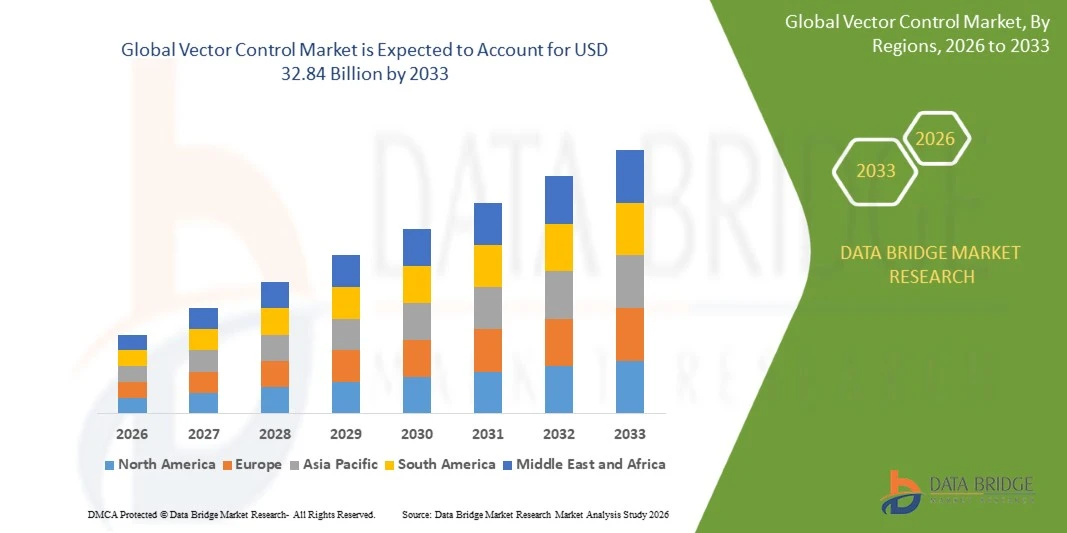
- As per Data Bridge Market Research analysis, the vector control market was valued at USD 20.92 billion in 2025 and is projected to reach USD 32.84 billion by 2033, growing at a CAGR of 5.80% from 2026 to 2033.
- The market is experiencing consistent growth driven by the increasing prevalence of vector-borne diseases, rising demand for effective pest management solutions, and expanding adoption of chemical, biological, and physical control methods across residential, commercial, agricultural, and public health applications.
- The increasing incidence of mosquito-borne diseases such as dengue and malaria, combined with rapid urbanization, changing climatic conditions, and government-led disease prevention initiatives, is compelling public health agencies, pest control service providers, and commercial establishments to adopt advanced vector management solutions. Chemical control methods remain important for large-scale vector suppression, while biological control and integrated vector management approaches are gaining traction as stakeholders prioritize sustainable practices, insecticide resistance management, and long-term disease
Market Size & Forecast
- Global Market Value (2025): USD 20.92 Billion
- Expected Market Value (2033): USD 32.84 Billion
- Forecast CAGR (2026–2033): 5.80%
- Leading Region in 2025: North America
- Fastest Growing Region: Asia Pacific
What are the Major Takeaways of the Vector Control Market?
- North America dominated the vector control market with the largest revenue share of 38.0% in 2025, supported by established public health infrastructure, advanced pest management services, and substantial investments in vector surveillance.
- Asia-Pacific is expected to be the fastest-growing region at a CAGR of 7.3% from 2026 to 2033, fueled by rising urbanization, high prevalence of vector-borne diseases, and expanding government disease prevention programs
- The insects segment led the market with a 59.50% share in 2025, driven by the widespread need to control mosquitoes, flies, cockroaches, ticks, and fleas
- Rodents are the fastest-growing vector type, projected to register a CAGR of 5.5%, reflecting the surge in demand for rat and mouse control in urban infrastructure, food processing facilities,
- The chemical methods segment dominated the method of control category with a 43.85% revenue share in 2025, led by the widespread use of insecticides, larvicides, rodenticides, and repellents.
- Sprays accounted for 38.0% of the market share in 2025, preferred by its widespread use in residential pest management, commercial facilities, and public health campaigns
- The treated nets and surface treatments segment is the fastest-growing mode of application category, with a CAGR of 6.8%, driven by continued efforts to prevent mosquito bites and reduce exposure to disease-transmitting insects.
Report Scope and Vector Control Market Segmentation
|
Attributes |
Vector Control Key Market Insights |
|
Segments Covered |
|
|
Countries Covered |
North America
Europe
Asia-Pacific
Middle East and Africa
South America
|
|
Key Market Players |
|
|
Market Opportunities |
|
|
Value Added Data Infosets |
In addition to the insights on market scenarios such as market value, growth rate, segmentation, geographical coverage, and major players, the market reports curated by the Data Bridge Market Research also include import export analysis, production capacity overview, production consumption analysis, price trend analysis, climate change scenario, supply chain analysis, value chain analysis, raw material/consumables overview, vendor selection criteria, PESTLE Analysis, Porter Analysis, and regulatory framework. |
What is the Key Trend in the Vector Control Market?
- Vector control providers are increasingly adopting integrated vector management strategies to control disease-transmitting mosquitoes, flies, and other pests while reducing dependence on conventional chemical insecticides.
- For instance, in May 2024, the World Health Organization (WHO) published its operational manual for integrated vector management, emphasizing evidence-based decision-making, intersectoral collaboration, and sustainable vector control approaches.
- Data-driven surveillance enables public health agencies to identify vector breeding hotspots, monitor insecticide resistance, and target control interventions more effectively.
- Governments and public health organizations are increasingly exploring biological solutions, including Wolbachia-infected mosquitoes, to complement conventional mosquito control and reduce the transmission of mosquito-borne diseases.
- For instance, in October 2023, the World Mosquito Program reported that its Wolbachia method had been associated with a 77% reduction in dengue incidence in a randomized controlled trial in Yogyakarta, Indonesia.
- As public health agencies prioritize sustainable disease prevention, resistance management, and targeted interventions, integrated and evidence-based vector control approaches are expected to gain importance across residential, commercial, and public health applications.
What are the Key Drivers of the Vector Control Market?
- The increasing prevalence of vector-borne diseases such as malaria, dengue, chikungunya, and Zika is significantly increasing demand for effective vector control products and disease prevention programs worldwide.
- For instance, in December 2024, the World Health Organization reported an estimated 263 million malaria cases and 597,000 malaria deaths globally in 2023, highlighting the continued need for effective vector control interventions.
- Rapid urbanization, climate variability, and expanding human settlements are creating favorable breeding conditions for mosquitoes and other disease-transmitting vectors, increasing demand for preventive pest management services.
- Governments, healthcare organizations, and municipal authorities are strengthening vector surveillance, insecticide-treated net distribution, and targeted mosquito control programs to reduce disease transmission and protect vulnerable populations.
- For instance, in June 2021, the New England Journal of Medicine published randomized trial findings from Yogyakarta, Indonesia, showing that Wolbachia-infected mosquito deployments reduced dengue incidence by 77.1%, demonstrating the potential of innovative vector control interventions.
- As disease prevention remains a public health priority, rising healthcare expenditure, government initiatives, and advances in biological and integrated control methods are expected to support demand for vector control solutions across affected regions.
What Factors are Challenging the Growth of the Vector Control Market?
- Vector control products face significant cost barriers due to recurring insecticide applications, surveillance requirements, specialized equipment, and the operational expenses of large-scale public health programs.
- For instance, in December 2025, the World Health Organization reported that global malaria control investments reached approximately USD 3.9 billion in 2024, falling short of the USD 9.3 billion annual target for 2025.
- These financial constraints limit the adoption of advanced vector management solutions in low-income communities and resource-constrained regions where disease burdens are often high and public health budgets remain restricted.
- The development of insecticide resistance among mosquitoes and other disease-transmitting vectors is reducing the effectiveness of conventional chemical treatments and increasing the need for alternative control products.
- For instance, the WHO's World Malaria Report 2025 confirmed pyrethroid resistance in 48 of 53 countries reporting resistance data for the 2020–2024 period, highlighting a major challenge for insecticide-treated mosquito nets.
- High implementation costs, insecticide resistance, regulatory requirements, and inconsistent funding continue to challenge market expansion, making affordable, sustainable, and scientifically validated vector control solutions essential for long-term disease prevention.
How is the Vector Control Market Segmented?
The vector control market is segmented on the basis of vector type, method of control, mode of application, and end-use sector.
- By Vector Type
On the basis of vector type, the vector control market is segmented into insects, rodents, and others. The insects segment dominated the market with an estimated share of 59.50% in 2025, owing to the widespread need to control mosquitoes, flies, cockroaches, ticks, and fleas. Mosquitoes are particularly important because they transmit diseases such as malaria, dengue, chikungunya, and Zika. Public health authorities invest in insecticides, larvicides, treated nets, and surveillance programs to reduce insect populations. Increasing urbanization and changing climatic conditions are expanding the areas suitable for insect breeding. Growing awareness of vector-borne disease prevention is also supporting demand for professional pest control services.
The rodents segment is expected to witness steady growth, with an estimated CAGR of 5.5% during forecast period, supported by increasing demand for rat and mouse control in urban infrastructure, food processing facilities, warehouses, and residential buildings. Rodents can contaminate food, damage electrical wiring, and spread pathogens, creating substantial sanitation and economic concerns. Commercial establishments increasingly adopt monitoring systems, bait stations, traps, and exclusion measures to prevent infestations. Urban expansion and inadequate waste management can create favorable conditions for rodent populations. Food safety regulations and hygiene standards further encourage businesses to implement preventive rodent management programs.
- By Method of Control
On the basis of method of control, the vector control market is segmented into chemical methods, physical and mechanical control methods, biological control methods, and other control methods. The chemical methods segment dominated the market with an estimated share of 43.85% in 2025, supported by the widespread use of insecticides, larvicides, rodenticides, and repellents. Chemical treatments provide rapid and scalable control of disease-transmitting insects and pest populations. Municipal authorities use these products in mosquito control campaigns, while commercial pest management providers rely on them to manage infestations. Residual spraying and larvicidal treatments are particularly important in areas facing recurring vector-borne disease outbreaks. Continuous demand for emergency pest control and preventive treatment further supports the segment.
The biological control methods segment is expected to register the fastest growth, with an estimated CAGR of 6.6% during forecast period, driven by increasing demand for environmentally sustainable vector management solutions. These methods use biological agents, including microbial larvicides, natural predators, and other organisms that suppress vector populations. Wolbachia-based mosquito control programs are also attracting attention for their potential to reduce the transmission of certain mosquito-borne diseases. Biological approaches can help reduce reliance on conventional chemical insecticides and support integrated vector management programs. Growing concerns about resistance to commonly used insecticides are encouraging research into alternative control technologies. Government initiatives and scientific partnerships are supporting the evaluation and deployment of these approaches.
- By Mode of Application
On the basis of mode of application, the vector control market is segmented into sprays, pellets and granules, powders, baits, liquid concentrates, aerosols, and treated nets and surface treatments. The sprays segment is expected to dominate the market with an estimated share of 38.0% in 2025, driven by its widespread use in residential pest management, commercial facilities, and public health campaigns. Sprays can be applied to targeted surfaces or designated outdoor areas to manage insects and other pests. Professional pest control operators use spray formulations for routine treatments and emergency infestation management. Municipal mosquito control programs may also use specialized spray applications to suppress adult mosquito populations. The availability of different formulations supports their use across varied environments.
The treated nets and surface treatments segment is expected to witness the fastest growth, with an estimated CAGR of 6.8% during forecast period, supported by continued efforts to prevent mosquito bites and reduce exposure to disease-transmitting insects. Insecticide-treated nets are important tools in malaria prevention programs, particularly in endemic regions. Long-lasting insecticidal nets can provide protection over an extended period when used and maintained appropriately. Public health campaigns and international disease prevention initiatives support the distribution of treated nets to vulnerable populations. Treated surfaces can also provide residual protection in selected vector control settings. Advances in insecticide formulations and resistance management are encouraging the development of improved products.
- By End-Use Sector
On the basis of end-use sector, the vector control market is segmented into commercial and industrial, and residential. The commercial and industrial segment is expected to dominate the market with an estimated share of 62.0% in 2025, supported by the need to maintain hygiene, comply with sanitation requirements, and prevent pest-related disruptions across business operations. Food processing plants, hotels, hospitals, warehouses, offices, and manufacturing facilities require consistent pest monitoring and control. Infestations can cause product contamination, property damage, reputational harm, and operational interruptions. These organizations frequently engage professional pest control service providers for scheduled inspections and treatment programs. Integrated pest management plans help businesses combine preventive measures, monitoring, and targeted interventions.
The residential segment is expected to witness the fastest growth, with an estimated CAGR of 6.2% during forecast period, driven by rising household awareness of mosquito-borne diseases, increasing urban populations, and demand for convenient pest management products. Homeowners and tenants use sprays, repellents, traps, treated screens, and other products to manage insects and rodents. Warmer conditions and localized mosquito breeding can increase the need for seasonal household protection. Growth in e-commerce and retail availability is improving access to consumer pest control products. Increasing concerns about household hygiene and protection from bites are also supporting demand.
Which Region Holds the Largest Share of the Vector Control Market?
- North America dominated the vector control market with the largest revenue share of 38.0% in 2025, supported by established public health infrastructure, advanced pest management services, and substantial investments in vector surveillance
- The region also benefits from strong disease surveillance systems, growing awareness of vector-borne diseases, and the adoption of integrated pest management and advanced monitoring technologies. Continued efforts to control mosquitoes, ticks, and other disease-carrying vectors, alongside government-led prevention programs, strengthen North America’s position in the global market.
U.S. Vector Control Market Insight
The U.S. vector control market is witnessing strong growth due to rising investments in public health programs, mosquito and tick control initiatives, and prevention of vector-borne diseases. The country’s established healthcare infrastructure, along with increasing adoption of integrated pest management, biological control solutions, and advanced surveillance technologies, is driving demand across residential, commercial, and public health applications. In addition, growing emphasis on reducing disease transmission and improving community health protection is accelerating vector control adoption across government agencies, healthcare organizations, and pest management service providers.
Asia-Pacific Vector Control Market Insight
The Asia-Pacific vector control market is expected to witness rapid growth, driven by increasing urbanization, favorable conditions for vector breeding, and rising investments in disease prevention programs across countries such as China, India, and Japan. Growing awareness regarding mosquito-borne diseases, expanding public health initiatives, and increasing demand for effective and affordable vector management solutions are supporting regional market expansion. In addition, the growing adoption of integrated vector management, biological control methods, and advanced monitoring technologies is accelerating market development across residential, commercial, and public health sectors.
Japan Vector Control Market Insight
The Japan vector control market is witnessing consistent growth due to rising investments in public health protection, mosquito management programs, and advanced pest control technologies. Government agencies, commercial establishments, and residential users are increasingly adopting effective vector control solutions to manage disease-carrying insects and maintain hygienic environments. Moreover, increasing integration of digital monitoring systems, environmentally conscious control methods, and the country’s focus on preventive healthcare are further contributing to market growth.
China Vector Control Market Insight
The China vector control market is growing rapidly, driven by increasing urbanization, expanding infrastructure, and rising government focus on public health and vector-borne disease prevention. Growing adoption of chemical treatments, biological control solutions, and integrated vector management approaches across residential, commercial, and public health sectors is significantly boosting market demand. In addition, increasing awareness regarding mosquito-borne diseases, expanding disease surveillance programs, and continuous improvements in pest management technologies are positioning China as an important growth market for vector control globally.
U.K. Vector Control Market Insight
The U.K. vector control market is experiencing steady growth, supported by rising adoption of pest management solutions across residential, commercial, and public health applications. Increasing investments in surveillance programs and growing demand for effective, environmentally responsible control methods are contributing to market growth. Furthermore, the integration of biological control, targeted treatments, and data-driven monitoring technologies is improving vector management efficiency, positioning the U.K. as an important market for sustainable vector control solutions.
Germany Vector Control Market Insight
The Germany vector control market is expanding steadily due to strong public health infrastructure, increasing awareness of vector-borne diseases, and growing adoption of advanced pest management technologies. Government authorities, commercial facilities, and residential users are increasingly utilizing vector control solutions to manage disease-carrying insects and maintain sanitary environments. Continuous advancements in integrated pest management, biological control methods, and environmental monitoring, along with a strong focus on preventive healthcare and sustainable pest control practices, are further driving market growth in Germany.
Which are the Top Companies in Vector Control Market?
The vector control industry is primarily led by well-established companies, including:
- Clarke (U.S.)
- Syngenta Crop Protection AG (Switzerland)
- Environmental Science U.S. LLC (U.S.)
- Bell Laboratories, Inc. (U.S.)
- Valent BioSciences LLC (U.S.)
- BASF SE (Germany)
- Bayer AG (Germany)
- Sumitomo Chemical Co., Ltd. (Japan)
- Mitsui Chemicals, Inc. (Japan)
- Central Garden & Pet Company (U.S.)
- Rentokil Initial plc (U.K.)
- Ecolab Inc. (U.S.)
- Rollins, Inc. (U.S.)
- Pelsis Group Limited (U.K.)
- Anticimex International AB (Sweden)
- Nisus Corporation (U.S.)
- Ensystex, Inc. (U.S.)
- MGK (U.S.)
- In2Care B.V. (Netherlands)
- Vestergaard Sàrl (Switzerland)
What are Latest Developments in Vector Control Market?
- In August 2025, the World Health Organization prequalified Mosquito Shield and Guardian, two spatial emanator products manufactured by SC Johnson. These products release a mosquito-repelling active ingredient and were assessed for use in malaria vector control programs. WHO’s decision expanded the set of quality-assured vector control products available for procurement by eligible public health programs.
- In April 2025, Syngenta announced WHO prequalification of Sovrenta®, its next-generation insecticide for malaria vector control. The product was developed to help address insecticide resistance in mosquitoes and expand the range of tools available to malaria-endemic countries. The announcement marked an important regulatory milestone for a new public health insecticide intended to support mosquito control programs
- In April 2025, Envu introduced Barricor® Essential Mosquito Control, a botanical-based insecticide formulated for professional mosquito management. The company stated that the product uses essential-oil ingredients and is designed to control mosquitoes while being safer for bees and butterflies when used as directed. Its introduction expanded the options available to lawn care professionals seeking mosquito control products for outdoor environments.
- In July 2024, Kao Corporation and Earth Corporation launched ARS Mos Shooter in Thailand, a jointly developed mosquito-control spray introduced to help eliminate mosquitoes. The launch brought together the companies’ pest control expertise to offer a product aimed at improving household mosquito management amid concerns about dengue and other mosquito-borne diseases.
- In April 2024, Dabur India launched Odomos Universal Mosquito Liquid Vaporizer, entering the mosquito liquid vaporizer category with a device and refill designed to fit standard machines. The launch expanded Dabur’s mosquito protection portfolio beyond its established topical repellent products, targeting consumers seeking indoor mosquito protection
- Interactive Data Analysis Dashboard
- Company Analysis Dashboard for high growth potential opportunities
- Research Analyst Access for customization & queries
- Competitor Analysis with Interactive dashboard
- Latest News, Updates & Trend analysis
- Harness the Power of Benchmark Analysis for Comprehensive Competitor Tracking
Data collection and base year analysis are done using data collection modules with large sample sizes. The stage includes obtaining market information or related data through various sources and strategies. It includes examining and planning all the data acquired from the past in advance. It likewise envelops the examination of information inconsistencies seen across different information sources. The market data is analysed and estimated using market statistical and coherent models. Also, market share analysis and key trend analysis are the major success factors in the market report. To know more, please request an analyst call or drop down your inquiry.
The key research methodology used by DBMR research team is data triangulation which involves data mining, analysis of the impact of data variables on the market and primary (industry expert) validation. Data models include Vendor Positioning Grid, Market Time Line Analysis, Market Overview and Guide, Company Positioning Grid, Patent Analysis, Pricing Analysis, Company Market Share Analysis, Standards of Measurement, Global versus Regional and Vendor Share Analysis. To know more about the research methodology, drop in an inquiry to speak to our industry experts.
Data Bridge Market Research is a leader in advanced formative research. We take pride in servicing our existing and new customers with data and analysis that match and suits their goal. The report can be customized to include price trend analysis of target brands understanding the market for additional countries (ask for the list of countries), clinical trial results data, literature review, refurbished market and product base analysis. Market analysis of target competitors can be analyzed from technology-based analysis to market portfolio strategies. We can add as many competitors that you require data about in the format and data style you are looking for. Our team of analysts can also provide you data in crude raw excel files pivot tables (Fact book) or can assist you in creating presentations from the data sets available in the report.