


What is the Vegan Waxes Market Size and Growth Rate?
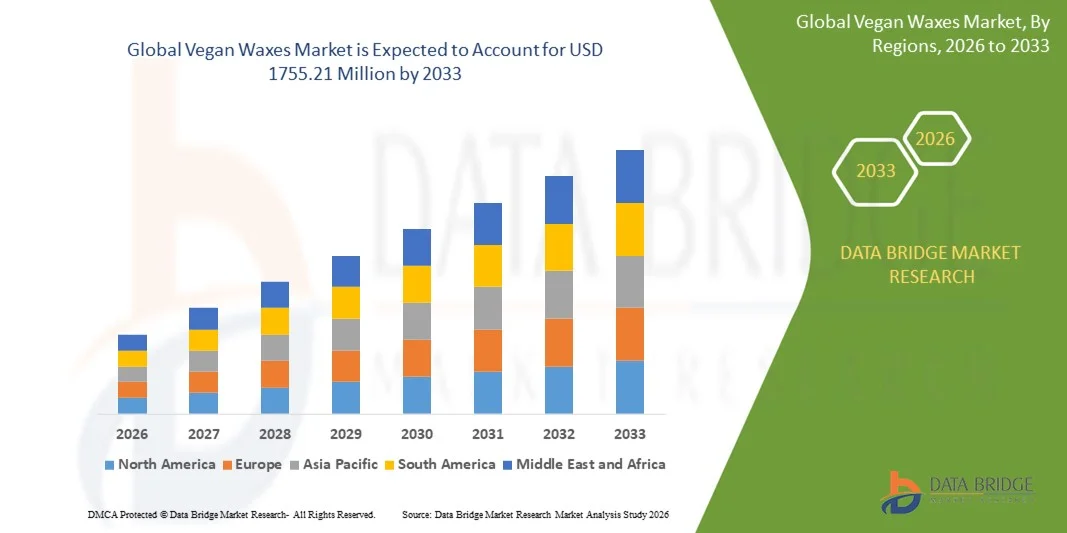
- As per Data Bridge Market Research Analysis the global vegan waxes market size was valued at USD 807.00 million in 2025 and is expected to reach USD 1755.21 million by 2033, at a CAGR of 10.20% during the forecast period
- The market growth is largely fueled by the rising consumer preference for natural, plant-based, and vegan ingredients in cosmetics, personal care, and food products, driving manufacturers to integrate vegan waxes such as Carnauba, Berry, and Rice Bran Wax into their formulations
- Furthermore, increasing awareness of sustainability, ethical sourcing, and cruelty-free certifications is establishing vegan waxes as the preferred ingredient choice for premium and eco-conscious brands. These converging factors are accelerating the adoption of vegan waxes across multiple end-use industries, thereby significantly boosting market growth
Market Size & Forecast
Global Market Value (2025): USD 807.00 million
Expected Market Value (2033): USD 1755.21 million
Forecast CAGR (2026–2033): 10.20%
What are the Major Takeaways of Vegan Waxes Market?
- Vegan waxes, derived from plant sources such as palm leaves, sugarcane, berries, and rice bran, are increasingly essential in cosmetics, pharmaceuticals, and food applications due to their natural origin, functional properties, and compatibility with clean-label formulations
- The escalating demand for vegan waxes is primarily fueled by growing health and environmentally conscious consumer behavior, regulatory support for sustainable ingredients, and the rising popularity of plant-based and cruelty-free products in both retail and industrial sectors
- North America dominated the vegan waxes market with a share of 33.35% in 2025, due to increasing consumer preference for natural, plant-based ingredients in cosmetics, personal care, and food products
- Asia-Pacific is expected to be the fastest growing region in the vegan waxes market during the forecast period due to rising urbanization, disposable incomes, and increasing awareness of plant-based and sustainable products in countries such as China, Japan, and India
- Carnauba wax segment dominated the market with a market share of 41.8% in 2025, due to its superior hardness, high melting point, and natural glossy finish, making it highly suitable for applications in cosmetics, food coatings, and polishes. Manufacturers and end-users often prefer Carnauba Wax for its versatility and excellent film-forming properties that enhance product durability and aesthetics. The market also sees strong demand for Carnauba Wax due to its sustainable sourcing from palm leaves in Brazil and its compatibility with vegan formulations, supporting eco-conscious consumer trends
Report Scope and Vegan Waxes Market Segmentation
|
Attributes |
Vegan Waxes Key Market Insights |
|
Segments Covered |
|
|
Countries Covered |
North America
Europe
Asia-Pacific
Middle East and Africa
South America
|
|
Key Market Players |
|
|
Market Opportunities |
|
|
Value Added Data Infosets |
In addition to the insights on market scenarios such as market value, growth rate, segmentation, geographical coverage, and major players, the market reports curated by the Data Bridge Market Research also include in-depth expert analysis, pricing analysis, brand share analysis, consumer survey, demography analysis, supply chain analysis, value chain analysis, raw material/consumables overview, vendor selection criteria, PESTLE Analysis, Porter Analysis, and regulatory framework. |
What is the Key Trend in the Vegan Waxes Market?
Growing Use of Plant-Based and Sustainable Ingredients
- The global vegan waxes market is witnessing a significant shift towards plant-based and sustainable ingredients, driven by increasing consumer awareness regarding environmental impact and ethical sourcing practices. This trend is influencing manufacturers to reformulate products using Carnauba, Berry, and Rice Bran Wax, which provide natural, high-quality alternatives to animal-derived waxes
- For instance, Cirebelle has launched CireNat™ Sugarcane Wax, derived from upcycled sugarcane by-products, allowing cosmetic and food manufacturers to offer eco-friendly and vegan-certified products. Such initiatives by key companies are accelerating the adoption of sustainable waxes across multiple end-use sectors, setting new industry standards
- Vegan waxes are increasingly integrated into cosmetics, personal care, and food products to meet consumer expectations for clean-label formulations, offering functionality such as emollience, texture, and gloss while maintaining sustainability credentials. The rising preference for natural ingredients is prompting innovation in wax blends that cater to diverse product requirements
- The trend is also supported by regulatory encouragement and certifications that emphasize sustainability and cruelty-free sourcing. Companies are leveraging these certifications to differentiate their products in competitive markets, highlighting the importance of traceable and ethically sourced waxes
- Consumer demand for plant-based and sustainable products is influencing both product development and marketing strategies, encouraging companies to prioritize transparent sourcing and eco-friendly production processes. This holistic approach reinforces the overall market shift towards sustainability and ethical consumerism
- The growing adoption of plant-based and sustainable waxes is expected to continue driving innovation and expanding applications in cosmetics, personal care, and food industries, establishing vegan waxes as a key component in future product portfolios and solidifying long-term market growth
Vegan Waxes Market Dynamics
Driver
Rising Demand for Vegan and Cruelty-Free Products
- Increasing consumer preference for vegan and cruelty-free products across cosmetics, personal care, and food industries is a major driver for the vegan waxes market. This demand encourages manufacturers to replace animal-based waxes with plant-derived alternatives such as Carnauba and Berry Wax
- For instance, Norevo GmbH has emphasized sustainable sourcing of carnauba wax in Brazil, catering to brands that require certified vegan and ethically sourced ingredients. Such strategic initiatives by key companies are propelling market growth and enhancing brand value in eco-conscious segments
- Consumers are increasingly seeking products with clean-label and environmentally friendly credentials, pushing manufacturers to innovate formulations that incorporate functional plant-based waxes without compromising quality or performance. This trend extends to packaging, coatings, and specialty applications where vegan waxes provide both functional and marketing advantages
- The rising awareness of ethical consumerism and sustainability is encouraging collaboration between wax producers and end-use industries, promoting research into high-performance, plant-derived waxes. This collaboration strengthens supply chains and ensures the availability of vegan waxes across multiple sectors
- The continuous growth in demand for vegan, cruelty-free, and sustainably sourced waxes is expected to sustain market expansion, driving further innovation, improving accessibility, and establishing plant-based waxes as standard ingredients in personal care, cosmetic, and food products
Restraint/Challenge
Limited Availability and High Cost of Premium Waxes
- The availability of high-quality plant-based waxes is limited due to dependency on agricultural production and regional sourcing constraints, which restricts large-scale supply and can impact pricing. These limitations pose a challenge for manufacturers aiming to integrate vegan waxes into commercial-scale formulations
- For instance, sourcing premium Carnauba Wax from Brazil involves complex logistics and adherence to sustainability standards, which can increase costs for cosmetic and food manufacturers. Such supply chain complexities can hinder rapid market adoption and affect competitiveness in price-sensitive segments
- High production and processing costs of plant-derived waxes also present challenges, as they are generally more expensive than conventional animal-based or synthetic waxes. Manufacturers need to balance cost considerations with consumer demand for high-quality, eco-friendly ingredients
- Limited availability can also lead to inconsistent supply and quality variations, impacting formulation reliability and product performance. Companies must invest in supplier partnerships and sustainable agricultural practices to ensure steady supply and maintain product standards
- Overcoming these challenges requires strategic sourcing, investment in sustainable cultivation, and the development of cost-efficient production methods. Addressing these barriers will be essential to support long-term growth and wider adoption of vegan waxes across industries
How is the Vegan Waxes Market Segmented?
The market is segmented on the basis of type, end-use industry, and form.
- By Type
On the basis of type, the vegan waxes market is segmented into Carnauba Wax, Berry Wax, Myrica Fruit Wax, and Rice Bran Wax. The Carnauba Wax segment dominated the market with the largest revenue share of 41.8% in 2025, driven by its superior hardness, high melting point, and natural glossy finish, making it highly suitable for applications in cosmetics, food coatings, and polishes. Manufacturers and end-users often prefer Carnauba Wax for its versatility and excellent film-forming properties that enhance product durability and aesthetics. The market also sees strong demand for Carnauba Wax due to its sustainable sourcing from palm leaves in Brazil and its compatibility with vegan formulations, supporting eco-conscious consumer trends.
The Berry Wax segment is anticipated to witness the fastest growth rate of 22.5% from 2026 to 2033, fueled by increasing adoption in niche cosmetics, personal care, and pharmaceutical applications. Berry Wax is valued for its emollient properties, moisturizing effects, and natural origin, making it suitable for vegan lip balms, creams, and topical medicines. Its rising popularity is also attributed to growing consumer preference for plant-based ingredients with functional benefits and minimal environmental impact, driving innovation in product formulations and expanding commercial use.
- By End-Use Industry
On the basis of end-use industry, the vegan waxes market is segmented into Pharmaceuticals, Cosmetics and Personal Care, Food, and Textile Industry. The Cosmetics and Personal Care segment dominated the market with the largest revenue share in 2025, driven by the rising consumer demand for natural and sustainable beauty products, including lipsticks, creams, and balms. Vegan waxes provide functional benefits such as texture enhancement, gloss, and long-lasting performance, which are crucial for premium cosmetic formulations. The market is further supported by growing awareness of cruelty-free certifications and increasing adoption of plant-based ingredients in personal care products.
The Food segment is expected to witness the fastest CAGR from 2026 to 2033, fueled by increasing use of vegan waxes in confectionery coatings, chocolate glazes, and bakery applications. Vegan waxes such as Carnauba and Berry Wax serve as natural glazing agents and stabilizers, replacing synthetic or animal-derived alternatives. Rising consumer preference for plant-based and allergen-free food products is encouraging manufacturers to integrate vegan waxes, enhancing product shelf life, appearance, and overall quality while adhering to vegan and clean-label standards.
- By Form
On the basis of form, the vegan waxes market is segmented into Flakes, Pellets, and Powder. The Flakes segment dominated the market with the largest revenue share of 39.7% in 2025, driven by its ease of handling, precise measurement, and suitability for melting and formulation in cosmetics, food, and pharmaceutical products. Flakes provide consistent quality, smooth blending, and high purity, which are critical for industrial-scale production processes. The market also benefits from the widespread adoption of flakes for creating uniform coatings, emulsions, and wax blends, enhancing product performance and consumer satisfaction.
The Pellets segment is anticipated to witness the fastest growth rate of 23.1% from 2026 to 2033, fueled by its convenience in automated processing and precise dosing for large-scale manufacturing. Pellets offer superior flowability, reduced dust generation, and efficient melting, making them ideal for cosmetics, candle production, and food applications. The rising demand for processed, ready-to-use wax forms in commercial production is driving growth, enabling manufacturers to improve production efficiency and maintain consistent product quality across batches.
Which Region Holds the Largest Share of the Vegan Waxes Market?
- North America dominated the vegan waxes market with the largest revenue share of 33.35% in 2025, driven by increasing consumer preference for natural, plant-based ingredients in cosmetics, personal care, and food products
- Consumers in the region highly value sustainably sourced and cruelty-free waxes such as Carnauba and Berry Wax, which align with growing awareness of ethical and eco-friendly products
- This widespread adoption is further supported by high disposable incomes, the presence of key manufacturers, and increasing demand for vegan-certified products in retail and e-commerce channels, establishing vegan waxes as a preferred solution across multiple end-use industries
U.S. Vegan Waxes Market Insight
The U.S. vegan waxes market captured the largest revenue share in 2025 within North America, fueled by the rapid adoption of plant-based cosmetics, functional foods, and pharmaceutical products. Consumers are increasingly prioritizing formulations with natural waxes for safety, sustainability, and performance benefits. The growing preference for organic, vegan-certified products, combined with rising investments by manufacturers in R&D for novel wax blends, further propels the market. In addition, regulatory support for clean-label and eco-friendly ingredients strengthens adoption in personal care and food industries.
Europe Vegan Waxes Market Insight
The Europe vegan waxes market is projected to expand at a substantial CAGR throughout the forecast period, primarily driven by increasing demand for sustainable and natural ingredients in cosmetics, pharmaceuticals, and food sectors. Rising urbanization, strong regulatory frameworks supporting vegan and cruelty-free certifications, and growing consumer consciousness regarding environmental impact are fostering market adoption. The region sees significant growth across personal care, food, and specialty pharmaceutical applications, with manufacturers introducing innovative wax blends to meet evolving consumer expectations.
U.K. Vegan Waxes Market Insight
The U.K. vegan waxes market is anticipated to grow at a noteworthy CAGR during the forecast period, driven by rising demand for ethical and sustainable personal care and food products. Concerns regarding environmental sustainability and animal welfare are encouraging both manufacturers and consumers to prefer plant-based waxes. The U.K.’s well-established retail infrastructure and strong e-commerce penetration are expected to continue supporting market expansion, while innovation in product formulations enhances appeal among health- and eco-conscious consumers.
Germany Vegan Waxes Market Insight
The Germany vegan waxes market is expected to expand at a considerable CAGR during the forecast period, fueled by the country’s emphasis on sustainability, innovation, and high-quality standards. German consumers show strong preference for natural and ethically sourced ingredients, supporting the use of Carnauba, Berry, and Rice Bran Wax in cosmetics, food, and pharmaceutical products. The integration of vegan waxes into high-end personal care and specialty food items, along with robust regulatory support for eco-friendly products, is driving growth in both B2B and retail channels.
Asia-Pacific Vegan Waxes Market Insight
The Asia-Pacific vegan waxes market is poised to grow at the fastest CAGR during the forecast period of 2026 to 2033, driven by rising urbanization, disposable incomes, and increasing awareness of plant-based and sustainable products in countries such as China, Japan, and India. The region's growing inclination towards natural cosmetics, functional foods, and eco-friendly pharmaceuticals is encouraging adoption of vegan waxes. In addition, APAC is emerging as a manufacturing hub for plant-based waxes, increasing affordability, accessibility, and export potential across global markets.
Japan Vegan Waxes Market Insight
The Japan vegan waxes market is gaining momentum due to the country’s high health consciousness, demand for sustainable beauty and food products, and rapid urbanization. Japanese consumers emphasize high-quality natural ingredients, driving demand for Carnauba and Berry Waxes in cosmetics and functional foods. Integration of vegan waxes into personal care, confectionery, and specialty pharmaceutical applications is expanding, while aging demographics and preferences for safe, easy-to-use natural formulations further support market growth.
China Vegan Waxes Market Insight
The China vegan waxes market accounted for the largest revenue share in Asia-Pacific in 2025, attributed to rapid urbanization, a growing middle class, and increasing health- and sustainability-conscious consumer behavior. Vegan waxes are increasingly used in cosmetics, food coatings, and pharmaceutical products, meeting the rising demand for natural, clean-label alternatives. Government initiatives promoting eco-friendly and plant-based manufacturing, along with strong domestic production capabilities, are key factors propelling market expansion in China.
Which are the Top Companies in Vegan Waxes Market?
The vegan waxes industry is primarily led by well-established companies, including:
- CALWAX (U.S.)
- Akrochem Corporation (U.S.)
- Strahl & Pitsch, Inc. (U.S.)
- NOREVO (Germany)
- Brenntag AG (Germany)
- FalconPro Industries (U.S.)
- KahlWax (Germany)
- Poth Hille (Germany)
- AF Suter & Co Ltd (Switzerland)
- Spectrum Chemical Manufacturing Corp. (U.S.)
- Paramold Manufacturing LLC (U.S.)
- The International Group, Inc. (U.S.)
- Hase Petroleum Wax Co. (U.S.)
- Parchem Fine & Specialty Chemicals (U.S.)
- Shri Ram Sons Wax Private Limited (India)
- Merck KGaA (Germany)
- Waxoils (U.S.)
- AADRA INTERNATIONAL (India)
What are Latest Developments in Vegan Waxes Market?
- In June 2025, Norevo GmbH strengthened its sustainability and traceability program for carnauba wax, working closely with local suppliers in Brazil. This initiative ensures ethical sourcing, transparency, and adherence to social and environmental standards across the supply chain. The program aligns with increasing demand from cosmetics, personal care, and food companies for responsibly sourced, vegan-certified ingredients. It also allows Norevo to differentiate its products in a competitive market while meeting regulatory and consumer expectations. By emphasizing traceable, sustainable supply chains, the company enhances brand credibility and fosters market confidence. This development reinforces the importance of sustainability as a core growth driver in the vegan waxes industry
- In May 2025, Cargill showcased a prototype gummy incorporating carnauba wax as a coating and glazing agent within its food innovation portfolio. This development illustrates the expanding application of vegan waxes in clean-label, plant-based, and functional food products. Carnauba wax enhances shelf life, texture, and appearance, serving as a natural alternative to synthetic coatings. The prototype highlights how major food manufacturers are integrating sustainable ingredients to meet consumer demand for vegan and eco-conscious products. This initiative also signals potential growth for vegan waxes in the food sector, extending beyond traditional cosmetic applications. Cargill’s innovation demonstrates the commercial viability of plant-based waxes in industrial-scale formulations
- In February 2025, Cirebelle introduced CireNat Rice Bran Wax, sourced from the by-product of rice bran oil production. This product offers a high melting point, structural integrity, and antioxidant benefits, making it highly suitable for vegan cosmetics, lip balms, and topical pharmaceutical formulations. The initiative demonstrates the company’s commitment to circular-economy principles, transforming by-products into functional, sustainable ingredients. The launch addresses the rising consumer and manufacturer demand for plant-based waxes that deliver performance without animal-derived components. It also reinforces the market trend toward clean-label, eco-conscious formulations in personal care and food sectors. Cirebelle’s Rice Bran Wax provides versatility for blending with other plant-based waxes, expanding its commercial appeal
- In January 2025, Cirebelle launched CireNat™ Sugarcane Wax, a 100% natural vegan wax derived from sugarcane by-products. This launch emphasizes sustainability by upcycling agricultural waste into high-value ingredients suitable for cosmetics, personal care, and food applications. The wax delivers superior gloss, emollient properties, and durability, making it a plant-based alternative to lanolin and beeswax. Cirebelle’s introduction of this product demonstrates the growing demand for eco-friendly and vegan-certified ingredients. The launch also highlights the focus of manufacturers on aligning product portfolios with consumer preferences for natural, ethically sourced materials. By providing a versatile solution, this wax supports innovation across multiple end-use industries
- In March 2024, Norevo GmbH partnered with the Initiative for Responsible Carnauba (IRC) to strengthen ethical sourcing and biodiversity conservation in Brazil’s carnauba wax production regions. This collaboration promotes fair labor practices, sustainable harvesting, and the protection of the Caatinga and Cerrado ecosystems. The initiative enhances traceability and transparency, providing vegan wax users with verified sustainable sourcing credentials. The partnership reflects growing market expectations for ethically produced ingredients in cosmetics, pharmaceuticals, and food products. By supporting responsible supply chains, Norevo strengthens its positioning as a trusted supplier of high-quality vegan waxes. The move underlines the increasing importance of sustainability and social responsibility in global ingredient markets

- Interactive Data Analysis Dashboard
- Company Analysis Dashboard for high growth potential opportunities
- Research Analyst Access for customization & queries
- Competitor Analysis with Interactive dashboard
- Latest News, Updates & Trend analysis
- Harness the Power of Benchmark Analysis for Comprehensive Competitor Tracking
Global Vegan Waxes Market, Supply Chain Analysis and Ecosystem Framework
To support market growth and help clients navigate the impact of geopolitical shifts, DBMR has integrated in-depth supply chain analysis into its Global Vegan Waxes Market research reports. This addition empowers clients to respond effectively to global changes affecting their industries. The supply chain analysis section includes detailed insights such as Global Vegan Waxes Market consumption and production by country, price trend analysis, the impact of tariffs and geopolitical developments, and import and export trends by country and HSN code. It also highlights major suppliers with data on production capacity and company profiles, as well as key importers and exporters. In addition to research, DBMR offers specialized supply chain consulting services backed by over a decade of experience, providing solutions like supplier discovery, supplier risk assessment, price trend analysis, impact evaluation of inflation and trade route changes, and comprehensive market trend analysis.
Data collection and base year analysis are done using data collection modules with large sample sizes. The stage includes obtaining market information or related data through various sources and strategies. It includes examining and planning all the data acquired from the past in advance. It likewise envelops the examination of information inconsistencies seen across different information sources. The market data is analysed and estimated using market statistical and coherent models. Also, market share analysis and key trend analysis are the major success factors in the market report. To know more, please request an analyst call or drop down your inquiry.
The key research methodology used by DBMR research team is data triangulation which involves data mining, analysis of the impact of data variables on the market and primary (industry expert) validation. Data models include Vendor Positioning Grid, Market Time Line Analysis, Market Overview and Guide, Company Positioning Grid, Patent Analysis, Pricing Analysis, Company Market Share Analysis, Standards of Measurement, Global versus Regional and Vendor Share Analysis. To know more about the research methodology, drop in an inquiry to speak to our industry experts.
Data Bridge Market Research is a leader in advanced formative research. We take pride in servicing our existing and new customers with data and analysis that match and suits their goal. The report can be customized to include price trend analysis of target brands understanding the market for additional countries (ask for the list of countries), clinical trial results data, literature review, refurbished market and product base analysis. Market analysis of target competitors can be analyzed from technology-based analysis to market portfolio strategies. We can add as many competitors that you require data about in the format and data style you are looking for. Our team of analysts can also provide you data in crude raw excel files pivot tables (Fact book) or can assist you in creating presentations from the data sets available in the report.













