What is the Global Vegetable Seeds Market Size and Growth Rate?
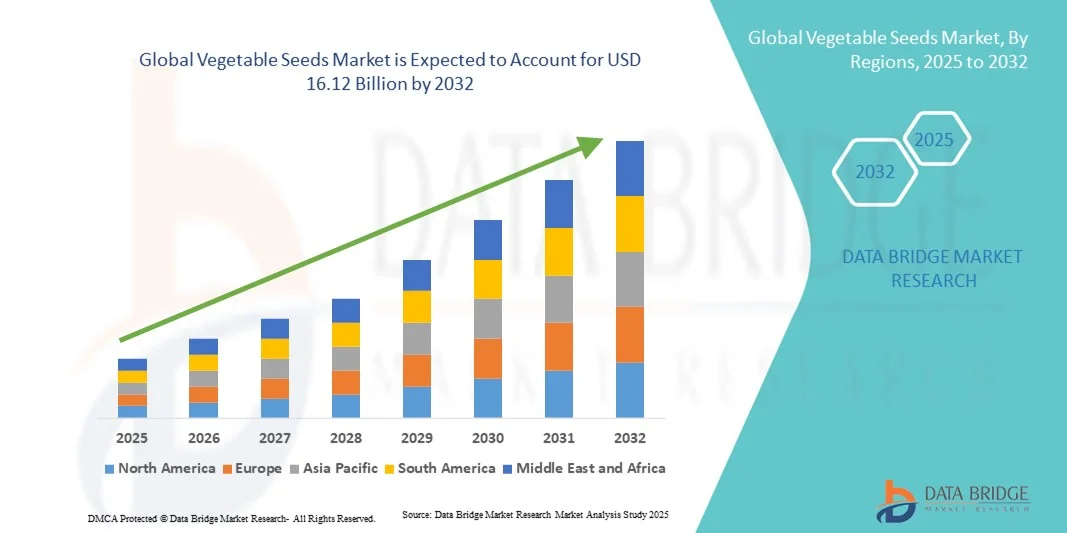
- As per Data Bridge Market Research Analysis the global vegetable seeds market size was valued at USD 8.64 billion in 2024 and is expected to reach USD 16.12 billion by 2032, at a CAGR of 8.10% during the forecast period
- The wide application scope of vegetables across several segments of food industries such as food service, food processing, baking and others is escalating the demand for vegetables across the world, which is highly impacting the demand and growth of the vegetable seeds
- Also, with the increase in the world population, which in turn has increased the demand for vegetables as they are one of the major sources of nutrients, thus the rapid rise in the world population is anticipated to boost the growth of the vegetable seeds market.
- Such aswise, the growing awareness regarding the consumption of vegetables, to meet nutritional and dietary needs has caused an increase in demand for vegetables which is also influencing the growth of the vegetable seeds market
Market Size & Forecast
- Global Market Value (2024): USD 8.64 billion
- Expected Market Value (2032): USD 16.12 billion
- Forecast CAGR (2024–2032): 8.10%
What are the Major Takeaways of Vegetable Seeds Market?
- The regulations in cultivation of GM crops as well as the varying climatic conditions will curb the growth of the vegetable seeds market. Moreover, the rising market for genetically modified (GM) crops, rise in seed replacement rate along with increasing number of people adopting farming activities and innovations in mechanical inputs on farms are some of the key determinants fueling the growth of the market
- North America dominated the vegetable seeds market with the largest revenue share of 38.7% in 2024, driven by the strong presence of leading seed companies, advanced agricultural infrastructure, and a high adoption rate of hybrid and genetically modified seeds
- The Europe vegetable seeds market is projected to grow at the fastest CAGR of 12.8% from 2025 to 2032, driven by the rising emphasis on sustainable agriculture, organic farming, and food security initiatives
- The tomato segment dominated the Vegetable Seeds market with the largest revenue share of 26.8% in 2024, owing to its global cultivation, high consumption rate, and continuous advancements in hybrid and disease-resistant varieties
Report Scope and Vegetable Seeds Market Segmentation
|
Attributes |
Vegetable Seeds Key Market Insights |
|
Segments Covered |
|
|
Countries Covered |
North America
Europe
Asia-Pacific
Middle East and Africa
South America
|
|
Key Market Players |
|
|
Market Opportunities |
|
|
Value Added Data Infosets |
|
What is the Key Trend in the Vegetable Seeds Market?
Integration of Advanced Breeding Technologies for Higher Yield and Resilience
- A significant and accelerating trend in the global vegetable seeds market is the integration of advanced breeding technologies such as CRISPR, marker-assisted selection, and genomic sequencing. These tools enable the development of high-yield, disease-resistant, and climate-resilient vegetable varieties, addressing the challenges of food security and climate change
- For instance, Syngenta and Bayer AG have been investing heavily in gene-editing research to develop vegetable seeds with enhanced nutritional value and improved resistance to pests and diseases, ensuring consistent production even under unfavorable conditions
- Precision breeding allows seed companies to accelerate the development of hybrid varieties that perform better under region-specific climatic conditions, ensuring optimized productivity and quality. Moreover, it helps in reducing dependency on chemical pesticides, supporting the global shift toward sustainable agriculture
- The use of AI and data analytics in plant breeding is also gaining traction, enabling companies to predict seed performance and optimize breeding cycles. These innovations are transforming conventional breeding into a data-driven process, improving efficiency and reliability
- This trend towards technologically advanced, climate-adaptive, and nutritionally enriched vegetable seeds is reshaping the global agriculture sector, helping farmers achieve higher yields while promoting sustainability. Companies such as Limagrain and Corteva are focusing on integrating digital tools and advanced biotechnology to strengthen their global seed portfolios
- The growing emphasis on innovation-driven agriculture and sustainable food production will continue to drive the adoption of next-generation vegetable seed technologies, supporting long-term productivity and food security
What are the Key Drivers of Vegetable Seeds Market?
- The increasing global population and the growing demand for high-yielding, nutritious, and pest-resistant vegetables are key drivers of the vegetable seeds market. Rising awareness about healthy eating habits and the expansion of horticultural farming practices are further boosting market growth
- For instance, in March 2024, Rijk Zwaan launched a new line of heat-tolerant lettuce varieties to help farmers combat climate change and maintain yield consistency. Such developments highlight the industry’s focus on sustainable, adaptable vegetable cultivation
- The adoption of hybrid seeds and genetically improved varieties is also a major factor driving growth, as these seeds offer better productivity, resistance to diseases, and extended shelf life, which is crucial for commercial vegetable farming
- Moreover, the rising investment in greenhouse and vertical farming is accelerating demand for high-quality vegetable seeds tailored for controlled environments. These practices enable year-round production and better resource efficiency
- Supportive government initiatives promoting sustainable agriculture, coupled with the increasing integration of digital farming technologies, are propelling the market forward. The surge in R&D investments by key players and growing awareness among farmers regarding modern cultivation techniques are expected to continue fueling market expansion
Which Factor is Challenging the Growth of the Vegetable Seeds Market?
- One of the major challenges restraining the growth of the vegetable seeds market is the high cost of hybrid and genetically modified seeds, which limits their adoption, especially among small and marginal farmers in developing regions. In addition, intellectual property rights (IPR) issues and seed piracy pose threats to innovation and fair competition in the market
- For instance, disputes related to seed patents, such as those involving Bayer AG and regional seed producers in Asia, have raised concerns over the accessibility and affordability of advanced seed varieties
- Climate variability also poses a significant challenge, as unpredictable weather conditions such as droughts and floods can adversely impact seed germination and yield performance, particularly in open-field cultivation
- Furthermore, a lack of awareness and technical expertise among farmers regarding hybrid and biotech seed utilization reduces the effectiveness of these innovations. Limited infrastructure for seed storage and distribution in developing countries further hampers market penetration
- Overcoming these challenges requires increased investment in farmer education, seed quality assurance programs, and government support through subsidies or credit access. Encouraging collaboration between public and private sectors to enhance R&D will be crucial for sustainable and inclusive market growth
How is the Vegetable Seeds Market Segmented?
The market is segmented on the basis of vegetable type, trait, form, and farm type.
- By Vegetable Type
On the basis of vegetable type, the vegetable seeds market is segmented into tomato, cabbage, cucurbit, carrot, sweet pepper, lettuce, watermelon, onion, root and bulb, Chinese cabbage, hot pepper, sweet corn, eggplant, okra, and others. The tomato segment dominated the Vegetable Seeds market with the largest revenue share of 26.8% in 2024, owing to its global cultivation, high consumption rate, and continuous advancements in hybrid and disease-resistant varieties. Tomatoes are a staple crop across both developed and developing economies, favored for their profitability and adaptability to diverse climatic conditions.
The lettuce segment is projected to witness the fastest growth rate of 19.4% from 2025 to 2032, driven by rising demand for fresh and healthy salad ingredients and the expansion of hydroponic and greenhouse farming practices that enable year-round production. The focus on nutritional diets and convenience foods continues to fuel segmental growth.
- By Trait
Based on trait, the vegetable seeds market is segmented into genetically modified (GM) and conventional. The conventional segment dominated the market with the largest share of 72.3% in 2024, attributed to wider consumer acceptance, lower regulatory constraints, and ease of cultivation for small and medium-scale farmers. Conventional vegetable seeds remain the preferred choice in regions with strict restrictions on GM crop cultivation, such as Europe and parts of Asia.
However, the genetically modified segment is expected to register the fastest CAGR of 18.2% during 2025–2032, driven by growing adoption of GM technology for improved yield, pest resistance, and drought tolerance. With ongoing innovations by leading seed developers, GM vegetable seeds are gaining traction, particularly in North and South American markets, where supportive regulatory environments and demand for high-yield varieties are boosting adoption.
- By Form
On the basis of form, the vegetable seeds market is divided into organic and inorganic. The inorganic segment held the largest market share of 64.5% in 2024, primarily due to the higher yield potential, cost-effectiveness, and widespread availability of hybrid and conventional inorganic seeds. These seeds are preferred by large-scale farmers aiming for higher productivity and consistent crop quality.
Meanwhile, the organic segment is expected to grow at the fastest CAGR of 17.6% from 2025 to 2032, fueled by increasing consumer preference for chemical-free produce and government initiatives promoting sustainable agriculture. Growing awareness of health and environmental benefits associated with organic farming is prompting seed companies to develop certified organic seed lines to cater to this expanding market.
- By Farm Type
On the basis of farm type, the vegetable seeds market is segmented into indoor and outdoor. The outdoor segment dominated the market with the largest share of 78.9% in 2024, driven by the vast area of traditional open-field cultivation and the cost efficiency of outdoor farming. Most staple vegetables such as tomatoes, onions, and peppers are extensively grown in open environments due to favorable climatic conditions and established farming infrastructure.
The indoor segment is projected to witness the fastest CAGR of 20.5% during 2025–2032, supported by the rapid growth of controlled-environment agriculture (CEA), including hydroponics, vertical farming, and greenhouse cultivation. Rising urbanization, land scarcity, and demand for year-round, pesticide-free vegetable production are propelling the expansion of indoor farming, thereby boosting demand for high-performance seeds suitable for these systems.
Which Region Holds the Largest Share of the Vegetable Seeds Market?
- North America dominated the vegetable seeds market with the largest revenue share of 38.7% in 2024, driven by the strong presence of leading seed companies, advanced agricultural infrastructure, and a high adoption rate of hybrid and genetically modified seeds. The region’s well-established commercial farming sector and focus on improving crop yields and resistance to pests and diseases are key contributors to this dominance
- Farmers in North America are increasingly adopting precision farming techniques and sustainable cultivation practices that enhance productivity and seed performance. Favorable government policies supporting agricultural innovation, along with consumer demand for high-quality, nutrient-rich vegetables, further drive market expansion
- The combination of advanced R&D capabilities, widespread mechanization, and the growing popularity of high-value horticultural crops has established North America as a leading hub in the global Vegetable Seeds industry
U.S. Vegetable Seeds Market Insight
The U.S. vegetable seeds market captured the largest revenue share of 82.5% in 2024 within North America, fueled by the widespread adoption of hybrid and disease-resistant seed varieties and increasing demand for high-yield crops. Advanced biotechnology and investments by leading seed producers such as Bayer CropScience and Corteva Agriscience have strengthened market growth. The shift towards sustainable farming practices, alongside consumer preference for fresh and organic produce, is propelling continuous innovation in seed genetics. Furthermore, rising greenhouse cultivation and controlled-environment farming in the U.S. are expanding opportunities for premium vegetable seeds.
Canada Vegetable Seeds Market Insight
The Canada vegetable seeds market is anticipated to witness a healthy CAGR during the forecast period, supported by favorable climatic conditions for diverse vegetable cultivation and rising consumer interest in locally grown produce. Government incentives promoting greenhouse farming and sustainable agriculture are enhancing market potential. The growing adoption of organic and non-GMO vegetable seeds, coupled with technological advancements in seed coating and irrigation management, is expected to strengthen Canada’s position in the regional market.
Mexico Vegetable Seeds Market Insight
The Mexico vegetable seeds market is expanding steadily due to the country’s robust export-oriented vegetable production and favorable trade agreements with the U.S. and Europe. Increasing adoption of hybrid seeds for key crops such as tomato, pepper, and cucumber is improving yield and quality. The nation’s focus on modernizing its agricultural practices, coupled with the rising popularity of greenhouse and drip irrigation systems, is driving the demand for high-performance seed varieties.
Which Region is the Fastest Growing Region in the Vegetable Seeds Market?
The Europe vegetable seeds market is projected to grow at the fastest CAGR of 12.8% from 2025 to 2032, driven by the rising emphasis on sustainable agriculture, organic farming, and food security initiatives. The region’s robust regulatory framework promoting non-GMO and environmentally friendly seed production is fostering innovation in seed breeding technologies. Growing demand for locally sourced, pesticide-free vegetables is also fueling the adoption of hybrid and open-pollinated seed varieties across Europe.
U.K. Vegetable Seeds Market Insight
The U.K. vegetable seeds market is witnessing strong growth due to increasing consumer demand for organic vegetables and government programs encouraging sustainable agriculture. The country’s expanding greenhouse farming sector and rising adoption of precision agriculture tools are enhancing productivity and seed quality. Investments in R&D for climate-resilient and high-yield seed varieties are further strengthening market prospects.
Germany Vegetable Seeds Market Insight
The Germany vegetable seeds market is expected to expand at a notable CAGR during the forecast period, supported by the country’s technological leadership in seed genetics and strong focus on eco-friendly farming. German farmers are increasingly adopting disease-resistant and high-nutrition vegetable seeds to meet rising domestic and export demand. In addition, the growing preference for regionally sourced and traceable food products is promoting the use of certified and sustainable seed varieties.
France Vegetable Seeds Market Insight
The France vegetable seeds market continues to grow steadily due to the nation’s rich agricultural heritage and government-backed initiatives promoting organic farming. Increasing consumer awareness regarding food safety and nutrition has led to a surge in demand for high-quality vegetable seeds. The expansion of hydroponic and vertical farming systems, particularly in urban areas, is also contributing to the adoption of premium hybrid and organic seed varieties.
Which are the Top Companies in Vegetable Seeds Market?
The vegetable seeds industry is primarily led by well-established companies, including:
- Advanta Seeds US (U.S.)
- Emerald Seed Company (U.S.)
- Limagrain (France)
- Bayer AG (Germany)
- Rijk Zwaan Zaadteelt en Zaadhandel B.V. (Netherlands)
- Early's Farm & Garden Centre (Canada)
- Mahyco (India)
- Bejo Zaden B.V. (Netherlands)
- Harris Seeds (U.S.)
- Peaceful Valley Holdings, Inc. (U.S.)
- TAKII & CO., LTD. (Japan)
- Mahindra Agri (India)
- Corteva (U.S.)
- DLF (Denmark)
- East-West Seed (Thailand)
- Stokes Seeds (Canada)
- Western Bio Vegetable Seeds Ltd. (India)
- BASF SE (Germany)
- KWS SAAT SE & Co. KGaA (Germany)
- Sakata Seed America (U.S.)
- Syngenta (Switzerland)
What are the Recent Developments in Global Vegetable Seeds Market?
- In July 2023, Syngenta, a leading player in the agricultural inputs industry, announced the acquisition of Feltrin Sementes, a vegetable seed company based in Brazil, aiming to expand its global product portfolio. This strategic move strengthens Syngenta’s presence in the international vegetable seeds market and enhances its offerings for growers worldwide
- In February 2022, BASF’s vegetable seeds business launched a new tearless onion variety, which became available in supermarkets across France, Germany, Italy, and the U.K. This innovation is expected to improve consumer convenience and boost BASF’s competitive position in the European vegetable seeds sector
- In September 2021, Bayer announced plans to expand its vegetable seed portfolio under the “Vegetables by Bayer” segment, including the introduction of organically produced seeds. This expansion reinforces Bayer’s commitment to sustainable agriculture and broadens its options for environmentally conscious growers
- In January 2021, Bayer showcased four new vegetable seed varieties, namely Anshuman, SVHA9093, Bazlet, and Himgauri, during the Pragati Diwas event held in Chikaballapur near Bengaluru, India. The launch highlights Bayer’s focus on innovative seed solutions tailored for diverse regional markets
- In April 2020, Sakata Seed America, a subsidiary of Sakata Seed Corporation, acquired U.S.-based lettuce seed company Vanguard Seed, enabling the introduction of new lettuce varieties to the North American market. This acquisition enhances Sakata’s portfolio and strengthens its market position in leafy vegetable seeds

- Interactive Data Analysis Dashboard
- Company Analysis Dashboard for high growth potential opportunities
- Research Analyst Access for customization & queries
- Competitor Analysis with Interactive dashboard
- Latest News, Updates & Trend analysis
- Harness the Power of Benchmark Analysis for Comprehensive Competitor Tracking
Data collection and base year analysis are done using data collection modules with large sample sizes. The stage includes obtaining market information or related data through various sources and strategies. It includes examining and planning all the data acquired from the past in advance. It likewise envelops the examination of information inconsistencies seen across different information sources. The market data is analysed and estimated using market statistical and coherent models. Also, market share analysis and key trend analysis are the major success factors in the market report. To know more, please request an analyst call or drop down your inquiry.
The key research methodology used by DBMR research team is data triangulation which involves data mining, analysis of the impact of data variables on the market and primary (industry expert) validation. Data models include Vendor Positioning Grid, Market Time Line Analysis, Market Overview and Guide, Company Positioning Grid, Patent Analysis, Pricing Analysis, Company Market Share Analysis, Standards of Measurement, Global versus Regional and Vendor Share Analysis. To know more about the research methodology, drop in an inquiry to speak to our industry experts.
Data Bridge Market Research is a leader in advanced formative research. We take pride in servicing our existing and new customers with data and analysis that match and suits their goal. The report can be customized to include price trend analysis of target brands understanding the market for additional countries (ask for the list of countries), clinical trial results data, literature review, refurbished market and product base analysis. Market analysis of target competitors can be analyzed from technology-based analysis to market portfolio strategies. We can add as many competitors that you require data about in the format and data style you are looking for. Our team of analysts can also provide you data in crude raw excel files pivot tables (Fact book) or can assist you in creating presentations from the data sets available in the report.