


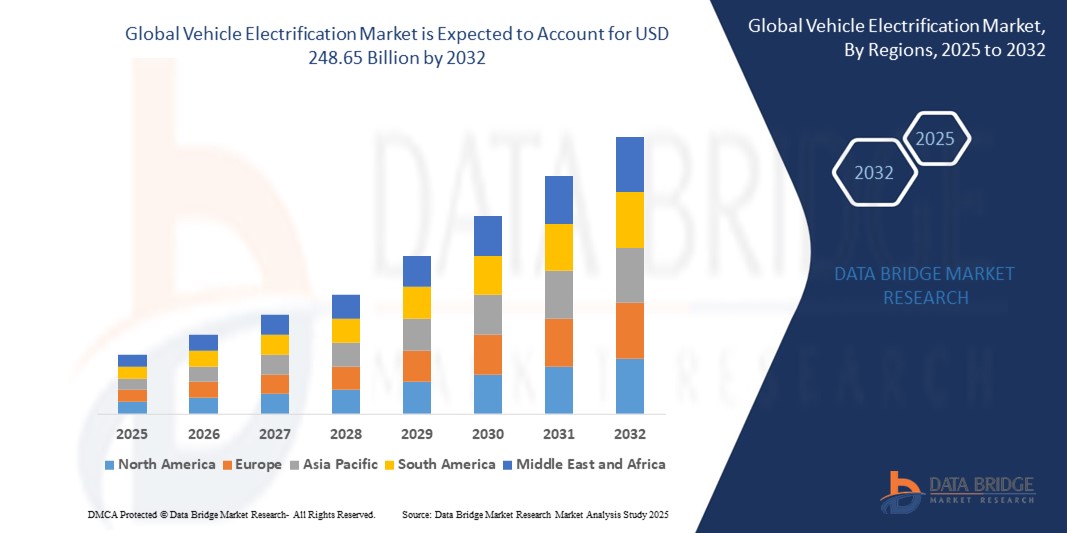
Vehicle Electrification Market Size
- The global Vehicle Electrification market size was valued at USD 110.26 Billion in 2024 and is expected to reach USD 248.65 Billion by 2032 at a CAGR of 10.7% during the forecast period
- Major factors that are expected to boost the growth of the vehicle electrification market in the forecast period are the increase in the demand for 48V architecture and the acceptance of advanced technologies like e-axle in the electric vehicles. On the other hand the struggle in achieving and maintaining an optimum power-to-weight ratio and rise in the price of electric systems are couple of factors that are derailing the growth of the vehicle electrification market in the timeline period.
Vehicle Electrification Market Analysis
- Vehicle electrification is referred to a variety of technologies that utilizes electricity to boost a vehicle. Electric vehicles are designed in order to run on electricity and the utilization of fossil fuels is decreased. Electric vehicles are also expected to assist in accomplishing the target of low carbon emissions from vehicles.
- The Vehicle Electrification Market is experiencing significant growth due to rising demand for fuel-efficient high-performance and low-emission vehicles. Increasing environmental concerns and stringent government emission regulations are accelerating the shift from conventional vehicles to electric alternatives.
- North America is projected to lead the Vehicle Electrification Market in 2025 accounting for the largest revenue share of 46.01% driven by government incentives rising electric vehicle (EV) production and growing investments in EV infrastructure.
- Asia-Pacific is expected to witness the highest growth rate in the Vehicle Electrification Market during the forecast period supported by expanding automotive manufacturing capabilities strong government policies favoring electrification and high EV adoption rates in countries like China Japan and South Korea.
- The Start-Stop segment is anticipated to dominate the market with a share of 32.9% owing to its cost-effectiveness and ability to reduce fuel consumption and emissions in internal combustion engine (ICE) vehicles.
Report Scope and Vehicle Electrification Market Segmentation
|
Attributes |
Vehicle Electrification Key Market Insights |
|
Segments Covered |
|
|
Countries Covered |
North America
Europe
Asia-Pacific
Middle East and Africa
South America
|
|
Key Market Players |
|
|
Market Opportunities |
|
|
Value Added Data Infosets |
In addition to the insights on market scenarios such as market value growth rate segmentation geographical coverage and major players the market reports curated by the Data Bridge Market Research also include import export analysis production capacity overview production consumption analysis price trend analysis climate change scenario supply chain analysis value chain analysis raw material/consumables overview vendor selection criteria PESTLE Analysis Porter Analysis and regulatory framework. |
Vehicle Electrification Market Trends
“Powering the Future of Sustainable Mobility”
- One of the key trends in the Vehicle Electrification market is the integration of advanced driver-assistance systems (ADAS) and AI-based vehicle control systems. These technologies enhance energy efficiency optimize powertrain management and support autonomous driving capabilities in electric vehicles (EVs).
- The adoption of over-the-air (OTA) software updates is gaining traction allowing automakers to remotely improve vehicle performance battery management and user experience without physical service visits. This trend is transforming the post-sale value chain in the EV market.
- The growing popularity of vehicle-to-grid (V2G) and bi-directional charging technologies is reshaping how electric vehicles interact with the power grid. These technologies enable EVs to store and return energy supporting grid stability and renewable energy integration.
- Automakers are increasingly shifting towards the use of modular EV platforms (skateboard chassis) to streamline production reduce costs and enhance scalability across multiple vehicle models. This trend is driving innovation and speeding up the rollout of new EV variants.
Vehicle Electrification Market Dynamics
Driver
“Government Mandates and Technological Advancements”
- Stringent emission regulations and carbon neutrality goals set by governments worldwide are major drivers accelerating the electrification of vehicles across all segments including passenger cars commercial fleets and two-wheelers.
- Technological breakthroughs in battery performance such as increased energy density fast-charging capabilities and longer lifecycle are making electric vehicles more practical and attractive to mainstream consumers.
- Significant investments from OEMs and Tier 1 suppliers in EV R&D along with partnerships in battery manufacturing and charging infrastructure are further pushing market growth on a global scale.
Restraint/Challenge
Infrastructure Limitations and High Initial Costs”
- Inadequate public charging infrastructure remains a major barrier especially in rural and developing areas limiting the mass adoption of electric vehicles due to range anxiety and lack of accessibility.
- The high upfront cost of electric vehicles driven largely by battery expenses continues to challenge market penetration in price-sensitive regions despite declining long-term operational costs.
- Supply chain constraints particularly in sourcing critical raw materials like lithium cobalt and nickel pose risks to production scalability and cost stability in the EV market.
Vehicle Electrification Market Scope
The market is segmented on the product type voltage vehicle type degree of hybridization channel type.
|
Segmentation |
Sub-Segmentation |
|
By Product Type |
|
|
By Voltage |
|
|
By Vehicle Type |
|
|
By Degree of Hybridization |
|
|
By Channel Type |
|
Vehicle Electrification Market Scope
The market is segmented on the basis product type, voltage, vehicle type, degree of hybridization, channel type.
- By Product Type
On the basis of product type the Vehicle Electrification market is segmented into Start-Stop, EPS, Liquid Heater PTC, Electric Air Conditioner Compressor, Electric Vacuum Pump, Electric Oil Pump, Electric Water Pump, Thermoelectric Generator, Electric Turbocharger, Starter Motor, Alternator, ISG, Actuator. The Start-Stop segment dominates the largest market revenue share of 32.9% in 2025. The Start-Stop segment grows due to rising fuel efficiency regulations and consumer demand for lower emissions. This technology reduces idling fuel consumption, making it a cost-effective electrification solution widely adopted in passenger cars and commercial vehicles worldwide.
The EPS segment is anticipated to witness the fastest growth rate of 18.7% from 2025 to 2032 EPS adoption is driven by its ability to improve vehicle handling, reduce energy consumption compared to hydraulic systems, and support advanced driver-assistance features. Increasing focus on lightweight and fuel-efficient vehicle designs boosts demand across passenger and commercial vehicle segments.
- By Voltage
On the basis of voltage the Vehicle Electrification market is segmented into 12V, 14V, 24V, 48V. The 12V based held the largest market revenue share in 2025. 12V vehicle electrification systems remain essential for powering auxiliary components with improved energy efficiency. Their integration in mild hybrid and micro-hybrid vehicles supports reduced emissions and better fuel economy, fueling continued demand from OEMs prioritizing cost-effective electrification solutions.
The 14V segment is expected to witness the fastest CAGR from 2025 to 2032. 14V electrical systems enable higher power output and support advanced vehicle features like start-stop, EPS, and infotainment. Growing vehicle electrification complexity and rising consumer expectations for comfort and safety features drive increased adoption of 14V architectures.
- By Vehicle Type
On the basis of vehicle type the Vehicle Electrification market is segmented into Passenger Car (PC), Two-Wheeler, Light-Commercial Vehicle (LCV) and Heavy Commercial Vehicle (HCV). The Passenger Car (PC), held the largest market revenue share in 2025 Passenger cars dominate electrification growth due to stringent emission norms and shifting consumer preference for electric and hybrid vehicles. OEM investments in EV technology, expanding model portfolios, and supportive government policies accelerate passenger car electrification globally.
The Two-Wheeler segment is expected to witness the fastest CAGR from 2025 to 2032 Electrification in two-wheelers is driven by urban pollution concerns, government subsidies, and rising fuel prices. Affordable electric scooters and motorcycles offer eco-friendly alternatives for last-mile connectivity, particularly in emerging markets with high demand for low-cost, efficient transportation..
- By degree of hybridization
On the basis of degree of hybridization the Vehicle Electrification market is segmented into ICE and Micro Hybrid Vehicle, HEV, PHEV, BEV & FCEV, 48 V Vehicle. The ICE and Micro Hybrid Vehicle held the largest market revenue share in 2025 and is expected to witness the fastest CAGR from 2025 to 2032 The ICE and micro hybrid segment grows as manufacturers adopt mild hybrid systems to meet emission targets cost-effectively. These vehicles combine internal combustion engines with electric components like start-stop and regenerative braking, offering improved fuel economy without full electrification.
- By Channel Type
On the basis of degree of channel type the Vehicle Electrification market is segmented into OEMs, Aftermarket. The OEMs held the largest market revenue share in 2025 and is expected to witness the fastest CAGR from 2025 to 2032 OEMs are key market drivers through heavy investments in electrification R&D, expanding EV lineups, and strategic partnerships. They focus on optimizing battery technology, vehicle platforms, and production processes to meet regulatory demands and evolving consumer preferences for electric mobility.
Vehicle Electrification Market Regional Analysis
- North America dominates the Vehicle Electrification market with the largest revenue share of 46.01% in 2024 North America leads vehicle electrification due to strong government incentives, growing EV infrastructure, and rising consumer adoption. Major automakers’ investments in electric models, coupled with stringent emission regulations, drive rapid market expansion, particularly in the U.S. and Canada.
U.S. Vehicle Electrification Market Insight
The U.S. Vehicle Electrification market captured the largest revenue share of 71.2% within North America in 2025 The U.S. market is fueled by federal tax credits, expanding charging networks, and aggressive state-level policies promoting EV adoption. OEMs are ramping up production of electric and hybrid vehicles to meet increasing consumer demand and regulatory requirements.
Europe Vehicle Electrification Market Insight
The Europe Vehicle Electrification market is projected to expand at a substantial CAGR throughout the forecast period Europe’s electrification market benefits from strict CO2 emission targets, supportive policies, and well-developed infrastructure. Growing urbanization and sustainability initiatives push OEMs and consumers toward electric vehicles, with extensive subsidies accelerating EV penetration across countries.
Germany Vehicle Electrification Market Insight
The Germany Vehicle Electrification market is anticipated to grow at a noteworthy CAGR during the forecast period Germany’s vehicle electrification is driven by government incentives, leading automotive OEMs, and strong industrial focus on battery and EV technology innovation. Robust charging infrastructure and environmental policies further support the transition to electric mobility.
France Vehicle Electrification Market Insight
The France Vehicle Electrification market is expected to expand at a considerable CAGR during the forecast period France’s market growth is supported by substantial government subsidies, expanding public charging networks, and ambitious climate goals. Consumer incentives and corporate fleet electrification programs are accelerating the adoption of electric and hybrid vehicles.
Asia-Pacific Intelligence Systems Market Insight
The Asia-Pacific Vehicle Electrification market is poised to grow at the fastest CAGR of over 28.1% in 2025 Asia-Pacific is the fastest-growing region, powered by government initiatives, urbanization, and increasing investments in EV manufacturing. Rapid electrification adoption in China, Japan, and India is supported by expanding infrastructure and favorable regulatory frameworks.
Japan Vehicle Electrification Market Insight
The Japan Vehicle Electrification market is fueled by strong focus on technological innovation and high-quality production. Japan’s vehicle electrification growth stems from advanced battery technology, government incentives, and OEM leadership in hybrid and electric vehicles. Focus on energy efficiency and infrastructure development continues to support market expansion..
China Vehicle Electrification Market Insight
The China Vehicle Electrification market accounted for the largest market revenue share in Asia Pacific in 2025 China dominates Asia-Pacific electrification due to massive government subsidies, local manufacturing capacity, and extensive charging networks. Policies targeting pollution reduction and strong consumer demand drive the world’s largest electric vehicle market.
Vehicle Electrification Market Share
The Vehicle Electrification industry is primarily led by well-established companies including:
- Ford Motor Company
- Volkswagen AG
- Continental AG
- Robert Bosch GmbH
- Magna International Inc.
- Westfalia-Automotive GmbH
- TowGo LLC
- WABCO
- Carit Automotive GmbH & Co. KG
- Daimler AG.
- Valeo Garmin Ltd.
- Cogent Embedded Inc.
- DornerWorks Ltd.
- Jaguar Land Rover Limited
- POCLAIN HYDRAULICS
- General Motors
- BorgWarner Inc.
- DENSO CORPORATION
- Johnson Electric Holdings Limited
Latest Developments in Global Vehicle Electrification Market
- Tesla announced the launch of its new 4680 battery production line in March 2025, aiming to significantly reduce costs and increase energy density. This initiative supports Tesla’s mission to scale EV manufacturing and accelerate global adoption of electric vehicles.
- In January 2025, Volkswagen unveiled plans to invest $35 billion by 2030 in electrification and digitalization. The initiative focuses on expanding EV model portfolios, enhancing battery tech, and building a comprehensive charging network across Europe and North America.
- BYD launched its new Blade Battery technology in February 2025, emphasizing enhanced safety, longevity, and energy efficiency. This advancement reinforces BYD’s position as a leader in affordable, reliable electric vehicles across Asia-Pacific and global markets.
- Ford announced in April 2025 a strategic partnership with a major battery supplier to secure raw materials and scale production capacity. This move is designed to meet increasing demand for electric trucks and SUVs in the North American market.

- Interactive Data Analysis Dashboard
- Company Analysis Dashboard for high growth potential opportunities
- Research Analyst Access for customization & queries
- Competitor Analysis with Interactive dashboard
- Latest News, Updates & Trend analysis
- Harness the Power of Benchmark Analysis for Comprehensive Competitor Tracking
Data collection and base year analysis are done using data collection modules with large sample sizes. The stage includes obtaining market information or related data through various sources and strategies. It includes examining and planning all the data acquired from the past in advance. It likewise envelops the examination of information inconsistencies seen across different information sources. The market data is analysed and estimated using market statistical and coherent models. Also, market share analysis and key trend analysis are the major success factors in the market report. To know more, please request an analyst call or drop down your inquiry.
The key research methodology used by DBMR research team is data triangulation which involves data mining, analysis of the impact of data variables on the market and primary (industry expert) validation. Data models include Vendor Positioning Grid, Market Time Line Analysis, Market Overview and Guide, Company Positioning Grid, Patent Analysis, Pricing Analysis, Company Market Share Analysis, Standards of Measurement, Global versus Regional and Vendor Share Analysis. To know more about the research methodology, drop in an inquiry to speak to our industry experts.
Data Bridge Market Research is a leader in advanced formative research. We take pride in servicing our existing and new customers with data and analysis that match and suits their goal. The report can be customized to include price trend analysis of target brands understanding the market for additional countries (ask for the list of countries), clinical trial results data, literature review, refurbished market and product base analysis. Market analysis of target competitors can be analyzed from technology-based analysis to market portfolio strategies. We can add as many competitors that you require data about in the format and data style you are looking for. Our team of analysts can also provide you data in crude raw excel files pivot tables (Fact book) or can assist you in creating presentations from the data sets available in the report.













