


Veno-Venous Extracorporeal Life Support Devices Market Overview
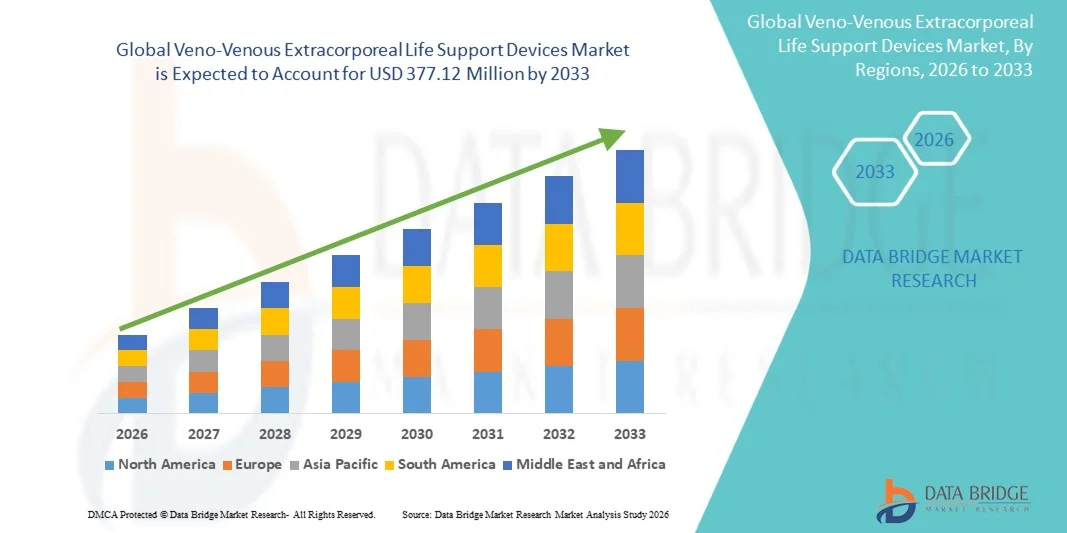
The Veno-Venous Extracorporeal Life Support Devices Market was valued at USD 255.25 million in 2025 and is projected to reach USD 377.12 million by 2033, growing at a CAGR of 5.00% from 2026 to 2033. The market is witnessing steady expansion driven by the rising incidence of severe acute respiratory failure, increasing cases of acute respiratory distress syndrome (ARDS), and growing adoption of advanced extracorporeal membrane oxygenation (ECMO)-based respiratory support systems in critical care settings
The growing need for advanced life-support interventions in patients unresponsive to conventional ventilation therapies is significantly boosting the adoption of veno-venous extracorporeal life support devices in hospitals and specialized cardiac and respiratory care centers. Technological advancements in oxygenator efficiency, biocompatible materials, and portable ECMO systems are enhancing clinical outcomes while reducing complications associated with long-duration extracorporeal support. In addition, increasing use of veno-venous extracorporeal life support in transplant support, infectious respiratory failure management, and emergency critical care transport is further accelerating market growth, alongside improving physician expertise and expanding clinical guidelines supporting early intervention strategies.
Key Market Trends & Insights
- North America dominated the Veno-Venous Extracorporeal Life Support Devices Market with the largest revenue share of 36.48% in 2025, supported by advanced ICU infrastructure, high ECMO adoption rates, and strong presence of leading critical care device manufacturers.
- The Single-Ventricular Device segment led the market with a 57.62% share in 2025, driven by its extensive use in veno-venous ECMO configurations for isolated respiratory failure management.
- Asia-Pacific is expected to be the fastest-growing region at a CAGR of 7.6% from 2026 to 2033, fueled by rising ICU capacity expansion, increasing incidence of severe respiratory failure cases, and growing adoption of ECMO programs in China, India, Japan, and South Korea.
- Biventricular Device are the fastest-growing type, projected to register a CAGR of 7.3%, reflecting the surge in clinical need for advanced cardiopulmonary support in complex multi-organ failure cases
- The Femoral Vein segment dominated the application category with a 44.18% revenue share in 2025, led by its ease of cannulation, rapid accessibility in emergency settings, and widespread use in ICU-based VV ECMO procedures
- Acute Respiratory Distress Syndrome deployment accounted for 46.85% of the market, preferred by its high global incidence and strong association with severe respiratory failure requiring extracorporeal support.
- The Lung Transplant Support segment is the fastest-growing indication category, with a CAGR of 7.5%, driven by the increasing demand for bridging strategies in end-stage lung disease patients.
Market Size & Forecast
- Global Market Value (2025): USD 255.25 Million
- Expected Market Value (2033): USD 377.12 Million
- Forecast CAGR (2026–2033): 5.00%
- Leading Region in 2025: North America
- Fastest Growing Region: Asia Pacific
Report Scope and Veno-Venous Extracorporeal Life Support Devices Market Segmentation
|
Attributes |
Veno-Venous Extracorporeal Life Support Devices Key Market Insights |
|
Segments Covered |
|
|
Countries Covered |
North America · U.S. · Canada · Mexico Europe · Germany · France · U.K. · Netherlands · Switzerland · Belgium · Russia · Italy · Spain · Turkey · Rest of Europe Asia-Pacific · China · Japan · India · South Korea · Singapore · Malaysia · Australia · Thailand · Indonesia · Philippines · Rest of Asia-Pacific Middle East and Africa · Saudi Arabia · U.A.E. · South Africa · Egypt · Israel · Rest of Middle East and Africa South America · Brazil · Argentina · Rest of South America |
|
Key Market Players |
· Getinge AB (Sweden) · LivaNova PLC (U.K.) · Medtronic (Ireland) · Terumo Corporation (Japan) · Eurosets S.r.l. (Italy) · Fresenius Medical Care AG (Germany) · Xenios AG (Germany) · MC3 Cardiopulmonary (U.S.) · Hemovent GmbH (Germany) · Spectrum Medical Ltd. (U.K.) · Braile Biomedica (Brazil) · NIPRO CORPORATION (Japan) · Abbott (U.S.) · Inspira Technologies Ltd. (Israel) · Resuscitec GmbH (Germany) · ALung Technologies (U.S.) · ZOLL Medical Corporation (U.S.) · Medos Medizintechnik GmbH (Germany) · Getinge Maquet Cardiopulmonary (Sweden) · Bioline Medical (Germany) |
|
Market Opportunities |
· Rising adoption of veno-venous extracorporeal life support devices in ARDS and post-viral respiratory failure cases · Growing demand for portable veno-venous extracorporeal life support devices systems is enabling rapid expansion of inter-hospital transport · Increasing integration of AI-driven perfusion monitoring and predictive anticoagulation management |
|
Value Added Data Infosets |
In addition to the insights on market scenarios such as market value, growth rate, segmentation, geographical coverage, and major players, the market reports curated by the Data Bridge Market Research also include in-depth expert analysis, patient epidemiology, pipeline analysis, pricing analysis, and regulatory framework. |
Veno-Venous Extracorporeal Life Support Devices Market Trends
Trend: Expansion of ECMO Use in Severe Respiratory Failure Care
Veno-venous extracorporeal life support adoption is steadily expanding in intensive care units as clinicians increasingly rely on extracorporeal membrane oxygenation for patients with severe acute respiratory failure and refractory ARDS who do not respond to conventional mechanical ventilation. This shift is being supported by improved clinical protocols, earlier intervention strategies, and growing physician familiarity with ECMO-based respiratory support in critical care environments. Technological improvements such as more efficient oxygenators, heparin-coated circuits, and compact pump systems are also improving safety and reducing complications during prolonged support. For instance, the widespread use of veno-venous extracorporeal life support during severe influenza outbreaks and COVID-19 associated respiratory failure cases across large tertiary hospitals demonstrates how rapidly ECMO has become an essential component of modern critical care respiratory management.
Veno-Venous Extracorporeal Life Support Devices Market Dynamics
Key Market Driver: Rising Burden of Acute Respiratory Distress Syndrome Cases
The increasing global burden of acute respiratory distress syndrome, severe pneumonia, and multi-factor respiratory failure is a major factor driving demand for veno-venous extracorporeal life support devices in advanced critical care settings. Patients with severe lung dysfunction often require extracorporeal support when traditional ventilation strategies fail to maintain adequate oxygenation and carbon dioxide removal. This has led to greater adoption of ECMO systems in ICUs, especially in tertiary care hospitals with specialized perfusion teams and advanced life-support infrastructure. In addition, improved survival outcomes in early ECMO initiation cases and expanding clinical evidence supporting veno-venous extracorporeal life support use are strengthening physician confidence. For instance, the growing application of ECMO therapy in post-viral lung injury and complex respiratory failure cases in high-volume critical care centers highlights the rising dependence on extracorporeal life support systems.
Key Restraint/Challenge: High Cost and Complex Operational Requirements of Veno-Venous Extracorporeal Life Support Devices
A significant restraint in the veno-venous extracorporeal life support devices market is the extremely high cost associated with system acquisition, installation, and long-term operation, which limits adoption across lower-resource healthcare settings. These systems require not only advanced capital equipment but also continuous consumables, anticoagulation drugs, and highly specialized maintenance, making the overall treatment pathway expensive. In addition, successful operation demands trained perfusionists, ICU specialists, and continuous patient monitoring, which creates workforce and infrastructure challenges for many hospitals. The complexity of managing complications such as bleeding, thrombosis, and infection further increases clinical burden and restricts widespread adoption. For instance, the concentration of ECMO programs in large academic hospitals and limited availability in smaller regional healthcare facilities highlights how cost and operational complexity remain key barriers to market expansion.
Key Market Opportunity: Integration of Portable and AI Assisted ECMO Platforms
The development of portable veno-venous extracorporeal life support systems combined with artificial intelligence driven monitoring platforms represents a major growth opportunity in the market. These advanced systems enable real-time tracking of oxygen delivery, blood flow dynamics, and anticoagulation levels, allowing clinicians to make faster and more accurate treatment decisions. AI integration also supports predictive analytics that can anticipate patient deterioration and optimize extracorporeal support parameters proactively. Furthermore, the emergence of compact, transportable ECMO devices is expanding their use beyond hospital ICUs into emergency transport services, military field medicine, and inter-hospital critical care transfer networks. For instance the increasing deployment of mobile ECMO teams for rapid patient stabilization and transfer between regional hospitals and tertiary care centers illustrates how portability and digital intelligence are reshaping the future of veno-venous extracorporeal life support adoption.
Veno-Venous Extracorporeal Life Support Devices Market Scope
The veno-venous extracorporeal life support devices market is segmented on the basis of type, application, indication, and end-user.
- By Type
On the basis of type, the Veno-Venous Extracorporeal Life Support Devices Market is segmented into single-ventricular device systems and biventricular device systems. The Single-Ventricular Device segment dominated the market with a 57.62% share in 2025, primarily due to its extensive use in veno-venous ECMO configurations for isolated respiratory failure management. These systems are widely preferred in ICU settings for treating ARDS and severe hypoxemia because they offer simpler setup, lower procedural complexity, and reduced priming volume compared to dual-support systems. Hospitals favor single-ventricular configurations due to faster deployment during emergencies and better compatibility with standard perfusion protocols. Continuous improvements in oxygenator efficiency and centrifugal pump technology are further enhancing performance reliability. Their lower cost relative to more complex configurations also supports broader adoption across tertiary care centers. However, their limitation lies in restricted cardiac support capability, which confines use primarily to respiratory-only failure cases.
The Biventricular Device segment is projected to register the fastest growth at a CAGR of 7.3% from 2026 to 2033, driven by rising clinical need for advanced cardiopulmonary support in complex multi-organ failure cases. These systems provide comprehensive support for both cardiac and respiratory dysfunction, making them increasingly relevant in critically ill patients with overlapping heart-lung failure conditions. Growing adoption in post-cardiac surgery recovery, transplant bridging, and severe septic shock cases is expanding their clinical utility. Technological advancements in integrated pump-oxygenator systems are improving safety and reducing operational complexity. Increasing availability of specialized ECMO centers is also supporting adoption. For instance, their rising use in tertiary cardiac ICUs for combined failure management highlights their expanding clinical relevance.
- By Application
On the basis of application, the Veno-Venous Extracorporeal Life Support Devices Market is segmented into femoral vein access, jugular vein access, right atrium access, and others. The Femoral Vein segment dominated the market with a 44.18% share in 2025, owing to its ease of cannulation, rapid accessibility in emergency settings, and widespread use in ICU-based VV ECMO procedures. Clinicians prefer femoral access due to its suitability in critically unstable patients where quick extracorporeal support initiation is essential. It allows relatively straightforward bedside insertion without complex imaging guidance in many cases. The approach is also widely supported in standardized ECMO protocols across major hospitals. However, limitations such as patient mobility restriction and infection risk during prolonged use remain key challenges. Despite these constraints, its reliability in emergency respiratory failure management continues to drive dominance.
The Jugular Vein segment is expected to witness the fastest growth at a CAGR of 7.1% from 2026 to 2033, driven by increasing preference for improved patient mobility, better cannula positioning, and enhanced oxygenation efficiency. Jugular access enables more stable blood flow dynamics and is often preferred in long-duration ECMO support cases. Growing use in awake ECMO strategies and early mobilization protocols in ICUs is further supporting adoption. Advancements in ultrasound-guided cannulation techniques are improving procedural success rates and safety. Increasing clinical emphasis on reducing immobilization-related complications is also driving demand. For instance, its growing use in prolonged respiratory failure cases requiring extended rehabilitation highlights its rising clinical importance.
- By Indication
On the basis of indication, the Veno-Venous Extracorporeal Life Support Devices Market is segmented into acute respiratory distress syndrome, severe pneumonia, COPD exacerbations, post-cardiac surgery respiratory failure, lung transplant support, and others. The Acute Respiratory Distress Syndrome segment dominated the market with a 46.85% share in 2025, driven by its high global incidence and strong association with severe respiratory failure requiring extracorporeal support. ARDS remains the most common indication for VV ECMO initiation in ICU settings, particularly in cases unresponsive to mechanical ventilation. Increasing cases linked to viral infections, sepsis, and pneumonia are further reinforcing demand. Strong clinical guidelines supporting early ECMO intervention are also improving adoption rates. Hospitals are increasingly integrating ARDS-specific ECMO protocols to improve survival outcomes. For instance, widespread use of VV ECLS in severe post-viral ARDS cases across tertiary care hospitals reflects its dominant clinical role.
The Lung Transplant Support segment is projected to register the fastest growth at a CAGR of 7.5% from 2026 to 2033, driven by increasing demand for bridging strategies in end-stage lung disease patients. Veno-venous extracorporeal life support is increasingly used to stabilize patients awaiting donor lungs, improving survival rates and transplant eligibility. Growing global lung transplant volumes and improved donor matching systems are supporting segment expansion. Technological advancements are enabling longer-duration extracorporeal support with fewer complications. Rising adoption of awake ECMO strategies is further improving patient outcomes during pre-transplant periods. For instance, its increasing use as a bridge-to-transplant therapy in advanced pulmonary fibrosis patients highlights its rapid clinical expansion.
- By End User
On the basis of end-user, the Veno-Venous Extracorporeal Life Support Devices Market is segmented into hospitals, clinics, and others. The Hospitals segment dominated the market with a 78.34% share in 2025, primarily due to the presence of advanced ICU infrastructure, specialized ECMO teams, and continuous monitoring capabilities required for VV ECLS therapy. Hospitals, especially tertiary and academic medical centers, handle the majority of critical respiratory failure cases requiring extracorporeal support. Availability of trained perfusionists and multidisciplinary critical care teams further strengthens adoption. High patient inflow and reimbursement support in developed healthcare systems also contribute to dominance. Continuous expansion of ICU capacity in emerging economies is further reinforcing hospital-based demand. For instance, large ECMO centers in major urban hospitals remain the primary hubs for veno-venous extracorporeal life support treatment globally.
The Clinics & Specialty Centers segment is expected to witness the fastest growth at a CAGR of 6.8% from 2026 to 2033, driven by decentralization of critical care services and expansion of specialized respiratory care units. These facilities are increasingly adopting compact and portable veno-venous extracorporeal life support systems for short- to medium-duration support cases. Growth is also supported by increasing referral networks between hospitals and specialty centers. Advancements in portable ECMO technology are enabling safer transfers and extended care outside traditional ICU environments. Rising demand for post-acute care and rehabilitation support is further accelerating adoption. For instance, the growing establishment of dedicated respiratory failure management centers highlights their expanding role in the extracorporeal life support ecosystem.
Veno-Venous Extracorporeal Life Support Devices Market Regional Analysis
North America dominated the Veno-Venous Extracorporeal Life Support Devices Market with the largest revenue share of 36.48% in 2025, supported by advanced ICU infrastructure, high ECMO adoption rates, and strong presence of leading critical care device manufacturers. The region also benefits from favorable reimbursement policies, well-established critical care networks, and increasing incidence of severe respiratory failure and ARDS cases requiring extracorporeal support. Rising investments in ECMO training programs, expanding hospital-based ECMO centers, and strong clinical acceptance of early VV ECLS intervention are further strengthening regional dominance. Increasing use of portable ECMO systems in emergency transport and transplant bridging applications continues to reinforce North America’s leadership position in the global market.
U.S. Veno-Venous Extracorporeal Life Support Devices Market Insight
The U.S. Veno-Venous Extracorporeal Life Support (VV ECLS) devices market is witnessing strong growth due to rising incidence of acute respiratory failure, high adoption of ECMO-based respiratory support systems, and advanced ICU infrastructure across major hospitals. The country’s mature critical care ecosystem, strong presence of leading medical device manufacturers, and favorable reimbursement environment are driving demand across tertiary care and academic medical centers. In addition, increasing use of VV ECLS in ARDS management, transplant bridging, and post-surgical respiratory support is accelerating adoption. Growing investment in ECMO training programs, expansion of mobile ECMO teams, and integration of advanced monitoring technologies are further strengthening market growth in the U.S.
Europe Veno-Venous Extracorporeal Life Support Devices Market Insight
The Europe Veno-Venous Extracorporeal Life Support (VV ECLS) devices market remains a major contributor to global revenue, driven by strong clinical adoption of extracorporeal life support therapies and well-established intensive care infrastructure. Widespread use of ECMO in severe ARDS cases, post-cardiac surgery complications, and infectious respiratory failure is supporting regional demand. Increasing investments in ICU modernization, strong emphasis on early ECMO initiation, and high awareness of advanced critical care protocols are further strengthening adoption. In addition, presence of specialized ECMO centers, multidisciplinary perfusion teams, and growing integration of biocompatible circuits and AI-assisted monitoring systems continue to enhance market expansion across Europe.
U.K. Veno-Venous Extracorporeal Life Support Devices Market Insight
The United Kingdom Veno-Venous Extracorporeal Life Support (VV ECLS) devices market is experiencing steady growth, supported by increasing adoption of ECMO in specialized critical care units, transplant programs, and emergency respiratory support services. Expansion of national ECMO networks and growing government focus on strengthening intensive care capacity are contributing to market development. Rising use of portable VV ECLS systems for inter-hospital transfer and emergency stabilization is further driving adoption. In addition, improving clinical expertise, expanding training programs for perfusion specialists, and increasing application in severe ARDS and post-viral respiratory failure cases are positioning the U.K. as an important regional market.
Germany Veno-Venous Extracorporeal Life Support Devices Market Insight
The Germany Veno-Venous Extracorporeal Life Support (VV ECLS) devices market is expanding steadily due to strong hospital infrastructure, advanced ICU capabilities, and high adoption of ECMO in complex respiratory and cardiopulmonary failure cases. Leading university hospitals and cardiac centers are increasingly utilizing VV ECLS for ARDS management, post-surgical support, and lung transplant bridging applications. Continuous advancements in oxygenator efficiency, centrifugal pump systems, and biocompatible circuits are improving clinical outcomes. Furthermore, strong emphasis on medical innovation, intensive care research, and government support for advanced healthcare technologies is further driving market growth in Germany.
Asia-Pacific Veno-Venous Extracorporeal Life Support Devices Market Insight
The Asia-Pacific Veno-Venous Extracorporeal Life Support (VV ECLS) devices market is expected to witness rapid growth, driven by rising burden of severe respiratory diseases, expanding ICU infrastructure, and increasing adoption of ECMO in tertiary hospitals. Growing investments in critical care modernization, rising awareness among clinicians, and improving access to advanced life-support technologies are supporting regional expansion. In addition, increasing healthcare expenditure, expansion of specialized ECMO centers, and growing availability of trained perfusion staff are accelerating adoption. Rising use of VV ECLS in infectious respiratory failure and transplant support cases is further positioning Asia-Pacific as the fastest-growing regional market globally.
Japan Veno-Venous Extracorporeal Life Support Devices Market Insight
The Japan Veno-Venous Extracorporeal Life Support (VV ECLS) devices market is witnessing consistent growth due to advanced healthcare infrastructure, strong critical care systems, and increasing use of ECMO in severe respiratory failure and post-surgical management. Leading hospitals and research institutes are adopting high-precision extracorporeal life support technologies to improve patient outcomes in ARDS and complex respiratory conditions. Continuous innovation in compact ECMO systems, biocompatible materials, and real-time monitoring solutions is further enhancing adoption. In addition, Japan’s strong focus on high-quality healthcare delivery and efficient critical care management is contributing to steady market expansion.
China Veno-Venous Extracorporeal Life Support Devices Market Insight
The China Veno-Venous Extracorporeal Life Support (VV ECLS) devices market is growing rapidly, driven by increasing incidence of respiratory diseases, expanding ICU capacity, and strong government support for critical care infrastructure development. Rapid adoption of ECMO systems in large tertiary hospitals is supporting market expansion, particularly in severe pneumonia and ARDS treatment. Growing investment in domestic medical device manufacturing, increasing clinical training programs, and wider availability of advanced life-support technologies are further accelerating adoption. In addition, rising demand for portable ECMO systems in emergency transport and inter-hospital transfer applications is positioning China as one of the fastest-growing markets globally.
Veno-Venous Extracorporeal Life Support Devices Market Share
The veno-venous extracorporeal life support devices industry is primarily led by well-established companies, including:
- Getinge AB (Sweden)
- LivaNova PLC (U.K.)
- Medtronic (Ireland)
- Terumo Corporation (Japan)
- Eurosets S.r.l. (Italy)
- Fresenius Medical Care AG (Germany)
- Xenios AG (Germany)
- MC3 Cardiopulmonary (U.S.)
- Hemovent GmbH (Germany)
- Spectrum Medical Ltd. (U.K.)
- Braile Biomedica (Brazil)
- NIPRO CORPORATION (Japan)
- Abbott (U.S.)
- Inspira Technologies Ltd. (Israel)
- Resuscitec GmbH (Germany)
- ALung Technologies (U.S.)
- ZOLL Medical Corporation (U.S.)
- Medos Medizintechnik GmbH (Germany)
- Getinge Maquet Cardiopulmonary (Sweden)
- Bioline Medical (Germany)
Latest Developments in Veno-Venous Extracorporeal Life Support Devices Market
- In January 2025, the FDA expanded investigational use authorization for SeaStar Medical’s Selective Cytopheretic Device for critically ill patients requiring extracorporeal support strategies, reflecting ongoing innovation in combining blood purification and VV ECMO systems to improve outcomes in severe multi-organ failure cases
- In April 2024, the FDA also issued a Class I recall for Abbott’s HeartMate II and HeartMate 3 ventricular assist systems due to obstruction risks from biological material buildup, highlighting broader safety concerns across extracorporeal and circulatory support technologies used in critical care environments
- In May 2024, the FDA reiterated ongoing safety oversight for ECMO oxygenators and extracorporeal circulation devices, particularly emphasizing quality and packaging integrity issues associated with certain manufacturers, reinforcing the need for improved compliance and monitoring across VV ECLS systems
- In October 2023, Mc3 Inc. recalled its Nautilus ECMO Oxygenator and Smart ECMO Module after identifying heat exchanger performance issues that could impair temperature regulation during ECMO therapy, prompting FDA classification as a Class II recall due to moderate patient risk
- In June 2023, the U.S. FDA issued a safety communication regarding a recall of Getinge/Maquet ECMO oxygenators used in extracorporeal circulation systems due to potential sterility concerns in packaging, which could increase infection risks during VV ECMO procedures. The agency advised healthcare providers to transition to alternative oxygenators and reinforced the importance of strict post-market surveillance for extracorporeal life support devices

- Interactive Data Analysis Dashboard
- Company Analysis Dashboard for high growth potential opportunities
- Research Analyst Access for customization & queries
- Competitor Analysis with Interactive dashboard
- Latest News, Updates & Trend analysis
- Harness the Power of Benchmark Analysis for Comprehensive Competitor Tracking
Data collection and base year analysis are done using data collection modules with large sample sizes. The stage includes obtaining market information or related data through various sources and strategies. It includes examining and planning all the data acquired from the past in advance. It likewise envelops the examination of information inconsistencies seen across different information sources. The market data is analysed and estimated using market statistical and coherent models. Also, market share analysis and key trend analysis are the major success factors in the market report. To know more, please request an analyst call or drop down your inquiry.
The key research methodology used by DBMR research team is data triangulation which involves data mining, analysis of the impact of data variables on the market and primary (industry expert) validation. Data models include Vendor Positioning Grid, Market Time Line Analysis, Market Overview and Guide, Company Positioning Grid, Patent Analysis, Pricing Analysis, Company Market Share Analysis, Standards of Measurement, Global versus Regional and Vendor Share Analysis. To know more about the research methodology, drop in an inquiry to speak to our industry experts.
Data Bridge Market Research is a leader in advanced formative research. We take pride in servicing our existing and new customers with data and analysis that match and suits their goal. The report can be customized to include price trend analysis of target brands understanding the market for additional countries (ask for the list of countries), clinical trial results data, literature review, refurbished market and product base analysis. Market analysis of target competitors can be analyzed from technology-based analysis to market portfolio strategies. We can add as many competitors that you require data about in the format and data style you are looking for. Our team of analysts can also provide you data in crude raw excel files pivot tables (Fact book) or can assist you in creating presentations from the data sets available in the report.













