


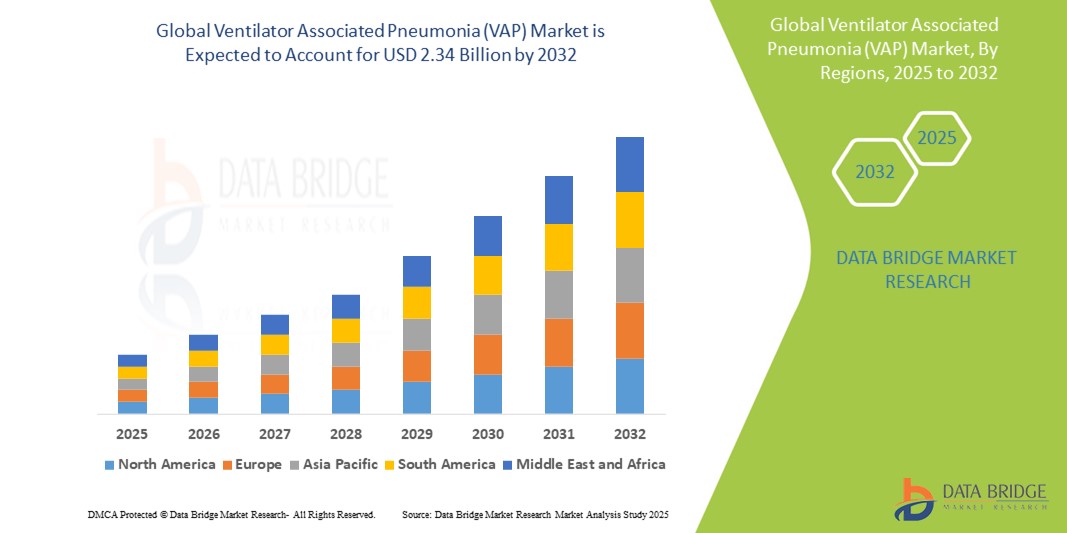
Ventilator Associated Pneumonia (VAP) Market Size
- The global ventilator associated pneumonia (VAP) market size was valued at USD 1.44 billion in 2024 and is expected to reach USD 2.34 billion by 2032, at a CAGR of 6.22% during the forecast period
- This growth is driven by factors such as rising incidence of hospital-acquired infections and ICU admissions and advancements in preventive and diagnostic technologies
Ventilator Associated Pneumonia (VAP) Market Analysis
- Ventilator Associated Pneumonia (VAP) is a type of hospital-acquired infection that occurs in patients who have been mechanically ventilated for more than 48 hours. It is characterized by inflammation and infection in the lung parenchyma and is often caused by multidrug-resistant pathogens, making it a critical concern in intensive care units (ICUs)
- The global ventilator associated pneumonia market is witnessing steady growth, driven by the rising incidence of ICU admissions, increasing use of mechanical ventilation, and the growing burden of multidrug-resistant organisms. With healthcare systems placing greater emphasis on infection control, there's heightened demand for advanced diagnostic tools, effective antibiotics, and preventive devices such as antimicrobial-coated endotracheal tubes
- North America is expected to dominate the ventilator associated pneumonia (VAP) market, with a market share of approximately 40.8% in 2025, driven by its advanced healthcare infrastructure, widespread use of mechanical ventilation in intensive care units (ICUs), and strong emphasis on infection control protocols
- Asia-Pacific is expected to be the fastest growing region in the global ventilator associated pneumonia (VAP) market, with a projected market share of approximately 23.2% in 2025, driven by the rapid expansion of healthcare infrastructure, increasing incidences of pneumonia, and growing demand for ventilator-associated pneumonia prevention and treatment options
- Mechanical ventilators segment is expected to dominate the market with a market share of 62.5% in 2025. This dominance is attributed to the critical role mechanical ventilators play in intensive care units (ICUs) for managing patients with severe respiratory conditions
Report Scope and Ventilator Associated Pneumonia (VAP) Market Segmentation
|
Attributes |
Ventilator Associated Pneumonia (VAP) Key Market Insights |
|
Segments Covered |
|
|
Countries Covered |
North America
Europe
Asia-Pacific
Middle East and Africa
South America
|
|
Key Market Players |
|
|
Market Opportunities |
|
|
Value Added Data Infosets |
In addition to the insights on market scenarios such as market value, growth rate, segmentation, geographical coverage, and major players, the market reports curated by the Data Bridge Market Research also include import export analysis, production capacity overview, production consumption analysis, price trend analysis, climate change scenario, supply chain analysis, value chain analysis, raw material/consumables overview, vendor selection criteria, PESTLE Analysis, Porter Analysis, and regulatory framework. |
Ventilator Associated Pneumonia (VAP) Market Trends
“Increasing Adoption of Preventive Technologies”
- One prominent trend in the ventilator associated pneumonia (VAP) market is the increasing adoption of preventive technologies such as silver-coated and antimicrobial endotracheal tubes (ETTs)
- These innovations are designed to reduce bacterial colonization and biofilm formation in mechanically ventilated patients, thereby minimizing the risk of infection
- For instance, studies have shown that silver-coated ETTs can significantly delay the onset of VAP and reduce microbial load, leading to fewer complications and shorter ICU stays. Hospitals are increasingly incorporating these tubes as a standard preventive measure, especially for high-risk patients
- These advancements are reshaping infection control protocols in critical care settings, improving patient outcomes, and driving demand for next-generation devices that focus on prevention and early intervention in ventilator-associated infections
Ventilator Associated Pneumonia (VAP) Market Dynamics
Driver
“Rising Incidence of Hospital-Acquired Infections and ICU Admissions”
- The increasing number of patients requiring mechanical ventilation in intensive care units (ICUs) has significantly contributed to the rising prevalence of ventilator associated pneumonia (VAP)
- Hospital-acquired infections (HAIs), particularly VAP, have become a major concern due to their impact on patient morbidity, mortality, and healthcare costs
- With the global aging population and rising chronic disease burden, ICU admissions are increasing, thereby elevating the risk of VAP among ventilated patients
For instance,
- According to a 2023 WHO report, approximately 10% of hospitalized patients in low- and middle-income countries and 7% in high-income countries acquire at least one healthcare-associated infection, with VAP being one of the most common among ICU patients
- As a result, there is a growing demand for effective preventive and therapeutic solutions to manage VAP and improve patient outcomes
Opportunity
“Innovations in Diagnostic Technologies for Early Detection”
- Advancements in molecular diagnostics, biomarker testing, and rapid microbiological methods are enabling earlier and more accurate detection of VAP
- Quick and precise identification of causative pathogens can significantly improve antibiotic stewardship and patient recovery times
- The integration of artificial intelligence and machine learning in clinical diagnostics also aids in identifying at-risk patients and predicting infection progression
For instance,
- In February 2024, a study published in The Lancet Respiratory Medicine highlighted that AI-based predictive algorithms could identify VAP development 48 hours in advance with over 85% accuracy, allowing timely intervention
- These technological innovations present lucrative opportunities for diagnostics companies and hospitals to improve clinical outcomes and reduce VAP-related complications
Restraint/Challenge
“Antibiotic Resistance Complicating Treatment Protocols”
- The growing prevalence of multidrug-resistant (MDR) bacteria is one of the biggest challenges in the effective treatment of VAP
- Patients with prolonged ventilation are often exposed to broad-spectrum antibiotics, which increases resistance development and limits treatment options
- Inadequate or delayed treatment due to resistant pathogens can lead to longer ICU stays, increased mortality, and elevated healthcare costs
For instance,
- According to the CDC’s 2023 Antibiotic Resistance Threats Report, over 2.8 million antibiotic-resistant infections occur in the U.S. each year, with VAP being a major contributor among ICU cases
- This challenge underscores the need for targeted therapies, robust antimicrobial stewardship programs, and continuous surveillance of resistance patterns to ensure effective management of VAP
Ventilator Associated Pneumonia (VAP) Market Scope
The market is segmented on the basis of product type, cause of infection, end-user, antibiotic resistance and administration setting
|
Segmentation |
Sub-Segmentation |
|
By Product Type |
|
|
By Cause of Infection |
|
|
By End-User |
|
|
By Antibiotic Resistance |
|
|
By Administration Setting |
|
In 2025, the mechanical ventilators is projected to dominate the market with a largest share in product type segment
The mechanical ventilators segment is expected to dominate the ventilator-associated pneumonia (VAP) market with the largest share of approximately 62.5% in 2025. This dominance is attributed to the critical role mechanical ventilators play in intensive care units (ICUs) for managing patients with severe respiratory conditions. Prolonged use of mechanical ventilation significantly increases the risk of VAP, thereby driving the demand for preventive and therapeutic interventions in this segment.
The bacterial VAP is expected to account for the largest share during the forecast period in cause of infection segment
In 2025, the bacterial VAP segment is expected to dominate the ventilator-associated pneumonia (VAP) market with the largest market share of approximately 59.4% due to its high prevalence among ICU patients receiving prolonged mechanical ventilation. As the most common cause of VAP, bacterial pathogens such as Pseudomonas aeruginosa, Staphylococcus aureus, and Klebsiella pneumoniae are frequently isolated in clinical settings, necessitating targeted antimicrobial therapies. The increased risk of multidrug-resistant (MDR) bacterial infections further drives the demand for advanced diagnostics and effective treatment regimens.
Ventilator Associated Pneumonia (VAP) Market Regional Analysis
“North America Holds the Largest Share in the Ventilator Associated Pneumonia (VAP) Market”
- North America dominates the ventilator associated pneumonia (VAP) market, with a market share of approximately 40.8% in 2025, driven by its advanced healthcare infrastructure, widespread use of mechanical ventilation in intensive care units (ICUs), and strong emphasis on infection control protocols
- U.S. contributes the largest share with 65.2% in the region due to its high number of ICU beds, greater adoption of technologically advanced ventilators and accessories, and a proactive approach to hospital-acquired infection (HAI) management
- Supportive government regulations and reimbursement policies further aid in early diagnosis and prompt treatment of VAP, ensuring better patient outcomes
- Moreover, ongoing research and the presence of key players investing in antimicrobial-coated devices and rapid diagnostic tools enhance North America's dominance in the VAP market
“Asia-Pacific is Projected to Register the Highest CAGR in the Ventilator Associated Pneumonia (VAP) Market”
- Asia-Pacific is expected to witness the highest growth rate in the global ventilator associated pneumonia (VAP) market, with a projected market share of approximately 23.2% in 2025, driven by the rapid expansion of healthcare infrastructure, increasing incidences of pneumonia, and growing demand for ventilator-associated pneumonia prevention and treatment options
- Countries such as China, India, and Japan are emerging as key markets due to increasing healthcare expenditures, the growing burden of respiratory diseases, and expanding access to critical care facilities equipped with mechanical ventilators and associated treatments
- Japan remains a leading market, supported by its advanced healthcare system, high standards of patient care, and comprehensive infection control measures in intensive care units (ICUs). Japan's focus on improving patient safety and infection prevention, including VAP, further drives the market for VAP treatments
- India is expected to register the highest CAGR in the VAP market with a projected market share of 5.5% by 2025, driven by the expanding healthcare infrastructure, rising incidence of respiratory conditions, and government initiatives to improve access to critical care services
Ventilator Associated Pneumonia (VAP) Market Share
The market competitive landscape provides details by competitor. Details included are company overview, company financials, revenue generated, market potential, investment in research and development, new market initiatives, global presence, production sites and facilities, production capacities, company strengths and weaknesses, product launch, product width and breadth, application dominance. The above data points provided are only related to the companies' focus related to market.
The Major Market Leaders Operating in the Market Are:
- AstraZeneca (U.K.)
- Aridis Pharmaceuticals Inc. (U.S.)
- Bayer AG (Germany)
- Baxter (U.S.)
- GE HealthCare (U.S.)
- Koninklijke Philips N.V. (Netherlands)
- Laboratory Corporation of America Holdings (U.S.)
- Medtronic (Ireland)
- ResMed (U.S.)
- Teleflex Incorporated (U.S.)
- Shionogi & Co., Ltd. (Japan)
- Wockhardt Limited (India)
Latest Developments in Global Ventilator Associated Pneumonia (VAP) Market
- In July 2024, Viromed Medical AG initiated a second groundbreaking study to explore the use of cold plasma in preventing ventilator-associated pneumonia (VAP). The study, aims to secure expedited special approval for the PulmoPlas device, developed by Viromed, for this innovative preventive treatment in Germany and the USA

- Interactive Data Analysis Dashboard
- Company Analysis Dashboard for high growth potential opportunities
- Research Analyst Access for customization & queries
- Competitor Analysis with Interactive dashboard
- Latest News, Updates & Trend analysis
- Harness the Power of Benchmark Analysis for Comprehensive Competitor Tracking
Data collection and base year analysis are done using data collection modules with large sample sizes. The stage includes obtaining market information or related data through various sources and strategies. It includes examining and planning all the data acquired from the past in advance. It likewise envelops the examination of information inconsistencies seen across different information sources. The market data is analysed and estimated using market statistical and coherent models. Also, market share analysis and key trend analysis are the major success factors in the market report. To know more, please request an analyst call or drop down your inquiry.
The key research methodology used by DBMR research team is data triangulation which involves data mining, analysis of the impact of data variables on the market and primary (industry expert) validation. Data models include Vendor Positioning Grid, Market Time Line Analysis, Market Overview and Guide, Company Positioning Grid, Patent Analysis, Pricing Analysis, Company Market Share Analysis, Standards of Measurement, Global versus Regional and Vendor Share Analysis. To know more about the research methodology, drop in an inquiry to speak to our industry experts.
Data Bridge Market Research is a leader in advanced formative research. We take pride in servicing our existing and new customers with data and analysis that match and suits their goal. The report can be customized to include price trend analysis of target brands understanding the market for additional countries (ask for the list of countries), clinical trial results data, literature review, refurbished market and product base analysis. Market analysis of target competitors can be analyzed from technology-based analysis to market portfolio strategies. We can add as many competitors that you require data about in the format and data style you are looking for. Our team of analysts can also provide you data in crude raw excel files pivot tables (Fact book) or can assist you in creating presentations from the data sets available in the report.













