What is the Vermicompost Market Size and Growth Rate?
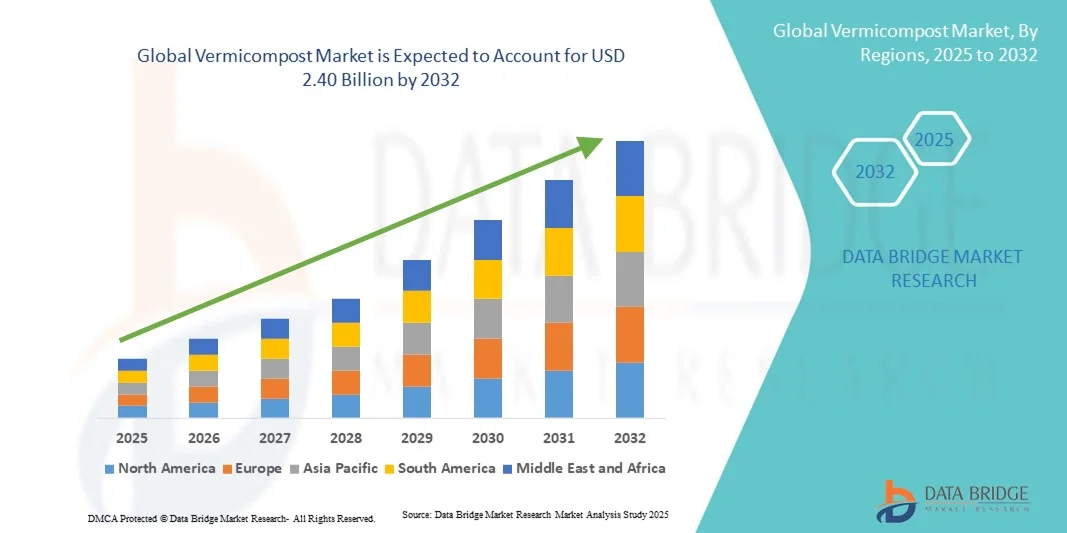
- As per Data Bridge Market Research Analysis the global vermicompost market size was valued at USD 1.49 billion in 2024 and is expected to reach USD 2.40 billion by 2032, at a CAGR of 6.1% during the forecast period
- The market growth is largely fuelled by the increasing adoption of organic farming practices, growing awareness about sustainable agriculture, and the rising demand for eco-friendly soil enhancers
- Expansion of horticulture and commercial crop production globally is further supporting the demand for nutrient-rich vermicompost as a natural fertilizer
Market Size & Forecast
- Global Market Value (2024): USD 1.49 Billion
- Expected Market Value (2032): USD 2.40 Billion
- Forecast CAGR (2025–2032): 6.1%
Vermicompost Market Analysis
- The nutrient-rich and eco-friendly nature of vermicompost makes it highly preferred among farmers, gardeners, and commercial growers, driving steady adoption across regions
- Technological advancements in vermicomposting processes, including automated systems and large-scale production facilities, are improving efficiency and quality, further boosting market growth
- Asia-Pacific dominated the vermicompost market with the largest revenue share of 42% in 2024, driven by increasing adoption of organic and sustainable farming practices, rapid urbanization, and strong government initiatives promoting organic fertilizers
- North America region is expected to witness the highest growth rate in the global vermicompost market, driven by technological advancements in composting, awareness campaigns on eco-friendly agriculture, and expanding demand for organic fertilizers across commercial and residential sectors
- The Lumbricus Rebellus segment held the largest market revenue share in 2024, driven by its high efficiency in decomposing organic waste and producing nutrient-rich compost suitable for a wide variety of crops. This type of vermicompost is widely preferred for its balanced nutrient profile and ability to improve soil structure and fertility
Report Scope and Vermicompost Market Segmentation
|
Attributes |
Vermicompost Key Market Insights |
|
Segments Covered |
|
|
Countries Covered |
North America
Europe
Asia-Pacific
Middle East and Africa
South America
|
|
Key Market Players |
|
|
Market Opportunities |
|
|
Value Added Data Infosets |
In addition to the insights on market scenarios such as market value, growth rate, segmentation, geographical coverage, and major players, the market reports curated by the Data Bridge Market Research also include import export analysis, production capacity overview, production consumption analysis, price trend analysis, climate change scenario, supply chain analysis, value chain analysis, raw material/consumables overview, vendor selection criteria, PESTLE Analysis, Porter Analysis, and regulatory framework. |
What is the Key Trend in the Vermicompost Market?
Growing Adoption of Organic and Sustainable Farming Practices
- The rising shift toward organic farming is transforming the agriculture sector by encouraging the use of vermicompost as a natural fertilizer. Vermicompost enhances soil fertility, improves crop yields, and reduces dependency on chemical fertilizers, supporting sustainable agricultural practices. The increasing interest in regenerative agriculture is further driving adoption as farmers seek long-term soil health solutions
- The increasing awareness of environmental sustainability and soil health is accelerating the adoption of vermicompost among smallholder farmers and large commercial farms alike. These organic fertilizers provide long-term benefits such as improved water retention and nutrient cycling. In additionally, they help reduce soil erosion and restore microbial diversity, creating more resilient farming systems
- The demand for high-quality, nutrient-rich vermicompost is also growing in horticulture, floriculture, and greenhouse cultivation, where precision nutrient management is critical for crop quality and yield. Its use supports faster plant growth, uniform crop maturation, and higher-quality produce, making it essential for premium markets
- For instance, in 2023, several European greenhouse operators reported improved crop yields and reduced chemical fertilizer use after implementing large-scale vermicompost programs. The use of vermicompost contributed to healthier plants, enhanced soil microbiome activity, and reduced environmental impact. Furthermore, it helped these operators achieve sustainability certifications, enhancing market credibility
- While adoption is growing, the market’s expansion relies on consistent quality standards, supply chain efficiency, and continued farmer education regarding the benefits of vermicompost. Ongoing research and innovation in vermicomposting techniques will also play a critical role in ensuring scalability and effectiveness
Vermicompost Market Dynamics
Driver
Increasing Awareness About Soil Health and Organic Farming Benefits
- The growing focus on soil health and sustainable agriculture is driving farmers and commercial growers to adopt vermicompost as an eco-friendly and nutrient-rich fertilizer. Its ability to enhance crop productivity while maintaining soil fertility makes it a preferred choice globally. The trend is further fueled by the increasing emphasis on climate-resilient agriculture practices
- Governments and NGOs are promoting organic farming initiatives, providing subsidies and training programs to encourage the use of vermicompost, especially in regions affected by soil degradation. Public-private partnerships are also helping scale production and distribution networks to reach underserved areas
- The rising consumer demand for chemical-free and organic produce is further fueling adoption, as farmers are incentivized to use vermicompost to meet market standards. This trend is particularly strong in export-driven agriculture, where compliance with organic certifications is mandatory
- For instance, in 2022, India’s Ministry of Agriculture launched awareness campaigns and subsidized vermicompost production units, resulting in increased adoption among small and mid-sized farms. Similar programs in Southeast Asia and Africa are expected to replicate this positive growth trajectory
- While favorable policies and environmental awareness are driving growth, efficient distribution networks and education on proper vermicompost application are key to sustained market adoption. Investment in farmer training programs and demonstration farms can further accelerate market penetration
Restraint/Challeng
High Production Costs and Limited Availability in Certain Regions
- The cost of large-scale vermicompost production, including labor, organic feedstock, and processing infrastructure, remains a major barrier for small and mid-sized farmers. High production costs limit accessibility and can discourage widespread adoption. Economies of scale are often difficult to achieve for decentralized or smallholder operations
- In many rural and developing regions, lack of proper infrastructure and logistics for distribution restricts the consistent availability of high-quality vermicompost, reducing market penetration. Seasonal variability in organic waste feedstock can also impact production reliability
- Farmers in remote areas often rely on traditional fertilizers due to easier accessibility and lower upfront costs, which can hinder the shift toward organic alternatives. Moreover, limited awareness about the long-term benefits of vermicompost reduces willingness to invest in higher-quality organic fertilizers
- For instance, in 2023, surveys in Sub-Saharan Africa indicated that over 60% of small-scale farmers lacked access to commercially produced vermicompost due to supply chain gaps and high costs. This situation highlights the need for localized production units and community-level composting programs
- While technological improvements and decentralized production units can mitigate these issues, addressing cost and availability challenges is essential for long-term market growth. Public-private collaborations, subsidies, and innovation in processing techniques are key strategies to overcome these barriers
Vermicompost Market Scope
The market is segmented on the basis of product type and application.
- By Product
On the basis of product type, the vermicompost market is segmented into Lumbricus Rebellus Vermicomposting, African Night Crawlers Vermicomposting, and Others. The Lumbricus Rebellus segment held the largest market revenue share in 2024, driven by its high efficiency in decomposing organic waste and producing nutrient-rich compost suitable for a wide variety of crops. This type of vermicompost is widely preferred for its balanced nutrient profile and ability to improve soil structure and fertility.
The African Night Crawlers segment is expected to witness the fastest growth rate from 2025 to 2032, fueled by its rapid reproduction rate, high adaptability to diverse climates, and superior composting performance. These worms are particularly popular among smallholder farmers and commercial horticulture operations seeking faster production cycles and high-quality organic fertilizer.
- By Application
On the basis of application, the vermicompost market is segmented into Home Gardening, Horticulture, Golf Courses, and Landscaping. The horticulture segment held the largest share in 2024, owing to the increasing adoption of organic fertilizers in greenhouses, nurseries, and commercial crop cultivation. Vermicompost enhances crop quality, supports sustainable farming practices, and is highly preferred for high-value crops.
The home gardening segment is expected to witness the fastest growth rate from 2025 to 2032, driven by rising urbanization, growing awareness of eco-friendly gardening practices, and the popularity of organic produce among households. Its ease of use, safety, and ability to improve soil health make it an attractive solution for individual gardeners and urban farming initiatives.
Vermicompost Market Regional Analysis
- Asia-Pacific dominated the vermicompost market with the largest revenue share of 42% in 2024, driven by increasing adoption of organic and sustainable farming practices, rapid urbanization, and strong government initiatives promoting organic fertilizers
- Farmers and horticulture operators in the region highly value vermicompost for improving soil fertility, enhancing crop yields, and supporting sustainable agricultural practices
- This widespread adoption is further supported by growing consumer demand for chemical-free food, development of local production units, and expansion of distribution networks, making vermicompost a preferred choice across both smallholder and commercial farms
China Vermicompost Market Insight
The China vermicompost market accounted for a major share in the Asia-Pacific region in 2024, owing to the country’s focus on organic farming initiatives, large-scale adoption in horticulture and landscaping, and rising demand for chemical-free crops. Technological advancements in vermicomposting, coupled with local production and distribution networks, are improving accessibility and efficiency. Growing consumer awareness regarding sustainability and eco-friendly agricultural practices is further driving market growth.
Japan Vermicompost Market Insight
The Japan vermicompost market is expected to witness the fastest growth rate from 2025 to 2032, driven by increasing urban agriculture, greenhouse cultivation, and home gardening activities. Farmers and residential users are adopting vermicompost for its high nutrient content, soil fertility enhancement, and environmental benefits. Government campaigns promoting organic fertilizers and local production units are supporting long-term market growth.
Europe Vermicompost Market Insight
The Europe vermicompost market is expected to witness the fastest growth rate from 2025 to 2032, fueled by the adoption of organic farming practices, sustainability initiatives, and regulatory support for soil health improvement. Countries such as Germany and the U.K. are incorporating vermicompost in horticulture, landscaping, and greenhouse cultivation. Consumer preference for organic and chemical-free produce is encouraging market expansion.
Germany Vermicompost Market Insight
The Germany vermicompost market is expected to witness the fastest growth rate from 2025 to 2032, driven by well-established organic farming regulations, strong agricultural infrastructure, and increasing awareness of sustainable fertilizers. Farmers are increasingly using vermicompost in horticulture and landscaping to improve soil fertility and crop quality. Technological improvements in vermicomposting are further supporting market growth.
U.K. Vermicompost Market Insight
The U.K. vermicompost market is expected to witness the fastest growth rate from 2025 to 2032 due to rising awareness about soil degradation, increasing adoption of home gardening and landscaping, and government-led organic farming programs. Both commercial and residential users are incorporating vermicompost to enhance plant health and improve soil productivity. Expansion of distribution channels and retail availability are further encouraging adoption.
North America Vermicompost Market Insight
The North America vermicompost market is expected to witness the fastest growth rate from 2025 to 2032, supported by the growing popularity of organic farming, urban gardening, and landscaping applications. In the U.S., farmers and gardeners prefer vermicompost for its nutrient-rich properties and environmental benefits. Awareness campaigns, availability of high-quality vermicompost, and consumer demand for chemical-free produce are further driving adoption.
Vermicompost Market Share
The Vermicompost industry is primarily led by well-established companies, including:
- MyNOKE (U.S.)
- Suman Vermi Compost (India)
- Agrilife (U.K.)
- Oxygen Theme (India)
- Davo’s Worm Farms (U.S.)
- Saosis Biotech Private Limited (India)
- WORM POWER (U.S.)
- Dirt Dynasty L.L.C. (U.S.)
- Black Diamond VermiCompost (U.S.)
- Kahariam Reality and Farms (India)
- NutriSoil (U.S.)
- Sri Gayathri Biotec (India)
- Citizen Communications, LLC (U.S.)
Latest Developments in Global Vermicompost Market
- In February 2024, researchers at IIT-Guwahati (India) developed a two-stage biodegradation technique aimed at enhancing organic waste management for municipal corporations and governing bodies. This innovation enables the production of high-quality vermicompost and organic compost enriched with essential nutrients such as nitrogen, phosphorus, and potassium (NPK), along with key micronutrients. The method not only supports sustainable waste recycling but also provides farmers with nutrient-rich soil amendments, boosting crop productivity and promoting eco-friendly agricultural practices. The advancement is expected to strengthen the adoption of vermicompost solutions across urban and rural farming sectors
- In April 2023, East-West Seed Knowledge Transfer Foundation (Bangladesh) implemented a vermicompost production initiative under the Smart Farming, Healthy Food project. The program encouraged farmers to utilize organic inputs such as vermicompost and organic mulch to improve soil health and environmental sustainability. Within the first eight months, 14 vermicompost operations collectively produced 2,818 kilograms of organic fertilizer. This initiative has enhanced farmer engagement in sustainable farming, increased awareness of organic soil amendments, and contributed to the growth of the regional vermicompost market

- Interactive Data Analysis Dashboard
- Company Analysis Dashboard for high growth potential opportunities
- Research Analyst Access for customization & queries
- Competitor Analysis with Interactive dashboard
- Latest News, Updates & Trend analysis
- Harness the Power of Benchmark Analysis for Comprehensive Competitor Tracking
Data collection and base year analysis are done using data collection modules with large sample sizes. The stage includes obtaining market information or related data through various sources and strategies. It includes examining and planning all the data acquired from the past in advance. It likewise envelops the examination of information inconsistencies seen across different information sources. The market data is analysed and estimated using market statistical and coherent models. Also, market share analysis and key trend analysis are the major success factors in the market report. To know more, please request an analyst call or drop down your inquiry.
The key research methodology used by DBMR research team is data triangulation which involves data mining, analysis of the impact of data variables on the market and primary (industry expert) validation. Data models include Vendor Positioning Grid, Market Time Line Analysis, Market Overview and Guide, Company Positioning Grid, Patent Analysis, Pricing Analysis, Company Market Share Analysis, Standards of Measurement, Global versus Regional and Vendor Share Analysis. To know more about the research methodology, drop in an inquiry to speak to our industry experts.
Data Bridge Market Research is a leader in advanced formative research. We take pride in servicing our existing and new customers with data and analysis that match and suits their goal. The report can be customized to include price trend analysis of target brands understanding the market for additional countries (ask for the list of countries), clinical trial results data, literature review, refurbished market and product base analysis. Market analysis of target competitors can be analyzed from technology-based analysis to market portfolio strategies. We can add as many competitors that you require data about in the format and data style you are looking for. Our team of analysts can also provide you data in crude raw excel files pivot tables (Fact book) or can assist you in creating presentations from the data sets available in the report.