Vertical Farming Nutrient Systems Market Overview
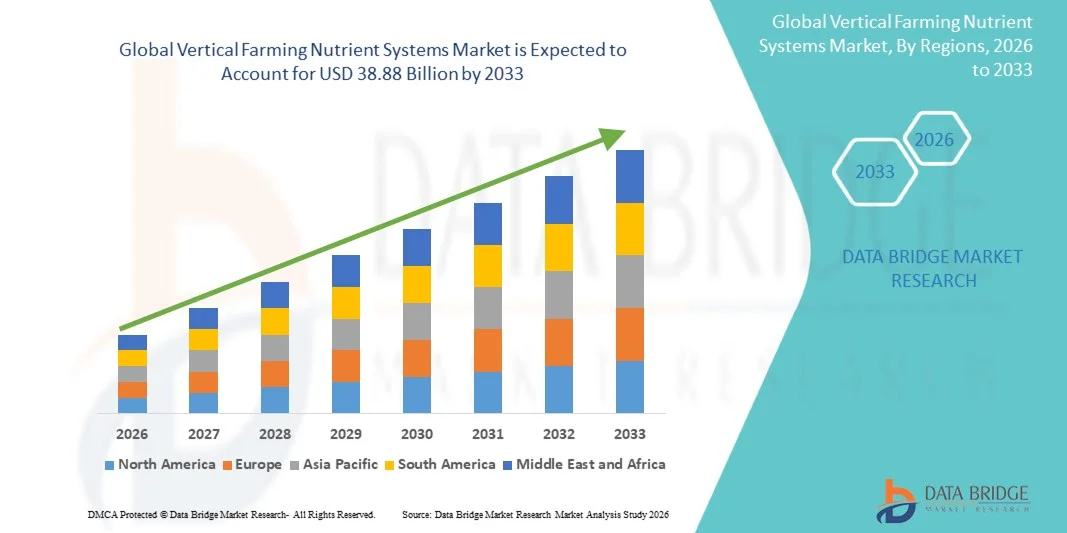
The Vertical Farming Nutrient Systems Market was valued at USD 11.70 billion in 2025 and is projected to reach USD 38.88 billion by 2033, growing at a CAGR of 16.20% from 2026 to 2033. The market is witnessing strong expansion driven by rising demand for high-yield, space-efficient food production systems, increasing adoption of controlled environment agriculture, and growing investments in urban farming infrastructure across developed and emerging economies.
The increasing pressure on conventional agriculture due to shrinking arable land, water scarcity, and climate variability is accelerating the shift toward vertical farming models. Advanced nutrient delivery systems, including hydroponic and aeroponic solutions, are enabling precise control over crop nutrition, improving yield consistency, reducing resource consumption, and supporting year-round cultivation of high-value crops such as leafy greens, herbs, and microgreens in urban and peri-urban farming setups.
Key Market Trends & Insights
- North America dominated the vertical farming nutrient systems market with the largest revenue share of 38.6% in 2025, supported by rapid adoption of controlled environment agriculture, strong investment in agritech startups, and increasing demand for locally produced fresh food.
- Asia-Pacific vertical farming nutrient systems market is expected to witness the fastest growth rate from 2026 to 2033, supported by rapid urbanization, rising population density, and increasing government initiatives promoting food security in countries such as China, Japan, Singapore, and India.
- The Macronutrients segment held the largest market revenue share of approximately 61.3% in 2025 driven by its essential role in plant growth, yield development, and large-scale commercial farming operations. Macronutrients such as nitrogen, phosphorus, and potassium are widely used in hydroponic and aeroponic systems to ensure stable crop productivity and consistent quality output across leafy greens and vegetable production systems.
- The Micronutrients segment is projected to register the fastest growth at a CAGR of 17.6% from 2026 to 2033, driven by increasing adoption of precision agriculture techniques and demand for high-nutrition crops. Rising use of micronutrients such as zinc, iron, and magnesium in controlled environment agriculture is enhancing plant immunity, improving nutrient absorption efficiency, and supporting premium-quality crop production in urban farming systems.
- The Hydroponic Nutrient Systems segment held the largest market revenue share of approximately 52.8% in 2025 driven by its widespread adoption in commercial vertical farms, greenhouse cultivation, and indoor farming facilities. Hydroponic systems are preferred due to their high yield efficiency, water-saving capability, and scalability for large-scale food production.
- The Aeroponic Nutrient Systems segment is projected to register the fastest growth at a CAGR of 18.9% from 2026 to 2033, driven by increasing demand for soil-less farming with higher oxygen exposure and faster plant growth cycles. Aeroponic systems are gaining traction in high-tech farms across the U.S., Japan, and South Korea, where controlled nutrient misting enables faster harvesting cycles and improved root nutrient absorption efficiency.
- The Leafy Greens segment held the largest market revenue share of approximately 46.7% in 2025 driven by strong demand for lettuce, spinach, and kale in urban food supply chains and retail distribution networks. Leafy greens are highly suitable for vertical farming due to their short growth cycles and high yield per square meter.
- The Herbs segment is projected to register the fastest growth at a CAGR of 16.4% from 2026 to 2033, driven by increasing demand for basil, mint, and coriander in food service and packaged food industries. Rising preference for pesticide-free and fresh herb production in controlled indoor farming environments is further supporting segment expansion globally.
- The Commercial Farming segment held the largest market revenue share of approximately 48.2% in 2025 driven by large-scale adoption of vertical farming nutrient systems for consistent crop production and supply chain efficiency. Commercial farms are increasingly integrating automated nutrient dosing systems to improve yield reliability and reduce operational costs.
- The Indoor Farming segment is projected to register the fastest growth at a CAGR of 19.3% from 2026 to 2033, driven by rapid urbanization and increasing demand for local food production in metropolitan areas. Expansion of indoor farming facilities in regions such as North America, Europe, and Asia-Pacific is accelerating the adoption of advanced nutrient management systems with AI-based monitoring capabilities.
- The Direct Sales segment held the largest market revenue share of approximately 55.4% in 2025 driven by strong procurement from large commercial vertical farms and agritech companies requiring customized nutrient solutions and integrated farming systems.
- The Online Retail segment is projected to register the fastest growth at a CAGR of 20.1% from 2026 to 2033, driven by increasing adoption of e-commerce platforms for agricultural inputs and rising demand from small-scale urban farmers and indoor gardening enthusiasts. Digital accessibility and product availability are significantly improving market penetration across emerging economies.
Market Size & Forecast
- Global Market Value (2025): USD 11.70 Billion
- Expected Market Value (2033): USD 38.88 Billion
- Forecast CAGR (2026–2033): 16.20%
- Leading Region in 2025: North America
- Fastest Growing Region: Asia-Pacific
Report Scope and Vertical Farming Nutrient Systems Market Segmentation
|
Attributes |
Vertical Farming Nutrient Systems Key Market Insights |
|
Segments Covered |
|
|
Countries Covered |
North America
Europe
Asia-Pacific
Middle East and Africa
South America
|
|
Key Market Players |
• Bayer AG (Germany) |
|
Market Opportunities |
• Expansion Of Urban Controlled Environment Agriculture |
|
Value Added Data Infosets |
In addition to the insights on market scenarios such as market value, growth rate, segmentation, geographical coverage, and major players, the market reports curated by the Data Bridge Market Research also include import export analysis, production capacity overview, production consumption analysis, price trend analysis, climate change scenario, supply chain analysis, value chain analysis, raw material/consumables overview, vendor selection criteria, PESTLE Analysis, Porter Analysis, and regulatory framework. |
Vertical Farming Nutrient Systems Market Trends
Trend: Growth In Controlled Environment Agriculture And Precision Nutrient Delivery Systems
Increasing demand for sustainable, high-efficiency food production systems is accelerating the adoption of vertical farming nutrient technologies across urban agriculture, commercial greenhouses, and indoor farming facilities. Conventional soil-based farming is increasingly constrained by land scarcity, climate variability, and water stress, encouraging growers to shift toward hydroponic and aeroponic nutrient systems that offer precise control over plant nutrition and growth cycles.
In modern vertical farms, companies are integrating automated nutrient dosing systems, for instance for leafy greens and herb cultivation, to maintain optimal electrical conductivity (EC) and pH levels, improving yield consistency and reducing nutrient wastage. In large-scale indoor farms, these systems are being used to recycle nutrient-rich water solutions, reducing freshwater consumption by up to 90% compared to conventional agriculture and improving operational efficiency in closed-loop farming environments.
The rapid expansion of urban food production infrastructure and greenhouse clusters is also increasing demand for smart nutrient monitoring systems capable of real-time adjustment through IoT sensors and AI-based analytics platforms. In addition, government-supported vertical farming projects, such as Singapore’s “30 by 30” food security initiative, are promoting controlled environment agriculture to reduce import dependency and strengthen local food resilience. Commercial vertical farming operations in the U.S. and the Netherlands have reported yield improvements of 25–40% for lettuce and spinach crops after integrating precision nutrient delivery systems with automated climate control platforms.
Vertical Farming Nutrient Systems Market Dynamics
Key Market Driver: Rising Demand For Sustainable And High-Yield Food Production Systems
Agricultural sectors worldwide are facing increasing pressure to enhance productivity while minimizing resource consumption, driving strong adoption of vertical farming nutrient systems in urban and peri-urban farming ecosystems. Rapid urbanization and declining arable land availability are pushing food producers to adopt controlled environment agriculture that enables year-round cultivation independent of seasonal constraints.
Large-scale commercial vertical farms in countries such as the U.S., Japan, and the Netherlands are increasingly deploying hydroponic nutrient delivery systems to optimize plant growth efficiency and reduce dependency on soil-based farming. For instance, AeroFarms in the U.S. has demonstrated significantly higher crop density compared to traditional farming methods while using up to 95% less water through advanced aeroponic nutrient circulation systems.
Similarly, food security initiatives in regions such as the Middle East and Asia-Pacific are investing in high-tech greenhouse systems to reduce import reliance and stabilize local supply chains. Real-world deployments in the UAE and Singapore have shown that controlled nutrient dosing systems can improve crop growth cycles by 20–30%, supporting faster harvesting and consistent year-round production in harsh climatic conditions.
Key Restraint/Challenge: High Initial Setup Costs And Technical Complexity
Despite strong adoption potential, vertical farming nutrient systems face constraints related to high capital investment requirements and operational complexity. Advanced hydroponic and aeroponic infrastructure requires significant investment in sensors, pumps, nutrient dosing units, and climate control systems, making it less accessible for small and medium-scale growers.
In addition, maintaining optimal nutrient balance requires skilled monitoring and technical expertise, as small deviations in nutrient concentration can significantly impact crop quality and yield consistency. Limited standardization across nutrient formulations and system designs further increases operational complexity and slows widespread adoption in emerging agricultural markets.
Commercial benchmarking indicates that while vertical farming can achieve water savings of up to 90%, initial setup costs can be 3–5 times higher than conventional greenhouse systems, creating financial barriers for new entrants and limiting scalability in price-sensitive regions.
Key Market Opportunity: Integration Of AI-Based Farming Automation And Smart Nutrient Systems
Modern vertical farming systems are increasingly integrating AI, IoT, and sensor-based nutrient optimization technologies to improve efficiency, reduce labor dependency, and enhance crop yield predictability. Automated nutrient dosing systems are being combined with real-time environmental monitoring to adjust nutrient flow based on plant growth stages and environmental conditions.
Agritech companies are increasingly deploying smart nutrient platforms, for instance for precision hydroponic lettuce and strawberry cultivation, to optimize nutrient absorption rates and reduce fertilizer waste. In large-scale indoor farming facilities, predictive analytics models are being used to forecast nutrient demand patterns, improving resource efficiency and minimizing operational costs.
In addition, advancements in bio-based nutrient formulations and closed-loop recycling systems are opening new opportunities for sustainable agriculture expansion across Asia-Pacific and North America. Commercial vertical farms in Japan and the Netherlands have reported yield increases of 30–45% in leafy vegetable production after integrating AI-driven nutrient management systems with automated irrigation and climate control infrastructure.
Vertical Farming Nutrient Systems Market Scope
The market is segmented on the basis of nutrient type, system type, crop type, application, and distribution channel.
• By Nutrient Type
On the basis of nutrient type, the vertical farming nutrient systems market is segmented into Macronutrients and Micronutrients. The Macronutrients segment held the largest market revenue share of approximately 61.3% in 2025 driven by its essential role in plant growth, yield development, and large-scale commercial farming operations. Macronutrients such as nitrogen, phosphorus, and potassium are widely used in hydroponic and aeroponic systems to ensure stable crop productivity and consistent quality output across leafy greens and vegetable production systems.
The Micronutrients segment is projected to register the fastest growth at a CAGR of 17.6% from 2026 to 2033, driven by increasing adoption of precision agriculture techniques and demand for high-nutrition crops. Rising use of micronutrients such as zinc, iron, and magnesium in controlled environment agriculture is enhancing plant immunity, improving nutrient absorption efficiency, and supporting premium-quality crop production in urban farming systems.
• By System Type
On the basis of system type, the market is segmented into Hydroponic Nutrient Systems, Aeroponic Nutrient Systems, and Aquaponic Nutrient Systems. The Hydroponic Nutrient Systems segment held the largest market revenue share of approximately 52.8% in 2025 driven by its widespread adoption in commercial vertical farms, greenhouse cultivation, and indoor farming facilities. Hydroponic systems are preferred due to their high yield efficiency, water-saving capability, and scalability for large-scale food production.
The Aeroponic Nutrient Systems segment is projected to register the fastest growth at a CAGR of 18.9% from 2026 to 2033, driven by increasing demand for soil-less farming with higher oxygen exposure and faster plant growth cycles. Aeroponic systems are gaining traction in high-tech farms across the U.S., Japan, and South Korea, where controlled nutrient misting enables faster harvesting cycles and improved root nutrient absorption efficiency.
• By Crop Type
On the basis of crop type, the market is segmented into Leafy Greens, Herbs, Fruits, Vegetables, and Others. The Leafy Greens segment held the largest market revenue share of approximately 46.7% in 2025 driven by strong demand for lettuce, spinach, and kale in urban food supply chains and retail distribution networks. Leafy greens are highly suitable for vertical farming due to their short growth cycles and high yield per square meter.
The Herbs segment is projected to register the fastest growth at a CAGR of 16.4% from 2026 to 2033, driven by increasing demand for basil, mint, and coriander in food service and packaged food industries. Rising preference for pesticide-free and fresh herb production in controlled indoor farming environments is further supporting segment expansion globally.
• By Application
On the basis of application, the market is segmented into Commercial Farming, Indoor Farming, Greenhouses, and Research & Development. The Commercial Farming segment held the largest market revenue share of approximately 48.2% in 2025 driven by large-scale adoption of vertical farming nutrient systems for consistent crop production and supply chain efficiency. Commercial farms are increasingly integrating automated nutrient dosing systems to improve yield reliability and reduce operational costs.
The Indoor Farming segment is projected to register the fastest growth at a CAGR of 19.3% from 2026 to 2033, driven by rapid urbanization and increasing demand for local food production in metropolitan areas. Expansion of indoor farming facilities in regions such as North America, Europe, and Asia-Pacific is accelerating the adoption of advanced nutrient management systems with AI-based monitoring capabilities.
• By Distribution Channel
On the basis of distribution channel, the market is segmented into Direct Sales, Distributors, Online Retail, and Specialty Suppliers. The Direct Sales segment held the largest market revenue share of approximately 55.4% in 2025 driven by strong procurement from large commercial vertical farms and agritech companies requiring customized nutrient solutions and integrated farming systems.
The Online Retail segment is projected to register the fastest growth at a CAGR of 20.1% from 2026 to 2033, driven by increasing adoption of e-commerce platforms for agricultural inputs and rising demand from small-scale urban farmers and indoor gardening enthusiasts. Digital accessibility and product availability are significantly improving market penetration across emerging economies.
Vertical Farming Nutrient Systems Market Regional Analysis
North America Vertical Farming Nutrient Systems Market Insight
North America dominated the vertical farming nutrient systems market with the largest revenue share of 38.6% in 2025, supported by rapid adoption of controlled environment agriculture, strong investment in agritech startups, and increasing demand for locally produced fresh food. Consumers and commercial growers in the region are highly focused on sustainable farming practices, water-efficient cultivation methods, and year-round crop production, which is accelerating the deployment of advanced nutrient delivery systems in hydroponic and indoor farming facilities. This widespread adoption is further supported by high technology penetration, strong R&D infrastructure, and increasing government support for urban agriculture initiatives, establishing vertical farming nutrient systems as a key component of modern food production networks.
U.S. Vertical Farming Nutrient Systems Market Insight
The U.S. vertical farming nutrient systems market captured the largest revenue share in 2025 within North America, driven by rapid expansion of indoor farming facilities and increasing adoption of AI-integrated nutrient management systems. Commercial vertical farms in the U.S. are increasingly prioritizing precision nutrient dosing to improve yield consistency and reduce operational waste. The growing presence of companies such as AeroFarms and Plenty has strengthened market development, with large-scale farms reporting water savings of up to 95% through hydroponic nutrient circulation systems. Moreover, rising consumer demand for pesticide-free leafy greens and herbs is significantly contributing to the expansion of nutrient system adoption across urban farming clusters and retail supply chains.
Europe Vertical Farming Nutrient Systems Market Insight
The Europe vertical farming nutrient systems market is expected to witness the fastest growth rate from 2026 to 2033, primarily driven by stringent sustainability regulations, increasing food import dependency concerns, and strong investments in climate-resilient agriculture. Countries such as the Netherlands and Germany are leading in controlled environment farming adoption, with advanced greenhouse and vertical farming infrastructure supporting precision nutrient systems. European consumers are increasingly preferring locally grown, chemical-free produce, which is accelerating demand for hydroponic and aeroponic nutrient technologies. The region is also experiencing strong growth in smart greenhouse integration, where nutrient systems are connected with IoT-based climate monitoring platforms for optimized crop production.
U.K. Vertical Farming Nutrient Systems Market Insight
The U.K. vertical farming nutrient systems market is expected to witness the fastest growth rate from 2026 to 2033, driven by rising urban farming initiatives, increasing focus on food security, and expansion of controlled environment agriculture projects in metropolitan areas. The country is witnessing growing adoption of indoor farming facilities in cities such as London, where limited arable land is pushing demand for space-efficient crop production systems. In addition, strong retail demand for fresh herbs and leafy greens is encouraging investment in nutrient-efficient hydroponic systems. The U.K.’s established retail and food service infrastructure is further supporting commercialization of vertically farmed produce.
Germany Vertical Farming Nutrient Systems Market Insight
The Germany vertical farming nutrient systems market is expected to witness the fastest growth rate from 2026 to 2033, fueled by strong emphasis on sustainability, advanced agricultural engineering capabilities, and increasing adoption of energy-efficient food production systems. Germany’s well-developed greenhouse sector is increasingly integrating precision nutrient systems to improve crop yield efficiency and reduce water consumption. The country’s focus on reducing agricultural carbon footprint is also accelerating the shift toward hydroponic and aeroponic farming technologies. In addition, collaborations between agritech companies and research institutions are enhancing innovation in nutrient formulation and automated delivery systems.
Asia-Pacific Vertical Farming Nutrient Systems Market Insight
The Asia-Pacific vertical farming nutrient systems market is expected to witness the fastest growth rate from 2026 to 2033, supported by rapid urbanization, rising population density, and increasing government initiatives promoting food security in countries such as China, Japan, Singapore, and India. The region is witnessing strong investments in smart farming infrastructure, with vertical farms being deployed in densely populated urban centers to ensure stable food supply. Singapore’s “30 by 30” initiative is a key example, promoting domestic food production through advanced hydroponic nutrient systems. In addition, Asia-Pacific is emerging as a manufacturing hub for agritech systems, improving affordability and accessibility of nutrient technologies.
Japan Vertical Farming Nutrient Systems Market Insight
The Japan vertical farming nutrient systems market is expected to witness the fastest growth rate from 2026 to 2033 due to high-tech agricultural adoption, limited arable land availability, and strong demand for food safety and quality. Japan is extensively using vertical farming systems in urban facilities, with companies integrating automated nutrient control systems to optimize crop growth in compact environments. The country’s aging population is also driving demand for locally produced, pesticide-free vegetables that require minimal manual farming effort. In addition, integration of robotics and IoT-enabled nutrient systems is enhancing operational efficiency in large-scale indoor farms.
China Vertical Farming Nutrient Systems Market Insight
The China vertical farming nutrient systems market accounted for the largest market revenue share in Asia-Pacific in 2025, attributed to rapid urbanization, expanding middle-class population, and strong government support for smart agriculture development. China is increasingly investing in vertical farming clusters and smart greenhouse projects to improve domestic food supply resilience. Large-scale adoption of hydroponic nutrient systems is being driven by demand for high-yield vegetable production in urban areas. In addition, strong domestic manufacturing capabilities are reducing system costs, enabling wider adoption across commercial farming and institutional agriculture projects.
Vertical Farming Nutrient Systems Market Share
The Vertical Farming Nutrient Systems industry is primarily led by well-established companies, including:
• Bayer AG (Germany)
• Syngenta Crop Protection AG (Switzerland)
• Yara International ASA (Norway)
• Nutrien Ltd. (Canada)
• The Scotts Miracle-Gro Company (U.S.)
• HydroGarden Ltd. (U.K.)
• Hydrofarm Holdings Group, Inc. (U.S.)
• ICL Group Ltd. (Israel)
• Valagro S.p.A. (Italy)
• Haifa Group (Israel)
• Corteva Agriscience (U.S.)
• BASF SE (Germany)
• GrowGeneration Corp. (U.S.)
• Netafim Ltd. (Israel)
• Signify N.V. (Netherlands)

- Interactive Data Analysis Dashboard
- Company Analysis Dashboard for high growth potential opportunities
- Research Analyst Access for customization & queries
- Competitor Analysis with Interactive dashboard
- Latest News, Updates & Trend analysis
- Harness the Power of Benchmark Analysis for Comprehensive Competitor Tracking
Data collection and base year analysis are done using data collection modules with large sample sizes. The stage includes obtaining market information or related data through various sources and strategies. It includes examining and planning all the data acquired from the past in advance. It likewise envelops the examination of information inconsistencies seen across different information sources. The market data is analysed and estimated using market statistical and coherent models. Also, market share analysis and key trend analysis are the major success factors in the market report. To know more, please request an analyst call or drop down your inquiry.
The key research methodology used by DBMR research team is data triangulation which involves data mining, analysis of the impact of data variables on the market and primary (industry expert) validation. Data models include Vendor Positioning Grid, Market Time Line Analysis, Market Overview and Guide, Company Positioning Grid, Patent Analysis, Pricing Analysis, Company Market Share Analysis, Standards of Measurement, Global versus Regional and Vendor Share Analysis. To know more about the research methodology, drop in an inquiry to speak to our industry experts.
Data Bridge Market Research is a leader in advanced formative research. We take pride in servicing our existing and new customers with data and analysis that match and suits their goal. The report can be customized to include price trend analysis of target brands understanding the market for additional countries (ask for the list of countries), clinical trial results data, literature review, refurbished market and product base analysis. Market analysis of target competitors can be analyzed from technology-based analysis to market portfolio strategies. We can add as many competitors that you require data about in the format and data style you are looking for. Our team of analysts can also provide you data in crude raw excel files pivot tables (Fact book) or can assist you in creating presentations from the data sets available in the report.