


What ia the Vessel Sealing Devices Market Size & Overview?
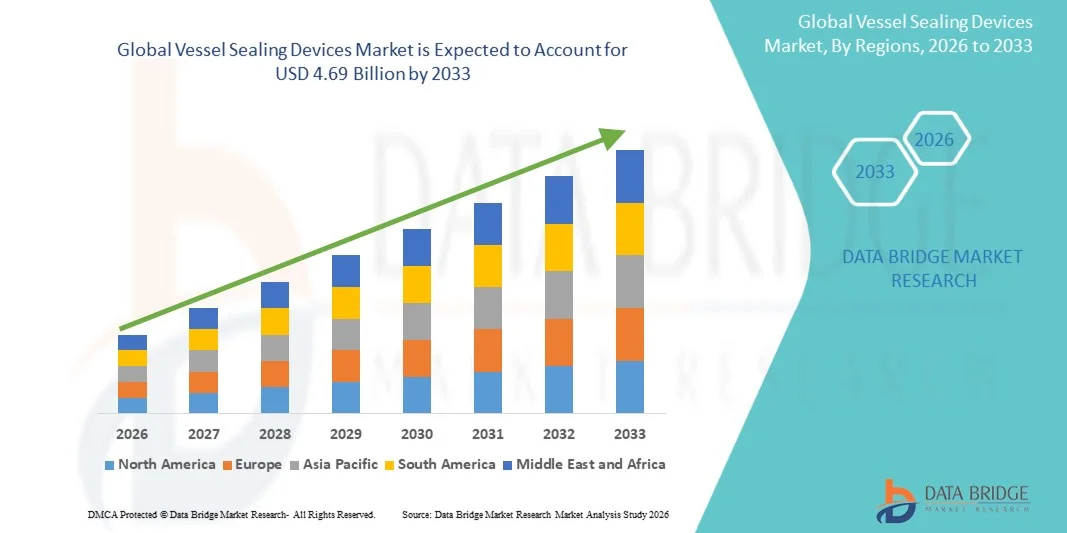
The global vessel sealing devices market was valued at USD 2.50 billion in 2025 and is projected to reach USD 4.69 billion by 2033, growing at a CAGR of 8.20% from 2026 to 2033. The market is witnessing steady growth driven by the increasing volume of minimally invasive surgeries, rising prevalence of chronic diseases requiring surgical intervention, and continuous technological advancements in electrosurgical and energy-based sealing systems.
The growing demand for precise hemostasis, reduced blood loss, and shorter recovery times is encouraging hospitals and ambulatory surgical centers to adopt advanced vessel sealing technologies across general surgery, gynecology, urology, and cardiovascular procedures. Bipolar and ultrasonic vessel sealing devices are increasingly replacing conventional suturing and ligation techniques by improving surgical efficiency, minimizing thermal spread, and enhancing patient outcomes. In addition, the expansion of healthcare infrastructure, increasing geriatric population, and rising preference for laparoscopic procedures are further supporting market growth globally.
Key Market Trends & Insights
- North America dominated the global vessel sealing devices market with the largest revenue share of 38.46% in 2025, supported by advanced healthcare infrastructure, high adoption of minimally invasive surgeries, and strong presence of leading medical device manufacturers.
- The General Surgery segment led the market with a 36.74% share in 2025, driven by owing to the extensive use of vessel sealing systems across colorectal, gastrointestinal, bariatric, and thyroid surgical procedures.
- Asia-Pacific is expected to be the fastest-growing region at a CAGR of 9.1% from 2026 to 2033, fueled by expanding healthcare infrastructure, rising surgical volumes, and increasing healthcare investments in China, India, and Japan.
- Laparoscopic Surgery is the fastest-growing simulation type, projected to register a CAGR of 8.7%, reflecting the surge in demand for minimally invasive procedures and faster postoperative recovery outcomes.
- The Instruments segment dominated the product type category with a 48.29% revenue share in 2025, led by the high procedural utilization and recurring demand for handheld vessel sealing devices across surgical specialties
- Bipolar accounted for 44.28% of the market, preferred by its widespread use in minimally invasive and open surgical procedures requiring precise vessel sealing and coagulation
- The Hybrid segment is the fastest-growing energy type category, with a CAGR of 9.2%, driven by increasing demand for multifunctional surgical devices combining ultrasonic and bipolar energy technologies.
Market Size & Forecast
- Global Market Value (2025): USD 2.50 Billion
- Expected Market Value (2033): USD 4.69 Billion
- Forecast CAGR (2026–2033): 8.20%
- Leading Region in 2025: North America
- Fastest Growing Region: Asia Pacific
Report Scope and Global Vessel Sealing Devices Market Segmentation
|
Attributes |
Vessel Sealing Devices Key Market Insights |
|
Segments Covered |
|
|
Countries Covered |
North America
Europe
Asia-Pacific
Middle East and Africa
South America
|
|
Key Market Players |
|
|
Market Opportunities |
|
|
Value Added Data Infosets |
In addition to the insights on market scenarios such as market value, growth rate, segmentation, geographical coverage, and major players, the market reports curated by the Data Bridge Market Research also include in-depth expert analysis, patient epidemiology, pipeline analysis, pricing analysis, and regulatory framework. |
What are the Vessel Sealing Devices Market Trends?
Trend: Rising Preference for Minimally Invasive and Energy-Based Surgeries
Healthcare providers are increasingly adopting advanced vessel sealing devices to improve surgical precision, minimize intraoperative blood loss, and shorten patient recovery times during minimally invasive procedures. The integration of bipolar and ultrasonic energy technologies enables efficient tissue sealing with reduced thermal spread and lower complication risks. Hospitals and ambulatory surgical centers are similarly utilizing vessel sealing systems to enhance procedural efficiency across gynecological, colorectal, bariatric, and cardiovascular surgeries, while robotic-assisted platforms are expanding the use of intelligent energy devices in complex operations.
For instance, in March 2024, Johnson & Johnson MedTech expanded its advanced energy surgery portfolio with enhanced vessel sealing technologies designed for minimally invasive and robotic-assisted surgical applications.
Vessel Sealing Devices Market Dynamics
Key Market Driver: Increasing Volume of Minimally Invasive Surgical Procedures
The growing global preference for minimally invasive surgeries has created substantial demand for vessel sealing devices capable of delivering rapid hemostasis, reduced tissue trauma, and improved surgical outcomes across multiple specialties. Hospitals, specialty clinics, and surgical centers are increasingly deploying advanced bipolar and ultrasonic sealing systems as essential components of modern operating rooms, reducing procedure times, minimizing postoperative complications, and improving overall patient safety and recovery efficiency.
For instance, in January 2024, Medtronic introduced upgraded LigaSure vessel sealing technology focused on improving precision and workflow efficiency during laparoscopic and open surgical procedures.
Key Restraint/Challenge: High Cost of Advanced Energy-Based Surgical Systems
A significant restraint in the global vessel sealing devices market is the high procurement and maintenance cost associated with advanced energy-based surgical platforms. Modern vessel sealing systems incorporate sophisticated generators, reusable handpieces, and precision energy control technologies, requiring considerable investment in equipment acquisition, staff training, and ongoing servicing. The overall financial burden extends to disposable instrument replacement and technology upgrades, making adoption challenging for smaller hospitals, ambulatory centers, and healthcare providers in cost-sensitive emerging markets.
For instance, in September 2024, Bolder Surgical highlighted increasing operational and equipment integration costs associated with next-generation vessel sealing technologies for pediatric and minimally invasive surgical procedures.
Key Market Opportunity: Expansion of Robotic-Assisted and Outpatient Surgeries
The expansion of robotic-assisted and outpatient surgical procedures presents a significant market opportunity for vessel sealing device manufacturers. Advanced sealing platforms can support enhanced surgical dexterity, precise energy delivery, and improved procedural consistency in robotic and ambulatory care environments. The development of compact, multifunctional sealing instruments and integrated digital energy systems is further increasing adoption opportunities across hospitals, ambulatory surgical centers, and specialty clinics in rapidly developing healthcare markets worldwide.
For instance, in May 2024, Olympus Corporation strengthened its advanced surgical energy portfolio with vessel sealing solutions optimized for robotic-assisted and outpatient minimally invasive surgeries.
Vessel Sealing Devices Market Scope
The vessel sealing devices market is segmented on the basis of application, product type, energy type, and end-use.
- By Application
On the basis of application, the global vessel sealing devices market is segmented into general surgery and laparoscopic surgery. The General Surgery segment dominated the market with a 36.74% share in 2025, owing to the extensive use of vessel sealing systems across colorectal, gastrointestinal, bariatric, and thyroid surgical procedures. Hospitals and surgical centers widely utilize these devices to achieve rapid hemostasis, minimize blood loss, and improve procedural efficiency during open and minimally invasive operations. The growing prevalence of chronic diseases requiring surgical intervention is further supporting segment expansion. Surgeons increasingly prefer advanced bipolar and ultrasonic technologies due to reduced thermal damage and enhanced tissue sealing precision. Continuous advancements in electrosurgical platforms and reusable handpieces are also strengthening adoption. The high volume of general surgical procedures performed globally continues to maintain this segment’s market dominance.
The Laparoscopic Surgery segment is projected to register the fastest growth at a CAGR of 8.7% from 2026 to 2033, driven by increasing preference for minimally invasive procedures and faster postoperative recovery outcomes. Vessel sealing devices are becoming essential in laparoscopic surgeries due to their ability to provide precise energy delivery and controlled tissue dissection within confined surgical spaces. Rising adoption of robotic-assisted surgical systems is further accelerating demand for advanced sealing technologies in laparoscopic applications. Healthcare providers are increasingly focusing on reducing hospital stays, postoperative pain, and complication rates, which supports segment growth. Technological improvements in compact sealing instruments and multifunctional surgical tools are enhancing procedural efficiency. Growing investments in minimally invasive surgical infrastructure across emerging economies are also contributing significantly to market expansion.
- By Product Type
On the basis of product type, the global vessel sealing devices market is segmented into instruments, generators, and accessories. The Instruments segment dominated the market with a 48.29% share in 2025, driven by high procedural utilization and recurring demand for handheld vessel sealing devices across surgical specialties. These instruments are widely adopted for their precision, ergonomic handling, and compatibility with laparoscopic and open surgeries. Hospitals and ambulatory surgical centers continuously procure advanced vessel sealing handpieces to improve workflow efficiency and patient safety. Increasing surgical volumes worldwide are further supporting strong product consumption. Manufacturers are also introducing disposable and reusable instrument variants with enhanced sealing performance and reduced thermal spread. Their direct role in surgical execution and frequent replacement cycle continue to support segment leadership globally.
The Accessories segment is anticipated to witness the fastest growth at a CAGR of 8.9% from 2026 to 2033, fueled by rising demand for compatible consumables, replacement components, and integrated surgical support products. Accessories such as cables, adapters, electrodes, and specialized connectors are increasingly required to support advanced energy platforms and multifunctional sealing systems. Growing installation of technologically advanced generators in hospitals is boosting demand for supporting accessory ecosystems. Healthcare facilities are also emphasizing operational efficiency and uninterrupted surgical workflows, encouraging higher accessory procurement rates. Continuous product innovation and compatibility enhancements are further strengthening adoption. Expanding minimally invasive surgery volumes worldwide are expected to create sustained growth opportunities for this segment.
- By Energy Type
On the basis of energy type, the global vessel sealing devices market is segmented into bipolar, ultrasonic, and hybrid. The Bipolar segment accounted for the largest market share of 44.28% in 2025, owing to its widespread use in minimally invasive and open surgical procedures requiring precise vessel sealing and coagulation. Bipolar vessel sealing systems are highly preferred for their controlled energy delivery, reduced lateral thermal spread, and ability to seal larger blood vessels effectively. These technologies are extensively utilized across gynecological, urological, and colorectal surgeries due to improved procedural safety and efficiency. Hospitals are increasingly investing in advanced bipolar platforms integrated with intelligent tissue sensing technologies. The segment also benefits from strong clinical familiarity and broad regulatory approvals worldwide. Continuous technological refinement in energy modulation and ergonomic device design is further supporting market dominance.
The Hybrid segment is expected to register the fastest growth at a CAGR of 9.2% from 2026 to 2033, driven by increasing demand for multifunctional surgical devices combining ultrasonic and bipolar energy technologies. Hybrid systems offer enhanced precision, simultaneous cutting and coagulation capabilities, and improved procedural flexibility during complex surgeries. Surgeons are increasingly adopting these platforms to reduce instrument exchange frequency and shorten operation times. Growing focus on advanced minimally invasive and robotic-assisted procedures is significantly supporting segment expansion. Technological innovations aimed at improving tissue dissection accuracy and reducing collateral damage are further accelerating adoption. Rising healthcare investments and increasing availability of next-generation surgical energy systems are expected to create substantial growth opportunities for the segment.
- By End-Use
On the basis of end-use, the global vessel sealing devices market is segmented into hospitals and specialty clinics, and ambulatory surgical centres. The Hospitals and Specialty Clinics segment dominated the market with a 61.53% share in 2025, supported by high surgical procedure volumes, availability of advanced operating infrastructure, and strong adoption of minimally invasive technologies. These healthcare facilities widely utilize vessel sealing devices across multiple departments, including general surgery, gynecology, oncology, and cardiovascular surgery. Increasing patient preference for technologically advanced treatment environments is further driving adoption. Hospitals also benefit from better reimbursement frameworks and larger procurement capacities for advanced electrosurgical systems. Continuous expansion of multispecialty healthcare networks and surgical capabilities is strengthening market leadership. The presence of skilled surgeons and integrated surgical support systems continues to support segment growth globally.
The Ambulatory Surgical Centres segment is projected to witness the fastest growth at a CAGR of 8.8% from 2026 to 2033, driven by increasing demand for cost-effective outpatient surgical procedures and shorter hospital stays. Ambulatory centers are rapidly adopting compact and efficient vessel sealing systems to improve procedural turnaround times and operational efficiency. Rising preference for minimally invasive day-care surgeries is significantly accelerating segment expansion. Healthcare systems worldwide are also encouraging outpatient treatment models to reduce overall hospitalization costs and improve patient convenience. Technological advancements in portable and user-friendly sealing devices are supporting broader adoption across ambulatory settings. Increasing investments in outpatient surgical infrastructure across emerging and developed economies are expected to further boost segment growth.
Vessel Sealing Devices Market Regional Analysis
North America dominated the global vessel sealing devices market with the largest revenue share of 38.46% in 2025, supported by advanced healthcare infrastructure, high adoption of minimally invasive surgeries, and strong presence of leading medical device manufacturers. The region also benefits from strong healthcare expenditure, increasing integration of robotic-assisted surgical systems, and growing utilization of vessel sealing technologies across general surgery, gynecology, urology, and cardiovascular applications. Rising focus on surgical precision, patient safety, and reduced postoperative recovery times continues to strengthen North America’s leadership position in the global market.
U.S. Vessel Sealing Devices Market Insight
The U.S. vessel sealing devices market is witnessing strong growth due to rising volumes of minimally invasive surgeries, increasing adoption of robotic-assisted surgical systems, and continuous advancements in electrosurgical technologies. The country’s advanced healthcare infrastructure, along with growing preference for precision-based surgical procedures, is driving demand across hospitals, ambulatory surgical centers, and specialty clinics. In addition, increasing prevalence of chronic diseases requiring surgical intervention and growing focus on reducing blood loss and recovery times are accelerating adoption of vessel sealing devices across multiple surgical specialties.
Europe Vessel Sealing Devices Market Insight
The Europe vessel sealing devices market remains a major contributor to global revenue, driven by strong healthcare infrastructure, technological innovation, and high demand for minimally invasive surgical solutions. The widespread use of advanced vessel sealing technologies in general surgery, gynecology, and laparoscopic procedures is supporting market expansion across the region. Increasing investments in robotic-assisted surgeries, coupled with strict healthcare quality standards and growing elderly population, continue to enhance the adoption of vessel sealing devices throughout Europe.
U.K. Vessel Sealing Devices Market Insight
The U.K. vessel sealing devices market is experiencing steady growth, supported by rising adoption of minimally invasive surgical techniques, increasing healthcare modernization initiatives, and growing demand for advanced energy-based surgical systems. Increasing investments in hospital infrastructure and rising preference for efficient hemostatic technologies are contributing to market growth. Furthermore, integration of intelligent bipolar and ultrasonic energy systems is improving surgical precision and operational efficiency, positioning the U.K. as a key innovation hub in the vessel sealing devices industry.
Germany Vessel Sealing Devices Market Insight
The Germany vessel sealing devices market is expanding steadily due to the country’s advanced healthcare system, strong medical device manufacturing capabilities, and increasing adoption of next-generation surgical technologies. Hospitals, specialty clinics, and surgical centers are increasingly utilizing vessel sealing devices for minimally invasive and complex surgical procedures. Continuous advancements in robotic surgery, bipolar energy platforms, and precision electrosurgical systems, along with strong government focus on healthcare innovation and patient safety, are further driving market growth in Germany.
Asia-Pacific Vessel Sealing Devices Market Insight
The Asia-Pacific vessel sealing devices market is expected to witness rapid growth, driven by expanding healthcare infrastructure, increasing surgical procedure volumes, and rising investments in advanced medical technologies across countries such as China, India, and Japan. Growing awareness regarding minimally invasive surgeries, rising adoption of modern electrosurgical devices, and increasing demand for cost-effective treatment solutions are supporting regional market expansion. In addition, the growing presence of private healthcare providers and improving access to advanced surgical care are accelerating vessel sealing device adoption across hospitals and specialty clinics.
Japan Vessel Sealing Devices Market Insight
The Japan vessel sealing devices market is witnessing consistent growth due to rising investments in advanced surgical technologies, healthcare modernization, and minimally invasive treatment approaches. Hospitals and medical institutions are increasingly adopting high-precision vessel sealing systems for laparoscopic, cardiovascular, and oncological procedures. Moreover, increasing integration of robotic-assisted surgery technologies and the country’s focus on efficient and high-quality patient care solutions are further contributing to market growth.
China Vessel Sealing Devices Market Insight
The China vessel sealing devices market is growing rapidly, driven by expanding healthcare infrastructure, increasing surgical procedure demand, and rising government focus on improving healthcare quality standards. Growing adoption of advanced bipolar and ultrasonic vessel sealing systems across hospitals and surgical centers is significantly boosting market demand. In addition, rising investments in healthcare modernization, increasing awareness regarding minimally invasive surgical techniques, and rapid technological advancements are positioning China as one of the fastest-growing markets for vessel sealing devices globally.
Which are the Top Companies in Vessel Sealing Devices Market?
The Vessel Sealing Devices industry is primarily led by well-established companies, including:
- Medtronic (Ireland)
- Johnson & Johnson Services, Inc. (U.S.)
- Ethicon, Inc. (U.S.)
- Olympus Corporation (Japan)
- Braun SE (Germany)
- Erbe Elektromedizin GmbH (Germany)
- CONMED Corporation (U.S.)
- Applied Medical Resources Corporation (U.S.)
- Boston Scientific Corporation (U.S.)
- Stryker (U.S.)
- Karl Storz SE & Co. KG (Germany)
- BOWA-electronic GmbH & Co. KG (Germany)
- KLS Martin Group (Germany)
- Smith & Nephew (U.K.)
- Zimmer Biomet (U.S.)
- Hologic, Inc. (U.S.)
- Intuitive Surgical, Inc. (U.S.)
- Aesculap, Inc. (B. Braun) (U.S.)
- Bolder Surgical, Inc. (U.S.)
- Richard Wolf GmbH (Germany)
What are the Latest Developments in Global Vessel Sealing Devices Market?
- In October 2025, Olympus Corporation announced the launch of THUNDERBEAT II, its next-generation hybrid surgical energy device designed for advanced vessel sealing and hemostatic tissue dissection in both laparoscopic and open surgeries. The system integrates three energy modes, including a newly added ultrasonic mode, to improve surgical precision, reduce thermal spread, and support complex minimally invasive procedures. The launch further strengthened Olympus’ advanced surgical energy portfolio and highlighted the growing focus on multifunctional vessel sealing technologies in modern operating rooms
- In September 2025, Medtronic launched the advanced Valleylab FT10 Vessel Sealing Generator in India to support precision electrosurgery and improved operating room efficiency. The platform features adaptive tissue sensing technology and advanced energy control capabilities intended to enhance vessel sealing performance during minimally invasive and open surgical procedures. This development reflected the increasing expansion of advanced surgical energy technologies into emerging healthcare markets
- In July 2025, Medtronic received CE Mark approval in Europe for integrating its LigaSure vessel sealing technology with the Hugo robotic-assisted surgery platform. The approval enabled robotic-assisted gynecologic, urologic, and general surgeries to utilize advanced vessel sealing capabilities within Medtronic’s robotic ecosystem. The development highlighted the growing convergence of robotic surgery and intelligent vessel sealing technologies across minimally invasive procedures
- In April 2025, Olympus Corporation expanded its advanced bipolar surgical energy portfolio in Mexico with the launch of the POWERSEAL Sealer/Divider device family. The new devices were designed to provide secure vessel sealing, multifunctional tissue dissection, and improved ergonomic handling across laparoscopic and open surgical applications. The expansion demonstrated Olympus’ strategy to strengthen its presence in Latin American minimally invasive surgery markets
- In August 2024, Olympus Corporation announced the launch of new POWERSEAL Straight Jaw and Curved Jaw Sealer/Divider devices to expand its advanced bipolar vessel sealing portfolio. The devices were developed to improve sealing strength, reduce jaw closing force, and enhance surgeon comfort during complex surgical procedures. The launch reinforced the industry’s focus on ergonomic, precision-based vessel sealing systems for minimally invasive and open surgeries

- Interactive Data Analysis Dashboard
- Company Analysis Dashboard for high growth potential opportunities
- Research Analyst Access for customization & queries
- Competitor Analysis with Interactive dashboard
- Latest News, Updates & Trend analysis
- Harness the Power of Benchmark Analysis for Comprehensive Competitor Tracking
Data collection and base year analysis are done using data collection modules with large sample sizes. The stage includes obtaining market information or related data through various sources and strategies. It includes examining and planning all the data acquired from the past in advance. It likewise envelops the examination of information inconsistencies seen across different information sources. The market data is analysed and estimated using market statistical and coherent models. Also, market share analysis and key trend analysis are the major success factors in the market report. To know more, please request an analyst call or drop down your inquiry.
The key research methodology used by DBMR research team is data triangulation which involves data mining, analysis of the impact of data variables on the market and primary (industry expert) validation. Data models include Vendor Positioning Grid, Market Time Line Analysis, Market Overview and Guide, Company Positioning Grid, Patent Analysis, Pricing Analysis, Company Market Share Analysis, Standards of Measurement, Global versus Regional and Vendor Share Analysis. To know more about the research methodology, drop in an inquiry to speak to our industry experts.
Data Bridge Market Research is a leader in advanced formative research. We take pride in servicing our existing and new customers with data and analysis that match and suits their goal. The report can be customized to include price trend analysis of target brands understanding the market for additional countries (ask for the list of countries), clinical trial results data, literature review, refurbished market and product base analysis. Market analysis of target competitors can be analyzed from technology-based analysis to market portfolio strategies. We can add as many competitors that you require data about in the format and data style you are looking for. Our team of analysts can also provide you data in crude raw excel files pivot tables (Fact book) or can assist you in creating presentations from the data sets available in the report.













