


Veterinary Automatic Osmometer Market Overview
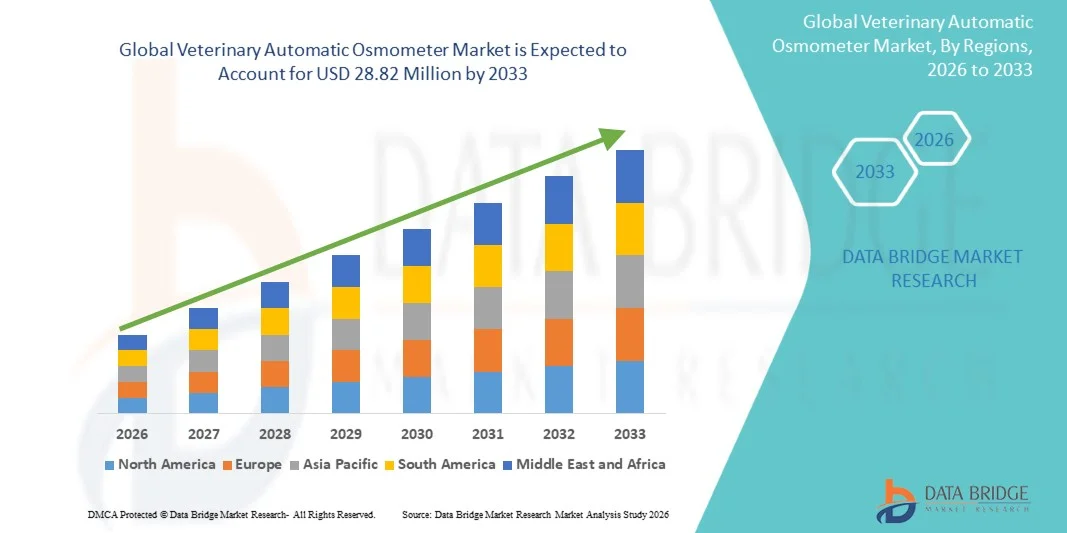
The Veterinary Automatic Osmometer Market was valued at USD 20.27 Million in 2025 and is projected to reach USD 28.82 million by 2033, growing at a CAGR of 4.50% from 2026 to 2033. The market is witnessing steady expansion driven by increasing demand for accurate veterinary diagnostic tools, growing adoption of automated laboratory instruments, and rising focus on early disease detection in animals across clinics and research facilities.
The increasing prevalence of chronic and metabolic disorders in companion animals and livestock, combined with the growing emphasis on evidence-based veterinary care, is encouraging veterinary hospitals, diagnostic laboratories, and research institutes to adopt advanced osmometry solutions. Automatic osmometers are increasingly replacing manual methods, offering faster, more precise, and reproducible results for clinical decision-making and animal health monitoring.
Key Market Trends & Insights
- North America dominated the Veterinary Automatic Osmometer Market with the largest revenue share of 38.6% in 2025, supported by advanced veterinary diagnostic infrastructure and high adoption of automated laboratory instruments.
- The Cart-Based segment led the market with a 63.4% share in 2025, driven by higher analytical accuracy, multi-sample processing capability, and strong adoption in veterinary diagnostic laboratories and research institutions.
- Asia-Pacific is expected to be the fastest-growing region at a CAGR of 5.8% from 2026 to 2033, fueled by rapid expansion of veterinary healthcare infrastructure, rising pet adoption, increasing livestock population, and growing investment in diagnostic laboratory modernization across China, India, and Southeast Asia.
- Portable is the fastest-growing product type, projected to register a CAGR of 6.7%, reflecting the surge in demand for point-of-care veterinary diagnostics and field-based animal healthcare services.
- The Small Companion Animals segment dominated the animal type category with a 58.1% revenue share in 2025, led by the rising global pet population and increasing expenditure on advanced veterinary care.
- Digital Imaging accounted for 66.5% of the market, preferred by superior accuracy, automation capabilities, and compatibility with modern veterinary diagnostic systems
- The Contrast Imaging segment is the fastest-growing technology category, with a CAGR of 6.5%, driven by improved visualization techniques and enhanced diagnostic sensitivity.
Market Size & Forecast
- Global Market Value (2025): USD 20.27 Million
- Expected Market Value (2033): USD 28.82 Million
- Forecast CAGR (2026–2033): 4.50%
- Leading Region in 2025: North America
- Fastest Growing Region: Asia Pacific
Report Scope and Veterinary Automatic Osmometer Market Segmentation
|
Attributes |
Veterinary Automatic Osmometer Key Market Insights |
|
Segments Covered |
|
|
Countries Covered |
North America · U.S. · Canada · Mexico Europe · Germany · France · U.K. · Netherlands · Switzerland · Belgium · Russia · Italy · Spain · Turkey · Rest of Europe Asia-Pacific · China · Japan · India · South Korea · Singapore · Malaysia · Australia · Thailand · Indonesia · Philippines · Rest of Asia-Pacific Middle East and Africa · Saudi Arabia · U.A.E. · South Africa · Egypt · Israel · Rest of Middle East and Africa South America · Brazil · Argentina · Rest of South America |
|
Key Market Players |
· Advanced Instruments LLC (U.S.) · Nova Biomedical Corporation (U.S.) · ELITechGroup S.A.S (France) · Arkray, Inc. (Japan) · Roche Diagnostics (Switzerland) · Abbott (U.S.) · Siemens Healthineers AG (Germany) · Danaher (U.S.) · Beckman Coulter, Inc. (U.S.) · Thermo Fisher Scientific Inc. (U.S.) · HORIBA Medical (France) · Randox Laboratories Ltd (U.K.) · Mettler-Toledo International Inc. (U.S.) · Analytik Jena GmbH (Germany) · Bio-Rad Laboratories, Inc. (U.S.) · Sysmex Corporation (Japan) · Mindray Medical International Limited (China) · Hitachi High-Tech Corporation (Japan) · Agilent Technologies, Inc. (U.S.) · F. Hoffmann-La Roche Ltd (Switzerland) |
|
Market Opportunities |
· Growing adoption of automated veterinary diagnostics in clinics and laboratories · Rising prevalence of kidney disorders, dehydration, and metabolic diseases · Expansion of modern veterinary infrastructure and point-of-care testing |
|
Value Added Data Infosets |
In addition to the insights on market scenarios such as market value, growth rate, segmentation, geographical coverage, and major players, the market reports curated by the Data Bridge Market Research also include in-depth expert analysis, patient epidemiology, pipeline analysis, pricing analysis, and regulatory framework. |
Veterinary Automatic Osmometer Market Trends
Trend: Rising Adoption of Automated Veterinary Diagnostic Systems
Veterinary healthcare providers are increasingly shifting from conventional manual osmolality testing methods to fully automated osmometer systems due to the need for higher accuracy, faster turnaround time, and reduced human error in diagnostic workflows. These systems are becoming an essential part of modern veterinary diagnostic laboratories, particularly for evaluating fluid balance, kidney performance, and metabolic conditions in animals. Integration with laboratory information management systems (LIMS) and digital reporting platforms is further enhancing data traceability and operational efficiency, allowing veterinarians to access real-time diagnostic results for faster clinical decision-making.
For instance, large veterinary diagnostic networks are deploying automated osmometry analyzers connected across multi-branch laboratories, enabling standardized reporting protocols and centralized data monitoring to improve consistency in animal health diagnostics.
Veterinary Automatic Osmometer Market Dynamics
Key Market Driver: Increasing Prevalence of Animal Kidney and Metabolic Disorders
The growing incidence of chronic kidney disease, diabetes-related complications, dehydration, and electrolyte imbalance in both companion animals and livestock is a major factor driving demand for advanced osmolality testing solutions. As pet ownership increases globally and animals live longer due to improved veterinary care, the need for early and precise disease detection has become more critical. Automatic osmometers play a key role in assessing solute concentration in biological fluids, helping veterinarians detect abnormalities at an early stage and monitor disease progression more effectively.
For instance, veterinary hospitals are increasingly using automated osmometry systems for geriatric pet health screening programs, where regular kidney function monitoring helps in early intervention, improved treatment planning, and reduced risk of organ failure in aging animals.
Key Restraint/Challenge: High Equipment Cost and Limited Adoption in Small Clinics
Despite technological advancements, the high acquisition cost of veterinary automatic osmometers remains a significant barrier, particularly for small-scale veterinary clinics and independent practitioners. In addition to the initial purchase price, ongoing expenses such as calibration, maintenance, consumables, and technician training further increase the total cost of ownership. This makes it difficult for smaller facilities, especially in developing regions, to justify investment in high-end diagnostic equipment when patient volumes may not support rapid return on investment.
For instance, many rural veterinary practices continue to rely on outsourced laboratory testing services instead of in-house osmometry due to budget limitations, lack of skilled personnel, and insufficient infrastructure to support advanced automated diagnostic systems.
Key Market Opportunity: Expansion of Point-of-Care Veterinary Diagnostics
The increasing demand for rapid, decentralized diagnostic solutions in veterinary medicine is creating strong opportunities for compact and portable automatic osmometers. Point-of-care testing allows veterinarians to perform immediate osmolality analysis directly at clinics, farms, or field locations, significantly reducing diagnostic delays and improving treatment outcomes in critical cases. This trend is particularly important in livestock management, where timely detection of dehydration and metabolic imbalance can prevent large-scale economic losses.
For instance, mobile veterinary health programs and farm-based veterinary services are adopting portable osmometry devices to conduct on-site hydration and electrolyte assessments in cattle and poultry, enabling faster clinical response and reducing dependence on centralized laboratories.
Veterinary Automatic Osmometer Market Scope
The veterinary automatic osmometer market is segmented on the basis of product type, animal type, technology, and application.
- By Product Type
On the basis of product type, the Veterinary Automatic Osmometer Market is segmented into cart-based and portable systems. The Cart-Based segment dominated the market with a 63.4% share in 2025, owing to its higher analytical accuracy, multi-sample processing capability, and strong adoption in veterinary diagnostic laboratories and research institutions. These systems are widely preferred in high-throughput environments where large volumes of animal samples need to be processed with consistent precision. They offer advanced calibration stability, automated workflows, and integration with laboratory information systems, making them suitable for complex diagnostic testing. In addition, cart-based osmometers provide superior reliability in critical disease diagnosis such as renal dysfunction and metabolic imbalance. However, their higher cost and space requirements limit adoption in small clinics. Despite this, their dominance is sustained by centralized veterinary laboratory infrastructure.
The Portable segment is expected to be the fastest growing at a CAGR of 6.7% from 2026–2033, driven by rising demand for point-of-care veterinary diagnostics and field-based animal healthcare services. These devices offer compact design, ease of transport, and rapid testing capabilities, making them ideal for small clinics, mobile veterinary units, and livestock farms. Increasing focus on early disease detection and emergency care is further accelerating adoption. Technological improvements in miniaturization and battery efficiency are enhancing device performance and reliability. Portable osmometers are increasingly being used in rural and underserved regions where laboratory infrastructure is limited. Growing livestock monitoring programs and on-site veterinary services are key contributors to segment expansion.
- By Animal Type
On the basis of animal type, the market is segmented into small companion animals and large animals. The Small Companion Animals segment dominated the market with a 58.1% share in 2025, driven by the rising global pet population and increasing expenditure on advanced veterinary care. Dogs and cats frequently require osmolality testing for kidney disorders, dehydration, and endocrine diseases, boosting diagnostic demand. Pet owners are increasingly opting for premium healthcare services, including preventive diagnostics and routine screening. Veterinary clinics are adopting automated osmometers to improve diagnostic accuracy and turnaround time for companion animal care. The growing trend of pet humanization is further strengthening demand for advanced diagnostic technologies. Continuous expansion of pet insurance coverage is also supporting segment growth.
The Large Animals segment is expected to be the fastest growing at a CAGR of 6.3% from 2026–2033, driven by increasing focus on livestock health monitoring and productivity optimization. Cattle, swine, and poultry require regular health assessment to prevent disease outbreaks and ensure food safety. Osmometry is increasingly being used to monitor hydration levels, metabolic balance, and infection-related fluid changes in livestock. Government initiatives supporting animal husbandry and dairy productivity are further accelerating adoption. Large-scale farming operations are integrating automated diagnostics to reduce mortality and improve yield efficiency. Rising demand for protein-rich food products globally is also contributing to segment expansion.
- By Technology
On the basis of technology, the market is segmented into digital imaging and contrast imaging. The Digital Imaging segment dominated the market with a 66.5% share in 2025, due to its superior accuracy, automation capabilities, and compatibility with modern veterinary diagnostic systems. Digital imaging-based osmometers enable precise measurement of solute concentration with minimal human intervention. These systems support high-throughput testing and seamless integration with electronic medical record systems. Veterinary laboratories prefer digital solutions due to faster processing speed and reduced error rates. Continuous advancements in sensor technology and software analytics are further enhancing performance. The segment benefits from widespread adoption in urban veterinary hospitals and diagnostic centers.
The Contrast Imaging segment is expected to be the fastest growing at a CAGR of 6.5% from 2026–2033, driven by improved visualization techniques and enhanced diagnostic sensitivity. This technology is increasingly being used for specialized veterinary applications where detailed fluid analysis is required. It enables better differentiation of sample composition, improving diagnostic precision in complex cases. Growing adoption in research institutions and advanced veterinary hospitals is supporting expansion. Continuous innovation in imaging contrast agents and analytical software is enhancing usability. Rising focus on precision veterinary diagnostics is a key growth driver for this segment.
- By Application
On the basis of application, the market is segmented into obstetrics/gynecology, cardiology, orthopedics, and other end users. The Cardiology segment dominated the market with a 39.8% share in 2025, driven by increasing prevalence of cardiovascular and renal-related complications in animals. Osmometry plays a key role in evaluating fluid balance, electrolyte levels, and systemic conditions affecting cardiac health. Veterinary cardiologists increasingly rely on automated osmometers for accurate and rapid diagnostic support. Growing awareness of heart diseases in aging pets is further strengthening demand. Advanced veterinary hospitals are integrating osmolality testing into routine cardiac screening protocols. Continuous improvements in diagnostic precision are enhancing clinical outcomes in this segment.
The Obstetrics/Gynecology segment is expected to be the fastest growing at a CAGR of 6.8% from 2026–2033, driven by increasing focus on reproductive health management in livestock and companion animals. Osmometry is used to monitor fluid balance and metabolic conditions during pregnancy and breeding cycles. Rising demand for animal reproduction efficiency in dairy and livestock farming is boosting adoption. Veterinary clinics are increasingly integrating diagnostic tools for prenatal and postnatal monitoring. Government support for livestock breeding programs is also contributing to growth. Expanding use in fertility optimization and reproductive disease management is accelerating segment expansion.
Veterinary Automatic Osmometer Market Regional Analysis
North America dominated the Veterinary Automatic Osmometer Market with the largest revenue share of 38.6% in 2025, supported by advanced veterinary diagnostic infrastructure and high adoption of automated laboratory instruments. The region also benefits from high pet ownership rates, significant expenditure on veterinary care, and widespread integration of digital diagnostic platforms across veterinary hospitals and laboratories. Increasing prevalence of chronic kidney diseases and metabolic disorders in pets is further driving demand for precise osmolality testing. Continuous investment in veterinary research, coupled with strong presence of key diagnostic equipment manufacturers, is reinforcing North America’s leadership in the global market.
U.S. Veterinary Automatic Osmometer Market Insight
The U.S. veterinary automatic osmometer market is witnessing strong growth due to rising expenditure on companion animal healthcare, advanced veterinary diagnostic infrastructure, and increasing prevalence of kidney and metabolic disorders in pets. The country’s well-established veterinary hospital network, along with high adoption of automated diagnostic systems, is driving demand across clinics, diagnostic laboratories, and research institutions. In addition, growing emphasis on early disease detection, preventive veterinary care, and integration of digital laboratory platforms is accelerating osmometer adoption across the U.S. veterinary ecosystem.
Europe Veterinary Automatic Osmometer Market Insight
The Europe veterinary automatic osmometer market remains a key contributor to global revenue, driven by strong regulatory standards for animal health, advanced veterinary research infrastructure, and increasing focus on precision diagnostics. The widespread use of automated laboratory equipment in veterinary hospitals and diagnostic centers is supporting market expansion across the region. Increasing investments in animal healthcare innovation, coupled with rising pet ownership and livestock monitoring programs, continue to enhance adoption of osmolality testing solutions throughout Europe.
U.K. Veterinary Automatic Osmometer Market Insight
The U.K. veterinary automatic osmometer market is experiencing steady growth, supported by increasing adoption of advanced veterinary diagnostic technologies and rising demand for high-quality pet healthcare services. Veterinary clinics and diagnostic laboratories are increasingly integrating automated osmometers for faster and more accurate fluid balance and kidney function testing. Furthermore, growing awareness of preventive animal healthcare and strong presence of veterinary research institutions are strengthening market expansion in the country.
Germany Veterinary Automatic Osmometer Market Insight
The Germany veterinary automatic osmometer market is expanding steadily due to the country’s strong veterinary healthcare system, advanced laboratory infrastructure, and high focus on animal welfare standards. Veterinary hospitals and diagnostic centers are increasingly adopting automated osmometry systems for precise metabolic and renal disorder analysis. Continuous investment in veterinary research, along with integration of digital diagnostic platforms, is further driving demand for advanced osmolality testing technologies in Germany.
Asia-Pacific Veterinary Automatic Osmometer Market Insight
The Asia-Pacific veterinary automatic osmometer market is expected to witness rapid growth, driven by expanding veterinary healthcare infrastructure, rising livestock population, and increasing pet adoption across countries such as China, India, and Japan. Growing awareness regarding animal health, rising investment in diagnostic laboratories, and increasing demand for cost-effective veterinary testing solutions are supporting regional market expansion. In addition, the growing presence of veterinary service providers and government initiatives for livestock health management are accelerating osmometer adoption across the region.
Japan Veterinary Automatic Osmometer Market Insight
The Japan veterinary automatic osmometer market is witnessing consistent growth due to advanced veterinary healthcare systems, high pet ownership rates, and increasing adoption of precision diagnostic technologies. Veterinary clinics and research institutes are increasingly using automated osmometers for accurate assessment of kidney function and metabolic conditions in animals. Moreover, integration of digital diagnostic platforms and strong focus on animal welfare and preventive healthcare are further contributing to market growth in Japan.
China Veterinary Automatic Osmometer Market Insight
The China veterinary automatic osmometer market is growing rapidly, driven by increasing livestock production, rising pet population, and expanding veterinary diagnostic infrastructure. Growing adoption of automated laboratory systems across veterinary hospitals and diagnostic centers is significantly boosting market demand. In addition, rising government focus on animal disease prevention, increasing investment in veterinary healthcare modernization, and rapid technological advancements are positioning China as one of the fastest-growing markets for veterinary automatic osmometers globally.
Veterinary Automatic Osmometer Market Share
The veterinary automatic osmometer industry is primarily led by well-established companies, including:
- Advanced Instruments LLC (U.S.)
- Nova Biomedical Corporation (U.S.)
- ELITechGroup S.A.S (France)
- Arkray, Inc. (Japan)
- Roche Diagnostics (Switzerland)
- Abbott (U.S.)
- Siemens Healthineers AG (Germany)
- Danaher (U.S.)
- Beckman Coulter, Inc. (U.S.)
- Thermo Fisher Scientific Inc. (U.S.)
- HORIBA Medical (France)
- Randox Laboratories Ltd (U.K.)
- Mettler-Toledo International Inc. (U.S.)
- Analytik Jena GmbH (Germany)
- Bio-Rad Laboratories, Inc. (U.S.)
- Sysmex Corporation (Japan)
- Mindray Medical International Limited (China)
- Hitachi High-Tech Corporation (Japan)
- Agilent Technologies, Inc. (U.S.)
- Hoffmann-La Roche Ltd (Switzerland)
Latest Developments in Veterinary Automatic Osmometer Market
- In March 2024, Nova Biomedical highlighted the expanded use of its Osmo1 single-sample osmometer in clinical laboratories, emphasizing its fast turnaround time and high-precision osmolality measurement capabilities for plasma and urine testing. The system is widely utilized in diagnostic workflows that support veterinary applications such as kidney function assessment and dehydration analysis, where rapid and accurate results are critical for patient management. This development reflects the growing preference for compact, automated osmometry solutions in decentralized laboratory environment
- In June 2023, Advanced Instruments reported increased global adoption of its OsmoTECH series osmometers across clinical and specialty laboratories, driven by demand for automated and high-throughput osmolality testing solutions. The platform enhances laboratory efficiency through reduced manual intervention and seamless workflow integration, making it suitable for veterinary diagnostic use in metabolic and renal disorder screening. This expansion underscores the rising importance of automated osmometry in modern diagnostic ecosystems
- In September 2022, ELITechGroup expanded its clinical diagnostics portfolio by strengthening its osmolality testing solutions designed for laboratory use. These systems are applied in both clinical and veterinary diagnostic environments for accurate measurement of fluid balance and electrolyte concentration. The enhancement supports improved diagnostic accuracy in conditions such as kidney dysfunction and metabolic imbalance in animals, reinforcing the role of automated osmometers in advanced veterinary care
- In November 2021, Nova Biomedical introduced workflow enhancements for its osmometry platforms, focusing on faster sample processing, improved automation, and reduced operator dependency in laboratory settings. These improvements are particularly valuable in veterinary diagnostic applications, where rapid osmolality testing is essential for emergency care and chronic disease monitoring. The development highlights ongoing innovation in automated laboratory diagnostics to improve accuracy and operational efficiency
- In February 2021, Advanced Instruments strengthened its global distribution network for osmometry systems, improving accessibility of automated osmolality testing solutions across research and diagnostic laboratories. These systems are widely used in veterinary diagnostics to evaluate hydration status, renal health, and metabolic conditions in animals. The initiative supported broader adoption of automated laboratory workflows and improved diagnostic efficiency in both developed and emerging markets

- Interactive Data Analysis Dashboard
- Company Analysis Dashboard for high growth potential opportunities
- Research Analyst Access for customization & queries
- Competitor Analysis with Interactive dashboard
- Latest News, Updates & Trend analysis
- Harness the Power of Benchmark Analysis for Comprehensive Competitor Tracking
Data collection and base year analysis are done using data collection modules with large sample sizes. The stage includes obtaining market information or related data through various sources and strategies. It includes examining and planning all the data acquired from the past in advance. It likewise envelops the examination of information inconsistencies seen across different information sources. The market data is analysed and estimated using market statistical and coherent models. Also, market share analysis and key trend analysis are the major success factors in the market report. To know more, please request an analyst call or drop down your inquiry.
The key research methodology used by DBMR research team is data triangulation which involves data mining, analysis of the impact of data variables on the market and primary (industry expert) validation. Data models include Vendor Positioning Grid, Market Time Line Analysis, Market Overview and Guide, Company Positioning Grid, Patent Analysis, Pricing Analysis, Company Market Share Analysis, Standards of Measurement, Global versus Regional and Vendor Share Analysis. To know more about the research methodology, drop in an inquiry to speak to our industry experts.
Data Bridge Market Research is a leader in advanced formative research. We take pride in servicing our existing and new customers with data and analysis that match and suits their goal. The report can be customized to include price trend analysis of target brands understanding the market for additional countries (ask for the list of countries), clinical trial results data, literature review, refurbished market and product base analysis. Market analysis of target competitors can be analyzed from technology-based analysis to market portfolio strategies. We can add as many competitors that you require data about in the format and data style you are looking for. Our team of analysts can also provide you data in crude raw excel files pivot tables (Fact book) or can assist you in creating presentations from the data sets available in the report.













