


Veterinary Dermatology Drugs Market Size
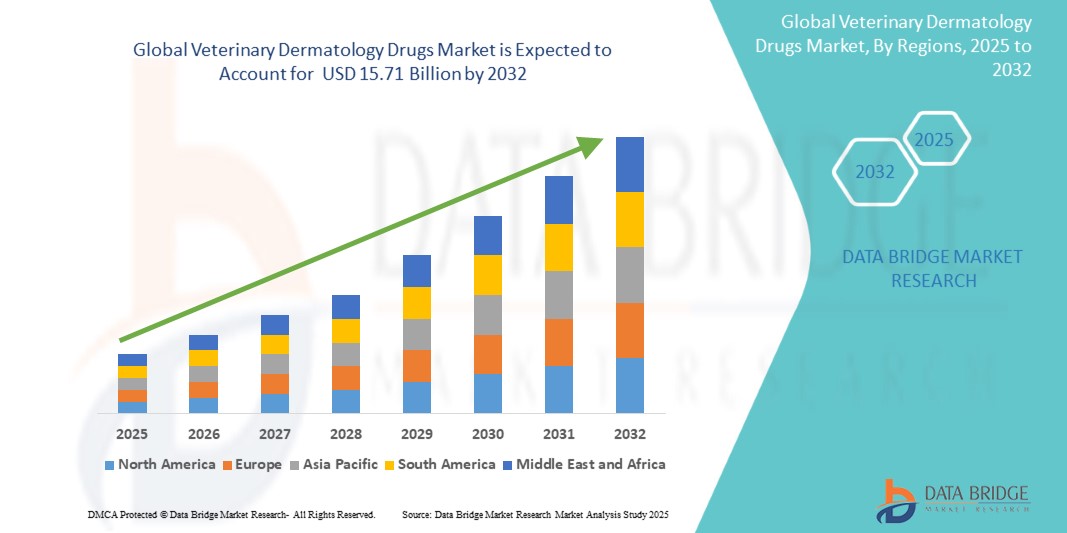
- The global veterinary dermatology drugs market size was valued at USD 4.79 billion in 2024 and is expected to reach USD 15.71 billion by 2032, at a CAGR of 16.02% during the forecast period
- This growth is driven by factors such as the increasing prevalence of skin diseases in animals and rising pet ownership, coupled with growing awareness of animal health and veterinary care
Veterinary Dermatology Drugs Market Analysis
- Veterinary dermatology drugs are essential for treating a range of skin conditions in animals, including allergies, infections, parasitic infestations, and autoimmune disorders, ensuring better quality of life and health outcomes for pets and livestock
- The market is driven by rising pet ownership, increasing awareness of animal health, and the growing incidence of dermatological conditions among companion animals
- North America is expected to dominate the veterinary dermatology drugs market with a market share of 31.5%, due to high pet ownership rates, robust veterinary healthcare infrastructure, and growing demand for premium animal care products
- Asia-Pacific is expected to be the fastest growing region in the veterinary dermatology drugs market with a market share of 25.5%, during the forecast period due to increasing pet adoption, rising awareness of animal health, and improving access to veterinary care
- Companion animal segment is expected to dominate the market with a market share of 66.5% due to its rising pet adoption rates, increased spending on pet healthcare, and growing awareness of skin-related conditions in pets
Report Scope and Veterinary Dermatology Drugs Market Segmentation
|
Attributes |
Veterinary Dermatology Drugs Key Market Insights |
|
Segments Covered |
|
|
Countries Covered |
North America
Europe
Asia-Pacific
Middle East and Africa
South America
|
|
Key Market Players |
|
|
Market Opportunities |
|
|
Value Added Data Infosets |
In addition to the insights on market scenarios such as market value, growth rate, segmentation, geographical coverage, and major players, the market reports curated by the Data Bridge Market Research also include import export analysis, production capacity overview, production consumption analysis, price trend analysis, climate change scenario, supply chain analysis, value chain analysis, raw material/consumables overview, vendor selection criteria, PESTLE Analysis, Porter Analysis, and regulatory framework. |
Veterinary Dermatology Drugs Market Trends
“Rise in Targeted Therapies and Innovative Drug Delivery Systems for Animal Skin Disorders”
- A key trend in the veterinary dermatology drugs market is the growing development of targeted therapies and advanced drug delivery systems designed to enhance treatment efficacy and reduce side effects
- These innovations include monoclonal antibodies and sustained-release formulations, which provide longer-lasting relief and reduce the need for frequent dosing
- For instance, treatments such as lokivetmab (a monoclonal antibody targeting canine atopic dermatitis) offer targeted action against specific allergens, improving symptom control with minimal systemic impact
- These advancements are improving treatment compliance, enhancing quality of life for animals, and expanding the therapeutic options available to veterinarians, thereby fueling market growth
Veterinary Dermatology Drugs Market Dynamics
Driver
“Rising Pet Ownership and Increasing Prevalence of Skin Disorders”
- The growing global pet population, coupled with rising awareness about animal health and wellness, is significantly boosting the demand for veterinary dermatology drugs
- Skin conditions such as atopic dermatitis, flea allergy dermatitis, and bacterial or fungal infections are increasingly common among companion animals, particularly dogs and cats, prompting more frequent veterinary visits and treatments
- Pet owners are becoming more proactive in seeking specialized dermatological care to improve their pets’ comfort and quality of life, driving the market for targeted and effective dermatology medications
For instance,
- In 2023, according to the American Pet Products Association (APPA), approximately 66% of U.S. households (equating to about 86.9 million homes) own a pet, and dermatological conditions are among the top reasons for veterinary consultations
- As skin disorders become more prevalent and pet owners increasingly seek professional care, the demand for veterinary dermatology drugs is expected to rise steadily
Opportunity
“Innovation in Biologics and Precision Medicine for Dermatological Treatments”
- Advancements in biologics and precision medicine are opening new avenues in veterinary dermatology, offering targeted treatments tailored to individual animals based on genetic and immunologic profiles
- Biologics, such as monoclonal antibodies, provide precise action against specific disease pathways, reducing side effects and improving therapeutic outcomes for chronic skin conditions such as atopic dermatitis
- In addition, innovations in diagnostic tools and personalized treatment plans are allowing veterinarians to accurately identify dermatological issues and customize therapies for enhanced effectiveness
For instance,
- In October 2023, Zoetis reported growing success with its biologic therapy, Cytopoint, which uses a monoclonal antibody to target interleukin-31 (IL-31), a key cytokine involved in canine atopic dermatitis. The product provides long-lasting relief with a single injection, improving pet and owner satisfaction
- As biologics and personalized approaches gain traction, they offer a significant opportunity to revolutionize veterinary dermatology care, enhance treatment precision, and expand the market
Restraint/Challenge
“High Cost of Advanced Therapies and Limited Access to Specialized Care”
- The high cost of advanced veterinary dermatology drugs, especially biologics and specialty formulations, presents a major challenge, limiting their adoption among pet owners with budget constraints and in regions with underdeveloped veterinary infrastructure
- Treatments such as monoclonal antibodies and targeted immunotherapies often come with premium pricing, which may not be affordable for all pet owners, especially when long-term or repeated dosing is required
- In addition, access to veterinary dermatology specialists is limited in many rural or low-income areas, resulting in delayed diagnosis and suboptimal treatment outcomes for affected animals
For instance,
- In July 2023, a report by the American Veterinary Medical Association (AVMA) highlighted the shortage of board-certified veterinary dermatologists in the U.S., with most specialists concentrated in urban centers. This geographic disparity, combined with the high cost of advanced treatments, limits care accessibility for many pets’ owner
- Consequently, the limited affordability and accessibility of specialized dermatological care can hinder market growth, especially in emerging economies and underserved communities
Veterinary Dermatology Drugs Market Scope
The market is segmented on the basis of animal, route of administration, indication, and distribution channel
|
Segmentation |
Sub-Segmentation |
|
By Animal |
|
|
By Route of administration |
|
|
By Indication |
|
|
By Distribution Channel |
|
In 2025, the companion animal is projected to dominate the market with a largest share in animal segment
The companion animal segment is expected to dominate the veterinary dermatology drugs market with the largest share of 66.5% in 2025 due to its rising pet adoption rates, increased spending on pet healthcare, and growing awareness of skin-related conditions in pets. The emotional bond between pet owners and their animals also drives demand for effective dermatological treatments. In addition, advancements in diagnostic capabilities and treatment options further support market growth in this segment.
The oral is expected to account for the largest share during the forecast period route of administration market
In 2025, the oral segment is expected to dominate the market with the largest market share of 46.5% due to its ease of administration, better compliance among pet owners, and broad availability of formulations. Oral drugs are often more cost-effective and convenient for long-term treatment of chronic dermatological conditions. In addition, advancements in palatable drug formulations enhance acceptance among animals, further boosting segment growth.
Veterinary Dermatology Drugs Market Regional Analysis
“North America Holds the Largest Share in the Veterinary Dermatology Drugs Market”
- North America dominates the veterinary dermatology drugs market with a market share of estimated 31.5%, driven by high pet ownership rates, robust veterinary healthcare infrastructure, and growing demand for premium animal care products
- U.S. holds a market share of 85.5%, due to the high prevalence of dermatological conditions in companion animals, increasing awareness among pet owners, and strong presence of leading pharmaceutical companies
- The favourable regulatory policies, widespread availability of advanced treatments such as biologics, and increasing spending on pet healthcare continue to support market dominance
- In addition, the rising trend of humanization of pets and growing investments in R&D for innovative dermatology solutions fuel the expansion of the veterinary dermatology drugs market across the region
“Asia-Pacific is Projected to Register the Highest CAGR in the Veterinary Dermatology Drugs Market”
- Asia-Pacific is expected to witness the highest growth rate in the veterinary dermatology drugs market with a market share of 25.5%, driven by increasing pet adoption, rising awareness of animal health, and improving access to veterinary care
- Countries such as China, India, and South Korea are emerging as significant markets due to the expanding middle-class population, growing disposable incomes, and increased focus on pet wellness
- Japan remains a key player in the region, supported by its advanced veterinary services and growing demand for dermatological treatments for companion animals
- India is projected to register the highest CAGR of 15.1% in the veterinary dermatology drugs market, driven by rapid urbanization, increasing veterinary infrastructure, and rising incidence of skin-related disorders in pets
Veterinary Dermatology Drugs Market Share
The market competitive landscape provides details by competitor. Details included are company overview, company financials, revenue generated, market potential, investment in research and development, new market initiatives, global presence, production sites and facilities, production capacities, company strengths and weaknesses, product launch, product width and breadth, application dominance. The above data points provided are only related to the companies' focus related to market.
The Major Market Leaders Operating in the Market Are:
- Elanco (U.S.)
- Merck & Co., Inc. (U.S.)
- Virbac (France)
- Zoetis Services LLC (U.S.)
- Boehringer Ingelheim International GmbH (Germany)
- Vetoquinol (France)
- Dechra Pharmaceuticals Limited (U.K.)
- HESTER BIOSCIENCES LIMITED (India)
- PetIQ, LLC. (U.S.)
- Ourofino Saúde Animal (Brazil)
- Swedencare AB (Sweden)
- Orion Oyj. (Finland)
- Norbrook (U.K.)
- Ceva (France)
- Bimeda Corporate (Ireland)
- Indian Immunologicals Ltd. (India)
- Vetanco (Argentina)
- Chanelle Pharma (Ireland)
- Pegasus Laboratories, Inc. (U.S.)
- Nutramax Laboratories, Inc. (U.S.)
Latest Developments in Global Veterinary Dermatology Drugs Market
- In October 2024, Animal Dermatology Group, Inc. expanded its network by acquiring four dermatology specialty practices: Long Green Animal Dermatology, Nashville Veterinary Dermatology, Animal Dermatology & Allergy, and Dermatology & Allergy Clinic for Animals. This strategic move aims to enhance the company's presence in veterinary dermatology services
- In October 2024, Elanco Animal Health received FDA approval for Credelio Quattro, a monthly chewable tablet for dogs aged eight weeks and older. This oral medication treats and prevents infestations of fleas, ticks, roundworms, hookworms, and tapeworms, and also prevents heartworm disease. Credelio Quattro is expected to be launched in the first quarter of 2025
- In September 2024, the U.S. FDA approved Zenrelia (ilunocitinib), a once-daily oral Janus kinase (JAK) inhibitor developed by Elanco Animal Health. This medication is indicated for controlling pruritus associated with allergic dermatitis and atopic dermatitis in dogs aged 12 months and older. Zenrelia offers a targeted approach to managing chronic skin conditions in canine
- In April 2024, the European Medicines Agency approved Lotimax, a chewable tablet containing lotilaner, for the treatment of flea, tick, and mite infestations in dogs. Lotimax is also indicated for treating demodicosis (caused by Demodex canis), providing a broad-spectrum solution for common parasitic skin conditions in canines
- In March 2024, the FDA approved Duotic, a combination of terbinafine (antifungal) and betamethasone acetate (glucocorticosteroid), for the treatment of otitis externa (ear infections) caused by yeast (Malassezia pachydermatis) in dogs. Duotic is notable for being the first FDA-approved veterinary otic medication targeting yeast-only infections without containing antibiotics

- Interactive Data Analysis Dashboard
- Company Analysis Dashboard for high growth potential opportunities
- Research Analyst Access for customization & queries
- Competitor Analysis with Interactive dashboard
- Latest News, Updates & Trend analysis
- Harness the Power of Benchmark Analysis for Comprehensive Competitor Tracking
Data collection and base year analysis are done using data collection modules with large sample sizes. The stage includes obtaining market information or related data through various sources and strategies. It includes examining and planning all the data acquired from the past in advance. It likewise envelops the examination of information inconsistencies seen across different information sources. The market data is analysed and estimated using market statistical and coherent models. Also, market share analysis and key trend analysis are the major success factors in the market report. To know more, please request an analyst call or drop down your inquiry.
The key research methodology used by DBMR research team is data triangulation which involves data mining, analysis of the impact of data variables on the market and primary (industry expert) validation. Data models include Vendor Positioning Grid, Market Time Line Analysis, Market Overview and Guide, Company Positioning Grid, Patent Analysis, Pricing Analysis, Company Market Share Analysis, Standards of Measurement, Global versus Regional and Vendor Share Analysis. To know more about the research methodology, drop in an inquiry to speak to our industry experts.
Data Bridge Market Research is a leader in advanced formative research. We take pride in servicing our existing and new customers with data and analysis that match and suits their goal. The report can be customized to include price trend analysis of target brands understanding the market for additional countries (ask for the list of countries), clinical trial results data, literature review, refurbished market and product base analysis. Market analysis of target competitors can be analyzed from technology-based analysis to market portfolio strategies. We can add as many competitors that you require data about in the format and data style you are looking for. Our team of analysts can also provide you data in crude raw excel files pivot tables (Fact book) or can assist you in creating presentations from the data sets available in the report.












