


What is the Veterinary Point-of-Care Diagnostics Market Size and Growth Rate?
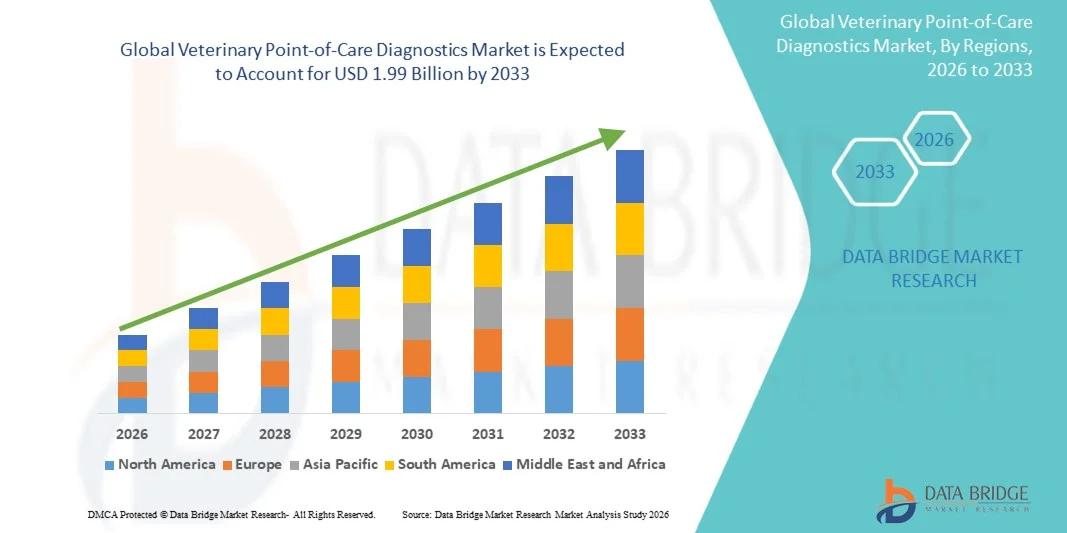
- As per Data Bridge Market Research analysis, the veterinary point-of-care diagnostics market was valued at USD 1.10 billion in 2025 and is projected to reach USD 1.99 billion by 2033, growing at a CAGR of 7.73% from 2026 to 2033.
- The market is experiencing robust growth driven by increasing pet ownership and animal healthcare expenditure, rising prevalence of infectious and zoonotic diseases, and growing demand for rapid, accurate, and on-site diagnostic testing across veterinary clinics, hospitals, and livestock farms. Advances in point-of-care diagnostic instruments and test kits are further supporting market expansion.
- The growing emphasis on early disease detection, preventive veterinary care, and timely clinical decision-making, combined with continuous innovations in portable diagnostic platforms, immunoassays, molecular diagnostics, and AI-enabled testing solutions, is encouraging veterinarians and animal healthcare providers to adopt point-of-care diagnostics. These systems enable faster diagnosis, reduce turnaround time, improve treatment outcomes, and support efficient disease surveillance in both companion and livestock animals.
Market Size & Forecast
- Global Market Value (2025): USD 1.10 Billion
- Expected Market Value (2033): USD 1.99 Billion
- Forecast CAGR (2026–2033): 7.73%
- Leading Region in 2025: North America
- Fastest Growing Region: Asia Pacific
What are the Major Takeaways of the Veterinary Point-of-Care Diagnostics Market?
- North America dominated the veterinary point-of-care diagnostics market with the largest revenue share of 48.1% in 2025, supported by high pet ownership, advanced veterinary healthcare infrastructure, favorable pet insurance coverage, and the strong presence of leading diagnostic manufacturers.
- Asia-Pacific is expected to be the fastest-growing region at a CAGR of 14.1% from 2026 to 2033, fueled by increasing companion animal adoption, expanding livestock production, rising veterinary healthcare expenditure, and improving access to advanced diagnostic technologies.
- The companion animals segment led the market with a 59.9% share in 2025, driven by increasing pet ownership, rising pet humanization, and growing expenditure on preventive veterinary healthcare.
- Livestock animals are the fastest-growing animal type, projected to register a CAGR of 11.8%, reflecting the surge in focus on food safety, disease surveillance, and herd health management.
- The clinical chemistry segment dominated the testing category with a 28.0% revenue share in 2025, led by its extensive use in routine veterinary health assessments and disease diagnosis.
- Immunodiagnostics accounted for 34.0% of the market share in 2025, preferred by its widespread application in rapid antigen, antibody, and hormone detection.
- The urine segment is the fastest-growing sample type category, with a CAGR of 12.4%, driven by the increasing use in kidney disease, urinary tract infection, and metabolic disorder diagnosis
Report Scope and Veterinary Point-of-Care Diagnostics Market Segmentation
|
Attributes |
Veterinary Point-of-Care Diagnostics Key Market Insights |
|
Segments Covered |
|
|
Countries Covered |
North America
Europe
Asia-Pacific
Middle East and Africa
South America
|
|
Key Market Players |
|
|
Market Opportunities |
|
|
Value Added Data Infosets |
In addition to the insights on market scenarios such as market value, growth rate, segmentation, geographical coverage, and major players, the market reports curated by the Data Bridge Market Research also include in-depth expert analysis, patient epidemiology, pipeline analysis, pricing analysis, and regulatory framework. |
What is the Key Trend in the Veterinary Point-of-Care Diagnostics Market?
- Veterinary clinics are increasingly adopting rapid molecular and multiplex point-of-care diagnostic platforms to enable faster disease detection, improve treatment decisions, and reduce turnaround times for companion and livestock animals.
- For instance, in January 2025, IDEXX Laboratories announced the IDEXX Cancer Dx Panel, a first-of-its-kind diagnostic panel for early detection of canine lymphoma in North America, expanding rapid diagnostic capabilities for companion animal healthcare.
- The integration of digital connectivity, cloud-based data management, and AI-assisted interpretation is enabling veterinarians to streamline diagnostic workflows while improving clinical efficiency and patient outcomes.
- Veterinary hospitals and animal health networks are increasingly utilizing portable point-of-care analyzers to support immediate clinical decision-making, preventive care programs, and infectious disease surveillance.
- For instance, in March 2023, Zoetis expanded the Vetscan Imagyst platform by introducing AI Dermatology and AI Equine Fecal Egg Count Analysis, enabling veterinarians to obtain rapid, AI-powered dermatology results within minutes during patient visits.
- As veterinary practices continue to prioritize rapid diagnosis, preventive healthcare, and decentralized testing, adoption of advanced point-of-care diagnostics is expected to accelerate across both companion animal and livestock healthcare settings.
What are the Key Drivers of the Veterinary Point-of-Care Diagnostics Market?
- The increasing prevalence of infectious and zoonotic diseases, combined with growing pet ownership and rising expenditure on animal healthcare, has significantly increased demand for rapid veterinary point-of-care diagnostic solutions across clinical settings.
- For instance, in January 2024, Zoetis expanded the Vetscan Imagyst platform by introducing AI Urine Sediment Analysis, enabling veterinarians to perform rapid, in-clinic urine sediment evaluation with AI-powered analysis for faster diagnosis and treatment decisions.
- Veterinary hospitals, clinics, and livestock producers are increasingly integrating in-house diagnostic testing to enable early disease detection, faster treatment decisions, and improved herd health management while minimizing laboratory turnaround times.
- For instance, in June 2025, IDEXX Laboratories launched the Catalyst Cortisol Test, providing veterinarians with rapid in-clinic adrenal function assessment to support same-visit clinical decision-making for Addison's disease and Cushing's syndrome in dogs.
- With increasing emphasis on preventive veterinary medicine, antimicrobial stewardship, and timely diagnosis, point-of-care diagnostics are becoming essential tools for improving clinical outcomes and operational efficiency across animal healthcare systems.
Which Factors are Challenging the Growth of the Veterinary Point-of-Care Diagnostics Market?
- Advanced veterinary point-of-care diagnostic systems require substantial capital investment, continuous consumable purchases, and regular maintenance, increasing the overall cost of ownership for veterinary practices.
- For instance, in October 2024, the World Organisation for Animal Health (WOAH) highlighted that veterinary laboratory networks worldwide continue to face poorly adapted infrastructure, insufficient funding, lack of trained staff, and inadequate equipment and consumables, limiting timely and reliable animal disease diagnosis.
- These high equipment and operating costs limit adoption among small veterinary clinics, rural animal healthcare facilities, and livestock practices operating within constrained healthcare budgets.
- Limited availability of trained veterinary professionals capable of operating advanced diagnostic platforms and interpreting complex test results further restricts adoption across underserved and resource-constrained regions.
- For instance, the Food and Agriculture Organization (FAO) highlights insufficient veterinary diagnostic capacity and workforce limitations as key challenges affecting effective animal disease surveillance and control globally.
- For instance, in May 2025, WOAH stated that under-resourced Veterinary Services lead to delayed disease detection, wider disease spread, and higher outbreak control costs, emphasizing the need for greater investment in veterinary diagnostic infrastructure and surveillance systems.
- High acquisition costs, infrastructure limitations, and workforce shortages continue to restrict widespread deployment of advanced veterinary point-of-care diagnostics, particularly in emerging markets despite increasing demand for rapid animal disease diagnosis.
How is the Veterinary Point-of-Care Diagnostics Market Segmented?
The veterinary point-of-care diagnostics market is segmented on the basis of animal type, testing category, technology, sample type, disease indication, and end user.
- By Animal Type
On the basis of animal type, the veterinary point-of-care diagnostics market is segmented into companion animals and livestock animals. The companion animals segment dominated the market with a 59.9% revenue share in 2025, driven by increasing pet ownership, rising pet humanization, and growing expenditure on preventive veterinary healthcare. Companion animals undergo routine wellness examinations, resulting in higher demand for rapid in-clinic diagnostic testing. Increasing prevalence of chronic diseases, infectious diseases, endocrine disorders, and cancer in pets is further supporting test volumes. Veterinary hospitals are increasingly adopting point-of-care analyzers to provide same-visit diagnosis and treatment decisions. Favorable pet insurance coverage in developed countries also encourages frequent diagnostic screening. Continuous product innovation by leading companies further strengthens the segment's leadership.
The livestock animals segment is projected to register the fastest growth at a CAGR of 11.8% from 2026 to 2033, driven by increasing focus on food safety, disease surveillance, and herd health management. Rising outbreaks of transboundary and zoonotic diseases are encouraging rapid on-farm diagnostic testing. Governments and livestock producers are investing in disease monitoring programs to reduce production losses and improve productivity. Growing demand for animal-derived food products is increasing the need for preventive healthcare. Portable point-of-care diagnostic devices enable faster disease detection while minimizing laboratory turnaround times. Expansion of commercial livestock farming across emerging economies is further accelerating segment growth.
- By Testing Category
On the basis of testing category, the veterinary point-of-care diagnostics market is segmented into hematology, diagnostic imaging, bacteriology, virology, cytology, clinical chemistry, parasitology, molecular diagnostics, urinalysis, and histopathology. The clinical chemistry segment dominated the market with an estimated revenue share of 28.0% in 2025, owing to its extensive use in routine veterinary health assessments and disease diagnosis. Clinical chemistry analyzers are widely utilized to evaluate liver, kidney, pancreatic, and metabolic disorders in companion and livestock animals. Veterinary clinics increasingly rely on these tests because of their rapid turnaround time and high diagnostic accuracy. Continuous advancements in analyzer automation have improved workflow efficiency and testing reliability. Growing demand for preventive animal healthcare further supports routine biochemical screening. Broad application across multiple disease conditions continues to reinforce the segment's leading position.
The molecular diagnostics segment is projected to witness the fastest growth at a CAGR of 13.2% from 2026 to 2033, driven by increasing demand for rapid and highly sensitive pathogen detection. Molecular technologies enable early identification of infectious diseases before clinical symptoms become severe. Rising incidence of zoonotic diseases and antimicrobial resistance is accelerating the adoption of PCR-based and nucleic acid testing. Technological advancements are making molecular platforms increasingly compact and suitable for point-of-care use. Veterinary laboratories and clinics are expanding molecular testing capabilities to improve treatment outcomes. Growing investment in precision veterinary medicine is further supporting segment expansion.
- By Technology
On the basis of technology, the veterinary point-of-care diagnostics market is segmented into immunodiagnostics, clinical biochemistry, molecular diagnostics, hematology, urinalysis, and other technologies. The immunodiagnostics segment dominated the market with an estimated revenue share of 34.0% in 2025, due to its widespread application in rapid antigen, antibody, and hormone detection. Immunodiagnostic assays are extensively used for infectious disease screening and routine veterinary wellness testing. These technologies provide fast, reliable, and cost-effective diagnostic results within veterinary clinics. Increasing demand for rapid disease diagnosis is driving broader adoption of immunoassay-based analyzers. Continuous improvements in assay sensitivity and specificity are enhancing clinical confidence. Their versatility across multiple animal species continues to support market leadership.
The molecular diagnostics segment is projected to register the fastest growth at a CAGR of 13.5% from 2026 to 2033, because of increasing demand for highly accurate infectious disease diagnosis. Veterinary professionals are increasingly utilizing molecular platforms for early pathogen detection and disease surveillance. Continuous innovation in portable PCR technologies is improving accessibility at the point of care. Rising concerns regarding zoonotic disease transmission are encouraging greater investment in molecular testing. Expansion of genomic technologies and precision veterinary medicine further strengthens adoption. Increasing availability of rapid molecular diagnostic kits is expected to accelerate future market growth.
- By Sample Type
On the basis of sample type, the veterinary point-of-care diagnostics market is segmented into blood/plasma/serum, urine, fecal, and other sample types. The blood/plasma/serum segment dominated the market with an estimated revenue share of 46.0% in 2025, owing to its broad use in routine diagnostic evaluation and disease monitoring. Blood-based testing provides valuable information regarding organ function, infections, endocrine disorders, and metabolic abnormalities. Veterinary clinics routinely perform blood chemistry, hematology, and immunodiagnostic testing during wellness examinations. Continuous improvements in portable blood analyzers are supporting rapid in-clinic testing. The availability of standardized testing protocols further strengthens adoption. High diagnostic reliability continues to maintain the segment's dominant position.
The urine segment is projected to witness the fastest growth at a CAGR of 12.4% from 2026 to 2033, supported by increasing use in kidney disease, urinary tract infection, and metabolic disorder diagnosis. AI-enabled urine sediment analysis and automated urinalysis platforms are improving diagnostic efficiency. Growing awareness regarding early renal disease detection in companion animals is increasing testing frequency. Veterinary clinics are increasingly integrating rapid urinalysis into preventive health programs. Technological advancements have enhanced the accuracy and convenience of urine-based diagnostics. Expansion of point-of-care urine analyzers continues to drive market growth.
- By Disease Indication
On the basis of disease indication, the veterinary point-of-care diagnostics market is segmented into infectious diseases, general ailments, orthopedic disorders, cancer, and other indications. The infectious diseases segment dominated the market with an estimated revenue share of 36.0% in 2025, driven by the increasing prevalence of bacterial, viral, and parasitic infections in companion and livestock animals. Early diagnosis is essential for timely treatment and effective disease control. Veterinary clinics increasingly utilize rapid diagnostic tests to minimize disease transmission and improve clinical outcomes. Government surveillance programs for zoonotic diseases further support testing demand. Continuous development of multiplex diagnostic assays is enhancing testing capabilities. Increasing awareness regarding preventive veterinary healthcare continues to reinforce market leadership.
The cancer segment is projected to register the fastest growth at a CAGR of 13.8% from 2026 to 2033, due to increasing incidence of oncology cases in companion animals. Rising awareness of early cancer detection is encouraging adoption of advanced diagnostic screening technologies. Veterinary professionals are increasingly utilizing rapid biomarker-based diagnostic tests for treatment planning. Continuous innovation in liquid biopsy and molecular oncology diagnostics is expanding clinical applications. Growing investment in companion animal oncology is supporting product development. Increasing availability of advanced cancer screening solutions is expected to drive future market expansion.
- By End User
On the basis of end user, the veterinary point-of-care diagnostics market is segmented into veterinary hospitals & clinics, home care settings, and other end users. The veterinary hospitals & clinics segment dominated the market with an estimated revenue share of 68.0% in 2025, owing to increasing availability of advanced in-house diagnostic facilities and skilled veterinary professionals. Most rapid diagnostic testing is performed during routine consultations and emergency care visits. Veterinary hospitals continue to invest in automated analyzers to improve workflow efficiency and clinical decision-making. Rising patient volumes and increasing preventive healthcare visits further support testing demand. Immediate access to diagnostic results enables same-visit treatment decisions and improved patient outcomes. Continuous investment in modern veterinary infrastructure reinforces segment dominance.
The home care settings segment is projected to witness the fastest growth at a CAGR of 12.7% from 2026 to 2033, driven by increasing pet owner preference for convenient at-home monitoring solutions. Growing availability of portable diagnostic devices is expanding home-based testing capabilities. Telemedicine integration is enabling veterinarians to remotely interpret diagnostic results and monitor disease progression. Rising demand for chronic disease management and preventive healthcare is encouraging home diagnostic adoption. Technological advancements are improving usability and testing accuracy for non-professional users. Increasing focus on remote animal healthcare is expected to support sustained market growth.
Which Region Holds the Largest Share of the Veterinary Point-of-Care Diagnostics Market?
- North America dominated the veterinary point-of-care diagnostics market with the largest revenue share of 48.1% in 2025, supported by high pet ownership, advanced veterinary healthcare infrastructure, favorable pet insurance coverage, and the strong presence of leading diagnostic manufacturers.
- The region also benefits from widespread adoption of rapid in-clinic diagnostic technologies, favorable pet insurance coverage, increasing prevalence of companion animal diseases, and growing demand for preventive veterinary care. Continuous technological advancements in molecular diagnostics and immunodiagnostics, along with rising investments in veterinary healthcare and animal disease surveillance, continue to strengthen North America's leadership position in the global market.
U.S. Veterinary Point-of-Care Diagnostics Market Insight
The U.S. veterinary point-of-care diagnostics market is witnessing strong growth due to increasing pet ownership, rising expenditure on companion animal healthcare, and widespread adoption of advanced in-clinic diagnostic technologies. The country's well-established veterinary healthcare infrastructure, strong presence of leading diagnostic manufacturers such as IDEXX Laboratories, Zoetis, and Thermo Fisher Scientific, and growing demand for rapid disease diagnosis are driving market expansion. Veterinary hospitals are increasingly integrating molecular diagnostics, immunodiagnostics, and AI-enabled analyzers to improve same-visit clinical decision-making and treatment outcomes. In addition, increasing emphasis on preventive veterinary medicine, pet insurance coverage, and chronic disease management is accelerating adoption of point-of-care diagnostic platforms across veterinary hospitals and clinics. According to the APPA National Pet Owners Survey, 94 million U.S. households own at least one pet, creating sustained demand for veterinary diagnostic testing and preventive healthcare services.
Asia-Pacific Veterinary Point-of-Care Diagnostics Market Insight
The Asia-Pacific veterinary point-of-care diagnostics market is expected to witness rapid growth, driven by increasing companion animal adoption, expanding livestock production, and rising investments in veterinary healthcare infrastructure across China, India, Japan, Australia, and Southeast Asia. Growing awareness regarding zoonotic disease surveillance, food safety, and preventive animal healthcare is encouraging veterinary clinics and livestock producers to adopt rapid diagnostic technologies. Governments across the region are strengthening disease surveillance systems while expanding veterinary laboratory networks to improve early disease detection. In addition, increasing availability of portable diagnostic platforms and rising commercial livestock farming are supporting long-term regional market expansion. The FAO Emergency Centre for Transboundary Animal Diseases (ECTAD) continues to strengthen veterinary diagnostic capacity and animal disease surveillance programs across Asia-Pacific countries.
Japan Veterinary Point-of-Care Diagnostics Market Insight
The Japan veterinary point-of-care diagnostics market is witnessing consistent growth due to increasing companion animal ownership, rising spending on pet healthcare, and growing adoption of advanced diagnostic technologies by veterinary hospitals and specialty clinics. Veterinarians are increasingly utilizing rapid in-clinic analyzers and molecular diagnostic platforms to improve early disease detection, preventive care, and chronic disease management. Continuous technological innovation, an aging pet population, and strong emphasis on animal welfare are further supporting market growth. The country's highly developed veterinary healthcare system also encourages adoption of next-generation diagnostic solutions. According to the Japan Pet Food Association, Japan had approximately 15.9 million dogs and cats kept as pets in 2024, supporting sustained demand for veterinary healthcare and diagnostic services.
China Veterinary Point-of-Care Diagnostics Market Insight
The China veterinary point-of-care diagnostics market is growing rapidly, driven by increasing pet ownership, expanding commercial livestock production, and rising government focus on animal disease prevention and food safety. Growing adoption of rapid diagnostic technologies across veterinary hospitals, animal health laboratories, and livestock operations is significantly boosting market demand. Continuous investments in veterinary infrastructure, stronger surveillance of transboundary animal diseases, and increasing awareness regarding preventive animal healthcare are supporting market expansion. Rising disposable incomes and increasing pet humanization are further accelerating demand for advanced veterinary diagnostic solutions. China's Ministry of Agriculture and Rural Affairs (MARA) continues implementing the National Animal Disease Surveillance Program, strengthening nationwide diagnostic testing and monitoring for major livestock diseases.
U.K. Veterinary Point-of-Care Diagnostics Market Insight
The U.K. veterinary point-of-care diagnostics market is experiencing steady growth, supported by increasing pet ownership, growing expenditure on companion animal healthcare, and widespread adoption of advanced diagnostic technologies by veterinary practices. Rising awareness regarding preventive healthcare, early disease diagnosis, and routine wellness screening is contributing to greater utilization of rapid point-of-care testing. Veterinary hospitals are increasingly investing in molecular diagnostics, digital pathology, and AI-assisted diagnostic platforms to improve workflow efficiency and patient outcomes. Ongoing research activities and continuous technological innovation are further supporting market development across the country. According to the PDSA Animal Wellbeing (PAW) Report 2025, 51% of U.K. adults own a pet, reflecting sustained demand for veterinary healthcare and diagnostic services.
Germany Veterinary Point-of-Care Diagnostics Market Insight
The Germany veterinary point-of-care diagnostics market is expanding steadily due to the country's advanced veterinary healthcare infrastructure, increasing companion animal population, and growing adoption of innovative diagnostic technologies. Veterinary hospitals and clinics are increasingly investing in rapid immunodiagnostic, hematology, and molecular diagnostic platforms to improve clinical decision-making and disease management. Germany's strong focus on animal welfare, livestock health monitoring, and veterinary research is further encouraging the adoption of advanced point-of-care diagnostics. Continuous investment in veterinary innovation and laboratory modernization continues to strengthen market growth. According to the German Pet Trade & Industry Association (ZZF), Germany had approximately 34 million companion animals living in households in 2024, making it one of Europe's largest pet care markets.
Which are the Top Companies in Veterinary Point-of-Care Diagnostics Market?
The veterinary point-of-care diagnostics industry is primarily led by well-established companies, including:
- IDEXX (U.S.)
- Zoetis Services LLC (U.S.)
- Virbac (France)
- Thermo Fisher Scientific Inc. (U.S.)
- Shenzhen Mindray Bio-Medical Electronics Co., Ltd. (China)
- Randox Laboratories Ltd. (U.K.)
- BioNote, Inc. (South Korea)
- MEGACOR Diagnostik GmbH (Austria)
- Fassisi GmbH (Germany)
- Biogal Galed Labs. Acs Ltd. (Israel)
- GeneReach Biotechnology Corp. (Taiwan)
- Eurolyser Diagnostica GmbH (Austria)
- Woodley Equipment Company Ltd. (U.K.)
- Eurofins Technologies (France)
- IMMY (U.S.)
- Tetracore, Inc. (U.S.)
- Getein Biotech, Inc. (China)
- QIAGEN (Netherlands)
- SEKISUI Diagnostics, LLC (U.S.)
- INDICAL BIOSCIENCE GmbH (Germany)
What are Latest Developments in Veterinary Point-of-Care Diagnostics Market?
- In June 2025, IDEXX Laboratories launched the Catalyst Cortisol Test, an advanced in-clinic diagnostic assay that provides real-time quantitative cortisol measurements to support the diagnosis of Addison's disease and the diagnosis and long-term management of Cushing's syndrome in dogs. The test delivers reference laboratory-quality results directly on the Catalyst platform during the patient visit, enabling veterinarians to make immediate treatment decisions while reducing dependence on external laboratories. The launch also marked the third expansion of the Catalyst platform in less than one year, further strengthening IDEXX's point-of-care diagnostic portfolio.
- In January 2025, IDEXX Laboratories announced the IDEXX Cancer Dx Panel, a first-of-its-kind blood-based diagnostic panel for the early detection of canine lymphoma. The test is designed to be incorporated into routine wellness screenings as well as diagnostic workups for sick dogs, providing veterinarians with actionable results within 2–3 days. IDEXX also announced plans to expand the panel over the next three years to cover the majority of canine cancers, reinforcing its commitment to advancing early cancer detection in veterinary medicine.
- In January 2024, Zoetis expanded the Vetscan Imagyst® platform with the launch of AI Urine Sediment Analysis, enabling veterinary clinics to automate urine sediment examination using artificial intelligence. The new diagnostic capability rapidly identifies clinically relevant urine particles, including cells, crystals, casts, and bacteria, while standardizing result interpretation and reducing manual microscopy time. The enhancement improves workflow efficiency and supports faster diagnosis of urinary tract and kidney disorders in companion animals.
- In March 2023, Zoetis expanded its Vetscan Imagyst platform by launching AI Dermatology and AI Equine Fecal Egg Count Analysis, adding two AI-powered diagnostic applications to its cloud-connected point-of-care system. The new solutions enable veterinarians to rapidly analyze dermatological samples and equine fecal specimens within minutes, improving diagnostic consistency, reducing turnaround time, and supporting more informed clinical decisions. The launch demonstrates Zoetis' continued investment in artificial intelligence to advance veterinary point-of-care diagnostics.

- Interactive Data Analysis Dashboard
- Company Analysis Dashboard for high growth potential opportunities
- Research Analyst Access for customization & queries
- Competitor Analysis with Interactive dashboard
- Latest News, Updates & Trend analysis
- Harness the Power of Benchmark Analysis for Comprehensive Competitor Tracking
Data collection and base year analysis are done using data collection modules with large sample sizes. The stage includes obtaining market information or related data through various sources and strategies. It includes examining and planning all the data acquired from the past in advance. It likewise envelops the examination of information inconsistencies seen across different information sources. The market data is analysed and estimated using market statistical and coherent models. Also, market share analysis and key trend analysis are the major success factors in the market report. To know more, please request an analyst call or drop down your inquiry.
The key research methodology used by DBMR research team is data triangulation which involves data mining, analysis of the impact of data variables on the market and primary (industry expert) validation. Data models include Vendor Positioning Grid, Market Time Line Analysis, Market Overview and Guide, Company Positioning Grid, Patent Analysis, Pricing Analysis, Company Market Share Analysis, Standards of Measurement, Global versus Regional and Vendor Share Analysis. To know more about the research methodology, drop in an inquiry to speak to our industry experts.
Data Bridge Market Research is a leader in advanced formative research. We take pride in servicing our existing and new customers with data and analysis that match and suits their goal. The report can be customized to include price trend analysis of target brands understanding the market for additional countries (ask for the list of countries), clinical trial results data, literature review, refurbished market and product base analysis. Market analysis of target competitors can be analyzed from technology-based analysis to market portfolio strategies. We can add as many competitors that you require data about in the format and data style you are looking for. Our team of analysts can also provide you data in crude raw excel files pivot tables (Fact book) or can assist you in creating presentations from the data sets available in the report.













