


What is the Video Surveillance Storage (VSS) Market Size and Growth Rate?
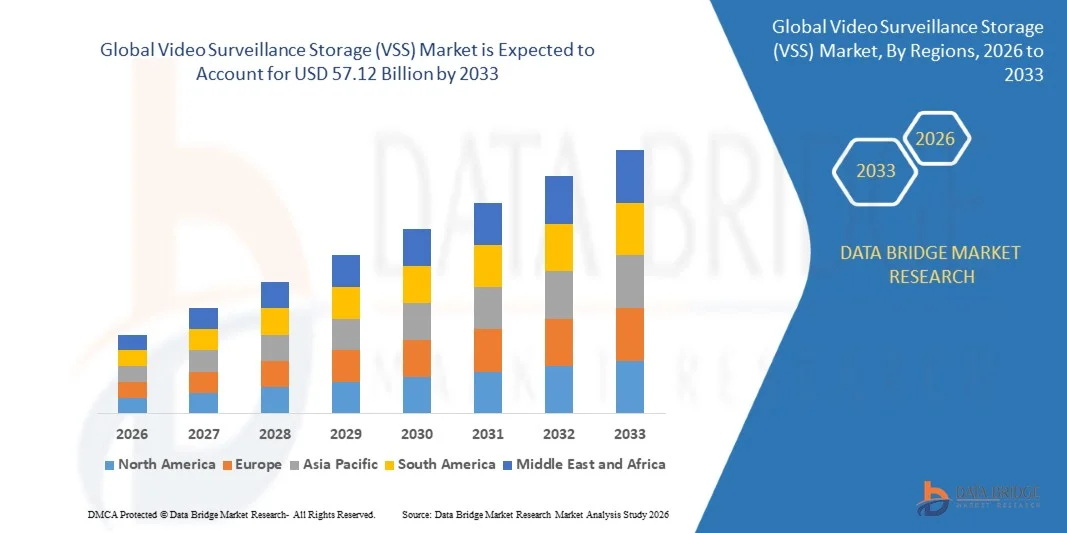
- As per Data Bridge Market Research analysis, the video surveillance storage (VSS) market was valued at USD 16.38 billion in 2025 and is projected to reach USD 57.12 billion by 2033, growing at a CAGR of 16.90% from 2026 to 2033.
- The market is witnessing strong growth due to the increasing deployment of IP-based surveillance systems, the rapid adoption of AI-powered video analytics, and the growing need for scalable, high-capacity storage solutions across commercial, industrial, government, and smart city applications.
- The rising installation of high-resolution surveillance cameras, including 4K and 8K systems, coupled with stringent data retention regulations and increasing security concerns, is significantly driving demand for advanced video surveillance storage. Organizations are increasingly adopting cloud, hybrid, and edge storage architectures to efficiently manage the exponential growth in video data while ensuring real-time accessibility, cybersecurity, and regulatory compliance. In addition, the expansion of smart cities, critical infrastructure protection, transportation networks, and enterprise security is further accelerating the adoption of next-generation VSS solutions worldwide.
Market Size & Forecast
- Market Value (2025): USD 2.32 Billion
- Expected Market Value (2033): USD 3.63 Billion
- Forecast CAGR (2026–2033): 4.40%
- Leading Region in 2025: North America
- Fastest Growing Region: Asia-Pacific
What are the Major Takeaways of the Video Surveillance Storage (VSS) Market?
- North America dominated the video surveillance storage (VSS) market with the largest revenue share in 2025, supported by increasing investments in public safety infrastructure, growing deployment of IP-based surveillance systems, and rising demand for secure storage of high-definition video data.
- Asia-Pacific video surveillance storage market is expected to witness the fastest growth rate from 2026 to 2033, supported by rapid urbanization, expanding smart city initiatives, and increasing government investments in surveillance infrastructure.
- The video recorders segment held the largest market revenue share in 2025, driven by its widespread deployment across retail stores, office buildings, residential complexes, and commercial facilities. Video recorders are preferred due to their ease of installation, integrated video management capabilities, and cost-effective storage architecture for small- and medium-scale surveillance systems.
- The storage area network (SAN) segment is projected to register the fastest growth from 2026 to 2033, driven by increasing demand for high-performance storage infrastructure in large enterprises, smart city projects, and government surveillance networks. Rising adoption of high-resolution cameras and AI-powered video analytics is accelerating segment expansion.
- The on-premises segment held the largest market revenue share in 2025, driven by increasing demand for direct control over surveillance data, enhanced cybersecurity, and compliance with regulatory requirements. Government agencies, critical infrastructure operators, and large enterprises continue to favor on-premises deployments for long-term video retention and secure data management.
- The cloud segment is projected to register the fastest growth from 2026 to 2033, driven by growing adoption of scalable storage solutions, lower infrastructure costs, remote accessibility, and increasing deployment of cloud-based video surveillance platforms across SMEs and commercial organizations.
Report Scope and Video Surveillance Storage (VSS) Market Segmentation
|
Attributes |
Video Surveillance Storage (VSS) Market Key Market Insights |
|
Segments Covered |
|
|
Countries Covered |
North America
Europe
Asia-Pacific
Middle East and Africa
South America
|
|
Key Market Players |
|
|
Market Opportunities |
|
|
Value Added Data Infosets |
In addition to the market insights such as market value, growth rate, market segments, geographical coverage, market players, and market scenario, the market report curated by the Data Bridge Market Research team includes in-depth expert analysis, import/export analysis, pricing analysis, production consumption analysis, and pestle analysis. |
What is the Key Trend in the Video Surveillance Storage (VSS) Market?
- Organizations across smart cities, transportation, retail, critical infrastructure, and commercial facilities are increasingly deploying AI-enabled video surveillance systems capable of facial recognition, object detection, behavior analysis, and real-time event monitoring. These advanced analytics generate significantly larger volumes of high-resolution video, driving demand for scalable, high-capacity, and intelligent video surveillance storage (VSS) solutions.
- For instance, in August 2025, Hikvision launched pStor, a Windows-based enterprise video storage software integrated with HikCentral Professional. The platform supports clustered storage architecture, resource pooling, direct stream storage, automatic failover, and compatibility with HDD, RAID, NAS, and SAN systems, enabling enterprises to efficiently manage large-scale AI-enabled surveillance deployments with faster video retrieval and long-term retention.
- The increasing adoption of AI-powered surveillance, 4K/8K cameras, and continuous 24/7 video recording is accelerating the need for surveillance-optimized storage devices that deliver higher capacity, improved reliability, lower power consumption, and faster data access.
- For instance, in February 2026, WD (formerly Western Digital) introduced its 40TB UltraSMR HDD and outlined a 100TB+ HAMR technology roadmap. These next-generation HDD innovations provide higher storage density, improved energy efficiency, and enhanced scalability for AI-driven video surveillance workloads, enabling longer video retention and cost-effective expansion of surveillance infrastructure.
- Enterprises are also increasingly adopting hybrid storage architectures that combine on-premises HDDs, NAS/SAN infrastructure, and cloud-based storage to improve resilience, simplify centralized management, and support geographically distributed surveillance networks.
- As organizations continue investing in AI-powered surveillance, smart city infrastructure, and higher-resolution imaging technologies, demand for intelligent, scalable, and energy-efficient video surveillance storage solutions is expected to accelerate, making AI-ready storage architectures a defining trend in the VSS market.
What are the Key Drivers of the Video Surveillance Storage (VSS) Market?
- The rapid deployment of AI-powered video surveillance systems, coupled with the widespread adoption of high-resolution IP cameras (4K, 8K, and multi-sensor cameras), has significantly increased the volume of video data generated across commercial, government, transportation, healthcare, and smart city applications. This is driving demand for high-capacity, scalable, and reliable video surveillance storage (VSS) solutions capable of supporting continuous recording and long-term data retention.
- In April 2025, Axis Communications introduced the AXIS Q6358-LE PTZ Camera, featuring a 4K UHD sensor, AI-based deep learning analytics, object classification, and advanced tracking capabilities. The deployment of AI-enabled 4K surveillance cameras generates substantially larger volumes of video data, increasing the need for high-capacity, reliable storage systems capable of continuous recording and long-term retention.
- Governments, enterprises, and critical infrastructure operators are increasingly investing in surveillance systems to enhance public safety, regulatory compliance, and operational security. As surveillance networks expand, organizations require storage platforms that deliver high availability, scalability, cybersecurity, and rapid video retrieval while supporting continuous 24/7 recording.
- Storage manufacturers are also introducing higher-capacity and energy-efficient HDD technologies to accommodate the exponential growth of surveillance footage generated by AI-enabled cameras and analytics platforms.
- As organizations continue expanding AI-enabled surveillance networks and deploying higher-resolution imaging technologies, demand for scalable, secure, and high-performance video surveillance storage solutions is expected to grow, making advanced storage infrastructure a fundamental component of modern physical security ecosystems.
Which Factors are Challenging the Growth of the Video Surveillance Storage (VSS) Market?
- Advanced video surveillance storage (VSS) solutions require significant capital investment in high-capacity HDDs, SSDs, NAS/SAN infrastructure, redundant storage architectures, networking equipment, cybersecurity, and backup systems to support continuous 24/7 recording and long-term video retention.
- These high deployment and maintenance costs limit adoption among small and medium-sized enterprises (SMEs), educational institutions, and organizations in price-sensitive and emerging markets, where budget constraints often delay investments in enterprise-grade storage infrastructure.
- For instance, in October 2024, Wasabi Technologies partnered with Johnson Controls to integrate Wasabi Hot Cloud Storage with the exacqVision Video Management System (VMS). The companies specifically highlighted that organizations are struggling with the rising cost of storing massive volumes of surveillance footage generated by modern IP cameras, making predictable and lower-cost storage a key requirement for enterprise customers. This partnership was launched to reduce the total cost of ownership (TCO) of video surveillance storage.
- The rapid growth of AI-enabled surveillance, 4K/8K cameras, and longer regulatory data retention requirements continues to increase storage complexity, forcing organizations to invest in scalable architectures, redundant storage systems, disaster recovery capabilities, and enhanced cybersecurity measures, all of which raise total cost of ownership.
- Consequently, the combination of high capital expenditure, ongoing maintenance costs, increasing energy consumption, and the complexity of managing rapidly expanding surveillance datasets remains a major challenge to the widespread adoption of advanced video surveillance storage solutions, particularly across cost-sensitive markets and smaller organizations.
How is the Video Surveillance Storage (VSS) Market?
The market is segmented on the basis of product, deployment, storage media, application, enterprise size, and end-user.
- By Product
On the basis of product, the video surveillance storage (VSS) market is segmented into video recorders, direct attached storage (DAS), storage area network (SAN), and network attached storage (NAS). The video recorders segment held the largest market revenue share in 2025, driven by its widespread deployment across retail stores, office buildings, residential complexes, and commercial facilities. Video recorders are preferred due to their ease of installation, integrated video management capabilities, and cost-effective storage architecture for small- and medium-scale surveillance systems.
The storage area network (SAN) segment is projected to register the fastest growth from 2026 to 2033, driven by increasing demand for high-performance storage infrastructure in large enterprises, smart city projects, and government surveillance networks. Rising adoption of high-resolution cameras and AI-powered video analytics is accelerating segment expansion.
- By Deployment
On the basis of deployment, the video surveillance storage market is segmented into cloud and on-premises. The on-premises segment held the largest market revenue share in 2025, driven by increasing demand for direct control over surveillance data, enhanced cybersecurity, and compliance with regulatory requirements. Government agencies, critical infrastructure operators, and large enterprises continue to favor on-premises deployments for long-term video retention and secure data management.
The cloud segment is projected to register the fastest growth from 2026 to 2033, driven by growing adoption of scalable storage solutions, lower infrastructure costs, remote accessibility, and increasing deployment of cloud-based video surveillance platforms across SMEs and commercial organizations.
- By Storage Media
On the basis of storage media, the video surveillance storage market is segmented into HDD and SSD. The HDD segment held the largest market revenue share in 2025, driven by its high storage capacity, lower cost per terabyte, and widespread use in continuous video recording applications. HDDs remain the preferred choice for large-scale surveillance deployments requiring long-term retention of video footage.
The SSD segment is projected to register the fastest growth from 2026 to 2033, driven by increasing demand for faster data access, real-time analytics processing, improved reliability, and growing adoption in AI-enabled surveillance systems and edge computing applications.
- By Application
On the basis of application, the video surveillance storage market is segmented into commercial, residential, industrial, and military/defense. The commercial segment held the largest market revenue share in 2025, driven by extensive deployment across retail, banking, hospitality, transportation, and corporate facilities. Growing emphasis on loss prevention, customer safety, and regulatory compliance continues to support demand for large-capacity surveillance storage systems.
The military/defense segment is projected to register the fastest growth from 2026 to 2033, driven by rising investments in border security, military base surveillance, intelligence gathering, and critical infrastructure protection. Increasing adoption of advanced monitoring technologies and long-term video retention requirements is supporting segment growth.
- By Enterprise Size
On the basis of enterprise size, the video surveillance storage market is segmented into SMEs and large enterprises. The large enterprises segment held the largest market revenue share in 2025, driven by extensive surveillance deployments across multiple facilities, increasing use of high-resolution IP cameras, and growing demand for scalable storage infrastructure. Large organizations continue to invest heavily in advanced storage architectures to support compliance and operational security requirements.
The SMEs segment is projected to register the fastest growth from 2026 to 2033, driven by increasing awareness of security solutions, declining storage costs, and growing adoption of cloud-based surveillance platforms. The availability of affordable and scalable storage solutions is accelerating adoption among small and medium-sized businesses.
- By End-User
On the basis of end-user, the video surveillance storage market is segmented into government and defense, education, BFSI, and manufacturing. The government and defense segment held the largest market revenue share in 2025, driven by extensive investments in public safety, transportation monitoring, border security, and critical infrastructure protection. Large-scale surveillance deployments and stringent data retention requirements continue to support segment dominance.
The BFSI segment is projected to register the fastest growth from 2026 to 2033, driven by increasing security concerns, regulatory compliance requirements, fraud prevention initiatives, and rising deployment of intelligent surveillance systems across banking branches, ATMs, and financial institutions. The growing integration of AI-based monitoring and video analytics is further supporting segment expansion.
Which Region Holds the Largest Share of the Video Surveillance Storage (VSS) Market?
- North America dominated the video surveillance storage (VSS) market with the largest revenue share in 2025, supported by increasing investments in public safety infrastructure, growing deployment of IP-based surveillance systems, and rising demand for secure storage of high-definition video data.
- Organizations across government, commercial, and residential sectors are increasingly adopting advanced storage solutions to manage expanding surveillance footage. The region also benefits from strong cloud adoption, advanced IT infrastructure, and the integration of artificial intelligence (AI) with video surveillance systems, making video surveillance storage a critical component of modern security ecosystems.
U.S. Video Surveillance Storage (VSS) Market Insight
The U.S. video surveillance storage market captured the largest revenue share in 2025 within North America, fueled by the widespread adoption of AI-powered surveillance technologies and the growing need for long-term video retention across commercial, industrial, and government facilities. Organizations are increasingly investing in scalable cloud and hybrid storage solutions to support high-resolution cameras and real-time analytics. Furthermore, the rising focus on cybersecurity, smart city initiatives, and critical infrastructure protection continues to accelerate demand for advanced video surveillance storage systems.
Europe Video Surveillance Storage (VSS) Market Insight
The Europe video surveillance storage market is expected to witness significant growth from 2026 to 2033, primarily driven by stringent data protection regulations, increasing security concerns, and the modernization of surveillance infrastructure. The growing adoption of smart city projects and intelligent transportation systems is boosting the demand for reliable storage solutions. European enterprises are increasingly deploying encrypted and compliant storage platforms to meet regulatory requirements while ensuring efficient management of large volumes of surveillance data.
U.K. Video Surveillance Storage (VSS) Market Insight
The U.K. video surveillance storage market is expected to witness notable growth from 2026 to 2033, driven by rising investments in public safety, transportation security, and smart city development. Organizations are increasingly deploying advanced surveillance systems that generate large amounts of video data, creating strong demand for scalable storage infrastructure. In addition, the growing use of cloud-based surveillance platforms and AI-enabled monitoring solutions is expected to further strengthen market expansion across the country.
Germany Video Surveillance Storage (VSS) Market Insight
The Germany video surveillance storage market is expected to witness strong growth from 2026 to 2033, fueled by increasing digitalization, industrial automation, and demand for secure data management solutions. Germany’s emphasis on advanced manufacturing, transportation security, and smart infrastructure projects is encouraging the adoption of high-capacity surveillance storage systems. The growing implementation of AI-powered video analytics and compliance-focused storage solutions is also contributing to market growth across commercial and industrial sectors.
Asia-Pacific Video Surveillance Storage (VSS) Market Insight
The Asia-Pacific video surveillance storage market is expected to witness the fastest growth rate from 2026 to 2033, supported by rapid urbanization, expanding smart city initiatives, and increasing government investments in surveillance infrastructure. Countries such as China, Japan, and India are deploying large-scale surveillance networks that require substantial storage capacity. The growing adoption of cloud computing, 5G connectivity, and AI-enabled surveillance technologies is further accelerating demand for advanced video surveillance storage solutions across the region.
Japan Video Surveillance Storage (VSS) Market Insight
The Japan video surveillance storage market is expected to witness substantial growth from 2026 to 2033 due to increasing adoption of intelligent surveillance systems, smart city projects, and advanced security technologies. The country's strong technological infrastructure and emphasis on public safety are driving investments in high-performance storage solutions capable of supporting high-definition video recording and analytics. Moreover, the integration of IoT-enabled surveillance devices and cloud-based storage platforms is expected to create additional growth opportunities in the market.
China Video Surveillance Storage (VSS) Market Insight
The China video surveillance storage market accounted for the largest market revenue share in Asia-Pacific in 2025, attributed to extensive deployment of surveillance cameras, rapid urban development, and large-scale smart city initiatives. China remains one of the world's largest adopters of video surveillance technologies, generating significant demand for high-capacity and scalable storage infrastructure. The presence of major domestic surveillance equipment manufacturers, combined with increasing adoption of AI, facial recognition, and cloud-based surveillance solutions, continues to drive market growth across residential, commercial, and government sectors.
Which are the Top Companies in Video Surveillance Storage (VSS) Market?
The video surveillance storage (VSS) industry is primarily led by well-established companies, including:
- Western Digital Corporation (U.S.)
- Seagate Technology (U.S.)
- Dell Technologies (U.S.)
- Hitachi Ltd. (Japan)
- NetApp (U.S.)
- Honeywell International Inc. (U.S.)
- Bosch Limited (Germany)
- Axis Communications (Sweden)
- Hangzhou Hikvision Digital Technology (China)
- Huawei Technologies (China)
- Dahua Technology (China)
- Cisco Systems (U.S.)
- Motorola Solutions (U.S.)
- Panasonic Corporation (Japan)
- Quantum Corporation (U.S.)
- Avigilon Corporation (Canada)
- Hanwha Vision (South Korea)
- Genetec (Canada)
- Synology Inc. (Taiwan)
- Toshiba Corporation (Japan)
What are Latest Developments in Video Surveillance Storage (VSS) Market?
- In February 2026, WD (formerly Western Digital) introduced a 40TB UltraSMR hard disk drive (HDD) and unveiled its 100TB+ HAMR technology roadmap, along with new high-performance and energy-efficient storage innovations. These advancements enhance video surveillance storage infrastructure by enabling higher-capacity CCTV storage, longer video retention periods, and cost-efficient management of AI-powered surveillance workloads.
- In January 2026, Videcon entered into a strategic partnership with Seagate to strengthen its video surveillance storage portfolio. The collaboration introduced surveillance-optimized HDDs designed for continuous 24/7 video recording, high-workload environments, and seamless integration with video management systems (VMS), supporting scalable surveillance deployments, AI-enabled video analytics, and long-term data retention.
- In August 2025, Hikvision launched pStor, a Windows-based enterprise video storage software for large-scale surveillance deployments. Integrated with HikCentral Professional, pStor supports direct video stream storage, clustered architecture, resource pooling, rapid footage retrieval, and automatic failover while providing compatibility with HDD, RAID, NAS, and SAN storage systems for flexible and centralized video storage management.
- In June 2025, Honeywell launched its first locally designed and manufactured 50 Series CCTV portfolio in India under the Atmanirbhar Bharat initiative. Developed in Bengaluru in collaboration with VVDN Technologies, the Class 1-certified 3 MP and 5 MP AI-enabled cameras feature advanced analytics, gyro-based image stabilization, and cybersecurity capabilities, driving demand for high-capacity and secure video surveillance storage across critical infrastructure and commercial applications.

- Interactive Data Analysis Dashboard
- Company Analysis Dashboard for high growth potential opportunities
- Research Analyst Access for customization & queries
- Competitor Analysis with Interactive dashboard
- Latest News, Updates & Trend analysis
- Harness the Power of Benchmark Analysis for Comprehensive Competitor Tracking
Data collection and base year analysis are done using data collection modules with large sample sizes. The stage includes obtaining market information or related data through various sources and strategies. It includes examining and planning all the data acquired from the past in advance. It likewise envelops the examination of information inconsistencies seen across different information sources. The market data is analysed and estimated using market statistical and coherent models. Also, market share analysis and key trend analysis are the major success factors in the market report. To know more, please request an analyst call or drop down your inquiry.
The key research methodology used by DBMR research team is data triangulation which involves data mining, analysis of the impact of data variables on the market and primary (industry expert) validation. Data models include Vendor Positioning Grid, Market Time Line Analysis, Market Overview and Guide, Company Positioning Grid, Patent Analysis, Pricing Analysis, Company Market Share Analysis, Standards of Measurement, Global versus Regional and Vendor Share Analysis. To know more about the research methodology, drop in an inquiry to speak to our industry experts.
Data Bridge Market Research is a leader in advanced formative research. We take pride in servicing our existing and new customers with data and analysis that match and suits their goal. The report can be customized to include price trend analysis of target brands understanding the market for additional countries (ask for the list of countries), clinical trial results data, literature review, refurbished market and product base analysis. Market analysis of target competitors can be analyzed from technology-based analysis to market portfolio strategies. We can add as many competitors that you require data about in the format and data style you are looking for. Our team of analysts can also provide you data in crude raw excel files pivot tables (Fact book) or can assist you in creating presentations from the data sets available in the report.













