What is the Virtual Customer Premises Equipment (vCPE) Market Size and Overview?
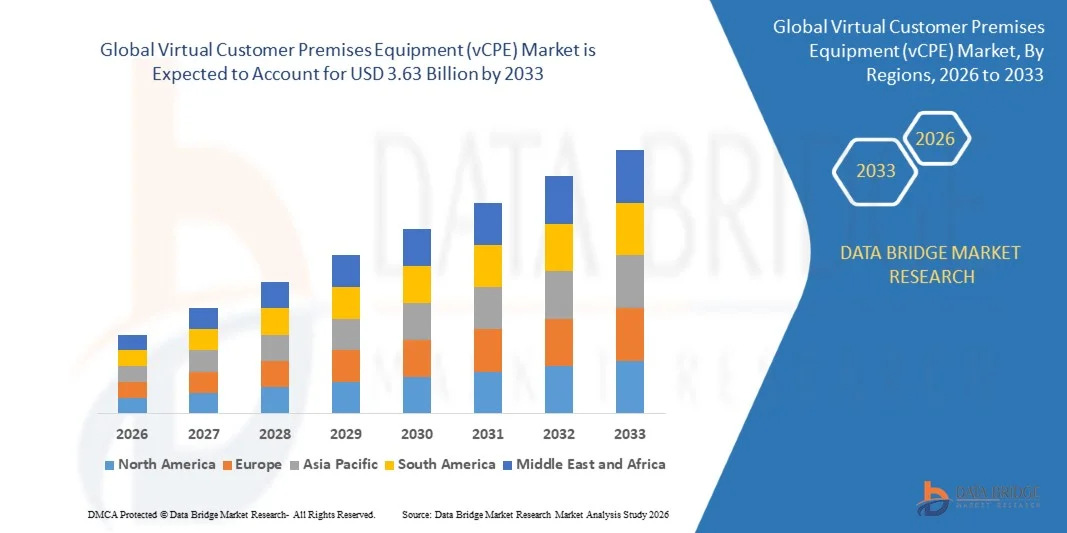
As per Data Bridge Market Research Analysis the Virtual Customer Premises Equipment (vCPE) Market was valued at USD 2.32 billion in 2025 and is projected to reach USD 3.63 billion by 2033, growing at a CAGR of 6.2% from 2026 to 2033. The market is experiencing exponential growth driven by the fundamental shift from traditional, hardware-based network appliances to agile, software-defined solutions . Enterprises and service providers are increasingly adopting vCPE to virtualize network functions such as routing, security, and SD-WAN, significantly reducing capital and operational expenditures while enhancing network flexibility and scalability. The acceleration of digital transformation, the surge in cloud-service adoption, and the rapid deployment of 5G networks are creating a pressing need for network architectures that can be provisioned and managed remotely with unprecedented speed and efficiency .
The growing demand for cost-effective and scalable network solutions, coupled with the rising complexity of managing multi-site and hybrid cloud environments, is compelling organizations to replace legacy hardware with virtualized functions . vCPE enables service providers to offer differentiated, on-demand services, while enterprises benefit from centralized management, zero-touch provisioning, and the ability to rapidly scale network capacity to meet evolving business needs. This transition is fundamental to the future of network infrastructure .
Market Size & Forecast
- Global Market Value (2025): USD 9.35 Billion
- Expected Market Value (2033): USD 27.24 Billion
- Forecast CAGR (2026–2033): 14.30%
- Leading Region in 2025: North America
- Fastest Growing Region: Asia-Pacific
Key Market Trends & Insights
- North America dominated the global vCPE market with the largest revenue share in 2025, driven by early adoption of SD-WAN, NFV, and cloud networking technologies among major enterprises and telecom providers .
- Asia-Pacific is expected to be the fastest-growing region, propelled by rapid digitization, significant investments in 5G infrastructure, and surging enterprise IT spending in countries like China and India .
- Cloud-based Deployment holds the largest market share and is the fastest-growing segment, favored for its scalability, flexibility, and lower upfront costs compared to on-premise solutions .
- Solutions (Virtual Routers, Switches, Orchestration Platforms) account for the dominant share of the market by component, as organizations invest in software platforms to enable network virtualization .
- Enterprise Application is projected to be the leading application segment, as large enterprises adopt vCPE to manage complex, multi-site networks and enhance operational efficiency .
- Telecom Service Providers are a key end-user, deploying vCPE to virtualize network functions for customers, thereby reducing operational costs and enabling rapid service delivery .
Report Scope and Virtual Customer Premises Equipment (vCPE) Market Segmentation
|
Attributes |
Virtual Customer Premises Equipment (vCPE) Key Market Insights |
|
Segments Covered |
|
|
Countries Covered |
North America
Europe
Asia-Pacific
Middle East and Africa
South America
|
|
Key Market Players |
|
|
Market Opportunities |
|
|
Value Added Data Infosets |
|
Virtual Customer Premises Equipment (vCPE) Market Trends
Trend: Growth in Motorsports & Professional Training
The market is witnessing a significant trend towards the convergence of vCPE with SD-WAN. Enterprises are increasingly deploying SD-WAN to gain better network agility, centralized control, and cost efficiency for multi-site operations . vCPE enables SD-WAN by virtualizing network functions such as routing, firewalling, and WAN optimization at the edge. This trend is particularly strong among large enterprises and service providers seeking to eliminate the complexity of legacy hardware-based CPE . Furthermore, cloud-native vCPE deployments are accelerating, driven by a preference for pay-as-you-go models, easy scalability, and automated updates .
Virtual Customer Premises Equipment (vCPE) Market Dynamics
Key Market Driver: Increasing Adoption of Cloud Services and Network Virtualization
The primary driver for the vCPE market is the relentless shift towards cloud-based services and network function virtualization (NFV) . As organizations increasingly adopt multi-cloud strategies to reduce capital expenditures on physical hardware, the demand for vCPE solutions has surged . vCPE allows network functions traditionally performed by physical equipment to be delivered as software via cloud platforms, enabling businesses to deploy and manage network services remotely without dedicated on-site hardware. This shift is critical for supporting modern IT environments characterized by remote work, IoT proliferation, and dynamic bandwidth demands .
Key Restraint/Challenge: Security Concerns and Integration Complexity
Despite its growth, the vCPE market faces significant challenges. Security concerns are paramount as virtualized networks operate in software-based cloud environments, making them potential targets for cyber threats. Ensuring data encryption and integrity across multiple platforms requires continuous monitoring and rigorous security protocols . Moreover, the complexity of integrating vCPE with existing legacy infrastructure is a major hurdle . The shortage of skilled IT professionals proficient in managing SDN, NFV, and overlay automation further complicates deployment and operational efficiency, slowing down adoption, particularly among smaller enterprises .
Key Market Opportunity: Expansion of 5G and Edge Computing
A significant market opportunity lies in the expansion of 5G networks and edge computing. The rollout of 5G and the growth of edge nodes are creating substantial demand for compact, power-efficient, and high-performance vCPE solutions that can handle low-latency applications . As telecom operators and enterprises deploy edge sites to support real-time services, the need for virtualized routing, security, and SD-WAN functions at the network edge will accelerate, opening new growth avenues for vCPE vendors who can deliver high-performance, scalable, and secure software-defined networking solutions .
How is the Virtual Customer Premises Equipment (vCPE) Market Segmented?
The virtual customer premises equipment (vCPE) market is segmented on the basis of component, deployment, application, and end-user.
- By Component
On the basis of component, the market is segmented into solutions and services. The solutions segment held a dominant market share in 2025, driven by the need for core virtualization platforms, orchestration tools, and integrated network management systems . This includes virtual routers and switches, which are essential for enabling NFV and SDN architectures. The services segment is anticipated to witness robust growth, fueled by increasing demand for consulting, integration, and managed services as enterprises seek expert support for complex vCPE deployments .
- By Deployment
On the basis of deployment, the market is categorized into cloud-based and on-premise. The cloud-based segment holds the largest share and is the fastest-growing, favored for its superior scalability, flexibility, and reduced upfront capital costs . It enables rapid service provisioning and centralized management across geographies, aligning with the shift toward cloud-first IT strategies. The on-premise segment maintains significance for organizations with stringent regulatory, data sovereignty, or security requirements that mandate keeping network functions within their physical control .
- By Application
On the basis of application, the market is divided into enterprise networking, data centers, telecom service providers, and residential. The enterprise networking segment is projected to be a leading application, as businesses of all sizes adopt vCPE to simplify multi-site connectivity and reduce hardware dependency . Telecom service providers are another key segment, using vCPE to virtualize network functions for their customers, enabling dynamic service delivery and cost optimization . Data centers are also a major application area, where vCPE facilitates centralized traffic management and policy enforcement .
- By End-User
On the basis of end-user, the market is segmented into large enterprises, small and medium enterprises (SMEs), and various industry verticals including telecom & IT, BFSI, and healthcare. Large enterprises currently command a significant share, leveraging vCPE to manage complex, geographically dispersed networks . However, the SME segment is expected to grow rapidly, driven by the availability of cost-effective, cloud-based vCPE solutions that require minimal upfront investment and in-house IT expertise . The Telecom & IT industry remains the dominant vertical, driven by its need for flexible, scalable, and cost-effective network infrastructure .
Which Region Holds the Largest Share of the Virtual Customer Premises Equipment (vCPE) Market?
North America dominated the vCPE market and accounted for the largest revenue share in 2025. This leadership is attributed to the region's early and widespread adoption of advanced networking technologies like SD-WAN and NFV, robust cloud infrastructure, and significant investments in 5G . The presence of major technology vendors such as Cisco, VMware, and Juniper, along with a high concentration of large enterprises and hyperscalers, further fuels the market . The U.S. market, in particular, is a frontrunner in deploying vCPE across telecom and enterprise sectors ..
Asia-Pacific vCPE Market Insight
The Asia-Pacific region is expected to witness the fastest growth in the vCPE market during the forecast period . This rapid expansion is driven by massive digitalization efforts, surging enterprise IT spending, and accelerated cloud adoption across countries like China, India, and Japan . Government initiatives promoting data localization and the rapid rollout of 5G networks are further catalyzing the demand for virtualized network infrastructure in the region .
Europe vCPE Market Insight
Europe is a significant market for vCPE, with growth fueled by stringent data privacy regulations like GDPR and an increasing focus on digital sovereignty. These factors encourage enterprises and governments to adopt agile and secure network solutions to maintain compliance . The region also sees consistent adoption driven by smart city projects and modernization initiatives by telecom operators .
U.S. vCPE Market Insight
The United States remains the single largest and most influential market for vCPE globally. Its dominance is reinforced by large-scale investments in 5G infrastructure, a strong presence of cloud hyperscalers, and a high rate of cloud adoption among enterprises . The U.S. market serves as a key innovation hub, with major technology companies continuously developing and deploying advanced vCPE solutions for complex, high-performance networking environments .
China vCPE Market Insight
The vCPE market in China is growing at an exceptional pace, driven by the country's massive investments in AI, digital infrastructure, and 5G . Chinese cloud providers and telecom operators are aggressively deploying advanced vCPE solutions to support their vast user base and expanding service portfolios. The market is characterized by the strong presence of domestic leaders like Huawei and ZTE, who compete with global players by offering cost-effective and scalable virtualized network solutions tailored to the local regulatory and business environment .
Which are the Top Companies in Virtual Customer Premises Equipment (vCPE) Market?
The virtual customer premises equipment (vCPE) industry is primarily led by well-established companies, including:
- Cisco Systems, Inc. (U.S.)
- VMware, Inc. (U.S.)
- Huawei Technologies Co., Ltd. (China)
- Nokia Corporation (Finland)
- Juniper Networks, Inc. (U.S.)
- Hewlett Packard Enterprise (U.S.)
- NEC Corporation (Japan)
- Ericsson AB (Sweden)
- Arista Networks, Inc. (U.S.)
- Ciena Corporation (U.S.)
- Versa Networks, Inc. (U.S.)
- Fortinet, Inc. (U.S.)
- ADVA Optical Networking (Germany)
- Intel Corporation (U.S.)
- ZTE Corporation (China)
- Dell Technologies Inc. (U.S.)
- Broadcom Inc. (U.S.)
- Palo Alto Networks Inc. (U.S.)
- Mavenir Systems Inc. (U.S.)
- Arrcus Inc. (U.S.)
What are Latest Developments in Virtual Customer Premises Equipment (vCPE) Market?
- In November 2023, Broadcom Inc. completed its acquisition of VMware Inc. for $69 billion, aiming to significantly expand its software and cloud services footprint and enhance its ability to offer end-to-end enterprise solutions, including virtualization and multi-cloud platforms that are central to the vCPE ecosystem .
- In March 2023, 6WIND launched a vCPE router with efficient routing and security features designed to run on low-cost hardware platforms, enabling service providers to offer scalable, secure, and zero-touch provisioning solutions .
- In January 2025, Vision Net introduced a region's first 800Gbps network, upgraded with Ciena’s optical solutions, to meet growing demand for high-performance networking, cloud computing, and enhanced services, reflecting the market's shift towards high-bandwidth, virtualized infrastructure .

- Interactive Data Analysis Dashboard
- Company Analysis Dashboard for high growth potential opportunities
- Research Analyst Access for customization & queries
- Competitor Analysis with Interactive dashboard
- Latest News, Updates & Trend analysis
- Harness the Power of Benchmark Analysis for Comprehensive Competitor Tracking
Data collection and base year analysis are done using data collection modules with large sample sizes. The stage includes obtaining market information or related data through various sources and strategies. It includes examining and planning all the data acquired from the past in advance. It likewise envelops the examination of information inconsistencies seen across different information sources. The market data is analysed and estimated using market statistical and coherent models. Also, market share analysis and key trend analysis are the major success factors in the market report. To know more, please request an analyst call or drop down your inquiry.
The key research methodology used by DBMR research team is data triangulation which involves data mining, analysis of the impact of data variables on the market and primary (industry expert) validation. Data models include Vendor Positioning Grid, Market Time Line Analysis, Market Overview and Guide, Company Positioning Grid, Patent Analysis, Pricing Analysis, Company Market Share Analysis, Standards of Measurement, Global versus Regional and Vendor Share Analysis. To know more about the research methodology, drop in an inquiry to speak to our industry experts.
Data Bridge Market Research is a leader in advanced formative research. We take pride in servicing our existing and new customers with data and analysis that match and suits their goal. The report can be customized to include price trend analysis of target brands understanding the market for additional countries (ask for the list of countries), clinical trial results data, literature review, refurbished market and product base analysis. Market analysis of target competitors can be analyzed from technology-based analysis to market portfolio strategies. We can add as many competitors that you require data about in the format and data style you are looking for. Our team of analysts can also provide you data in crude raw excel files pivot tables (Fact book) or can assist you in creating presentations from the data sets available in the report.