


Virtual Desktop Market Size
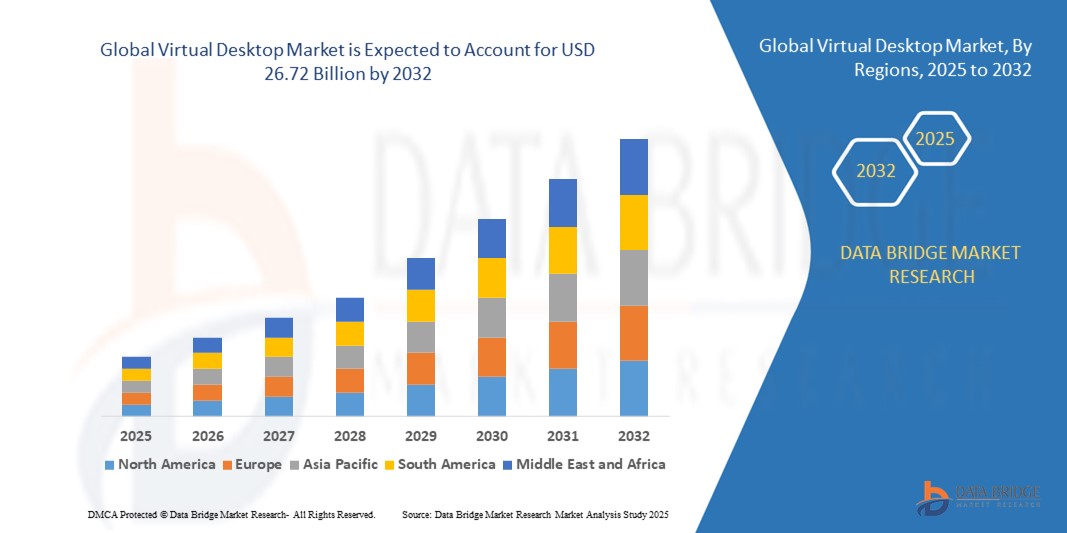
- The global virtual desktop market size was valued at USD 9.04 billion in 2024 and is expected to reach USD 26.72 billion by 2032, at a CAGR of 14.5% during the forecast period
- The market growth is largely fueled by the increasing adoption of cloud computing and remote work solutions, driving organizations to deploy virtual desktop infrastructure (VDI) for enhanced flexibility, scalability, and cost efficiency
- Furthermore, rising demand for secure, centralized, and easily manageable IT environments is prompting businesses to implement virtual desktops, enabling seamless access to applications and data across multiple devices. These converging factors are accelerating the adoption of virtual desktop solutions, thereby significantly boosting the industry's growth
Virtual Desktop Market Analysis
- Virtual desktops are software-based solutions that allow users to access a desktop environment hosted on a central server from any device. These systems offer benefits such as centralized management, enhanced security, reduced hardware costs, and support for remote and hybrid work models
- The growing adoption of VDI is primarily driven by the need for business continuity, data security, compliance requirements, and the increasing trend of remote work across various industries, fueling demand for flexible, reliable, and secure virtual desktop solutions
- North America dominated the virtual desktop market with a share of 33.24% in 2024, due to widespread adoption of remote work solutions, digital transformation initiatives, and increasing demand for secure, scalable virtual desktop infrastructure (VDI)
- Asia-Pacific is expected to be the fastest growing region in the virtual desktop market during the forecast period due to rapid urbanization, technological advancements, and the rising adoption of cloud-based virtual desktops in countries such as China, Japan, and India
- Persistent segment dominated the market with a market share of 62.5% in 2024, due to its ability to retain user-specific settings, applications, and data across sessions. Enterprises favor persistent virtual desktops for employees requiring a personalized, consistent desktop experience, particularly in scenarios involving specialized software or regulatory compliance. The segment’s popularity is also reinforced by the growing need for secure access to sensitive corporate information and the ability to maintain a stable work environment for remote and hybrid workforces
Report Scope and Virtual Desktop Market Segmentation
|
Attributes |
Virtual Desktop Key Market Insights |
|
Segments Covered |
|
|
Countries Covered |
North America
Europe
Asia-Pacific
Middle East and Africa
South America
|
|
Key Market Players |
|
|
Market Opportunities |
|
|
Value Added Data Infosets |
In addition to the market insights such as market value, growth rate, market segments, geographical coverage, market players, and market scenario, the market report curated by the Data Bridge Market Research team includes in-depth expert analysis, import/export analysis, pricing analysis, production consumption analysis, and pestle analysis. |
Virtual Desktop Market Trends
Rising Demand for Secure and Manageable IT Environments
- The virtual desktop market is gaining momentum as organizations prioritize security and centralized management. Virtual desktop infrastructure (VDI) offers enhanced data protection, reduced endpoint risks, and easier IT governance in increasingly complex corporate environments
- For instance, VMware has expanded its Horizon Cloud virtual desktop service to address enterprise security demands. The solution delivers centralized control, multi-device compatibility, and compliance-ready infrastructure, reinforcing the company’s leadership in secure VDI deployments
- The rise in ransomware threats and phishing attacks is further accelerating adoption. Virtual desktops centralize data management on secure servers, minimizing vulnerabilities at employee endpoints and significantly strengthening organizational cybersecurity capabilities
- In addition, organizations are embracing bring-your-own-device (BYOD) policies. Virtual desktops ensure safe access to corporate networks from personal devices, balancing ease of use with enterprise-grade monitoring and endpoint protection frameworks for higher compliance assurance
- Scalability and operational flexibility are influencing trends as businesses expand workforces. VDI platforms enable organizations to scale resources in real time, ensuring effective management of seasonal staff increases without extensive hardware turnaround requirements
- Sustainability initiatives are enhancing the appeal of cloud-hosted desktops. By reducing physical endpoint dependence and extending device lifecycles, organizations decrease IT waste and energy consumption, aligning technology usage with long-term environmental goals globally
Virtual Desktop Market Dynamics
Driver
Growth of Remote and Hybrid Work Models
- The surge in remote and hybrid work adoption post-pandemic is a major growth driver. Virtual desktops allow workers secure access to office applications from any location, reinforcing productivity and enterprise continuity worldwide
- For instance, Citrix has promoted its DaaS (Desktop-as-a-Service) platform as a key enabler for hybrid workforce environments. The company supports flexible workplace arrangements while providing IT managers with centrally managed security and compliance capabilities
- Employees demand seamless access across devices, making virtual desktops valuable. This flexibility ensures consistent user experiences regardless of geographic location, enabling businesses to maintain collaboration and workflow stability in globally distributed teams
- In addition, industries requiring strict compliance such as finance and healthcare are accelerating adoption. Virtual desktops allow enterprises to safeguard sensitive data on centralized servers, avoiding risks of unauthorized local device storage and breaches
- The ability to reduce hardware procurement is reinforcing cost benefits. Organizations can repurpose older devices while running advanced applications on centralized virtual environments, making this model more sustainable as IT budgets face resource pressures
Restraint/Challenge
High Deployment Costs and Complexity
- The virtual desktop market faces barriers due to high deployment and infrastructure costs. Building robust VDI networks requires significant initial investments in servers, storage, and high-performance networks, limiting accessibility for smaller businesses
- For instance, several SMEs adopting Microsoft Azure Virtual Desktop reported challenges with cost management. Unexpected expenses in bandwidth, licensing, and integration increased budgets, making long-term return on investment harder to achieve consistently
- The complexity of implementation presents another challenge. Extensive IT expertise is needed for configuration, scaling, and integration with existing enterprise systems, often requiring external consultants, thereby raising additional capital expenditure requirements
- In addition, latency issues in geographically dispersed networks create user dissatisfaction. Performance inefficiencies such as lag, downtime, or application crashes hinder adoption, especially for businesses dependent on real-time collaboration and critical applications
- Ongoing subscription licensing models also add to long-term expenses. For enterprises, recurring payments for virtual desktop deployments combined with maintenance contracts increase operational costs and prevent consistent scaling of digital workplaces globally
Virtual Desktop Market Scope
The market is segmented on the basis of type, solutions, deployment, and enterprise size.
- By Type
On the basis of type, the Virtual Desktop market is segmented into persistent and non-persistent desktops. The persistent segment dominated the largest market revenue share of 62.5% in 2024, driven by its ability to retain user-specific settings, applications, and data across sessions. Enterprises favor persistent virtual desktops for employees requiring a personalized, consistent desktop experience, particularly in scenarios involving specialized software or regulatory compliance. The segment’s popularity is also reinforced by the growing need for secure access to sensitive corporate information and the ability to maintain a stable work environment for remote and hybrid workforces.
The non-persistent segment is anticipated to witness the fastest growth rate from 2025 to 2032, fueled by increasing adoption in large-scale IT environments where cost efficiency and simplified management are priorities. Non-persistent desktops are ideal for temporary or task-based workers, offering quick provisioning and easy reset capabilities. The scalability, lower storage requirements, and reduced IT management overhead make non-persistent solutions increasingly attractive for businesses focusing on operational efficiency and flexible workforce deployment.
- By Solutions
On the basis of solutions, the Virtual Desktop market is segmented into software/platforms and services. The software/platforms segment held the largest market revenue share in 2024, driven by the widespread adoption of virtualization platforms, desktop management tools, and secure access software. Enterprises leverage these platforms to enable remote work, centralize IT management, and ensure consistent user experiences across devices. Integration with cloud services, multi-device compatibility, and security features such as encryption and multi-factor authentication further enhance the appeal of software solutions.
The services segment is expected to witness the fastest growth during 2025–2032, driven by increasing demand for managed Virtual Desktop Infrastructure (VDI) solutions, consulting, deployment, and maintenance services. Businesses increasingly rely on service providers to reduce the burden on in-house IT teams, accelerate deployment, and ensure compliance with security standards. The growth of hybrid work models and outsourcing trends is further fueling demand for services, making this segment a key growth driver for the market.
- By Deployment
On the basis of deployment, the Virtual Desktop market is segmented into cloud and on-premise deployments. The cloud segment dominated the largest market revenue share in 2024, fueled by its ability to provide flexible, scalable, and cost-efficient virtual desktop solutions. Cloud deployments enable organizations to support remote and hybrid work environments, reduce upfront infrastructure costs, and easily scale desktops as per workforce requirements. In addition, integration with cloud storage, enhanced disaster recovery capabilities, and simplified management are key factors driving adoption.
The on-premise segment is anticipated to witness the fastest growth from 2025 to 2032, driven by enterprises prioritizing data security, regulatory compliance, and control over infrastructure. Industries such as banking, healthcare, and government increasingly prefer on-premise virtual desktops to safeguard sensitive information and maintain localized control over IT assets. The demand is further supported by organizations seeking high-performance solutions for resource-intensive applications and customized IT configurations.
- By Enterprise Size
On the basis of enterprise size, the Virtual Desktop market is segmented into small and medium enterprises (SMEs) and large enterprises. Large enterprises dominated the market in 2024, driven by their higher adoption of virtual desktop solutions to manage extensive workforces across multiple geographies. The need to provide secure, standardized, and centrally managed desktops for thousands of employees, along with regulatory compliance requirements, reinforces the demand for VDI in large organizations.
The SME segment is expected to witness the fastest growth from 2025 to 2032, fueled by increasing digitalization, cost-conscious IT strategies, and adoption of cloud-based virtual desktop solutions. SMEs are leveraging VDI to enable remote work, reduce IT management overhead, and access enterprise-grade solutions without heavy upfront investments. The ease of deployment, scalability, and flexible subscription-based models make virtual desktops an attractive proposition for smaller organizations seeking operational efficiency and business continuity.
Virtual Desktop Market Regional Analysis
- North America dominated the virtual desktop market with the largest revenue share of 33.24% in 2024, driven by widespread adoption of remote work solutions, digital transformation initiatives, and increasing demand for secure, scalable virtual desktop infrastructure (VDI)
- Enterprises and small businesses highly value the ability to provide employees with consistent desktop experiences, centralized IT management, and secure access from multiple devices.
- This adoption is further supported by high IT budgets, strong cloud infrastructure, and a technologically skilled workforce, establishing virtual desktops as a preferred solution for both large enterprises and SMEs
U.S. Virtual Desktop Market Insight
The U.S. market captured the largest revenue share within North America in 2024, fueled by the accelerated shift to remote and hybrid work models. Organizations are prioritizing secure, flexible, and cost-effective desktop solutions, enabling employees to access enterprise resources from anywhere. The growing demand for cloud-based virtual desktops, combined with integration with collaboration tools and endpoint management platforms, is further driving market expansion. Robust IT infrastructure and government initiatives supporting digital workplaces also contribute to market growth.
Europe Virtual Desktop Market Insight
The Europe Virtual Desktop Market is projected to expand at a substantial CAGR throughout the forecast period, primarily driven by digital transformation in businesses, increasing cloud adoption, and the need for secure remote access solutions. Enterprises in countries such as Germany, France, and the U.K. are implementing VDI to improve operational efficiency, enhance data security, and enable hybrid work models. Adoption is also supported by regulatory compliance requirements and the growing preference for centralized IT management across multinational organizations.
U.K. Virtual Desktop Market Insight
The U.K. market is anticipated to grow at a noteworthy CAGR during the forecast period, driven by the increasing trend of remote work, IT modernization initiatives, and the demand for secure, easily manageable virtual desktops. Organizations are investing in cloud-based VDI solutions to support distributed teams, reduce IT overhead, and ensure business continuity. Growing awareness of cybersecurity risks and integration with enterprise collaboration tools further boost adoption.
Germany Virtual Desktop Market Insight
The Germany market is expected to expand at a considerable CAGR during the forecast period, fueled by increasing digitalization, demand for secure IT infrastructure, and adoption of hybrid work models. Enterprises are focusing on high-performance VDI solutions to support resource-intensive applications and maintain compliance with stringent data security regulations. Strong IT infrastructure and a focus on innovation further promote adoption of virtual desktops in both commercial and government sectors.
Asia-Pacific Virtual Desktop Market Insight
The Asia-Pacific market is poised to grow at the fastest CAGR during the forecast period of 2025–2032, driven by rapid urbanization, technological advancements, and the rising adoption of cloud-based virtual desktops in countries such as China, Japan, and India. The region’s growing inclination towards digital workplaces, supported by government initiatives promoting IT modernization, is driving adoption. Moreover, increasing availability of affordable cloud infrastructure and services is enabling SMEs and large enterprises to adopt virtual desktop solutions widely.
Japan Virtual Desktop Market Insight
The Japan market is gaining momentum due to its highly digitalized economy, increasing remote work adoption, and demand for efficient IT solutions. Enterprises are focusing on secure, easy-to-manage VDI solutions that integrate with existing IT ecosystems. The country’s aging workforce is also driving demand for simplified and accessible virtual desktop solutions to enhance productivity and reduce IT management complexity.
China Virtual Desktop Market Insight
The China market accounted for the largest revenue share in Asia-Pacific in 2024, attributed to rapid technological adoption, strong government support for digital workplaces, and growing cloud infrastructure. Enterprises across sectors such as IT, BFSI, and manufacturing are increasingly adopting virtual desktops to enable flexible work models, enhance cybersecurity, and improve operational efficiency. The availability of cost-effective VDI solutions and strong local service providers further drive market expansion in the country.
Virtual Desktop Market Share
The virtual desktop industry is primarily led by well-established companies, including:
- NVIDIA Corporation (U.S.)
- Citrix Systems Inc. (U.S.)
- IGEL Technology (U.S.)
- Cisco Systems, Inc. (U.S.)
- Parallels International GmbH (Germany)
- IBM (U.S.)
- Trend Micro Incorporated (U.S.)
- VMware Inc. (U.S.)
- Microsoft Corporation (U.S.)
- Amazon Web Services (U.S.)
- Google Cloud (U.S.)
- Oracle Corporation (U.S.)
- Red Hat, Inc. (U.S.)
- Broadcom Inc. (U.S.)
Latest Developments in Global Virtual Desktop Market
- In November 2023, Microsoft announced the General Availability of its new Azure Virtual Desktop Web Client User Interface. This update allows users to restore web client settings to default values, choose between light and dark themes, and view resources in grid or list formats. The enhanced user interface improves usability and personalization for enterprise users, facilitating wider adoption of Azure Virtual Desktop across organizations. By simplifying management and improving user experience, this development is expected to strengthen Microsoft’s position in the virtual desktop market and accelerate demand for cloud-based desktop solutions
- In August 2023, VMware unveiled new AI integrations within its Anywhere Workspace platform. The enhancements leverage artificial intelligence to drive improved vulnerability management, automate team member experiences, and simplify application lifecycle management. These AI-enabled features enhance productivity and security for enterprises using virtual desktop infrastructure, positioning VMware as a leader in intelligent, cloud-based workplace solutions. The innovation is likely to increase adoption of VMware’s VDI offerings, particularly among organizations seeking AI-driven efficiency and secure hybrid work environments
- In July 2023, Citrix partnered with Twilio, a leading global provider of customer engagement software. This collaboration demonstrates Citrix’s commitment to delivering integrated, high-performance Desktop-as-a-Service (DaaS) solutions that seamlessly work with Twilio Flex environments. By combining Citrix’s virtual desktop capabilities with Twilio’s communication tools, enterprises can enhance collaboration, improve operational efficiency, and deliver consistent remote experiences, further driving the adoption of Citrix virtual desktop solutions in enterprise settings
- In April 2023, Virtual Cable partnered with Huawei Cloud Forge to accelerate public cloud adoption in digital workplaces. Virtual Cable, known for its UDS Enterprise software supporting desktop virtualization, application virtualization, and remote device access, tailored VDI solutions for different sectors to provide personalized user experiences. This partnership enhances the security, productivity, and efficiency of businesses adopting virtual desktops, expanding the reach of Virtual Cable’s solutions and contributing to overall growth in the virtual desktop market
- In 2024, Cisco and NVIDIA assisted companies in quickly deploying secure AI-enhanced environments for hybrid workforces. They developed advanced data center infrastructures supporting AI-driven meetings, flexible workspaces, and virtual desktops. This initiative has facilitated faster implementation of scalable, secure virtual desktop environments, enabling organizations to improve collaboration and operational efficiency while supporting hybrid and remote work models. The adoption of AI-powered virtual desktop solutions through these partnerships is expected to drive market growth by enhancing enterprise digital transformation initiatives

- Interactive Data Analysis Dashboard
- Company Analysis Dashboard for high growth potential opportunities
- Research Analyst Access for customization & queries
- Competitor Analysis with Interactive dashboard
- Latest News, Updates & Trend analysis
- Harness the Power of Benchmark Analysis for Comprehensive Competitor Tracking
Data collection and base year analysis are done using data collection modules with large sample sizes. The stage includes obtaining market information or related data through various sources and strategies. It includes examining and planning all the data acquired from the past in advance. It likewise envelops the examination of information inconsistencies seen across different information sources. The market data is analysed and estimated using market statistical and coherent models. Also, market share analysis and key trend analysis are the major success factors in the market report. To know more, please request an analyst call or drop down your inquiry.
The key research methodology used by DBMR research team is data triangulation which involves data mining, analysis of the impact of data variables on the market and primary (industry expert) validation. Data models include Vendor Positioning Grid, Market Time Line Analysis, Market Overview and Guide, Company Positioning Grid, Patent Analysis, Pricing Analysis, Company Market Share Analysis, Standards of Measurement, Global versus Regional and Vendor Share Analysis. To know more about the research methodology, drop in an inquiry to speak to our industry experts.
Data Bridge Market Research is a leader in advanced formative research. We take pride in servicing our existing and new customers with data and analysis that match and suits their goal. The report can be customized to include price trend analysis of target brands understanding the market for additional countries (ask for the list of countries), clinical trial results data, literature review, refurbished market and product base analysis. Market analysis of target competitors can be analyzed from technology-based analysis to market portfolio strategies. We can add as many competitors that you require data about in the format and data style you are looking for. Our team of analysts can also provide you data in crude raw excel files pivot tables (Fact book) or can assist you in creating presentations from the data sets available in the report.













