


Virtual ICU (vICU) Advanced Care Services Market Overview
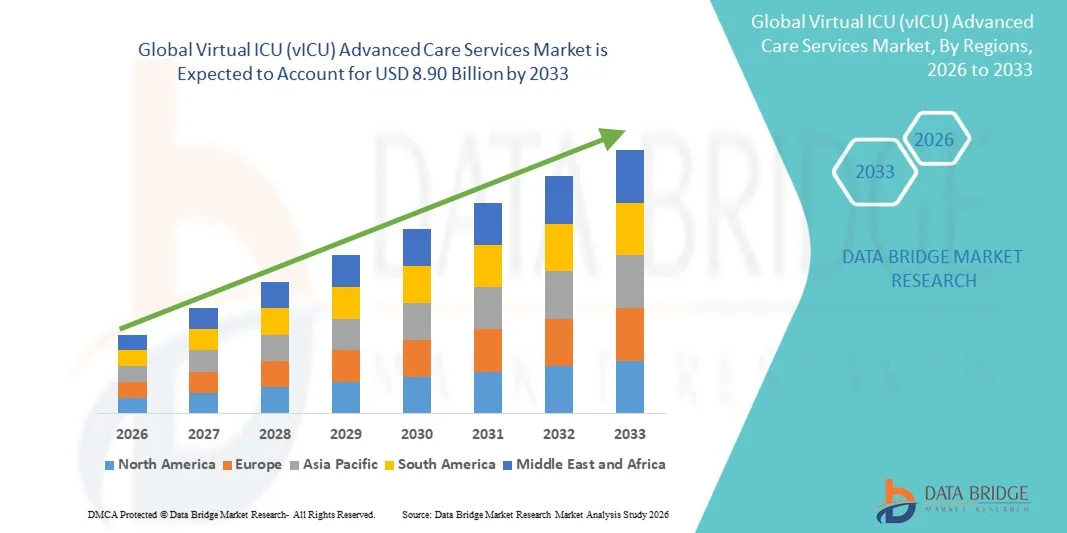
The Virtual ICU (vICU) Advanced Care Services Market was valued at USD 2.68 billion in 2025 and is projected to reach USD 8.90 billion by 2033, growing at a CAGR of 16.20% from 2026 to 2033. The market is experiencing steady growth driven by the increasing demand for remote critical care management, rising shortages of intensivists and skilled ICU staff, and rapid advancements in telehealth, artificial intelligence, and real-time patient monitoring technologies.
The growing burden of chronic diseases, aging populations, and the increasing number of critically ill patients worldwide, combined with the need to improve ICU efficiency and patient outcomes, is encouraging healthcare providers to adopt virtual ICU solutions. Advanced vICU platforms equipped with predictive analytics, remote monitoring capabilities, and centralized command centers are increasingly complementing traditional intensive care units, enabling continuous patient surveillance, faster clinical decision-making, and cost-effective critical care delivery across hospitals and healthcare networks.
Key Market Trends & Insights
- North America dominated the Virtual ICU (vICU) Advanced Care Services Market with the largest revenue share of 42.18% in 2025, supported by advanced healthcare it infrastructure, high telehealth adoption, and strong investments in critical care digitization.
- The Services segment led the market with a 46.37% share in 2025, driven by the increasing demand for remote intensivist support, continuous patient monitoring, and centralized critical care management.
- Asia-Pacific is expected to be the fastest-growing region at a CAGR of 15.1% from 2026 to 2033, fueled by expanding healthcare infrastructure, increasing ICU admissions, and rising adoption of telemedicine technologies in China, India, and Southeast Asia.
- Software is the fastest-growing component type, projected to register a CAGR of 15.4, reflecting the surge in rapid advancements in artificial intelligence, predictive analytics, and clinical decision support technologies.
- The Medical ICU segment dominated the ICU type category with a 31.48% revenue share in 2025, led by the high volume of patients requiring intensive monitoring for respiratory diseases, sepsis, infectious diseases, and multiple organ dysfunction conditions
- Remote Patient Monitoring accounted for 38.64% of the market, preferred by the growing need for continuous surveillance of critically ill patients across healthcare facilities
- The Clinical Decision Support segment is the fastest-growing application category, with a CAGR of 16.2%, driven by demand for adaptive, data-driven training and autonomous driving test platforms.
Market Size & Forecast
- Global Market Value (2025): USD 2.68 Billion
- Expected Market Value (2033): USD 8.90 Billion
- Forecast CAGR (2026–2033): 16.20%
- Leading Region in 2025: North America
- Fastest Growing Region: Asia Pacific
Report Scope and Virtual ICU (vICU) Advanced Care Services Market Segmentation
|
Attributes |
Virtual ICU (vICU) Advanced Care Services Key Market Insights |
|
Segments Covered |
|
|
Countries Covered |
North America · U.S. · Canada · Mexico Europe · Germany · France · U.K. · Netherlands · Switzerland · Belgium · Russia · Italy · Spain · Turkey · Rest of Europe Asia-Pacific · China · Japan · India · South Korea · Singapore · Malaysia · Australia · Thailand · Indonesia · Philippines · Rest of Asia-Pacific Middle East and Africa · Saudi Arabia · U.A.E. · South Africa · Egypt · Israel · Rest of Middle East and Africa South America · Brazil · Argentina · Rest of South America |
|
Key Market Players |
· Oracle (U.S.) · Teladoc Health, Inc. (U.S.) · Hicuity Health (U.S.) · INTOUCH TECHNOLOGIES, INC. (U.S.) · iMDsoft (Israel) · SOC TELEMED (U.S.) · VeeOne Health (U.S.) · AMC Health (U.S.) · Medical Information Technology, Inc. (U.S.) · Masimo (U.S.) · Medtronic (Ireland) · GE HealthCare (U.S.) · Koninklijke Philips N.V. (Netherlands) · NVIDIA Corporation (U.S.) · AirStrip Technologies, Inc. (U.S.) · Current Health Ltd. (U.K.) · eVisit, Inc. (U.S.) · Andor Health, Inc. (U.S.) |
|
Market Opportunities |
· Expansion of virtual ICU networks into rural and underserved hospitals · Integration of artificial intelligence and predictive analytics into vICU platforms · Growing adoption of centralized multi-hospital command centers |
|
Value Added Data Infosets |
In addition to the insights on market scenarios such as market value, growth rate, segmentation, geographical coverage, and major players, the market reports curated by the Data Bridge Market Research also include in-depth expert analysis, patient epidemiology, pipeline analysis, pricing analysis, and regulatory framework. |
Virtual ICU (vICU) Advanced Care Services Market Trends
Trend: Increasing Adoption of AI-Driven Remote Critical Care Monitoring
Healthcare providers are increasingly adopting AI-enabled virtual ICU platforms to enhance continuous patient surveillance, optimize clinical workflows, and support timely interventions for critically ill patients. The integration of predictive analytics, machine learning algorithms, and real-time monitoring technologies enables early detection of patient deterioration and facilitates proactive care management. Large healthcare systems are also leveraging centralized command centers to remotely supervise multiple ICUs, while cloud-based platforms improve care coordination and expand access to specialist expertise across geographically dispersed facilities.
For instance, in March 2025, Philips expanded its advanced tele-ICU capabilities through AI-enhanced patient monitoring solutions designed to improve clinical decision-making and critical care outcomes across connected hospital networks.
Virtual ICU (vICU) Advanced Care Services Market Dynamics
Key Market Driver: Rising Shortage of Intensivists and Critical Care Specialists
The growing shortage of intensivists and skilled critical care professionals has created substantial demand for virtual ICU services that extend specialist expertise across multiple healthcare facilities. Hospitals, healthcare systems, and regional care networks are deploying vICU platforms to provide continuous remote oversight, improve staff efficiency, and maintain high-quality critical care delivery despite workforce constraints. These solutions help reduce response times, support bedside clinicians, and improve patient outcomes while enabling healthcare providers to optimize resource utilization and operational performance.
For instance, in January 2025, Oracle Health enhanced its virtual care portfolio with advanced remote monitoring and critical care management capabilities aimed at helping hospitals address clinician shortages and rising ICU demand.
Key Restraint/Challenge: High Implementation and Integration Costs of vICU Infrastructure
A significant restraint in the global virtual ICU market is the substantial investment required for deploying comprehensive tele-ICU infrastructure. Advanced vICU systems require sophisticated monitoring equipment, secure communication networks, interoperable software platforms, and ongoing technical support, resulting in considerable implementation and maintenance expenses. The total cost of ownership also includes staff training, cybersecurity measures, and integration with existing electronic health record systems, making adoption challenging for smaller hospitals and resource-constrained healthcare providers.
For instance, in October 2024, HCA Healthcare announced continued investments in digital critical care infrastructure and remote monitoring technologies, highlighting the significant financial commitment required to scale advanced virtual ICU operations across large hospital networks.
Key Market Opportunity: Expansion of Virtual Critical Care Services in Underserved Regions
The expansion of virtual ICU services into rural, remote, and underserved healthcare settings presents a significant market opportunity. Advanced telehealth platforms enable hospitals with limited access to intensivists to receive continuous specialist support, improving care quality and reducing the need for patient transfers. The increasing availability of cloud-based solutions, broadband connectivity, and AI-assisted clinical tools is further accelerating adoption, creating growth opportunities across emerging healthcare markets and regional hospital networks worldwide.
For instance, in February 2025, Teladoc Health expanded its connected care capabilities to support remote acute and critical care programs, helping healthcare providers extend specialist services to underserved patient populations.
Virtual ICU (vICU) Advanced Care Services Market Scope
The Virtual ICU (vICU) advanced care services market is segmented on the basis of component, ICU type, application, and end user.
- By Component
On the basis of component, the Virtual ICU (vICU) Advanced Care Services Market is segmented into hardware, software, and services. The Services segment dominated the market with a 46.37% share in 2025, driven by the increasing demand for remote intensivist support, continuous patient monitoring, and centralized critical care management. Healthcare providers increasingly rely on outsourced and managed vICU services to address shortages of critical care specialists and improve patient outcomes. These services enable 24/7 surveillance of ICU patients while reducing the burden on bedside clinical staff. Growing adoption of telehealth infrastructure and value-based healthcare models is further strengthening demand. Service providers also offer implementation, consulting, and operational support, enhancing adoption among hospitals. The segment continues to benefit from healthcare systems seeking scalable and cost-effective critical care delivery solutions.
The Software segment is projected to register the fastest growth at a CAGR of 15.4% from 2026 to 2033, driven by rapid advancements in artificial intelligence, predictive analytics, and clinical decision support technologies. Modern vICU software platforms provide real-time patient data aggregation, risk stratification, and early warning capabilities that improve clinical decision-making. Increasing integration with electronic health records and hospital information systems is enhancing operational efficiency. Cloud-based software solutions are expanding accessibility and reducing deployment complexities for healthcare providers. Growing investments in digital health transformation and smart hospital initiatives are further accelerating adoption. The rising need for data-driven critical care management is expected to sustain strong growth throughout the forecast period.
- By ICU Type
On the basis of ICU type, the Virtual ICU (vICU) Advanced Care Services Market is segmented into Medical ICU, Surgical ICU, Cardiac ICU, Neonatal ICU, Pediatric ICU, Trauma ICU, Neuro ICU, and Other ICUs. The Medical ICU (MICU) segment dominated the market with a 31.48% share in 2025 owing to the high volume of patients requiring intensive monitoring for respiratory diseases, sepsis, infectious diseases, and multiple organ dysfunction conditions. Medical ICUs frequently manage critically ill patients who require continuous surveillance and timely clinical interventions. Virtual ICU platforms enhance patient monitoring efficiency and support intensivists in managing large patient populations. Rising prevalence of chronic diseases and aging populations are increasing MICU admissions globally. Healthcare providers are prioritizing remote monitoring technologies to improve outcomes and reduce ICU mortality rates. The segment continues to benefit from broad applicability across general critical care settings.
The Neuro ICU segment is expected to witness the fastest growth at a CAGR of 15.8% from 2026 to 2033, driven by the increasing incidence of stroke, traumatic brain injuries, epilepsy-related emergencies, and other neurological disorders. Neurocritical patients require continuous monitoring and rapid intervention, making virtual ICU technologies particularly valuable. Advanced analytics and remote specialist access improve neurological assessment and treatment decision-making. Growing investments in specialized neuroscience care centers are supporting adoption of vICU solutions. The increasing availability of tele-neurology services is further enhancing market growth. Rising awareness regarding early intervention and neurological outcome optimization is expected to drive strong demand during the forecast period.
- By Application
On the basis of application, the Virtual ICU (vICU) Advanced Care Services Market is segmented into remote patient monitoring, clinical decision support, emergency response management, critical care consultation, and post-operative monitoring. The Remote Patient Monitoring segment accounted for the largest market share of 38.64% in 2025, driven by the growing need for continuous surveillance of critically ill patients across healthcare facilities. Remote monitoring solutions provide real-time access to patient vitals, laboratory data, and clinical alerts, enabling faster intervention and improved care delivery. Hospitals are increasingly deploying centralized monitoring hubs to oversee multiple ICUs simultaneously. These systems help reduce clinician workload while enhancing patient safety and operational efficiency. Increasing adoption of connected medical devices and IoT-enabled healthcare infrastructure is further strengthening the segment. The demand for continuous and proactive critical care management remains a major growth driver.
The Clinical Decision Support segment is projected to grow at the fastest rate with a CAGR of 16.2% from 2026 to 2033 due to increasing adoption of AI-powered analytics and predictive care technologies. Clinical decision support tools assist healthcare professionals by identifying patient deterioration risks and recommending evidence-based interventions. These platforms improve treatment accuracy, reduce medical errors, and enhance patient outcomes. Integration with electronic health records enables comprehensive analysis of patient data in real time. Healthcare organizations are investing heavily in intelligent care platforms to improve ICU efficiency and resource allocation. The growing focus on precision medicine and data-driven healthcare delivery is expected to accelerate segment growth.
- By End User
On the basis of end user, the Virtual ICU (vICU) Advanced Care Services Market is segmented into hospitals, specialty clinics, ambulatory care centers, long-term care facilities, and critical care centers. The Hospitals segment dominated the market with a 68.42% share in 2025, supported by the widespread deployment of virtual ICU programs across large healthcare networks and multi-specialty hospitals. Hospitals account for the majority of ICU admissions and require advanced monitoring solutions to manage critically ill patients effectively. Virtual ICU platforms help optimize staffing efficiency, improve patient outcomes, and support centralized care delivery. Increasing pressure to reduce healthcare costs while maintaining quality standards is encouraging adoption. Growing investments in digital healthcare infrastructure and telemedicine are further strengthening the segment. The presence of extensive patient volumes and established IT capabilities supports continued market leadership.
The Critical Care Centers segment is anticipated to register the fastest growth at a CAGR of 15.7% from 2026 to 2033, driven by increasing demand for specialized intensive care services and advanced patient management solutions. These centers focus exclusively on managing high-acuity patients and require continuous access to expert critical care resources. Virtual ICU technologies enable enhanced monitoring, specialist collaboration, and faster clinical decision-making. Expanding healthcare infrastructure and growing investments in dedicated critical care facilities are supporting adoption. Rising incidence of severe illnesses and complex medical conditions is further driving demand. The need for highly efficient and technology-enabled critical care environments is expected to fuel rapid segment expansion over the forecast period.
Virtual ICU (vICU) Advanced Care Services Market Regional Analysis
North America dominated the Virtual ICU (vICU) Advanced Care Services Market with the largest revenue share of 42.18% in 2025, supported by advanced healthcare IT infrastructure, high telehealth adoption, and strong investments in critical care digitization. The region also benefits from a high concentration of large hospital networks, favorable reimbursement frameworks, and strong investments in digital health transformation initiatives. Growing implementation of AI-enabled patient monitoring systems, centralized command centers, and remote critical care programs is further accelerating market growth. Increasing focus on improving ICU efficiency, addressing critical care workforce shortages, and enhancing patient outcomes continues to strengthen North America’s leadership position in the global market.
U.S. Virtual ICU (vICU) Advanced Care Services Market Insight
The U.S. Virtual ICU (vICU) advanced care services market is witnessing strong growth due to rising investments in telehealth infrastructure, increasing demand for remote critical care management, and growing shortages of intensivists and skilled ICU staff. The country’s advanced healthcare ecosystem, along with increasing adoption of AI-powered monitoring, predictive analytics, and connected care platforms, is driving demand across hospitals and healthcare networks. In addition, growing emphasis on improving patient outcomes, reducing ICU mortality rates, and optimizing healthcare resource utilization is accelerating vICU adoption across healthcare providers.
Europe Virtual ICU (vICU) Advanced Care Services Market Insight
The Europe Virtual ICU (vICU) advanced care services market remains a major contributor to global revenue, driven by strong healthcare infrastructure, technological innovation, and increasing demand for advanced critical care solutions. The widespread use of telemedicine platforms, remote patient monitoring systems, and centralized command centers is supporting market expansion across the region. Increasing investments in digital health technologies, coupled with rising healthcare modernization initiatives and a highly skilled clinical workforce, continue to enhance the adoption of virtual ICU services throughout Europe.
U.K. Virtual ICU (vICU) Advanced Care Services Market Insight
The U.K. Virtual ICU (vICU) advanced care services market is experiencing steady growth, supported by rising adoption of digital healthcare technologies, remote monitoring platforms, and tele-critical care services. Increasing investments in healthcare digitization and growing demand for cost-effective, specialist-led critical care solutions are contributing to market growth. Furthermore, integration of artificial intelligence, predictive analytics, and real-time clinical decision support tools is improving care quality and operational efficiency, positioning the U.K. as a key innovation hub in the virtual critical care industry.
Germany Virtual ICU (vICU) Advanced Care Services Market Insight
The Germany Virtual ICU (vICU) advanced care services market is expanding steadily due to the country’s advanced healthcare infrastructure, strong digital health capabilities, and increasing adoption of next-generation critical care technologies. Hospitals and healthcare organizations are increasingly utilizing virtual ICU platforms for patient monitoring, specialist consultations, and ICU workflow optimization. Continuous advancements in artificial intelligence, remote monitoring systems, and healthcare interoperability solutions, along with strong government focus on healthcare innovation and quality care delivery, are further driving market growth in Germany.
Asia-Pacific Virtual ICU (vICU) Advanced Care Services Market Insight
The Asia-Pacific Virtual ICU (vICU) advanced care services market is expected to witness rapid growth, driven by expanding healthcare infrastructure, increasing ICU admissions, and rising investments in digital health technologies across countries such as China, India, and Japan. Growing awareness regarding telemedicine benefits, rising adoption of advanced patient monitoring systems, and increasing demand for scalable and cost-effective critical care solutions are supporting regional market expansion. Additionally, the growing presence of healthcare technology providers and healthcare modernization initiatives is accelerating virtual ICU adoption across hospitals and healthcare systems.
Japan Virtual ICU (vICU) Advanced Care Services Market Insight
The Japan Virtual ICU (vICU) advanced care services market is witnessing consistent growth due to rising investments in healthcare digitization, advanced patient monitoring technologies, and critical care modernization initiatives. Healthcare providers and research institutions are increasingly adopting virtual ICU platforms for remote patient management, specialist collaboration, and clinical workflow improvement. Moreover, increasing integration of artificial intelligence and predictive analytics technologies and the country’s focus on efficient, high-quality healthcare delivery are further contributing to market growth.
China Virtual ICU (vICU) Advanced Care Services Market Insight
The China Virtual ICU (vICU) advanced care services market is growing rapidly, driven by expanding healthcare infrastructure, rising government focus on healthcare digitalization, and increasing demand for remote critical care services. Growing adoption of AI-enabled monitoring systems and tele-ICU platforms across hospitals and healthcare networks is significantly boosting market demand. In addition, rising investments in healthcare technology, increasing awareness regarding advanced critical care management, and rapid technological advancements are positioning China as one of the fastest-growing markets for virtual ICU services globally.
Virtual ICU (vICU) Advanced Care Services Market Share
The Virtual ICU (vICU) advanced care services industry is primarily led by well-established companies, including:
- Oracle (U.S.)
- Teladoc Health, Inc. (U.S.)
- Hicuity Health (U.S.)
- INTOUCH TECHNOLOGIES, INC. (U.S.)
- iMDsoft (Israel)
- SOC TELEMED (U.S.)
- VeeOne Health (U.S.)
- AMC Health (U.S.)
- Medical Information Technology, Inc. (U.S.)
- Masimo (U.S.)
- Medtronic (Ireland)
- GE HealthCare (U.S.)
- Koninklijke Philips N.V. (Netherlands)
- NVIDIA Corporation (U.S.)
- AirStrip Technologies, Inc. (U.S.)
- Current Health Ltd. (U.K.)
- eVisit, Inc. (U.S.)
- Andor Health, Inc. (U.S.)
Latest Developments in Virtual ICU (vICU) Advanced Care Services Market
- In January 2025, Lok Bandhu Hospital in Lucknow launched a new Tele-ICU care service as part of its healthcare modernization program. The initiative was introduced to strengthen remote critical care delivery, improve access to intensivist expertise, and enhance treatment outcomes for critically ill patients. The development highlights the increasing adoption of virtual ICU infrastructure across government hospitals and regional healthcare systems
- In August 2024, Aster DM Healthcare announced the launch of its Tele-ICU services under the Aster Connected Care platform in India. The solution provides 24/7 audio-visual communication, continuous ICU monitoring, rapid response alerts, virtual rounds, and access to expert intensivists, enabling hospitals to enhance critical care delivery through advanced digital technologies
- In April 2024, HealthNet Global and Apollo Spectra Hospitals introduced a revolutionary Tele-ICU program at Apollo Spectra Hospital in Delhi. The program leverages advanced telemedicine technology to enable remote patient monitoring, specialist intervention, and uninterrupted critical care services, helping bridge healthcare access gaps in underserved regions
- In March 2024, Apollo Hospitals unveiled the Apollo Tele-ICU Spoke at Tridev Hospital in Deoghar, Jharkhand. Equipped with advanced monitoring technologies and connected to Apollo’s critical care specialists, the facility was designed to extend expert ICU support to regional hospitals and improve access to high-quality critical care services in remote areas
- In February 2024, the Karnataka government inaugurated new Tele-ICU hubs at Victoria Hospital, Bengaluru, and Ballari District Hospital under the 10BedICU program. The hubs were established to connect specialists at major hospitals with critically ill patients across multiple district and taluk hospitals, expanding access to intensive care expertise through a centralized virtual ICU network

- Interactive Data Analysis Dashboard
- Company Analysis Dashboard for high growth potential opportunities
- Research Analyst Access for customization & queries
- Competitor Analysis with Interactive dashboard
- Latest News, Updates & Trend analysis
- Harness the Power of Benchmark Analysis for Comprehensive Competitor Tracking
Data collection and base year analysis are done using data collection modules with large sample sizes. The stage includes obtaining market information or related data through various sources and strategies. It includes examining and planning all the data acquired from the past in advance. It likewise envelops the examination of information inconsistencies seen across different information sources. The market data is analysed and estimated using market statistical and coherent models. Also, market share analysis and key trend analysis are the major success factors in the market report. To know more, please request an analyst call or drop down your inquiry.
The key research methodology used by DBMR research team is data triangulation which involves data mining, analysis of the impact of data variables on the market and primary (industry expert) validation. Data models include Vendor Positioning Grid, Market Time Line Analysis, Market Overview and Guide, Company Positioning Grid, Patent Analysis, Pricing Analysis, Company Market Share Analysis, Standards of Measurement, Global versus Regional and Vendor Share Analysis. To know more about the research methodology, drop in an inquiry to speak to our industry experts.
Data Bridge Market Research is a leader in advanced formative research. We take pride in servicing our existing and new customers with data and analysis that match and suits their goal. The report can be customized to include price trend analysis of target brands understanding the market for additional countries (ask for the list of countries), clinical trial results data, literature review, refurbished market and product base analysis. Market analysis of target competitors can be analyzed from technology-based analysis to market portfolio strategies. We can add as many competitors that you require data about in the format and data style you are looking for. Our team of analysts can also provide you data in crude raw excel files pivot tables (Fact book) or can assist you in creating presentations from the data sets available in the report.













