


Virtual Mirror Market Size
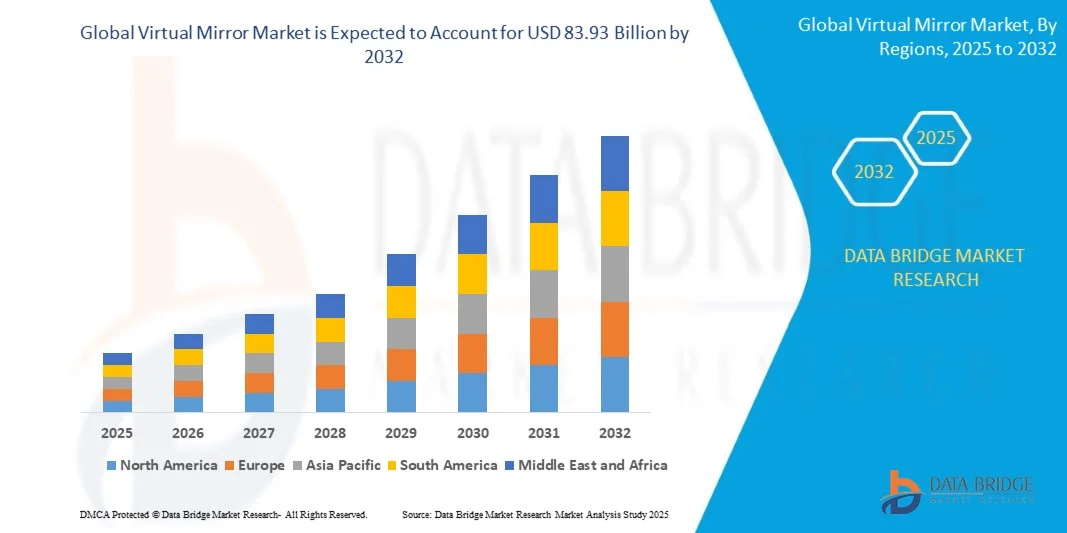
- The global virtual mirror market size was valued at USD 11.84 billion in 2024 and is expected to reach USD 83.93 billion by 2032, at a CAGR of 27.74% during the forecast period
- The market growth is largely fuelled by the increasing adoption of augmented reality (AR) and artificial intelligence (AI) technologies in retail, automotive, and cosmetic sectors, enabling enhanced consumer experiences and interactive engagement
- Rising demand for contactless shopping solutions, personalized virtual try-on experiences, and seamless integration with e-commerce platforms is driving market expansion
Virtual Mirror Market Analysis
- The market is witnessing rapid technological advancements, including gesture recognition, 3D mapping, and real-time analytics, which are transforming consumer interaction with products
- Expansion of smart stores, luxury retail outlets, and automotive showrooms leveraging virtual mirrors for immersive experiences is supporting steady market growth
- North America dominated the virtual mirror market with the largest revenue share of 38.5% in 2024, driven by the rising adoption of augmented reality (AR) and AI-enabled solutions in retail and automotive sectors, as well as increasing investments in immersive customer experiences
- Asia-Pacific region is expected to witness the highest growth rate in the global virtual mirror market, driven by rapid urbanization, increasing disposable incomes, growing retail modernization, and the rising adoption of AR/VR technologies in emerging economies
- The hardware segment held the largest market revenue share in 2024, driven by the increasing adoption of high-resolution displays, cameras, and sensors that enable immersive AR and AI-powered experiences. Hardware components form the core of virtual mirror systems, offering durability, accuracy, and enhanced visualization, making them a preferred choice across retail stores, automotive showrooms, and beauty outlets
Report Scope and Virtual Mirror Market Segmentation
|
Attributes |
Virtual Mirror Key Market Insights |
|
Segments Covered |
|
|
Countries Covered |
North America
Europe
Asia-Pacific
Middle East and Africa
South America
|
|
Key Market Players |
|
|
Market Opportunities |
|
|
Value Added Data Infosets |
In addition to the insights on market scenarios such as market value, growth rate, segmentation, geographical coverage, and major players, the market reports curated by the Data Bridge Market Research also include in-depth expert analysis, geographically represented company-wise production and capacity, network layouts of distributors and partners, detailed and updated price trend analysis and deficit analysis of supply chain and demand. |
Virtual Mirror Market Trends
“Increasing Adoption of Augmented Reality and AI-Enabled Virtual Mirrors”
- The growing shift toward augmented reality (AR) and AI-powered virtual mirrors is transforming the retail and automotive sectors by enabling interactive and immersive visualization experiences. These mirrors allow consumers to try products virtually in real-time, reducing the need for physical trials and enhancing purchasing confidence, driving adoption across stores, showrooms, and e-commerce platforms. The technology also supports advanced analytics, helping businesses track user preferences and optimize inventory and merchandising strategies, creating a seamless shopping journey for end-users
- The high demand for personalized and contactless experiences is accelerating the integration of virtual mirrors with AI-driven recommendation engines and mobile platforms. These solutions are particularly valuable for fashion retailers, cosmetics brands, and car dealerships, offering convenience, reduced wait times, and improved customer engagement. The trend is further supported by increasing digitalization initiatives, omnichannel strategies, and the growing consumer expectation for interactive and intuitive technology in both physical and online retail spaces
- The affordability and ease of implementation of modern virtual mirror solutions are making them attractive for small and medium-sized retailers. Businesses benefit from increased customer interaction, improved sales conversion, and reduced return rates without significant infrastructure investment. Additionally, cloud-based deployment and scalable software solutions allow retailers to rapidly update content and features, keeping pace with seasonal trends and product launches
- For instance, in 2023, several European fashion chains reported higher customer engagement and decreased product returns after installing AI-powered virtual mirrors in flagship stores, allowing shoppers to virtually try outfits and accessories with real-time suggestions. The integration with loyalty programs and social media sharing also increased brand visibility and customer retention, highlighting the measurable business impact of virtual mirror adoption
- While AR and AI-enabled virtual mirrors are accelerating market adoption, sustained growth will depend on continuous technological innovation, seamless integration with existing retail systems, and user-friendly interfaces to maximize consumer satisfaction and operational efficiency. Ongoing investment in software updates, cross-platform compatibility, and employee training will further strengthen market penetration and long-term adoption
Virtual Mirror Market Dynamics
Driver
“Growing Demand For Personalized Shopping Experiences And Contactless Retail Solutions”
- The rising consumer preference for personalized shopping experiences is pushing retailers to adopt virtual mirrors as a key engagement tool. These mirrors offer tailored recommendations and realistic virtual trials, enhancing customer satisfaction and driving repeat purchases. In addition, real-time feedback and analytics allow brands to understand preferences and improve product offerings, which strengthens competitive positioning in highly dynamic retail markets
- Retailers and automotive showrooms are increasingly prioritizing contactless solutions to ensure safety and convenience, especially post-pandemic. This has led to greater investment in virtual mirrors that allow customers to visualize products without physical interaction. The solutions also reduce operational bottlenecks, minimize staffing requirements for in-store assistance, and enhance customer trust by maintaining hygienic environments
- Vendors are focusing on producing high-resolution, AI-powered, and user-friendly virtual mirrors to meet evolving consumer expectations. Emphasis on realistic rendering, data analytics integration, and interactive features enhances brand differentiation and loyalty. Companies are also exploring integrations with AR apps and e-commerce platforms, allowing customers to seamlessly move from virtual trial to online purchase, further boosting revenue streams
- For instance, in 2022, a major U.S. automotive showroom chain implemented AI-integrated virtual mirrors for car customization, increasing customer engagement and facilitating purchase decisions. The implementation also allowed staff to manage multiple client interactions simultaneously, optimizing showroom efficiency while providing a highly interactive experience
- While consumer demand and digital adoption are driving the market, continuous product innovation, interoperability with existing platforms, and retail staff training will be crucial for long-term growth. Expansion into emerging markets and partnerships with software developers will further drive adoption and enhance market opportunities
Restraint/Challenge
“High Cost Of Advanced Virtual Mirror Systems And Limited Adoption In Small Retailers”
- The high cost of sophisticated AR and AI-enabled virtual mirrors limits adoption among small and mid-sized retailers. These systems often require significant investment in hardware, software, and maintenance, making them less accessible for price-sensitive businesses. Additionally, the need for regular software upgrades and technical support adds recurring expenses, which can further discourage small-scale adoption
- In several regions, lack of awareness about the benefits of virtual mirrors compared to traditional displays hampers adoption. Retailers may prefer conventional setups due to perceived cost and complexity, slowing market penetration. Low digital literacy and limited exposure to AR/VR technology in some areas exacerbate these challenges, making education and marketing critical components for adoption
- Supply chain and technical implementation challenges, including installation delays and software compatibility issues, further constrain growth, particularly in emerging markets. Long lead times for high-end display components, limited availability of skilled installers, and connectivity issues in remote locations can delay deployment and affect customer experience
- For instance, in 2023, multiple small fashion boutiques in Southeast Asia delayed virtual mirror adoption due to installation difficulties and high equipment costs. Several pilot projects reported integration challenges with existing POS and inventory management systems, highlighting the need for standardized solutions and vendor support
- While virtual mirror technology continues to evolve, addressing cost, awareness, and integration challenges remains essential for broader adoption and sustainable market development. Strategic partnerships, modular system offerings, and financing options will help overcome barriers and expand accessibility to a wider range of retailers
Virtual Mirror Market Scope
The virtual mirror market is segmented on the basis of component, technology, deployment, and industry.
• By Component
On the basis of component, the virtual mirror market is segmented into hardware, solution, and services. The hardware segment held the largest market revenue share in 2024, driven by the increasing adoption of high-resolution displays, cameras, and sensors that enable immersive AR and AI-powered experiences. Hardware components form the core of virtual mirror systems, offering durability, accuracy, and enhanced visualization, making them a preferred choice across retail stores, automotive showrooms, and beauty outlets.
The solution segment is expected to witness the fastest growth rate from 2025 to 2032, propelled by software platforms that provide AI-driven recommendations, virtual try-on capabilities, and integration with mobile and e-commerce systems. Solution-based virtual mirrors allow businesses to personalize user experiences, track customer preferences, and optimize sales strategies, boosting adoption in digitally advanced retail and service environments.
• By Technology
On the basis of technology, the market is segmented into 3D body scanning, photo accurate VFR, 3D augmented reality & virtual reality, and other technologies. The 3D augmented reality & virtual reality segment accounted for the largest share in 2024 due to its ability to provide highly realistic and interactive visualization experiences. This technology enhances consumer engagement by allowing virtual trials of apparel, accessories, and vehicles with real-time feedback.
The 3D body scanning segment is expected to witness the fastest growth rate from 2025 to 2032, driven by rising demand for precise fit and measurement data in fashion retail and custom product applications. This technology enables accurate sizing, reduces return rates, and improves overall customer satisfaction.
• By Deployment
On the basis of deployment, the market is segmented into cloud and on-premise. The cloud segment held the largest market revenue share in 2024, fueled by easy scalability, remote access, and seamless software updates that reduce infrastructure costs. Cloud deployment allows businesses to deploy virtual mirror solutions across multiple locations while integrating analytics and AI capabilities for improved consumer insights.
The on-premise segment is expected to witness significant growth from 2025 to 2032, driven by the need for data privacy, offline functionality, and customization in high-end retail and automotive showrooms. On-premise solutions offer control over sensitive customer data while supporting real-time processing and integration with local IT infrastructure.
• By Industry
On the basis of industry, the market is segmented into retail and other industries. The retail segment dominated the market in 2024, attributed to rising adoption in fashion, cosmetics, and footwear sectors where virtual mirrors enhance product visualization, reduce returns, and increase customer engagement. Retailers are increasingly integrating these systems into physical stores to bridge offline and online experiences.
The other industries segment is expected to witness the fastest growth from 2025 to 2032, fueled by increasing adoption in automotive, furniture, and healthcare sectors. Virtual mirrors in these sectors provide interactive demonstrations, customization options, and training simulations, improving operational efficiency and customer satisfaction.
Virtual Mirror Market Regional Analysis
- North America dominated the virtual mirror market with the largest revenue share of 38.5% in 2024, driven by the rising adoption of augmented reality (AR) and AI-enabled solutions in retail and automotive sectors, as well as increasing investments in immersive customer experiences
- Consumers and businesses in the region highly value interactive visualization, personalized recommendations, and contactless trial experiences offered by virtual mirrors, enhancing engagement and boosting sales conversion rates
- This widespread adoption is further supported by high digital literacy, robust technological infrastructure, and the growing integration of virtual mirrors with e-commerce platforms, establishing them as a preferred solution for retailers and automotive showrooms
U.S. Virtual Mirror Market Insight
The U.S. virtual mirror market captured the largest revenue share in 2024 within North America, fueled by rapid digitalization and the increasing deployment of AI and AR solutions in retail and automotive industries. Businesses are prioritizing immersive customer experiences, including virtual try-ons and product customization, to drive engagement and reduce return rates. The integration of virtual mirrors with mobile applications and e-commerce platforms further enhances consumer convenience and supports omnichannel retail strategies.
Europe Virtual Mirror Market Insight
The Europe virtual mirror market is expected to witness the fastest growth rate from 2025 to 2032, primarily driven by increasing investments in digital retail solutions and omnichannel strategies. The growing adoption of AR and AI technologies in fashion, cosmetics, and automotive sectors is boosting market penetration. European consumers are drawn to personalized, contactless experiences that enhance convenience and product selection efficiency. The trend is further supported by digital innovation initiatives across major cities and retail hubs.
U.K. Virtual Mirror Market Insight
The U.K. virtual mirror market is expected to witness the fastest growth rate from 2025 to 2032, driven by heightened focus on digital retail transformation and enhanced customer engagement. Retailers are increasingly implementing AR and AI-powered mirrors to provide virtual try-on experiences and personalized recommendations, reducing return rates and increasing purchase confidence. The country’s strong e-commerce ecosystem and high consumer acceptance of technology-enabled shopping solutions continue to propel market growth.
Germany Virtual Mirror Market Insight
The Germany virtual mirror market is expected to witness the fastest growth rate from 2025 to 2032, fueled by technological advancements in AR/AI systems and the demand for innovative retail experiences. German retailers and automotive showrooms are adopting virtual mirrors for realistic product visualization, personalized recommendations, and interactive marketing campaigns. Integration with digital platforms and sustainability-focused technologies further enhances adoption among tech-savvy consumers.
Asia-Pacific Virtual Mirror Market Insight
The Asia-Pacific virtual mirror market is expected to witness the fastest growth rate from 2025 to 2032, driven by increasing urbanization, rising disposable incomes, and the growing digital retail landscape in countries such as China, Japan, and India. Retailers and automotive companies are investing in virtual mirrors to deliver immersive shopping experiences and optimize space utilization. Government initiatives promoting digital adoption and smart retail solutions are further supporting market expansion.
Japan Virtual Mirror Market Insight
The Japan virtual mirror market is expected to witness significant growth from 2025 to 2032 due to high consumer acceptance of technology, rapid digital transformation in retail, and demand for interactive shopping experiences. Virtual mirrors integrated with AI recommendation engines and AR visualization tools are increasingly deployed in fashion, cosmetics, and automotive showrooms. The aging population and emphasis on convenience are further driving adoption in both commercial and high-end retail segments.
China Virtual Mirror Market Insight
The China virtual mirror market accounted for the largest revenue share in Asia-Pacific in 2024, attributed to rapid urbanization, a growing middle-class consumer base, and widespread adoption of digital and AI-enabled retail technologies. Retailers and automotive showrooms are leveraging virtual mirrors to enhance customer engagement, increase sales, and reduce product returns. Government initiatives supporting smart retail, along with strong local technology providers, are key factors propelling market growth.
Virtual Mirror Market Share
The Virtual Mirror industry is primarily led by well-established companies, including:
- Cisco Systems Inc. (U.S.)
- DigitalDM (U.S.)
- My Size Inc. (U.S.)
- Zugara Inc. (U.S.)
- ViuBox (U.K.)
- Astrafit (U.K.)
- Virtual On Ltd (U.K.)
- Terawe Corp, Ltd. (U.K.)
- Fits.me (U.K.)
- MirrAR (U.S.)
Latest Developments in Global Virtual Mirror Market
- In October 2023, Fittingbox completed the acquisition of Ditto Technologies Inc., a company specializing in virtual eyewear try-on solutions. This strategic move is aimed at enhancing Fittingbox’s product offerings by integrating Ditto’s technology and expanding its capabilities. The acquisition is expected to strengthen Fittingbox’s position in the digital eyewear market, grow its customer base, and extend its reach across key regions including the U.S., Europe, and Japan, boosting overall market presence
- In April 2023, Snap Inc. announced the expansion of its augmented reality (AR) mirror technology into new retail sectors, including home goods and furniture stores. This initiative enables consumers to virtually visualize products in their own spaces before purchase, enhancing shopping experiences. The move is expected to accelerate adoption of virtual mirrors across diverse industries, increase consumer engagement, and drive growth in the AR-powered retail solutions market

- Interactive Data Analysis Dashboard
- Company Analysis Dashboard for high growth potential opportunities
- Research Analyst Access for customization & queries
- Competitor Analysis with Interactive dashboard
- Latest News, Updates & Trend analysis
- Harness the Power of Benchmark Analysis for Comprehensive Competitor Tracking
Global Virtual Mirror Market, Supply Chain Analysis and Ecosystem Framework
To support market growth and help clients navigate the impact of geopolitical shifts, DBMR has integrated in-depth supply chain analysis into its Global Virtual Mirror Market research reports. This addition empowers clients to respond effectively to global changes affecting their industries. The supply chain analysis section includes detailed insights such as Global Virtual Mirror Market consumption and production by country, price trend analysis, the impact of tariffs and geopolitical developments, and import and export trends by country and HSN code. It also highlights major suppliers with data on production capacity and company profiles, as well as key importers and exporters. In addition to research, DBMR offers specialized supply chain consulting services backed by over a decade of experience, providing solutions like supplier discovery, supplier risk assessment, price trend analysis, impact evaluation of inflation and trade route changes, and comprehensive market trend analysis.
Data collection and base year analysis are done using data collection modules with large sample sizes. The stage includes obtaining market information or related data through various sources and strategies. It includes examining and planning all the data acquired from the past in advance. It likewise envelops the examination of information inconsistencies seen across different information sources. The market data is analysed and estimated using market statistical and coherent models. Also, market share analysis and key trend analysis are the major success factors in the market report. To know more, please request an analyst call or drop down your inquiry.
The key research methodology used by DBMR research team is data triangulation which involves data mining, analysis of the impact of data variables on the market and primary (industry expert) validation. Data models include Vendor Positioning Grid, Market Time Line Analysis, Market Overview and Guide, Company Positioning Grid, Patent Analysis, Pricing Analysis, Company Market Share Analysis, Standards of Measurement, Global versus Regional and Vendor Share Analysis. To know more about the research methodology, drop in an inquiry to speak to our industry experts.
Data Bridge Market Research is a leader in advanced formative research. We take pride in servicing our existing and new customers with data and analysis that match and suits their goal. The report can be customized to include price trend analysis of target brands understanding the market for additional countries (ask for the list of countries), clinical trial results data, literature review, refurbished market and product base analysis. Market analysis of target competitors can be analyzed from technology-based analysis to market portfolio strategies. We can add as many competitors that you require data about in the format and data style you are looking for. Our team of analysts can also provide you data in crude raw excel files pivot tables (Fact book) or can assist you in creating presentations from the data sets available in the report.













