


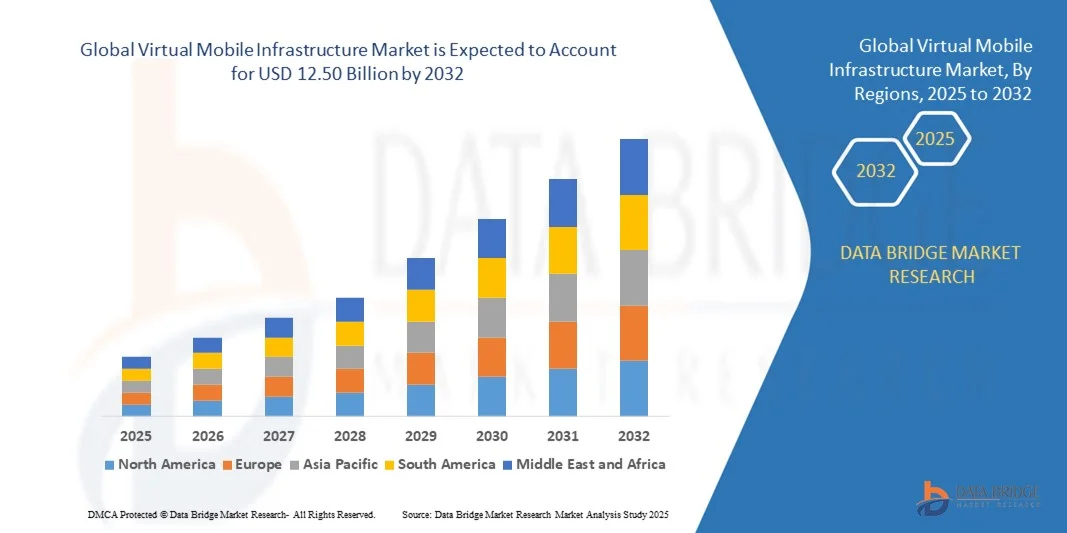
Global Virtual Mobile Infrastructure Market Size
- The global virtual mobile infrastructure market size was valued at USD 2.97 billion in 2024 and is projected to reach USD 12.50 billion by 2032, growing at a CAGR of 19.68% during the forecast period.
- Market expansion is primarily driven by the increasing demand for secure mobile environments and the surge in remote workforce trends, compelling enterprises to adopt centralized mobile management solutions.
- Additionally, rising concerns over data breaches, device theft, and compliance are positioning VMI as a strategic technology, offering enhanced security, scalability, and cost-efficiency, thus propelling rapid adoption across various industry verticals.
Global Virtual Mobile Infrastructure Market Analysis
- Virtual Mobile Infrastructure (VMI), which enables the remote hosting of mobile operating systems and apps on centralized servers, is becoming a pivotal solution in enterprise mobility strategies, offering enhanced security, simplified device management, and reduced endpoint vulnerabilities across both public and private sectors.
- The rising demand for VMI is primarily driven by increasing cybersecurity concerns, growing adoption of BYOD (Bring Your Own Device) policies, and the need for cost-effective, scalable mobile computing solutions amid a globally expanding remote and hybrid workforce.
- North America led the virtual mobile infrastructure market with the largest revenue share of 40.7% in 2024, driven by early cloud technology adoption, stringent data protection regulations, and the strong presence of major VMI providers. The U.S. market experienced robust growth, particularly in sectors like BFSI, healthcare, and IT services, driven by a growing need for secure mobile environments and centralized data access.
- Asia-Pacific is projected to be the fastest growing region in the virtual mobile infrastructure market during the forecast period, supported by rapid digitalization, rising enterprise mobility adoption, and increased IT spending in emerging economies such as China, India, and Southeast Asian countries.
- The cloud-based segment dominated the market with the largest market revenue share of 52.5% in 2024, driven by its scalability, cost-effectiveness, and ease of deployment without significant upfront investment.
Report Scope and Global Virtual Mobile Infrastructure Market Segmentation
|
Attributes |
Virtual Mobile Infrastructure Key Market Insights |
|
Segments Covered |
|
|
Countries Covered |
North America
Europe
Asia-Pacific
Middle East and Africa
South America
|
|
Key Market Players |
|
|
Market Opportunities |
|
|
Value Added Data Infosets |
In addition to the insights on market scenarios such as market value, growth rate, segmentation, geographical coverage, and major players, the market reports curated by the Data Bridge Market Research also include in-depth expert analysis, pricing analysis, brand share analysis, consumer survey, demography analysis, supply chain analysis, value chain analysis, raw material/consumables overview, vendor selection criteria, PESTLE Analysis, Porter Analysis, and regulatory framework. |
Global Virtual Mobile Infrastructure Market Trends
Enhanced Efficiency Through AI and Intelligent Automation
- A significant and accelerating trend in the global Virtual Mobile Infrastructure (VMI) Market is the increasing integration of artificial intelligence (AI) and intelligent automation to enhance mobile device management, threat detection, and user experience within virtualized environments. This synergy is streamlining operations and providing organizations with more adaptive, proactive, and secure VMI solutions.
- For instance, platforms like Microsoft Azure Virtual Desktop and VMware Horizon Cloud are incorporating AI-powered monitoring and analytics to predict system performance issues, optimize resource allocation, and identify potential security breaches before they escalate.
- AI integration in VMI systems enables real-time behavior analysis of user sessions to detect anomalies, automate routine IT tasks such as provisioning and patching, and personalize virtual workspace environments based on user preferences or roles. This not only reduces IT workload but also improves operational continuity and end-user satisfaction.
- Additionally, intelligent automation tools can dynamically scale VMI resources in response to usage patterns or security threats, ensuring optimal system performance and resilience. For example, IBM Cloud for VMI uses AI-driven orchestration to manage workloads and provide seamless failover during peak traffic or cyberattacks.
- The convergence of VMI with AI technologies supports centralized visibility across multiple endpoints and user sessions, enhancing decision-making for IT administrators. Integration with platforms like AWS AI Services also enables deeper analytics and automated compliance reporting, especially in regulated industries.
- This trend toward more intelligent, self-optimizing VMI solutions is transforming how enterprises manage their mobile infrastructure. As a result, companies such as Cisco, Oracle, and Citrix Systems are investing heavily in AI-enhanced VMI offerings to deliver more efficient, secure, and adaptive mobile computing environments tailored to modern enterprise needs.
Global Virtual Mobile Infrastructure Market Dynamics
Driver
Growing Demand Due to Security Concerns and Mobile Workforce Expansion
-
The rising frequency of cybersecurity threats, coupled with the global shift towards remote and hybrid work models, is significantly driving demand for Virtual Mobile Infrastructure (VMI) as organizations seek more secure, scalable, and cost-effective ways to manage mobile access to enterprise resources.
- For instance, in 2024, Citrix Systems launched enhancements to its VMI solutions that leverage zero-trust security frameworks, offering advanced session monitoring and identity verification for remote users. Such developments by leading players are expected to accelerate VMI market growth throughout the forecast period.
- As enterprises face increasing pressure to protect sensitive data on mobile endpoints, VMI offers a compelling alternative by ensuring that no data is stored on user devices—thereby mitigating risks associated with device loss, theft, or malware attacks.
- Additionally, the growing adoption of BYOD (Bring Your Own Device) policies is contributing to the widespread integration of VMI solutions, allowing organizations to support personal device usage without compromising on data security or compliance.
- Features such as centralized app deployment, remote access control, and simplified IT management are especially appealing to industries with high security and compliance requirements—including healthcare, finance, and government sectors. VMI also aligns with digital transformation efforts, offering a secure and agile approach to mobile infrastructure that complements cloud-first strategies.
Restraint/Challenge
Implementation Complexity and High Integration Costs
- Despite its advantages, VMI adoption is hindered by concerns around implementation complexity, legacy system compatibility, and high initial costs—especially for small to medium-sized enterprises (SMEs) with limited IT resources.
- For instance, deploying VMI often requires integration with existing virtual desktop infrastructure (VDI), identity management systems, and mobile device platforms, which can be resource-intensive and technically challenging for non-cloud-native organizations.
- Moreover, the upfront costs associated with licensing, infrastructure upgrades, and staff training can deter adoption, particularly in cost-sensitive markets or regions where cloud infrastructure is still developing. While cloud-based VMI solutions like AWS WorkSpaces and Microsoft Azure Virtual Desktop offer more accessible pricing models, advanced features such as AI-driven analytics or zero-trust architecture often require premium subscriptions.
- Another major challenge is ensuring consistent user experience across various mobile platforms and network conditions. In some cases, latency or performance issues can undermine productivity, especially in areas with unstable internet connectivity.
- To overcome these barriers, vendors must focus on offering modular, scalable, and easy-to-deploy VMI solutions with flexible pricing models. Additionally, investments in automation, user training, and partner ecosystems will be essential to reduce adoption friction and support long-term market growth.
Global Virtual Mobile Infrastructure Market Scope
The market is segmented on the basis of deployment type, application, end user and service type.
- By Deployment Type
On the basis of deployment type, the Global Virtual Mobile Infrastructure Market is segmented into cloud-based, on-premises, and hybrid. The cloud-based segment dominated the market with the largest market revenue share of 52.5% in 2024, driven by its scalability, cost-effectiveness, and ease of deployment without significant upfront investment. Cloud-based solutions enable organizations to access virtual mobile infrastructure remotely and integrate seamlessly with various mobile applications, making them highly attractive for enterprises undergoing digital transformation.
The hybrid segment is anticipated to witness the fastest growth rate of 24.3% from 2025 to 2032, fueled by organizations seeking the security and control of on-premises infrastructure alongside the flexibility and scalability of cloud solutions. Hybrid deployments are increasingly preferred by enterprises with strict regulatory compliance or those transitioning gradually to cloud environments.
- By Application
On the basis of application, the global virtual mobile infrastructure market is segmented into enterprise mobility management, remote desktop access, and mobile application development. The enterprise mobility management segment accounted for the largest market revenue share of 48.7% in 2024, owing to the growing need for secure mobile device management, policy enforcement, and app distribution in enterprises adopting BYOD policies. EMM solutions help maintain corporate data security while enhancing employee productivity.
The remote desktop access segment is expected to witness the fastest CAGR of 22.5% from 2025 to 2032, driven by the rise in remote work trends and demand for secure access to office desktops and applications from any location. This segment benefits from the ongoing shift towards flexible work environments post-pandemic.
- By End User
On the basis of end user, the Global Virtual Mobile Infrastructure Market is segmented into large enterprises, small and medium enterprises (SMEs), and government. The large enterprises segment dominated the market in 2024 with a 55.3% revenue share, owing to their extensive IT infrastructure needs, higher investment capabilities, and demand for secure mobile access for large, distributed workforces. Large enterprises prioritize scalable and compliant virtual mobile solutions.
The SMEs segment is projected to witness the fastest CAGR of 20.1% from 2025 to 2032, driven by increased adoption of cloud-based, cost-effective virtual mobile infrastructure solutions aimed at improving operational efficiency and securing corporate resources within budget constraints.
- By Service Type
On the basis of service type, the Global Virtual Mobile Infrastructure Market is segmented into Infrastructure as a Service (IaaS), Platform as a Service (PaaS), and Software as a Service (SaaS). The IaaS segment held the largest market revenue share of 46.8% in 2024, driven by the demand for scalable and flexible infrastructure that supports virtual mobile environments without the need for physical hardware ownership. IaaS enables dynamic provisioning and management of computing resources.
The SaaS segment is expected to witness the fastest growth rate of 23.4% from 2025 to 2032, fueled by growing adoption of subscription-based models that offer easy deployment, automatic updates, and minimal IT management overhead. SaaS appeals especially to organizations seeking rapid deployment and low upfront costs for virtual mobile infrastructure solutions.
Global Virtual Mobile Infrastructure Market Regional Analysis
- North America dominated the Global Virtual Mobile Infrastructure Market with the largest revenue share of 40.7% in 2024, driven by increasing adoption of digital workspace solutions, strong IT infrastructure, and a growing need for secure mobile access across enterprises.
- Organizations in the region prioritize seamless remote connectivity, data security, and centralized management of mobile devices, which fuels demand for virtual mobile infrastructure solutions.
- This widespread adoption is further supported by high technological awareness, advanced network infrastructure, and the increasing trend of remote work and Bring Your Own Device (BYOD) policies, establishing virtual mobile infrastructure as a critical tool for enhancing enterprise mobility and productivity in both large and small organizations.
U.S. Virtual Mobile Infrastructure Market Insight
The U.S. virtual mobile infrastructure market captured the largest revenue share of 42% in 2024 within North America, driven by rapid adoption of cloud-based digital workspace solutions and the growing trend of remote and hybrid work models. Enterprises are prioritizing secure mobile access and centralized management of mobile endpoints to ensure data security and operational efficiency. The increasing demand for Bring Your Own Device (BYOD) policies, coupled with advanced IT infrastructure and strong investments in cybersecurity, is significantly boosting market growth. Moreover, the integration of virtual mobile infrastructure with popular cloud services and mobile device management platforms is further accelerating adoption across various industries.
Europe Virtual Mobile Infrastructure Market Insight
The Europe virtual mobile infrastructure market is projected to expand at a robust CAGR throughout the forecast period, primarily fueled by stringent data privacy regulations such as GDPR and the rising need for secure mobile access solutions across enterprises. Growing digital transformation initiatives and increased remote working culture are fostering widespread adoption of virtual mobile infrastructure. European organizations are increasingly leveraging cloud-based deployments for improved scalability and security. The market growth is also supported by the rise in mobile workforce and demand for centralized IT management in both public and private sectors.
U.K. Virtual Mobile Infrastructure Market Insight
The U.K. virtual mobile infrastructure market is expected to grow at a significant CAGR during the forecast period, driven by the acceleration of digital workspace adoption and heightened focus on mobile security. The U.K.’s strong emphasis on cybersecurity and compliance with regulatory frameworks encourages enterprises to adopt virtual mobile infrastructure solutions for enhanced access control. The growing trend of remote work and hybrid office models is also contributing to market expansion. Additionally, the country’s well-established IT services ecosystem and active government support for digital innovation bolster market growth.
Germany Virtual Mobile Infrastructure Market Insight
The Germany virtual mobile infrastructure market is anticipated to grow considerably during the forecast period, fueled by strong industrial digitalization initiatives and increasing awareness of mobile security risks. Germany’s robust IT infrastructure, combined with its focus on data privacy and security, drives adoption in manufacturing, automotive, and financial sectors. The integration of virtual mobile infrastructure with Industry 4.0 technologies and enterprise mobility solutions is gaining traction. Furthermore, Germany’s emphasis on sustainable IT solutions supports the shift towards cloud and hybrid deployment models in virtual mobile infrastructure.
Asia-Pacific Virtual Mobile Infrastructure Market Insight
The Asia-Pacific virtual mobile infrastructure market is poised to register the fastest CAGR of 26% from 2025 to 2032, driven by rapid urbanization, digital transformation initiatives, and expanding mobile workforce in countries such as China, India, Japan, and Australia. Governments’ push for smart city projects and enhanced cybersecurity frameworks supports market growth. The region’s growing adoption of cloud services and mobile device management solutions further accelerates demand. Additionally, increased investments by multinational corporations and local enterprises in mobile infrastructure to support flexible work environments are key growth factors.
Japan Virtual Mobile Infrastructure Market Insight
The Japan virtual mobile infrastructure market is gaining strong momentum due to the country’s advanced technological landscape and increasing demand for secure remote access solutions. The rise in remote working, coupled with Japan’s aging workforce, is propelling the adoption of easy-to-manage, secure mobile infrastructure. Integration with IoT and enterprise mobility management platforms is also expanding the market. Japan’s focus on innovation and data security compliance further drives the adoption of virtual mobile infrastructure across corporate and government sectors.
China Virtual Mobile Infrastructure Market Insight
The China virtual mobile infrastructure market accounted for the largest revenue share in Asia-Pacific in 2024, supported by the country’s rapid digitalization, booming mobile user base, and expansion of cloud computing infrastructure. China’s government initiatives aimed at smart cities and digital economy growth heavily influence market uptake. The presence of domestic technology providers and competitive pricing of virtual mobile infrastructure solutions make them accessible to a wide range of enterprises, including SMEs. The increasing demand for secure, scalable mobile access across industries such as manufacturing, finance, and retail is propelling market growth.
Global Virtual Mobile Infrastructure Market Share
The Virtual Mobile Infrastructure industry is primarily led by well-established companies, including:
- Cisco Systems (U.S.)
- IBM (U.S.)
- Oracle (U.S.)
- Citrix Systems (U.S.)
- Samsung Electronics (South Korea)
- Nokia (Finland)
- Red Hat (U.S.)
- Microsoft (U.S.)
- VMware (U.S.)
- Ericsson (Sweden)
- Hewlett Packard Enterprise (U.S.)
- Atos (France)
- Forced Networks (U.S.)
- Parallels (U.S.A)
- Amazon Web Services (U.S.)
What are the Recent Developments in Global Virtual Mobile Infrastructure Market?
- In April 2023, VMware, a global leader in cloud infrastructure and digital workspace technology, announced the launch of an enhanced virtual mobile infrastructure (VMI) platform aimed at improving secure remote access for enterprises across Asia-Pacific. This initiative focuses on providing scalable, cloud-based solutions tailored to the growing demand for mobile workforce enablement and robust data security. By leveraging advanced virtualization and endpoint management technologies, VMware is strengthening its position in the rapidly expanding global VMI market while addressing region-specific enterprise mobility challenges.
- In March 2023, Citrix Systems introduced Citrix Endpoint Management 23.1, featuring upgraded virtual mobile infrastructure capabilities designed for healthcare and financial sectors. This release enhances secure mobile access, compliance, and user experience, addressing the critical needs of industries with stringent data protection requirements. Citrix’s innovation underscores its commitment to delivering next-generation mobile workspace solutions that empower organizations to securely manage mobile devices and applications in increasingly complex environments.
- In March 2023, Microsoft successfully rolled out its Azure Virtual Desktop enhancements, integrating advanced mobile infrastructure support to facilitate seamless remote work environments for global enterprises. This deployment, part of the company’s broader cloud strategy, provides businesses with secure, scalable access to virtualized mobile applications and desktops, reinforcing Microsoft’s leadership in the cloud-based virtual workspace market. The initiative also highlights the growing importance of hybrid and remote work models worldwide.
- In February 2023, BlackBerry Limited partnered with a leading European telecommunications provider to deliver secure virtual mobile infrastructure solutions tailored for government agencies and critical infrastructure sectors. This collaboration aims to enhance data security, compliance, and mobile workforce productivity by leveraging BlackBerry’s expertise in endpoint security and management. The partnership exemplifies BlackBerry’s focus on expanding its footprint in the secure enterprise mobility market amid rising cybersecurity concerns.
- In January 2023, IBM unveiled its new MaaS360 with Watson VMI integration at the Mobile World Congress, showcasing advanced AI-driven mobile infrastructure management tools. This solution enables enterprises to streamline device and application management while enhancing security through intelligent analytics and automation. IBM’s launch highlights the company’s dedication to innovation in virtual mobile infrastructure, helping organizations improve operational efficiency and secure mobile access in an increasingly digital business landscape.

- Interactive Data Analysis Dashboard
- Company Analysis Dashboard for high growth potential opportunities
- Research Analyst Access for customization & queries
- Competitor Analysis with Interactive dashboard
- Latest News, Updates & Trend analysis
- Harness the Power of Benchmark Analysis for Comprehensive Competitor Tracking
Data collection and base year analysis are done using data collection modules with large sample sizes. The stage includes obtaining market information or related data through various sources and strategies. It includes examining and planning all the data acquired from the past in advance. It likewise envelops the examination of information inconsistencies seen across different information sources. The market data is analysed and estimated using market statistical and coherent models. Also, market share analysis and key trend analysis are the major success factors in the market report. To know more, please request an analyst call or drop down your inquiry.
The key research methodology used by DBMR research team is data triangulation which involves data mining, analysis of the impact of data variables on the market and primary (industry expert) validation. Data models include Vendor Positioning Grid, Market Time Line Analysis, Market Overview and Guide, Company Positioning Grid, Patent Analysis, Pricing Analysis, Company Market Share Analysis, Standards of Measurement, Global versus Regional and Vendor Share Analysis. To know more about the research methodology, drop in an inquiry to speak to our industry experts.
Data Bridge Market Research is a leader in advanced formative research. We take pride in servicing our existing and new customers with data and analysis that match and suits their goal. The report can be customized to include price trend analysis of target brands understanding the market for additional countries (ask for the list of countries), clinical trial results data, literature review, refurbished market and product base analysis. Market analysis of target competitors can be analyzed from technology-based analysis to market portfolio strategies. We can add as many competitors that you require data about in the format and data style you are looking for. Our team of analysts can also provide you data in crude raw excel files pivot tables (Fact book) or can assist you in creating presentations from the data sets available in the report.













