


Virtual Reality Neuropsychological Therapy Market Overview
The Virtual Reality Neuropsychological Therapy Market was valued at USD 2.85 billion in 2025 and is projected to reach USD 23.82 billion by 2033, growing at a CAGR of 30.40% from 2026 to 2033. The Virtual Reality Neuropsychological Therapy Market is experiencing steady growth driven by increasing prevalence of neurological and psychological disorders, rising demand for innovative and non-invasive treatment approaches, and rapid advancements in VR-based healthcare technologies.
Growing cases of anxiety, depression, PTSD, and cognitive impairments, along with expanding awareness of mental health treatment, are encouraging healthcare providers and rehabilitation centers to adopt virtual reality–based therapeutic solutions. In addition, supportive government initiatives, increasing investments in digital health infrastructure, and the integration of VR with AI and neuroscience-based therapies are further accelerating market adoption, enabling personalized, immersive, and controlled treatment environments for improved patient outcomes.
Key Market Trends & Insights
- North America dominated the Virtual Reality Neuropsychological Therapy Market with the largest revenue share of 34.12% in 2025, supported by advanced healthcare infrastructure, strong adoption of digital therapeutics, and significant investments in VR-based mental health treatment and neurorehabilitation technologies.
- The Full Immersive VR segment dominated the market with a 42.08% share in 2025, owing to its ability to provide highly engaging and realistic therapeutic environments for patients undergoing neuropsychological treatment.
- Asia-Pacific is expected to be the fastest-growing region at a CAGR of 7.5% from 2026 to 2033, fueled by rising mental health awareness, expanding healthcare infrastructure, increasing urbanization, and growing adoption of VR therapy solutions in countries such as China, India, and Japan.
- The Software segment is the fastest-growing offering category, projected to register a CAGR of 7.1%, supported by continuous advancements in AI-integrated therapeutic platforms, personalized treatment algorithms, and cloud-based VR therapy solutions.
- Among end users, Hospitals, Clinics, and Surgical Centers dominated the market with a 46.35% revenue share in 2025, attributed to higher patient inflow, early adoption of neuropsychological VR therapies, and increasing integration of VR tools into psychiatric and neurological treatment protocols.
Market Size & Forecast
- Global Market Value (2025): USD 2.85 Billion
- Expected Market Value (2033): USD 23.82 Billion
- Forecast CAGR (2026–2033): 30.40%
- Leading Region in 2025: North America
- Fastest Growing Region: Asia-Pacific
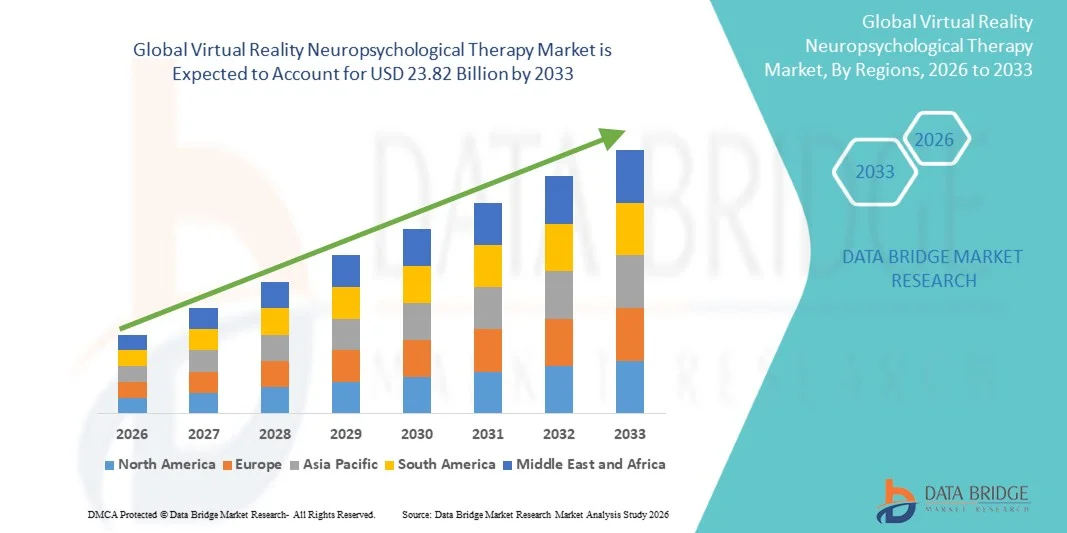
Report Scope and Virtual Reality Neuropsychological Therapy Market Segmentation
|
Attributes |
Virtual Reality Neuropsychological Therapy Key Market Insights |
|
Segments Covered |
|
|
Countries Covered |
North America · U.S. · Canada · Mexico Europe · Germany · France · U.K. · Netherlands · Switzerland · Belgium · Russia · Italy · Spain · Turkey · Rest of Europe Asia-Pacific · China · Japan · India · South Korea · Singapore · Malaysia · Australia · Thailand · Indonesia · Philippines · Rest of Asia-Pacific Middle East and Africa · Saudi Arabia · U.A.E. · South Africa · Egypt · Israel · Rest of Middle East and Africa South America · Brazil · Argentina · Rest of South America |
|
Key Market Players |
• AppliedVR (U.S.) |
|
Market Opportunities |
· Expansion of VR-Based Mental Health Treatment in Emerging Markets · Integration of AI and Personalized Neurotherapy Platforms · Rising Adoption in Neurorehabilitation and Elderly Care Applications |
|
Value Added Data Infosets |
In addition to the insights on market scenarios such as market value, growth rate, segmentation, geographical coverage, and major players, the market reports curated by the Data Bridge Market Research also include in-depth expert analysis, geographically represented company-wise production and capacity, network layouts of distributors and partners, detailed and updated price trend analysis and deficit analysis of supply chain and demand. |
Virtual Reality Neuropsychological Therapy Market Trends
Trend: Rising Adoption of VR-Based Neurorehabilitation and Mental Health Therapy
Healthcare providers are increasingly integrating Virtual Reality Neuropsychological Therapy into clinical psychology and neurorehabilitation programs to treat conditions such as PTSD, anxiety disorders, phobias, stroke-related cognitive impairment, and autism spectrum disorders. Hospitals and rehabilitation centers are using immersive VR environments to simulate controlled exposure therapy, cognitive behavioral therapy (CBT), and attention retraining exercises. For instance, VR exposure therapy platforms like those used in military PTSD treatment programs have demonstrated significant symptom reduction rates in controlled clinical studies, improving patient engagement compared to traditional therapy methods. The expansion of digital therapeutics reimbursement in countries such as the U.S. and Germany is further accelerating clinical adoption.
Virtual Reality Neuropsychological Therapy Market Dynamics
Key Market Driver: Increasing Prevalence of Mental Health and Neurological Disorders
The rising global burden of mental health conditions is a major driver for the Virtual Reality Neuropsychological Therapy market. According to the World Health Organization (WHO), nearly 1 in 8 people globally live with a mental disorder, while depression and anxiety disorders collectively cost the global economy over USD 1 trillion annually in lost productivity. VR-based therapy is increasingly being adopted as a scalable and standardized intervention tool in psychiatric hospitals, clinics, and rehabilitation centers.
For instance, VR-based exposure therapy programs such as Oxford VR’s automated fear-of-heights treatment have shown clinically significant symptom reduction in over 70% of participants in controlled trials, highlighting strong therapeutic effectiveness and driving hospital-level adoption across Europe and North America.
Key Restraint/Challenge: High Implementation and Clinical Validation Costs
Despite strong growth potential, the market faces significant barriers due to high development and deployment costs of clinical-grade VR therapy systems. Advanced systems require integration of medical-grade head-mounted displays, motion tracking sensors, biometric feedback systems, and validated therapeutic software, significantly increasing capital expenditure for healthcare providers.
In addition, regulatory approval and clinical validation processes for digital therapeutics remain lengthy and expensive. For instance, obtaining clearance under frameworks such as the U.S. FDA Digital Health Software Precertification Program or Europe’s CE medical device certification can take multiple years, delaying commercialization. Smaller clinics and emerging-market hospitals often struggle with upfront investment costs, which can exceed USD 10,000–50,000 per full VR therapy setup, limiting widespread adoption outside large healthcare systems.
Key Market Opportunity: Expansion of AI-Driven Personalized VR Therapy Platforms
A major growth opportunity lies in the integration of artificial intelligence with VR neuropsychological therapy systems to enable adaptive, personalized treatment pathways. AI algorithms can analyze patient response patterns in real time—such as eye movement, reaction time, and physiological signals—to dynamically adjust therapy difficulty and exposure levels.
Virtual Reality Neuropsychological Therapy Market Scope
The Virtual Reality Neuropsychological Therapy market is segmented on the basis of technology, offering, and end user.
- By Technology
On the basis of technology, the Virtual Reality Neuropsychological Therapy Market is segmented into Full Immersive VR, Semi-Immersive VR, and Non-Immersive VR. The Full Immersive VR segment dominated the market with a 42.08% share in 2025, owing to its ability to provide highly engaging and realistic therapeutic environments for patients undergoing neuropsychological treatment. These systems utilize head-mounted displays, motion tracking technologies, and interactive virtual scenarios to enhance treatment outcomes for conditions such as PTSD, anxiety disorders, phobias, cognitive impairment, and neurological rehabilitation. The technology enables therapists to create controlled and repeatable treatment environments, improving patient engagement and compliance. Growing adoption in hospitals, rehabilitation centers, and mental health clinics is further supporting segment growth. Advancements in hardware capabilities, improved graphics rendering, and integration of biometric monitoring systems are enhancing therapeutic effectiveness. Increasing clinical evidence supporting immersive therapy interventions and rising investments in digital mental healthcare solutions are also contributing to market expansion. Furthermore, the growing prevalence of mental health disorders and neurological conditions worldwide continues to strengthen demand for immersive therapeutic technologies.
The Semi-Immersive VR segment is projected to register the fastest growth at a CAGR of 7.3% from 2026 to 2033, driven by its ability to balance affordability and therapeutic effectiveness. These systems offer immersive experiences through large displays, projection systems, and interactive environments without requiring fully immersive hardware configurations. Healthcare providers are increasingly adopting semi-immersive platforms due to lower implementation costs and greater accessibility for patients. The technology is gaining traction in outpatient clinics, rehabilitation facilities, and academic research institutions. Growing demand for scalable neuropsychological treatment solutions and increasing focus on cost-efficient mental healthcare delivery are accelerating adoption. Continuous improvements in display technologies, motion sensing capabilities, and software platforms are enhancing treatment quality. In addition, expanding use in cognitive training, neurorehabilitation, and behavioral therapy programs is supporting market growth. Rising healthcare investments in emerging economies and increasing awareness of VR-assisted therapy benefits are expected to further propel segment expansion during the forecast period.
- By Offering
On the basis of offering, the Virtual Reality Neuropsychological Therapy Market is segmented into Hardware Devices, Software, and Services. The Hardware Devices segment dominated the market with a 39.46% share in 2025, owing to the essential role of VR headsets, motion tracking sensors, haptic feedback systems, eye-tracking devices, and biometric monitoring equipment in delivering immersive therapeutic experiences. These devices form the technological foundation of neuropsychological therapy platforms and are widely utilized across hospitals, rehabilitation centers, and research institutions. Increasing demand for advanced therapeutic solutions, coupled with ongoing improvements in device performance and usability, is driving hardware adoption. Healthcare providers continue to invest in high-quality equipment to improve patient outcomes and treatment accuracy. The integration of physiological monitoring technologies and real-time feedback systems is further enhancing therapy effectiveness. Growing use of standalone VR devices and portable therapeutic platforms is expanding accessibility across clinical settings. In addition, technological advancements in display resolution, motion tracking precision, and patient comfort are reinforcing the segment's leading position within the market.
The Software segment is projected to register the fastest growth at a CAGR of 7.5% from 2026 to 2033, driven by increasing demand for AI-powered therapy platforms, personalized treatment programs, and cloud-based neuropsychological therapy solutions. Software platforms are becoming increasingly sophisticated, enabling real-time patient monitoring, adaptive therapeutic environments, and advanced behavioral analytics. Healthcare organizations are adopting software-driven solutions to improve treatment customization and clinical efficiency. The growing integration of artificial intelligence, machine learning, and predictive analytics is enhancing therapeutic effectiveness and patient engagement. In addition, cloud deployment models are facilitating remote therapy delivery and expanding access to care. Increasing investment in digital therapeutics and mental health technology innovation is supporting rapid software development. The rising popularity of telehealth services and home-based rehabilitation programs is further accelerating adoption. As healthcare providers seek scalable and data-driven treatment solutions, software platforms are expected to witness significant growth throughout the forecast period.
- By End User
On the basis of end user, the Virtual Reality Neuropsychological Therapy Market is segmented into Hospitals, Clinics, and Surgical Centers; Diagnostic Laboratories; Healthcare Institutes; and Others. The Hospitals, Clinics, and Surgical Centers segment dominated the market with a 46.35% share in 2025, owing to the widespread adoption of virtual reality technologies for mental health treatment, neurorehabilitation, pain management, and cognitive therapy applications. These healthcare facilities possess the infrastructure, clinical expertise, and financial resources necessary for implementing advanced therapeutic technologies. Increasing prevalence of anxiety disorders, PTSD, depression, cognitive impairment, and neurological conditions is driving patient demand for innovative treatment approaches. Hospitals are integrating VR-based therapies into neurology, psychiatry, rehabilitation, and behavioral health programs to improve treatment outcomes and patient engagement. Growing acceptance of digital therapeutics and supportive reimbursement initiatives are further supporting adoption. In addition, rising investments in healthcare modernization and technological innovation are strengthening the segment’s leadership position. The availability of multidisciplinary treatment teams and access to advanced diagnostic capabilities also contribute to widespread utilization of VR neuropsychological therapy solutions.
The Healthcare Institutes segment is projected to register the fastest growth at a CAGR of 7.2% from 2026 to 2033, driven by increasing research activities, growing investments in neuroscience innovation, and expanding adoption of virtual reality technologies for clinical studies and therapeutic development. Universities, academic medical centers, and specialized research institutes are utilizing VR platforms to investigate cognitive function, behavioral disorders, neurological rehabilitation, and mental health treatment effectiveness. The growing number of collaborative research projects between healthcare providers, technology developers, and academic institutions is accelerating innovation within the field. Increasing government funding for neuroscience research and digital health initiatives is further supporting market growth. Healthcare institutes are also adopting VR technologies for medical education, professional training, and patient rehabilitation research. Continuous advancements in immersive technologies and data analytics capabilities are improving research outcomes and therapeutic applications. Rising interest in personalized medicine and evidence-based treatment approaches is expected to further drive adoption across healthcare institutes during the forecast period.
Virtual Reality Neuropsychological Therapy Market Regional Analysis
North America dominated the Virtual Reality Neuropsychological Therapy market and accounted for the largest revenue share of 34.12% in 2025, supported by advanced healthcare infrastructure, strong adoption of digital therapeutics, and significant investments in VR-based mental health treatment and neurorehabilitation technologies. The region benefits from a high prevalence of mental health disorders, increasing acceptance of technology-driven therapeutic interventions, and strong healthcare spending. Widespread adoption of immersive VR platforms for treating anxiety, PTSD, phobias, chronic pain, and cognitive impairments is driving market growth. In addition, favorable reimbursement initiatives, ongoing clinical research, and the presence of leading VR healthcare technology providers are accelerating adoption across hospitals, rehabilitation centers, and mental health clinics. Growing integration of artificial intelligence, real-time patient monitoring, and personalized treatment solutions continues to strengthen North America's leadership position in the global market.
U.S. Virtual Reality Neuropsychological Therapy Market Insight
The U.S. Virtual Reality Neuropsychological Therapy market is witnessing strong growth due to increasing investments in digital health technologies, expanding use of virtual reality in behavioral healthcare, and growing demand for innovative treatment solutions for mental and neurological disorders. Healthcare providers are increasingly integrating VR-based therapies into psychiatric care, cognitive rehabilitation, and pain management programs. The country's advanced healthcare ecosystem, strong clinical research capabilities, and supportive regulatory environment are contributing to market expansion. Furthermore, increasing awareness regarding mental health, rising adoption of telehealth services, and growing availability of FDA-cleared digital therapeutics are driving demand across healthcare institutions. The presence of major industry participants and continuous technological innovation further support market growth in the U.S.
Europe Virtual Reality Neuropsychological Therapy Market Insight
The Europe Virtual Reality Neuropsychological Therapy market remains a major contributor to global revenue, driven by increasing investments in digital healthcare infrastructure, growing mental health awareness, and supportive government initiatives promoting innovative therapeutic technologies. The region has witnessed rising adoption of VR-based exposure therapy, cognitive rehabilitation, and neurological treatment solutions across hospitals and specialized mental health centers. Strong academic research networks and increasing collaboration between healthcare providers and technology developers are fostering innovation in neuropsychological therapy applications. Furthermore, favorable reimbursement frameworks in several European countries and increasing focus on improving patient outcomes are supporting market expansion across the region.
U.K. Virtual Reality Neuropsychological Therapy Market Insight
The U.K. Virtual Reality Neuropsychological Therapy market is experiencing steady growth, supported by increasing adoption of immersive healthcare technologies and rising investments in mental health treatment programs. Healthcare providers are increasingly utilizing VR platforms for anxiety management, PTSD treatment, phobia therapy, and cognitive rehabilitation. Growing government focus on mental health services and digital healthcare transformation is contributing to market development. Additionally, strong research activities in neuroscience and digital therapeutics, combined with increasing acceptance of technology-assisted treatment approaches, are accelerating adoption across hospitals, rehabilitation facilities, and academic institutions. Continuous advancements in VR software and patient engagement tools are further supporting market growth.
Germany Virtual Reality Neuropsychological Therapy Market Insight
The Germany Virtual Reality Neuropsychological Therapy market is expanding steadily due to the country's advanced healthcare infrastructure, strong medical research capabilities, and increasing focus on digital health innovation. Hospitals, rehabilitation centers, and research institutions are increasingly adopting VR-based therapy platforms for neurological rehabilitation, cognitive assessment, and behavioral health treatment. The growing prevalence of age-related neurological disorders and rising demand for non-pharmacological treatment approaches are driving adoption. Furthermore, increasing government support for healthcare digitization and strong investments in medical technology development are enhancing market growth. Continuous advancements in immersive therapeutic solutions are positioning Germany as a key market within Europe.
Asia-Pacific Virtual Reality Neuropsychological Therapy Market Insight
The Asia-Pacific Virtual Reality Neuropsychological Therapy market is expected to witness the fastest growth and is projected to register a CAGR of 7.5% from 2026 to 2033, driven by rising mental health awareness, expanding healthcare infrastructure, increasing urbanization, and growing adoption of VR therapy solutions across China, India, Japan, South Korea, and Southeast Asian countries. Increasing prevalence of anxiety, depression, cognitive disorders, and neurological conditions is creating significant demand for innovative treatment solutions. Governments and healthcare organizations are investing heavily in healthcare modernization and digital therapeutics platforms to improve access to mental health services. Additionally, improving internet connectivity, increasing affordability of VR hardware, and growing acceptance of technology-enabled healthcare solutions are accelerating regional market expansion. The emergence of local VR healthcare technology providers is further supporting market growth throughout the region.
Japan Virtual Reality Neuropsychological Therapy Market Insight
The Japan Virtual Reality Neuropsychological Therapy market is witnessing consistent growth due to increasing investments in advanced healthcare technologies, rising prevalence of neurological disorders, and strong demand for innovative rehabilitation solutions. Healthcare providers are increasingly utilizing VR-based therapies for cognitive rehabilitation, elderly care, and mental health treatment. The country's aging population is creating substantial demand for neurorehabilitation services and cognitive support technologies. Furthermore, Japan's leadership in virtual reality innovation, combined with strong government support for healthcare digitization, is driving adoption across hospitals, rehabilitation facilities, and research centers. Continuous technological advancements are expected to further strengthen market growth.
China Virtual Reality Neuropsychological Therapy Market Insight
The China Virtual Reality Neuropsychological Therapy market is growing rapidly, driven by increasing mental health awareness, expanding healthcare infrastructure, and rising government investments in digital healthcare technologies. Growing prevalence of psychological disorders, increasing urban stress levels, and improving access to healthcare services are contributing to market expansion. Healthcare providers are increasingly adopting VR-based therapy platforms to improve treatment accessibility and patient engagement. In addition, the country's rapidly expanding technology sector, strong investments in artificial intelligence, and increasing focus on healthcare innovation are supporting the development of advanced neuropsychological therapy solutions. These factors are positioning China as one of the fastest-growing markets for Virtual Reality Neuropsychological Therapy globally.
Virtual Reality Neuropsychological Therapy Market Share
The Virtual Reality Neuropsychological Therapy industry is primarily led by well-established companies, including:
- AppliedVR (U.S.)
- Oxford VR (United Kingdom)
- Psious (Amelia Virtual Care) (Spain)
- MindMaze (Switzerland)
- Limbix (U.S.)
- Neuro Rehab VR (U.S.)
- Karuna Labs (U.S.)
- Mimerse (Sweden)
- Virtual Reality Medical Center (VRMC) (U.S.)
- Bravemind (University of Southern California, U.S.)
- Firsthand Technology (U.S.)
- Rehametrics (Spain)
- Penumbra Inc. (U.S.)
- Cognifit (Spain)
- XR Therapy Solutions (U.S.)
- Psious/Amelia Care Platform Partners (Europe)
- Healium (U.S.)
- XRHealth Europe (Israel/Europe operations)
- Virti Ltd. (United Kingdom)
- Medical Realities Ltd. (United Kingdom)
- SyncThink Inc. (U.S.)
- NeuroTrainer (U.S.)
- Neurofit Systems (U.S.)
- Virtually Better Inc. (U.S.)
- GameChangeVR (U.S.)
- Immertec (U.S.)
- Oculus/Meta Reality Labs (U.S.)
- HTC VIVE Healthcare (Taiwan)
- Siemens Healthineers (Germany)
Latest Developments in Virtual Reality Neuropsychological Therapy Market
- In November 2021, AppliedVR received U.S. FDA De Novo authorization for EaseVRx (later renamed RelieVRx), becoming the first FDA-authorized prescription virtual reality therapeutic for chronic low back pain. The immersive therapy platform utilizes cognitive behavioral therapy (CBT), mindfulness training, and behavioral medicine techniques delivered through virtual reality, marking a major milestone in the clinical adoption of VR-based therapeutic interventions and digital therapeutics
- In February 2022, XRHealth secured USD 10 million in funding to expand its virtual reality healthcare ecosystem and accelerate the development of VR-based therapeutic and rehabilitation services. The investment was backed by organizations including HTC, AARP, and Bridges Israel, supporting the company's efforts to broaden access to immersive healthcare treatments and virtual clinics globally
- In March 2022, AppliedVR rebranded its FDA-authorized EaseVRx platform as RelieVRx and announced positive three-month durability study results. The development reinforced the long-term effectiveness of VR-based pain management therapies and strengthened the company's position within the growing digital therapeutics and neuropsychological treatment landscape
- In September 2022, XRHealth integrated NeuroReality's cognitive rehabilitation platform, Koji's Quest, into its virtual clinic ecosystem. The addition expanded XRHealth's neurorehabilitation capabilities for patients recovering from stroke and brain injuries by providing immersive cognitive training and functional rehabilitation experiences within virtual reality environments
- In May 2024, AppliedVR launched its FDA-authorized RelieVRx platform for workers' compensation patients, payers, and physicians. The expansion increased access to immersive VR-based treatment for chronic pain management and demonstrated the growing acceptance of virtual reality therapeutics within mainstream healthcare and occupational health programs
- In November 2024, XRHealth acquired NeuroReality and its flagship neurorehabilitation product, Koji's Quest, to strengthen its therapeutic XR platform. The acquisition expanded XRHealth's portfolio of cognitive rehabilitation and neurological recovery solutions, supporting treatment for stroke, traumatic brain injury, dementia, long COVID, and other neurological conditions through immersive virtual reality experiences
- In February 2025, XRHealth acquired RealizedCare, an immersive digital therapeutics company specializing in behavioral health, chronic pain, and stress management solutions. The acquisition enhanced XRHealth's AI-driven therapeutic platform and broadened its portfolio of evidence-based virtual reality treatments, further accelerating innovation in digital mental health and neuropsychological therapy

- Interactive Data Analysis Dashboard
- Company Analysis Dashboard for high growth potential opportunities
- Research Analyst Access for customization & queries
- Competitor Analysis with Interactive dashboard
- Latest News, Updates & Trend analysis
- Harness the Power of Benchmark Analysis for Comprehensive Competitor Tracking
Data collection and base year analysis are done using data collection modules with large sample sizes. The stage includes obtaining market information or related data through various sources and strategies. It includes examining and planning all the data acquired from the past in advance. It likewise envelops the examination of information inconsistencies seen across different information sources. The market data is analysed and estimated using market statistical and coherent models. Also, market share analysis and key trend analysis are the major success factors in the market report. To know more, please request an analyst call or drop down your inquiry.
The key research methodology used by DBMR research team is data triangulation which involves data mining, analysis of the impact of data variables on the market and primary (industry expert) validation. Data models include Vendor Positioning Grid, Market Time Line Analysis, Market Overview and Guide, Company Positioning Grid, Patent Analysis, Pricing Analysis, Company Market Share Analysis, Standards of Measurement, Global versus Regional and Vendor Share Analysis. To know more about the research methodology, drop in an inquiry to speak to our industry experts.
Data Bridge Market Research is a leader in advanced formative research. We take pride in servicing our existing and new customers with data and analysis that match and suits their goal. The report can be customized to include price trend analysis of target brands understanding the market for additional countries (ask for the list of countries), clinical trial results data, literature review, refurbished market and product base analysis. Market analysis of target competitors can be analyzed from technology-based analysis to market portfolio strategies. We can add as many competitors that you require data about in the format and data style you are looking for. Our team of analysts can also provide you data in crude raw excel files pivot tables (Fact book) or can assist you in creating presentations from the data sets available in the report.













