


What is the Virtualization Software Market Size and Growth Rate?
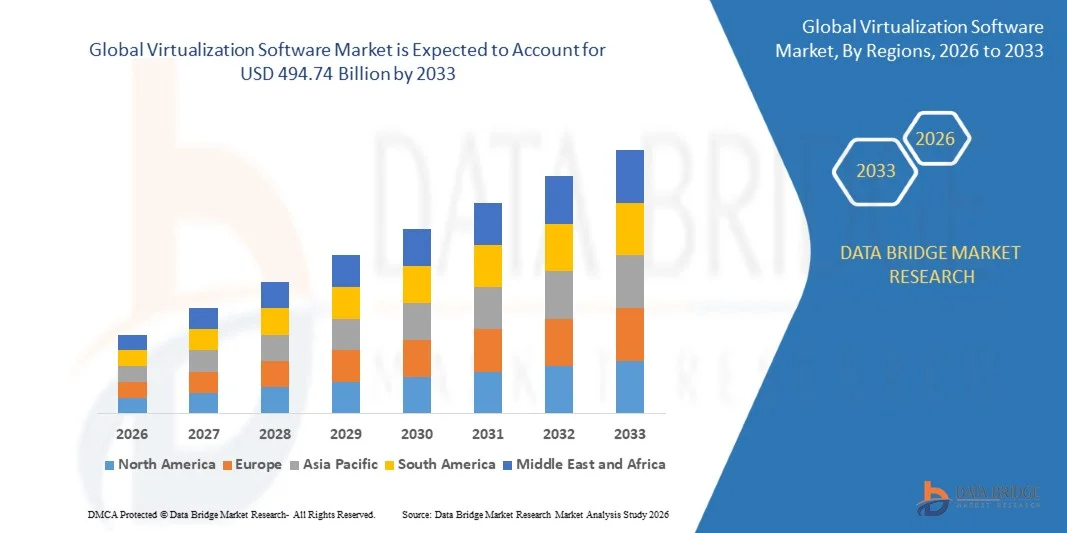
- As per Data Bridge Market Research analysis, the virtualization software market was valued at USD 100.81 billion in 2025 and is projected to reach USD 494.74 billion by 2033, growing at a CAGR of 22.00% from 2026 to 2033.
- The market is experiencing consistent growth driven by increasing adoption of cloud-based services, rising demand for efficient IT resource utilization, expansion of enterprise server virtualization, and growing deployment of cloud-native architectures and software-defined infrastructure.
- The increasing need for scalable and flexible computing infrastructure, combined with the expansion of data centers, hybrid-cloud environments, and edge computing, is compelling enterprises to adopt virtualization software. Server and compute virtualization remains a major component of the market, while hybrid configurations and mobile and endpoint virtualization are expanding as organizations seek greater infrastructure flexibility, resource optimization, and secure access to virtualized workloads.
Market Size & Forecast
- Global Market Value (2025): USD 100.81 Billion
- Expected Market Value (2033): USD 494.74 Billion
- Forecast CAGR (2026–2033): 22.00%
- Leading Region in 2025: North America
- Fastest Growing Region: Asia Pacific
What are the Major Takeaways of the Virtualization Software Market?
- North America dominated the virtualization software market with the largest revenue share of 42.42% in 2025, supported by mature enterprise IT infrastructure, widespread cloud adoption, and strong investments in data centers and virtualization technologies.
- Asia-Pacific is expected to be the fastest-growing region at a CAGR of 17.26% from 2026 to 2033, fueled by rapid digital transformation, expanding cloud infrastructure, increasing data-center investments, and growing virtualization adoption across China, India, and other emerging economies.
- The PC virtualization segment led the market with a 62.46% share in 2025, driven by widespread enterprise adoption of virtualized computing environments and server infrastructure.
- Mobile virtualization are the fastest-growing platform type, projected to register a CAGR of 16.32%, reflecting the surge in demand for secure and flexible computing environments across mobile and endpoint devices.
- The server virtualization segment dominated the type category with a 42.72% revenue share in 2025, led by extensive deployment across enterprise data centers and cloud infrastructure.
- On-Premise accounted for 50.54% of the market share in 2025, preferred by organizations seeking direct control over infrastructure, applications, and data.
- The hybrid segment is the fastest-growing deployment mode category, with a CAGR of 17.74%, driven by increasing adoption of hybrid-cloud infrastructure.
Report Scope and Virtualization Software Market Segmentation
|
Attributes |
Virtualization Software Key Market Insights |
|
Segments Covered |
|
|
Countries Covered |
North America
Europe
Asia-Pacific
Middle East and Africa
South America
|
|
Key Market Players |
|
|
Market Opportunities |
|
|
Value Added Data Infosets |
In addition to the market insights such as market value, growth rate, market segments, geographical coverage, market players, and market scenario, the market report curated by the Data Bridge Market Research team includes in-depth expert analysis, import/export analysis, pricing analysis, production consumption analysis, and pestle analysis. |
What is the Key Trend in the Virtualization Software Market?
- Enterprises are increasingly integrating virtualization software with hybrid-cloud and cloud-native infrastructure to manage virtual machines and containers through unified platforms, improving workload portability, operational consistency, and infrastructure flexibility across data-center, cloud, and edge environments.
- For instance, in May 2025, Red Hat reported that deployments of OpenShift Virtualization had increased 178% since the start of 2024, reflecting growing enterprise adoption of platforms that combine traditional virtual machines with cloud-native workloads.
- Virtualization platforms are also evolving to support artificial intelligence workloads, with vendors integrating AI infrastructure, Kubernetes management, GPUs, and private-cloud capabilities into virtualization environments to accommodate increasingly demanding enterprise applications.
- For instance, in August 2025, Broadcom announced that VMware Cloud Foundation would become an AI-native platform, with VMware Private AI Services integrated into Cloud Foundation 9.0 to support secure AI workloads within private-cloud environments.
- The convergence of virtualization, Kubernetes, and private-cloud technologies is enabling organizations to operate virtual machines and containers through common management frameworks while supporting workload modernization and reducing infrastructure complexity.
What are the Key Drivers of the Virtualization Software Market?
- The rapid expansion of hybrid-cloud, private-cloud, and edge-computing environments is increasing demand for virtualization software that enables organizations to consolidate workloads, improve resource utilization, and maintain consistent infrastructure management across distributed IT environments.
- For instance, in April 2025, Red Hat highlighted OpenShift Virtualization's ability to deploy and manage virtual machines across hybrid-cloud, multicloud, and edge environments, while running virtual machines and containers through a unified platform.
- Enterprises are also seeking greater control over infrastructure costs, security, data sovereignty, and workload placement, encouraging organizations to modernize virtualization environments and evaluate private-cloud architectures alongside public-cloud deployments.
- For instance, in May 2025, Broadcom's global survey of 1,800 senior IT leaders found that 53% identified private cloud as their top priority for deploying new workloads during the following three years, while 69% were considering workload repatriation from public clouds.
- With organizations increasingly requiring scalable infrastructure for traditional applications, cloud-native workloads, and AI, virtualization software is becoming an important foundation for consolidating computing resources, improving workload mobility, and supporting modern enterprise IT strategies
Which Factors are Challenging the Growth of the Virtualization Software Market?
- Rising virtualization licensing and subscription costs are creating financial challenges for enterprises, particularly organizations with large virtual-machine estates that historically relied on perpetual licensing and separate maintenance agreements.
- For instance, in January 2025, Austrian cloud provider Anexia migrated approximately 12,000 virtual machines from VMware to a KVM-based platform after reporting substantial increases in VMware licensing costs and changes to commercial terms following Broadcom's acquisition
- These changing commercial models can increase migration pressure and encourage customers to evaluate alternative virtualization platforms, open-source hypervisors, and integrated cloud-native solutions to control infrastructure expenditure and reduce vendor dependency.
- For instance, in July 2025, Telefónica Germany shifted support for its VMware environment to Spinnaker after reporting that its proposed renewal price from Broadcom was approximately five times higher than expected, highlighting the cost challenges associated with changing virtualization licensing models.
- The financial pressure is particularly significant for service providers and enterprises operating extensive virtualized environments, where subscription commitments and bundled software requirements can raise total ownership costs and complicate long-term infrastructure planning.
How is the Virtualization Software Market Segmented?
The virtualization software market is segmented on the basis of platform, type, deployment mode, and end user.
- By Platform
On the basis of platform, the virtualization software market is segmented into PC virtualization and mobile virtualization. The PC virtualization segment dominated the market with 62.46% share in 2025, supported by widespread enterprise adoption of virtualized computing environments and server infrastructure. PC virtualization enables organizations to consolidate computing resources and improve utilization of existing hardware infrastructure. It is extensively deployed across enterprise data centers, private-cloud environments, application development, and testing operations. Growing demand for infrastructure optimization and centralized IT management continues to support adoption of PC virtualization. The segment also benefits from established virtualization platforms and compatibility with enterprise computing environments.
The mobile virtualization segment is projected to register the fastest growth at a CAGR of 16.32% during forecast period, driven by increasing demand for secure and flexible computing environments across mobile and endpoint devices. Mobile virtualization enables organizations to create isolated environments for applications, operating systems, and enterprise resources on mobile devices. Growing enterprise mobility and remote-working practices are increasing demand for secure access to corporate applications. The technology can also support separation of personal and business environments on shared devices. Increasing adoption of smartphones, tablets, and connected endpoints is creating additional opportunities for mobile virtualization.
- By Type
On the basis of type, the virtualization software market is segmented into application virtualization, network virtualization, hardware virtualization, desktop virtualization, software-defined storage, server virtualization, OS virtualization, and other types. The server virtualization segment dominated the market with 42.72% share in 2025, supported by extensive deployment across enterprise data centers and cloud infrastructure. Server virtualization allows multiple virtual machines to operate on shared physical computing resources. Organizations use the technology to consolidate servers, improve resource utilization, and simplify infrastructure management. It also enables flexible workload provisioning and migration across virtualized environments. Increasing data-center expansion and cloud adoption continue to strengthen demand for server virtualization.
The network virtualization segment is projected to register the fastest growth at a CAGR of 15.96% during forecast period, supported by increasing adoption of software-defined networking and virtualized network functions. Network virtualization enables organizations to separate network services from dedicated physical hardware and manage resources through software. The technology provides greater flexibility in network configuration, provisioning, and management. Increasing deployment of 5G infrastructure and software-defined data centers is creating additional demand for virtualized networks. Growing edge-computing deployments are also increasing requirements for flexible and programmable network architectures.
- By Deployment Mode
On the basis of deployment mode, the virtualization software market is segmented into On-premises, Cloud/SaaS-hosted, and hybrid. The On-premises segment dominated the market with 50.54% share in 2025, supported by organizations seeking direct control over infrastructure, applications, and data. On-premises virtualization enables enterprises to operate virtual machines within their own data-center environments. It remains widely used by organizations with established infrastructure and strict security or compliance requirements. The deployment model also provides greater control over workload placement, infrastructure configuration, and internal IT policies. Enterprises can use virtualization to improve utilization of existing physical infrastructure without completely replacing their data centers.
The hybrid segment is projected to register the fastest growth at a CAGR of 17.74% during forecast period, driven by increasing adoption of hybrid-cloud infrastructure. Hybrid deployment enables organizations to combine on-premises resources with public and private cloud environments according to workload requirements. Enterprises can retain sensitive or critical workloads within controlled infrastructure while using cloud resources for scalability and additional capacity. This approach also supports workload mobility across different computing environments. Increasing cloud migration and demand for flexible infrastructure management are strengthening adoption of hybrid virtualization.
- By End User
On the basis of end user, the virtualization software market is segmented into IT and telecommunications, BFSI, healthcare and life sciences, manufacturing, government and defense, media and entertainment, retail and e-commerce, education, and others. The IT and telecommunications segment dominated the market with 28.88% share in 2025, supported by extensive virtualization requirements across enterprise infrastructure, data centers, and telecommunications networks. IT organizations use virtualization to consolidate servers, optimize computing resources, and support cloud workloads. Telecommunications companies are increasingly using virtualized network functions to improve network flexibility and infrastructure management. Growing data-center expansion and cloud-service adoption are further strengthening demand from this sector. The increasing deployment of software-defined infrastructure also creates additional applications for virtualization technologies.
The healthcare and life sciences segment is projected to register the fastest growth at a CAGR of 16.92% during forecast period, supported by increasing digitalization of healthcare infrastructure and growing adoption of cloud-enabled applications. Healthcare organizations are using virtualization to improve the scalability and management of computing resources supporting digital healthcare workloads. Virtualized infrastructure can support clinical applications, electronic health records, analytics, medical research, and remote healthcare services. Growing requirements for secure and reliable access to healthcare applications are encouraging infrastructure modernization. Increasing adoption of cloud and hybrid IT environments is creating further opportunities for virtualization across healthcare organizations.
Which Region Holds the Largest Share of the Virtualization Software Market?
- North America dominated the virtualization software market with the largest revenue share of 42.42% in 2025, supported by mature enterprise IT infrastructure, widespread cloud adoption, and strong investments in data centers and virtualization technologies
- The region also benefits from the strong presence of hyperscale cloud providers, established enterprise technology ecosystems, increasing adoption of hybrid-cloud architectures, and continued investments in data-center modernization. Growing requirements for infrastructure consolidation, workload mobility, cybersecurity, and efficient resource utilization continue to strengthen North America's leadership position in the global virtualization software market
U.S. Virtualization Software Market Insight
The U.S. virtualization software market is witnessing strong growth due to widespread adoption of cloud computing, enterprise data centers, and hybrid-cloud infrastructure. The country’s mature IT ecosystem, along with the strong presence of major virtualization, cloud, and technology providers, is driving demand across enterprises, telecommunications, BFSI, healthcare, and government applications. In addition, growing investments in data-center modernization, workload consolidation, cybersecurity, and AI infrastructure are accelerating virtualization adoption across organizations.
Asia-Pacific Virtualization Software Market Insight
The Asia-Pacific virtualization software market is expected to witness rapid growth, driven by increasing digitalization, expanding cloud infrastructure, and rising investments in data centers across countries such as China, India, Japan, and South Korea. Growing adoption of hybrid-cloud environments, enterprise applications, and software-defined infrastructure is supporting regional market expansion. In addition, increasing IT modernization initiatives, rapid growth of digital services, and expanding telecommunications infrastructure are accelerating virtualization adoption across enterprises and public-sector organizations.
Japan Virtualization Software Market Insight
The Japan virtualization software market is witnessing consistent growth due to rising investments in cloud infrastructure, enterprise IT modernization, and data-center technologies. Businesses, telecommunications providers, and government organizations are increasingly adopting virtualization to improve infrastructure utilization, workload management, and operational flexibility. Moreover, increasing integration of hybrid-cloud platforms, edge computing, and advanced data-management technologies, along with Japan’s focus on digital transformation and resilient IT infrastructure, is further contributing to market growth.
China Virtualization Software Market Insight
The China virtualization software market is growing rapidly, driven by expanding cloud infrastructure, increasing data-center investments, and rising enterprise digital transformation. Growing adoption of virtualization across cloud computing, telecommunications, manufacturing, and financial services is significantly boosting market demand. In addition, increasing investments in domestic data centers, software-defined infrastructure, AI computing, and hybrid-cloud environments are supporting virtualization deployment, positioning China as an important growth market for virtualization software.
U.K. Virtualization Software Market Insight
The U.K. virtualization software market is experiencing steady growth, supported by rising adoption of cloud computing, hybrid IT infrastructure, and enterprise data-center modernization. Increasing investments in scalable and secure computing environments are contributing to market growth across financial services, healthcare, government, and telecommunications applications. Furthermore, growing integration of virtualization with cloud-native technologies, cybersecurity solutions, and software-defined infrastructure is improving resource utilization and operational flexibility, supporting the U.K. as an important European market for virtualization software.
Germany Virtualization Software Market Insight
The Germany virtualization software market is expanding steadily due to the country’s strong industrial base, advanced enterprise IT infrastructure, and increasing adoption of cloud and data-center technologies. Manufacturing companies, financial institutions, telecommunications providers, and government organizations are increasingly utilizing virtualization for workload consolidation, infrastructure optimization, and flexible IT management. Continuous advancements in hybrid-cloud platforms, edge computing, cybersecurity, and software-defined infrastructure, along with Germany’s strong focus on industrial digitalization, are further driving market grow
Which are the Top Companies in Virtualization Software Market?
The virtualization software industry is primarily led by well-established companies, including:
- Microsoft Corporation (U.S.)
- Oracle (U.S.)
- Nutanix, Inc. (U.S.)
- Proxmox Server Solutions GmbH (Austria)
- Canonical Ltd. (U.K.)
- IBM Corporation (U.S.)
- Hewlett Packard Enterprise Development LP (U.S.)
- Lenovo (Hong Kong)
- SUSE (U.K.)
- Virtuozzo International GmbH (Switzerland)
- Scale Computing, Inc. (U.S.)
- Acronis International GmbH (Switzerland)
- Huawei Technologies Co., Ltd. (China)
- Cisco Systems, Inc. (U.S.)
- Amazon Web Services, Inc. (U.S.)
- Google LLC (U.S.)
- Alibaba Cloud (Singapore) Private Limited (Singapore)
- OpenNebula Systems S.L.U. (Spain)
- Mirantis, Inc. (U.S.)
- Vates SAS (France)
What are Latest Developments in Virtualization Software Market?
- In June 2025, Broadcom announced the general availability of VMware Cloud Foundation 9.0, introducing a modern private-cloud platform with a unified operating model spanning data centers, edge environments, and managed cloud infrastructure. The platform supports traditional, modern, and AI applications while adding centralized operations, security, compliance, cost management, and workload-management capabilities. This development strengthens VMware’s positioning around integrated private and hybrid-cloud virtualization.
- In May 2025, Red Hat announced the public preview of Red Hat OpenShift Virtualization on Microsoft Azure Red Hat OpenShift, enabling organizations to run and manage virtual machines alongside containers on a Kubernetes-based hybrid-cloud platform. The offering includes migration tooling and automation designed to help organizations modernize existing VM workloads while maintaining support for traditional applications. This development expands virtualization capabilities into cloud-native and hybrid-cloud environments.
- In August 2024, Broadcom unveiled VMware Cloud Foundation 9, outlining a unified private-cloud platform designed to simplify the deployment, consumption, and operation of virtualized infrastructure. The announced platform included integrated multi-tenancy, native virtual private cloud capabilities, enhanced security management, and expanded support for AI workloads. The development highlighted the industry's movement toward integrated virtualization and private-cloud platforms.
- In April 2022, Microsoft announced the general availability of System Center 2022, adding enhanced data-center management capabilities across Windows Server, Azure Stack HCI, VMware environments, and Linux systems. The release included Virtual Machine Manager capabilities for managing virtual machines, software-defined networking, storage pools, and Azure Stack HCI clusters. This development strengthened centralized management of virtualized workloads across diverse IT environments.
- In February 2021, Microsoft India announced the general availability of Azure Stack HCI in India, providing organizations with a hyperconverged infrastructure solution supporting hybrid-cloud scenarios across data centers, remote offices, cloud, and edge locations. The platform supports both Windows and Linux virtual machines and was made available through Microsoft-validated hardware partners. This development expanded Microsoft's hybrid infrastructure and virtualization capabilities for organizations in the Indian market.

- Interactive Data Analysis Dashboard
- Company Analysis Dashboard for high growth potential opportunities
- Research Analyst Access for customization & queries
- Competitor Analysis with Interactive dashboard
- Latest News, Updates & Trend analysis
- Harness the Power of Benchmark Analysis for Comprehensive Competitor Tracking
Data collection and base year analysis are done using data collection modules with large sample sizes. The stage includes obtaining market information or related data through various sources and strategies. It includes examining and planning all the data acquired from the past in advance. It likewise envelops the examination of information inconsistencies seen across different information sources. The market data is analysed and estimated using market statistical and coherent models. Also, market share analysis and key trend analysis are the major success factors in the market report. To know more, please request an analyst call or drop down your inquiry.
The key research methodology used by DBMR research team is data triangulation which involves data mining, analysis of the impact of data variables on the market and primary (industry expert) validation. Data models include Vendor Positioning Grid, Market Time Line Analysis, Market Overview and Guide, Company Positioning Grid, Patent Analysis, Pricing Analysis, Company Market Share Analysis, Standards of Measurement, Global versus Regional and Vendor Share Analysis. To know more about the research methodology, drop in an inquiry to speak to our industry experts.
Data Bridge Market Research is a leader in advanced formative research. We take pride in servicing our existing and new customers with data and analysis that match and suits their goal. The report can be customized to include price trend analysis of target brands understanding the market for additional countries (ask for the list of countries), clinical trial results data, literature review, refurbished market and product base analysis. Market analysis of target competitors can be analyzed from technology-based analysis to market portfolio strategies. We can add as many competitors that you require data about in the format and data style you are looking for. Our team of analysts can also provide you data in crude raw excel files pivot tables (Fact book) or can assist you in creating presentations from the data sets available in the report.













