


What is the Global Visible Light Communication Market Size and Growth Rate?
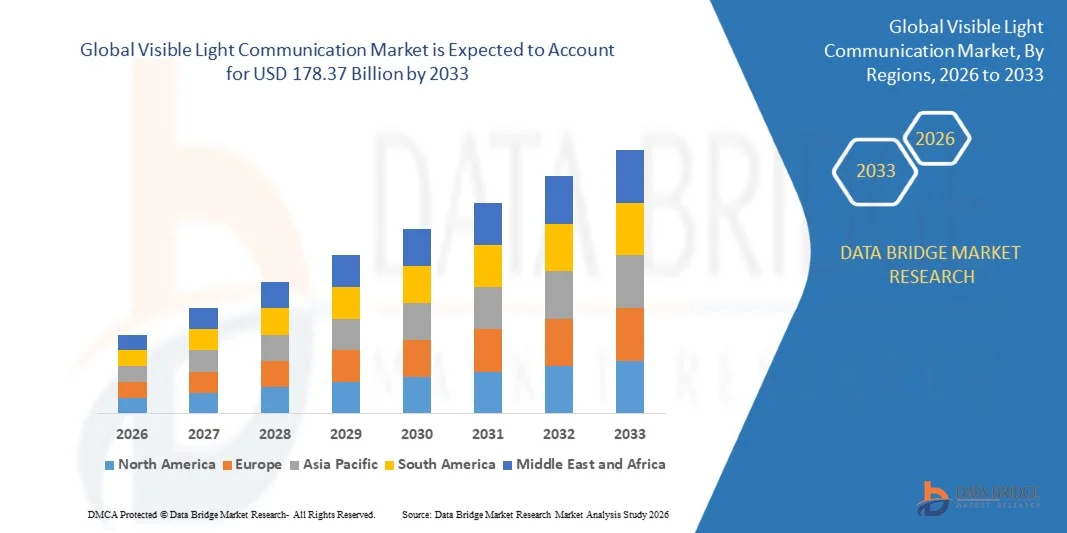
- As per Data Bridge Market Research analysis that the global Visible Light Communication market size was valued at USD 7.83 billion in 2025 and is expected to reach USD 178.37 billion by 2033, at a CAGR of47.80% during the forecast period
- The rise in the presence of LEDs in signaling or illumination entity across the globe acts as one of the major factors driving the growth of visible light communication market. The increase in demand for a secure, fast and reliable network across Li-Fi industry, and rise in spectrum crisis because of increased data usage influencing the network providers to switch towards robust and high efficiency internet services accelerate the market growth
- The implementation of the LED-based lighting system in various applications such as in-flight communication, automotive & transport and smartphones, and high demand for mapping portals further influence the market
Market Size & Forecast
Global Market Value (2025): USD 7.83 billion
Expected Market Value (2033): USD 178.37 billion
Forecast CAGR (2026–2033): 47.80%
What are the Major Takeaways of Visible Light Communication Market?
- Increase in penetration of smartphones, increase in investments, rise in in the number of internet users, rapid digitization, expansion of end use industries and high data traffic in the developed countries positively affect the visible light communication market. Furthermore, high emergence of new applications such as IoT and 5G, and increase in demand for real-time traffic updates extend profitable opportunities
- North America dominated the visible light communication market with the largest revenue share of 36.45% in 2025, driven by strong demand for home automation, enhanced security features, and rising consumer awareness of smart home technologies
- The Asia-Pacific (APAC) visible light communication market is forecasted to grow at the fastest CAGR of 8.84% from 2026 to 2033, driven by rapid urbanization, rising disposable incomes, and smart city initiatives
- The LED segment dominated the market with the largest revenue share of 48.5% in 2025, owing to the widespread adoption of LED lighting infrastructure worldwide
Report Scope and Visible Light Communication Market Segmentation
|
Attributes |
Visible Light Communication Key Market Insights |
|
Segments Covered |
|
|
Countries Covered |
North America
Europe
Asia-Pacific
Middle East and Africa
South America
|
|
Key Market Players |
|
|
Market Opportunities |
|
|
Value Added Data Infosets |
In addition to the insights on market scenarios such as market value, growth rate, segmentation, geographical coverage, and major players, the market reports curated by the Data Bridge Market Research also include in-depth expert analysis, pricing analysis, brand share analysis, consumer survey, demography analysis, supply chain analysis, value chain analysis, raw material/consumables overview, vendor selection criteria, PESTLE Analysis, Porter Analysis, and regulatory framework. |
What is the Key Trend in the Visible Light Communication Market?
“Enhanced Connectivity Through Li-Fi and IoT Integration”
- A notable trend shaping the global visible light communication (VLC) market is the rapid integration of Li-Fi technology with the Internet of Things (IoT) ecosystem, enabling ultra-fast, secure, and interference-free wireless communication
- For instance, pureLiFi has pioneered Li-Fi solutions that deliver gigabit internet using LED light sources, positioning visible light communication as a viable alternative to Wi-Fi, particularly in areas requiring low-latency and interference-free connectivity. Similarly, Signify’s Trulifi system is being deployed in offices and industrial environments to support data-heavy applications with enhanced reliability
- The adoption of visible light communication in IoT frameworks allows seamless communication between smart devices in environments such as hospitals, aircraft cabins, and factories, where RF-based systems face limitations due to congestion or security concerns
- Furthermore, Li-Fi enables ultra-secure data transmission, as visible light signals cannot penetrate walls, reducing risks of unauthorized access. This feature is particularly valued in government and defense applications
- Companies such as Oledcomm and Velmenni are developing advanced visible light communication solutions tailored for smart cities, connected vehicles, and industrial automation, pushing the market toward broader adoption
- Overall, this trend is transforming visible light communication from a niche technology into a mainstream enabler of next-generation wireless communication and IoT ecosystems, reshaping expectations for speed, security, and reliability
What are the Key Drivers of Visible Light Communication Market?
- The growing demand for high-speed, interference-free communication is a primary driver of the visible light communication market, especially in environments where Wi-Fi or radio frequency (RF) signals face limitations
- For instance, in February 2025, Oledcomm unveiled its new LiFiMAX2 solution, offering ultra-fast connectivity in hospitals and schools where secure, low-radiation alternatives to Wi-Fi are preferred. Such launches underline visible light communication’s suitability in sensitive and data-heavy sectors
- Another driver is the expanding adoption of LED lighting infrastructure worldwide, which serves as the backbone for visible light communication deployment. Since LEDs are energy-efficient and already widely installed, embedding visible light communication capabilities becomes cost-effective
- Rising data security concerns also support visible light communication growth, as light-based communication ensures data cannot travel beyond physical boundaries, reducing interception risks
- In addition, the surge in smart city initiatives, connected vehicles, and Industry 4.0 automation is fueling demand for visible light communication in real-time data exchange, intelligent traffic systems, and machine-to-machine communication
- Combined with the low energy consumption and cost benefits of visible light communication -enabled LEDs, these factors are expected to propel market adoption across both developed and emerging economies
Which Factor is Challenging the Growth of the Visible Light Communication Market?
- Despite strong potential, the visible light communication market faces challenges due to line-of-sight dependency and limited range of visible light signals. Since visible light communication requires a direct or near-direct light path between the transmitter and receiver, obstacles or ambient light interference can disrupt communication quality
- For instance, enterprise trials of Li-Fi in open office environments have reported performance drops under bright sunlight, raising concerns about reliability in uncontrolled settings
- In addition, the higher installation costs for advanced visible light communication systems, compared to traditional Wi-Fi or RF-based networks, pose a barrier for small businesses and residential consumers. While companies such as Zero1 and Velmenni are working to reduce costs, affordability remains a hurdle
- Another critical challenge is the lack of global standards and interoperability, slowing large-scale deployments. Without harmonized regulations, integration with existing digital infrastructure is often complex and fragmented
- To address these obstacles, industry leaders are focusing on hybrid communication systems, combining visible light communication with Wi-Fi to ensure uninterrupted connectivity
- Overcoming these issues through technological advancements, cost reductions, and standardization will be vital for unlocking visible light communication’s potential as a mainstream communication technology
How is the Visible Light Communication Market Segmented?
The market is segmented on the basis of component, transmission type, and application.
- By Component
On the basis of component, the visible light communication (VLC) market is segmented into Light Emitting Diodes (LEDs), Photodetectors, Microcontrollers, and Software and Services. The LED segment dominated the market with the largest revenue share of 48.5% in 2025, owing to the widespread adoption of LED lighting infrastructure worldwide. LEDs act as the fundamental medium for VLC systems, offering energy efficiency, high modulation speeds, and easy integration into existing lighting networks. The continuous replacement of traditional lighting with smart LED systems in households, offices, and public spaces further strengthens this dominance.
Meanwhile, the Software and Services segment is projected to grow at the fastest CAGR from 2026 to 2033, driven by the rising need for advanced signal processing, network optimization, and cloud-based management platforms. The increasing role of software in enabling seamless integration with IoT and AI platforms is expected to make it the most dynamic growth area within this segment.
- By Transmission Type
On the basis of transmission type, the visible light communication market is segmented into Uni-directional and Bi-directional communication systems. The Uni-directional segment held the largest market share of 61.2% in 2025, driven by its extensive use in indoor location-based services, advertising displays, and secure point-to-point communication. These systems are simpler, cost-effective, and widely deployed in retail, museums, and educational institutions for one-way data transmission.
However, the Bi-directional segment is anticipated to witness the fastest CAGR from 202 to 2033, fueled by its growing adoption in next-generation Li-Fi networks, industrial automation, and real-time data exchange applications. Bi-directional systems allow simultaneous two-way communication, making them more suitable for consumer electronics, smart offices, and vehicular connectivity. The increasing demand for high-speed internet and the ability of bi-directional visible light communication to serve as a Wi-Fi alternative are expected to accelerate this segment’s expansion significantly during the forecast period.
- By Application
On the basis of application, the visible light communication market is segmented into Consumer Electronics, Defense and Security, Transportation, Public Infrastructure, Life Sciences, and Other Applications. The Consumer Electronics segment accounted for the largest revenue share of 42.7% in 2025, driven by the integration of visible light communication in smartphones, laptops, and wearables to provide high-speed, secure, and interference-free communication. The rapid penetration of Li-Fi-enabled devices and the surge in data consumption across connected homes further strengthen this segment’s dominance.
On the other hand, the Transportation segment is projected to grow at the fastest CAGR from 2026 to 2033, propelled by increasing investments in intelligent transport systems and connected vehicles. visible light communication is being adopted in vehicle-to-vehicle (V2V) and vehicle-to-infrastructure (V2I) communications for improved safety, traffic management, and autonomous driving support. With the rising need for real-time, reliable data exchange in transportation, this segment is expected to emerge as the most transformative application area of visible light communication.
Which Region Holds the Largest Share of the Visible Light Communication Market?
- North America dominated the visible light communication market with the largest revenue share of 36.45% in 2025, driven by strong demand for home automation, enhanced security features, and rising consumer awareness of smart home technologies
- Consumers in the region value the convenience, advanced safety, and seamless integration of visible light communication with other connected devices such as thermostats, lighting systems, and security cameras
- High disposable incomes, a tech-savvy population, and growing reliance on remote monitoring further cement visible light communication’s role as a preferred solution across residential and commercial sectors
U.S. Visible Light Communication Market Insight
The U.S. visible light communication market captured the largest revenue share of 81% in 2025 within North America, propelled by the widespread adoption of connected devices and home automation systems. Rising demand for DIY smart home setups, voice-controlled assistants, and app-based integration is a key driver. Integration with platforms such as Amazon Alexa, Google Assistant, and Apple HomeKit continues to strengthen market growth, with consumers prioritizing convenience and secure, intelligent entry solutions.
Europe Visible Light Communication Market Insight
The Europe visible light communication market is projected to grow at a robust CAGR, supported by stringent safety regulations and rising demand for connected devices in homes and offices. Increasing urbanization, emphasis on energy efficiency, and adoption across both new constructions and renovation projects are fueling demand. Consumers in Europe are drawn to the security, comfort, and eco-friendly advantages of visible light communication, making it a strong growth hub.
U.K. Visible Light Communication Market Insight
The U.K. visible light communication market is expected to grow at a noteworthy CAGR during the forecast period, supported by the rising popularity of home automation and smart security systems. Concerns over burglary and property safety are encouraging adoption across residential and commercial applications. The country’s well-developed retail and e-commerce ecosystem further enhances access to smart visible light communication -enabled solutions, boosting growth prospects.
Germany Visible Light Communication Market Insight
The Germany visible light communication market is anticipated to expand considerably, driven by digital security awareness and demand for innovative, sustainable technologies. Germany’s advanced infrastructure, combined with its focus on eco-conscious solutions, accelerates visible light communication integration into residential and commercial buildings. Local consumers increasingly favor privacy-focused and secure automation systems, supporting steady adoption trends.
Which Region is the Fastest Growing Region in the Visible Light Communication Market?
The Asia-Pacific (APAC) visible light communication market is forecasted to grow at the fastest CAGR of 8.84% from 2026 to 2033, driven by rapid urbanization, rising disposable incomes, and smart city initiatives. Growing adoption of smart homes, coupled with government-led digitalization programs in countries such as China, Japan, and India, is fueling expansion. APAC’s strong position as a manufacturing hub for visible light communication systems and components makes the technology more affordable and widely accessible to consumers.
Japan Visible Light Communication Market Insight
The Japan visible light communication market is gaining strong momentum, backed by the country’s tech-oriented culture and rapid urbanization. Growing adoption of smart homes and IoT-enabled buildings is driving demand. Integration with lighting systems, home cameras, and IoT devices is expanding usage, while the country’s aging population fuels demand for secure, user-friendly automation solutions in both residential and commercial environments.
China Visible Light Communication Market Insight
The China visible light communication market accounted for the largest revenue share in APAC in 2025, supported by a growing middle class, smart city initiatives, and high technology adoption rates. As one of the largest global markets for smart home devices, China is seeing rapid penetration of visible light communication across residential, commercial, and rental properties. Strong domestic manufacturing capabilities and affordable visible light communication product offerings further accelerate market adoption.
Which are the Top Companies in Visible Light Communication Market?
The visible light communication industry is primarily led by well-established companies, including:
- LightPointe Communications, Inc. (U.S.)
- Signify Holding (Netherlands)
- Oledcomm (France)
- LUCIBEL (France)
- pureLiFi (U.K.)
- Acuity Brands Lighting, Inc. (U.S.)
- General Electric (GE) (U.S.)
- LVX System (U.S.)
- Koninklijke Philips N.V. (Netherlands)
- Velmenni OÜ (Estonia)
- Zero1 Pte Ltd. (Singapore)
- Outstanding Technology Co., Ltd. (Japan)
- Panasonic Corporation (Japan)
- Wireless Excellence Limited (U.K.)
- Supreme Architecture Inc. (U.S.)
- Lightbee (Spain)
- Qualcomm Technologies, Inc. (U.S.)
What are the Recent Developments in Global Visible Light Communication Market?
- In April 2025, the Indian Institute of Science (IISc) announced a major breakthrough by developing a device that can convert infrared light into visible light. This advancement holds significant potential to transform defense and optical communication systems by enabling the use of widely available visible-light cameras instead of bulky infrared sensors. This milestone is expected to accelerate innovation and practical adoption across multiple industries
- In March 2025, pureLiFi, a global leader in LiFi technology, unveiled its LINXC Bridge system at the Mobile World Congress in Barcelona in partnership with Solace Power. This solution equips Fixed Wireless Access (FWA) broadband providers with self-installable outdoor Customer Premises Equipment (CPE), ensuring faster installations and consistent speeds for users. This launch is set to redefine consumer broadband experiences worldwide
- In November 2025, Nav Wireless Technologies Pvt. Ltd. signed a pivotal Transfer of Technology (ToT) agreement with the Centre for Development of Advanced Computing (C-DAC) in Chennai under the guidance of the Ministry of Electronics and Information Technology (MeitY). The solutions, NLOS VICINITY and ILLUMINATE, utilize Visible Light Communication (VLC) for applications ranging from smart lighting to indoor positioning. This collaboration highlights the vital role of public-private partnerships in advancing innovation and economic growth
- In October 2023, Casio Computer Co., Ltd. announced the expansion of its Dubai subsidiary’s role to cover a wider African market and strengthen its regional sales structure. The subsidiary’s name was changed from CASIO Middle East FZE to CASIO Middle East and Africa FZE effective November 1, 2022, with operations commencing under the new identity. This move reinforces Casio’s commitment to strategic global expansion in emerging regions
- In September 2022, researchers from the Intelligent and Converged Network introduced the concept of an Internet of Light, designed to integrate with the Internet of Things (IoT). The initiative aims to enhance human well-being by combining intelligent lighting with digital information services, particularly as people spend increasing amounts of time indoors. This vision underscores the potential of illumination networks in shaping future digital ecosystems
- In July 2022, the Scottish National Investment Bank invested EUR 10 million in Edinburgh-based pureLiFi to accelerate the global rollout of its innovative VLC-based networking solution, LiFi. This funding supports years of research dedicated to creating next-generation wireless communication alternatives. This investment strengthens pureLiFi’s position as a frontrunner in the global VLC technology landscape

- Interactive Data Analysis Dashboard
- Company Analysis Dashboard for high growth potential opportunities
- Research Analyst Access for customization & queries
- Competitor Analysis with Interactive dashboard
- Latest News, Updates & Trend analysis
- Harness the Power of Benchmark Analysis for Comprehensive Competitor Tracking
Data collection and base year analysis are done using data collection modules with large sample sizes. The stage includes obtaining market information or related data through various sources and strategies. It includes examining and planning all the data acquired from the past in advance. It likewise envelops the examination of information inconsistencies seen across different information sources. The market data is analysed and estimated using market statistical and coherent models. Also, market share analysis and key trend analysis are the major success factors in the market report. To know more, please request an analyst call or drop down your inquiry.
The key research methodology used by DBMR research team is data triangulation which involves data mining, analysis of the impact of data variables on the market and primary (industry expert) validation. Data models include Vendor Positioning Grid, Market Time Line Analysis, Market Overview and Guide, Company Positioning Grid, Patent Analysis, Pricing Analysis, Company Market Share Analysis, Standards of Measurement, Global versus Regional and Vendor Share Analysis. To know more about the research methodology, drop in an inquiry to speak to our industry experts.
Data Bridge Market Research is a leader in advanced formative research. We take pride in servicing our existing and new customers with data and analysis that match and suits their goal. The report can be customized to include price trend analysis of target brands understanding the market for additional countries (ask for the list of countries), clinical trial results data, literature review, refurbished market and product base analysis. Market analysis of target competitors can be analyzed from technology-based analysis to market portfolio strategies. We can add as many competitors that you require data about in the format and data style you are looking for. Our team of analysts can also provide you data in crude raw excel files pivot tables (Fact book) or can assist you in creating presentations from the data sets available in the report.













