


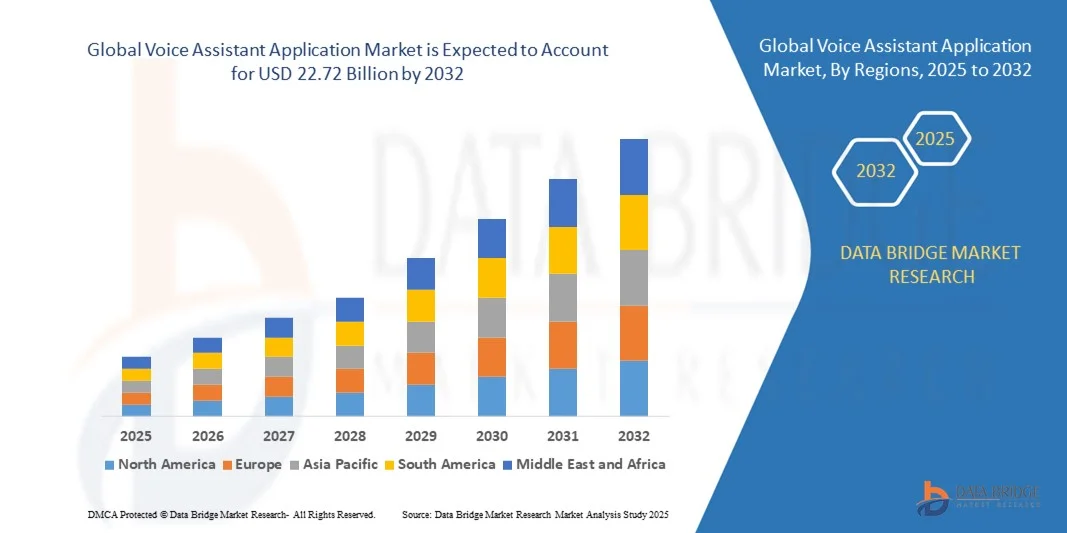
What is the Global Voice Assistant Application Market Size and Growth Rate?
- The global voice assistant application market size was valued at USD 3.76 billion in 2024 and is expected to reach USD 22.72 billion by 2032, at a CAGR of 25.20% during the forecast period
- Rising demand for cloud-based voice over internet protocol solutions, surge in the evolution of cellular network technology and rising adoption of advanced technologies such as artificial intelligence are the major factors attributable to the growth of the voice assistant application market
What are the Major Takeaways of Voice Assistant Application Market?
- Rising deployment of technologies and solutions that reduce the operational and production costs and rising evolution in natural language processing and automated speech recognition technologies will emerge as the major market growth driving factor
- Surge in the awareness of the benefits of cloud-based solutions, growing number of small and medium scale enterprises especially in the developing economies and surge in the sale of smartphones will further aggravate the growth of the market. Growing focus on customer engagement, and emergence of low-code platforms for voice-assistant applications are some other factors bolstering the growth of the market
- North America dominated the voice assistant application market with a revenue share of 35.51% in 2024, driven by widespread adoption of smart home devices, high disposable incomes, and technological awareness
- The Asia-Pacific market is expected to grow at the fastest CAGR of 11.03% during 2025–2032, fueled by rising disposable incomes, urbanization, and rapid technological adoption in China, Japan, and India
- The Services segment dominated the market with the largest revenue share of 58.3% in 2024, driven by growing demand for subscription-based AI assistants, cloud integration, and ongoing system updates
Report Scope and Voice Assistant Application Market Segmentation
|
Attributes |
Voice Assistant Application Key Market Insights |
|
Segments Covered |
|
|
Countries Covered |
North America
Europe
Asia-Pacific
Middle East and Africa
South America
|
|
Key Market Players |
|
|
Market Opportunities |
|
|
Value Added Data Infosets |
In addition to the insights on market scenarios such as market value, growth rate, segmentation, geographical coverage, and major players, the market reports curated by the Data Bridge Market Research also include in-depth expert analysis, pricing analysis, brand share analysis, consumer survey, demography analysis, supply chain analysis, value chain analysis, raw material/consumables overview, vendor selection criteria, PESTLE Analysis, Porter Analysis, and regulatory framework. |
What is the Key Trend in the Voice Assistant Application Market?
Seamless Integration of AI and Multi-Platform Voice Control
- A notable and accelerating trend in the global voice assistant application market is the integration of advanced artificial intelligence (AI) with multiple voice-controlled ecosystems, including Amazon Alexa, Google Assistant, and Apple HomeKit. This combination is enhancing user convenience, personalization, and overall control across devices
- For instance, popular Voice Assistant Applications now allow users to interact with multiple home systems using voice commands, such as controlling lighting, climate, or home security, creating a unified and automated environment
- AI-enabled voice assistant applications can analyze user behavior, learn preferences, and provide intelligent suggestions or alerts. Some platforms offer predictive scheduling, adaptive responses, and contextual recommendations based on usage patterns, boosting operational efficiency and user satisfaction
- The integration of these applications with smart home ecosystems enables centralized management of various devices, simplifying user interaction and improving the connected experience
- Companies such as Google and Amazon are continually developing AI-powered Voice Assistant Applications with enhanced natural language processing, voice recognition, and personalized automation features
- This trend is transforming consumer expectations, driving adoption across both residential and commercial segments for a more connected and efficient lifestyle
What are the Key Drivers of Voice Assistant Application Market?
- The rising adoption of smart home ecosystems and increasing consumer demand for convenience and automation are primary drivers of voice assistant applications
- For instance, in 2024, Honeywell’s Onity, Inc. introduced IoT-integrated voice-controlled security solutions, illustrating the trend of enhanced automation in connected devices. Such innovations are expected to fuel market growth
- Awareness of home security, energy efficiency, and time-saving automation is encouraging consumers to invest in voice-enabled smart systems. Voice Assistant Applications offer seamless control over lighting, HVAC, and entertainment systems, improving daily convenience
- The growing ecosystem of connected devices and platforms is increasing the need for applications that can integrate multiple systems, providing users with a centralized interface for management
- Features such as hands-free operation, remote monitoring, activity logs, and device control through smartphone applications enhance the appeal of Voice Assistant Applications, supporting adoption in both households and enterprises
Which Factor is Challenging the Growth of the Voice Assistant Application Market?
- Cybersecurity concerns are a major barrier to adoption, as voice assistant applications rely on network connectivity and cloud-based services that can be vulnerable to hacking and data breaches
- High-profile incidents of IoT vulnerabilities have made some consumers hesitant to adopt connected smart home solutions, impacting market penetration
- Addressing these concerns requires advanced encryption, secure authentication, regular software updates, and consumer education. Companies such as August and Level Home emphasize robust security features to reassure users
- In addition, the relatively high cost of advanced Voice Assistant Applications, particularly those with integrated cameras, AI features, or biometric capabilities, can deter price-sensitive consumers in developing regions
- While more affordable basic models are emerging, the perceived premium of AI-enabled solutions may still slow adoption, especially among users who do not immediately see the benefit
- Overcoming these challenges with improved cybersecurity, consumer awareness, and cost-effective solutions will be crucial to sustaining long-term market growth
How is the Voice Assistant Application Market Segmented?
The market is segmented on the basis of component, deployment mode, organization size, channel integration and application.
- By Component
On the basis of component, the voice assistant application market is segmented into Standalone and Services. The Services segment dominated the market with the largest revenue share of 58.3% in 2024, driven by growing demand for subscription-based AI assistants, cloud integration, and ongoing system updates. Service-oriented solutions provide continuous improvements in speech recognition, natural language processing, and multi-device synchronization, making them attractive for both enterprises and end-users. These solutions are preferred for their ability to scale with organizational needs and reduce upfront infrastructure costs.
The Standalone segment is expected to witness the fastest CAGR from 2025 to 2032, fueled by the adoption of edge-based Voice Assistant Applications that operate locally without internet dependency, offering enhanced privacy and reduced latency. The increasing interest in personal, offline-enabled voice assistants is propelling growth in this segment. Overall, component-wise segmentation highlights the importance of services for recurring revenue and the rapid uptake of standalone solutions.
- By Deployment Mode
On the basis of deployment mode, the market is segmented into On-premises and Cloud-based solutions. The Cloud-based segment dominated the market with a revenue share of 61.4% in 2024, driven by benefits such as centralized management, AI-driven analytics, seamless updates, and multi-device synchronization. Cloud-based Voice Assistant Applications allow enterprises to manage vast data, implement updates remotely, and integrate with other cloud services efficiently, boosting adoption in enterprises and smart homes.
Conversely, the On-premises segment is expected to witness the fastest CAGR from 2025 to 2032, as organizations increasingly adopt local deployment for sensitive applications requiring enhanced data privacy, security, and offline functionality. Demand for secure, self-contained voice systems in healthcare, banking, and government sectors is supporting this growth. Deployment mode analysis emphasizes cloud dominance while highlighting the emerging opportunity for secure on-premises solutions.
- By Organization Size
On the basis of organization size, the voice assistant application market is segmented into Small and Medium-sized Enterprises (SMEs) and Large Enterprises. Large enterprises dominated the market in 2024 with a revenue share of 64.1%, driven by substantial investments in AI-powered Voice Assistant Applications across customer service, smart operations, and enterprise automation. Large organizations prioritize scalability, integration with existing enterprise software, and advanced analytics for decision-making.
The SME segment is expected to witness the fastest CAGR from 2025 to 2032, fueled by the increasing availability of cost-effective, plug-and-play Voice Assistant Applications and subscription-based services tailored for smaller operations. The trend toward digital transformation in SMEs, combined with growing adoption of cloud-based voice solutions, is driving market expansion. This segmentation highlights the significant contribution of large enterprises while showing SMEs as a high-growth opportunity.
- By Channel Integration
On the basis of channel integration, the market is segmented into Websites, Mobile Applications, Contact Centres, Smart Speakers, and social media. The Mobile Applications segment dominated the market with a revenue share of 42.5% in 2024, driven by the widespread use of smartphones and the convenience of accessing Voice Assistant Applications on-the-go. Mobile platforms provide instant access to voice commands, AI-powered interactions, and seamless integration with other digital services.
The Smart Speakers segment is expected to witness the fastest CAGR from 2025 to 2032, fueled by the growing adoption of Amazon Echo, Google Nest, and Apple HomePod devices in homes and offices, and the increasing preference for hands-free, voice-first interactions. Channel integration analysis highlights mobile dominance while illustrating smart speakers as a high-growth channel for personalized, voice-driven experiences.
- By Application
On the basis of application, the market is segmented into Smart Retail and e-commerce, Smart Banking, Connected Healthcare, Smart Transportation, Smart Manufacturing, Smart Learning, and Others. The Smart Retail and e-commerce segment dominated the market with a revenue share of 38.9% in 2024, driven by the adoption of Voice Assistant Applications for customer support, personalized recommendations, and conversational commerce. Retailers leverage AI-powered assistants to enhance engagement, reduce response times, and increase conversion rates.
The Connected Healthcare segment is expected to witness the fastest CAGR from 2025 to 2032, as hospitals and healthcare providers increasingly implement voice-enabled solutions for patient interaction, remote monitoring, and clinical documentation, supporting operational efficiency and patient satisfaction. Application-wise segmentation demonstrates the dominance of retail while showcasing healthcare as a rapidly growing sector for voice technology adoption.
Which Region Holds the Largest Share of the Voice Assistant Application Market?
- North America dominated the voice assistant application market with a revenue share of 35.51% in 2024, driven by widespread adoption of smart home devices, high disposable incomes, and technological awareness
- Consumers value convenience, seamless integration with other smart devices, and advanced security features offered by Voice Assistant Applications
- The region’s strong infrastructure, tech-savvy population, and preference for remote monitoring and automation reinforce the adoption of voice-enabled solutions in both residential and commercial sectors
U.S. Voice Assistant Application Market Insight
The U.S. voice assistant application market held the largest revenue share within North America in 2024, supported by rapid adoption of connected devices and home automation trends. Consumers increasingly prioritize voice-controlled systems, mobile application integration, and keyless solutions for enhanced convenience and security. Integration with platforms such as Alexa, Google Assistant, and Apple HomeKit further drives market growth. DIY smart home setups and growing interest in automated living solutions have also contributed to expansion, making the U.S. a critical market for enterprise and consumer-focused Voice Assistant Application solutions.
Europe Voice Assistant Application Market Insight
The Europe voice assistant application market is expected to expand at a substantial CAGR during the forecast period, supported by rising urbanization and regulatory emphasis on security. Consumers are adopting smart home and office solutions for convenience and energy efficiency. Residential, commercial, and multi-family housing projects increasingly integrate voice-enabled systems into both new constructions and renovations. Europe’s focus on digital transformation, coupled with technological awareness and connectivity infrastructure, is fostering market growth across countries such as Germany, France, and the U.K., positioning the region as a significant contributor to global adoption.
U.K. Voice Assistant Application Market Insight
The U.K. market is projected to grow at a strong CAGR due to the increasing trend of home automation and demand for security and convenience. Keyless solutions are gaining popularity among homeowners and businesses concerned about burglary and safety. The U.K.’s robust e-commerce ecosystem, strong internet penetration, and growing adoption of connected devices are supporting this growth. Consumers are increasingly opting for voice-enabled platforms for smart homes, while commercial enterprises leverage these solutions for centralized operations and customer engagement, further boosting adoption in both residential and business applications.
Germany Voice Assistant Application Market Insight
The Germany market is expected to experience significant growth, driven by awareness of digital security, technological advancement, and eco-conscious solutions. Adoption is prevalent in both residential and commercial spaces, supported by Germany’s strong infrastructure and emphasis on innovation. Integration with home automation platforms is increasing, with demand for secure and privacy-focused Voice Assistant Applications aligning with consumer expectations. Germany’s smart home and enterprise sectors are contributing to rising adoption, while innovation in AI-driven voice solutions further accelerates market growth.
Which Region is the Fastest Growing Region in the Voice Assistant Application Market?
The Asia-Pacific market is expected to grow at the fastest CAGR of 11.03% during 2025–2032, fueled by rising disposable incomes, urbanization, and rapid technological adoption in China, Japan, and India. Government initiatives promoting smart homes and digitalization are accelerating the adoption of Voice Assistant Applications. APAC’s position as a manufacturing hub for devices and components is also driving affordability and accessibility. The region’s growing middle class and inclination toward automated living solutions are expanding the consumer base, making Asia-Pacific the fastest-growing region in the global Voice Assistant Application market.
Japan Voice Assistant Application Market Insight
The Japan market is growing due to high-tech culture, urbanization, and demand for convenience. Adoption is driven by smart homes and connected buildings, with integration across IoT devices such as lighting and security systems. Japan’s aging population also increases demand for easy-to-use, secure voice solutions for residential and commercial applications. Local enterprises and government initiatives promoting digital living further support market expansion, enhancing adoption rates across smart homes and workplaces.
China Voice Assistant Application Market Insight
The China market accounted for the largest revenue share in Asia-Pacific in 2024, driven by a growing middle class, urbanization, and technological adoption. Voice Assistant Applications are increasingly integrated into residential, commercial, and rental properties. Government-backed smart city initiatives and the availability of affordable domestic solutions are major growth factors. Strong local manufacturers and rising consumer awareness are boosting adoption, making China a key contributor to the Asia-Pacific market expansion in Voice Assistant Applications.
Which are the Top Companies in Voice Assistant Application Market?
The voice assistant application industry is primarily led by well-established companies, including:
- Google LLC (U.S.)
- Cisco Systems, Inc. (U.S.)
- Microsoft (U.S.)
- SAMSUNG (South Korea)
- Oracle (U.S.)
- Broadcom (U.S.)
- Verizon (U.S.)
- Avaya Inc. (U.S.)
- Citrix Systems, Inc. (U.S.)
- Deutsche Telekom AG (Germany)
- Huawei Technologies Co., Ltd. (China)
- IBM (U.S.)
- Microsoft (U.S.) – duplicate entry
- Apple Inc. (U.S.)
- Amazon Web Services, Inc. (U.S.)
- Nuance Communications, Inc. (U.S.)
- SemVox GmbH (Germany)
- Raytheon Technologies Corporation (U.S.)
- Sensory Inc. (U.S.)
- Voice Technologies Corporation (U.S.)
- VoiceVault Inc. (U.S.)
What are the Recent Developments in Global Voice Assistant Application Market?
- In January 2023, Amazon and Disney will launch "Hey Disney," a first-of-its-kind voice assistant, designed to deliver a wide spectrum of Disney experiences through Echo devices at home and complimentary services at select Disney Resort hotels. The assistant leverages the Alexa Unique Assistant framework for AI-based speech recognition, enabling seamless interaction with Alexa to provide personalized Disney content. This innovation marks a significant step in voice assistant integration for entertainment and hospitality applications
- In November 2022, Sony partnered with enterprise conversational AI firm Yellow.ai to introduce "Isha," a multilingual voice assistant for customer support in India. The virtual agent can converse in Bengali, Hindi, and English, providing answers to client queries or connecting them to human agents when necessary. This launch highlights Sony’s focus on AI-driven, multilingual customer engagement solutions
- In June 2022, Sonos rolled out a free software update introducing its voice assistant, enabling users to control their speakers through voice commands. Customers can request specific songs, albums, radio stations, or playlists, group and ungroup speakers, and save favorites directly via the Sonos app. This update underscores Sonos’ commitment to enhancing user convenience and smart home integration

- Interactive Data Analysis Dashboard
- Company Analysis Dashboard for high growth potential opportunities
- Research Analyst Access for customization & queries
- Competitor Analysis with Interactive dashboard
- Latest News, Updates & Trend analysis
- Harness the Power of Benchmark Analysis for Comprehensive Competitor Tracking
Data collection and base year analysis are done using data collection modules with large sample sizes. The stage includes obtaining market information or related data through various sources and strategies. It includes examining and planning all the data acquired from the past in advance. It likewise envelops the examination of information inconsistencies seen across different information sources. The market data is analysed and estimated using market statistical and coherent models. Also, market share analysis and key trend analysis are the major success factors in the market report. To know more, please request an analyst call or drop down your inquiry.
The key research methodology used by DBMR research team is data triangulation which involves data mining, analysis of the impact of data variables on the market and primary (industry expert) validation. Data models include Vendor Positioning Grid, Market Time Line Analysis, Market Overview and Guide, Company Positioning Grid, Patent Analysis, Pricing Analysis, Company Market Share Analysis, Standards of Measurement, Global versus Regional and Vendor Share Analysis. To know more about the research methodology, drop in an inquiry to speak to our industry experts.
Data Bridge Market Research is a leader in advanced formative research. We take pride in servicing our existing and new customers with data and analysis that match and suits their goal. The report can be customized to include price trend analysis of target brands understanding the market for additional countries (ask for the list of countries), clinical trial results data, literature review, refurbished market and product base analysis. Market analysis of target competitors can be analyzed from technology-based analysis to market portfolio strategies. We can add as many competitors that you require data about in the format and data style you are looking for. Our team of analysts can also provide you data in crude raw excel files pivot tables (Fact book) or can assist you in creating presentations from the data sets available in the report.













