


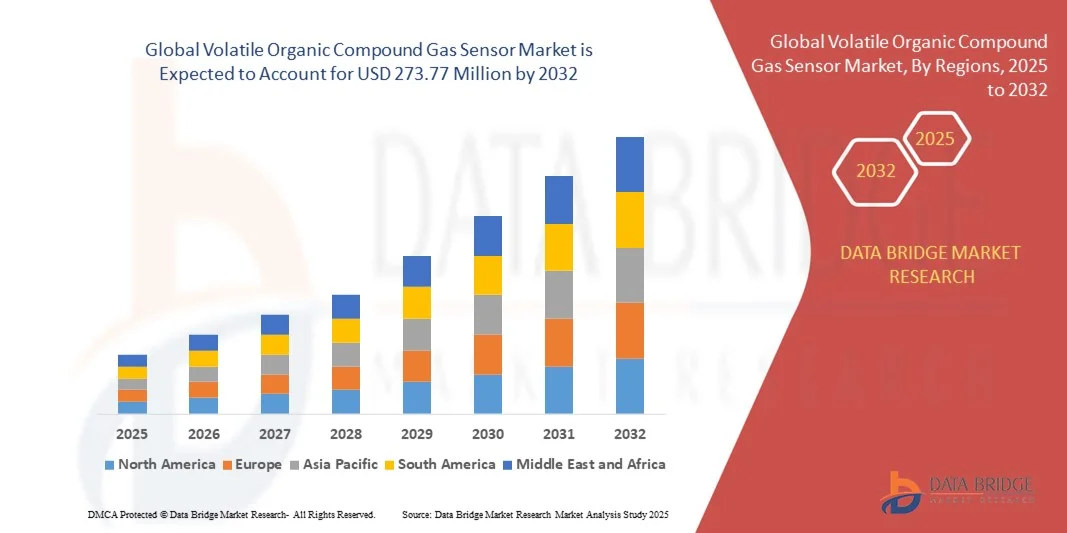
Volatile Organic Compound Gas Sensor Market Size
- The global volatile organic compound gas sensor market size was valued at USD 153.50 million in 2024 and is expected to reach USD 273.77 million by 2032, at a CAGR of 7.5% during the forecast period
- The market growth is largely fuelled by the increasing demand for air quality monitoring in industrial, commercial, and residential applications, along with stringent environmental regulations aimed at controlling VOC emissions
- Rising adoption of smart and connected sensor technologies in IoT-enabled devices and HVAC systems is further supporting market expansion
Volatile Organic Compound Gas Sensor Market Analysis
- Increasing industrialization and urbanization across emerging economies are driving the need for VOC gas sensors to monitor harmful emissions and maintain workplace safety standards
- The growing awareness of indoor air quality, particularly in smart buildings and homes, is accelerating the deployment of low-cost, high-precision VOC sensors
- Europe dominated the VOC gas sensor market with the largest revenue share of 42% in 2024, driven by stringent environmental regulations, strong industrialization, and increasing adoption of air quality monitoring systems across residential, commercial, and industrial sectors
- Asia-Pacific region is expected to witness the highest growth rate in the global volatile organic compound gas sensor market, driven by increasing industrialization, government initiatives to improve air quality, and the availability of affordable, locally manufactured sensor technologies
- The single gas detection sensor segment held the largest market revenue share in 2024, driven by its simplicity, cost-effectiveness, and widespread usage in industrial and environmental monitoring. These sensors are commonly deployed in applications requiring detection of a specific VOC compound, offering accurate and reliable measurements
Report Scope and Volatile Organic Compound Gas Sensor Market Segmentation
|
Attributes |
Volatile Organic Compound Gas Sensor Key Market Insights |
|
Segments Covered |
|
|
Countries Covered |
North America
Europe
Asia-Pacific
Middle East and Africa
South America
|
|
Key Market Players |
|
|
Market Opportunities |
|
|
Value Added Data Infosets |
In addition to the insights on market scenarios such as market value, growth rate, segmentation, geographical coverage, and major players, the market reports curated by the Data Bridge Market Research also include import export analysis, production capacity overview, production consumption analysis, price trend analysis, climate change scenario, supply chain analysis, value chain analysis, raw material/consumables overview, vendor selection criteria, PESTLE Analysis, Porter Analysis, and regulatory framework. |
Volatile Organic Compound Gas Sensor Market Trends
Increasing Adoption of Real-Time and Portable VOC Gas Sensors
- The growing adoption of portable and real-time VOC gas sensors is transforming environmental and industrial monitoring by enabling on-site detection of harmful gases. These devices provide rapid feedback, allowing immediate corrective actions in industrial plants, commercial spaces, and residential areas, thereby reducing health risks and environmental exposure
- Rising demand for air quality monitoring in urban and industrial regions is accelerating the deployment of handheld and wireless VOC sensors. These tools are particularly effective in areas lacking centralized monitoring systems, helping reduce response time and ensure compliance with regulatory standards
- The affordability, miniaturization, and ease of use of modern VOC gas sensors are making them attractive for routine environmental monitoring and workplace safety programs. Companies and authorities benefit from frequent measurements without incurring high operational costs or logistical challenges
- For instance, in 2023, several manufacturing facilities in Europe reported improved workplace safety metrics after implementing on-site VOC monitoring systems. These sensors allowed early detection of hazardous emissions, enabling timely interventions and reducing potential exposure incidents
- While portable and real-time VOC sensors are accelerating air quality management, their effectiveness depends on technological reliability, calibration standards, and affordability. Manufacturers must focus on localized solutions and integration with IoT systems to fully capitalize on this growing demand
Volatile Organic Compound Gas Sensor Market Dynamics
Driver
Rising Environmental Regulations and Growing Awareness of Air Quality
- Stringent environmental regulations globally are driving industries and municipalities to adopt VOC gas sensors for continuous monitoring of emissions and workplace safety. Compliance with legal standards for air quality is prompting investments in advanced sensing solutions
- Increased awareness among consumers and businesses regarding indoor and outdoor air pollution is boosting demand for real-time detection solutions. Organizations are investing in VOC sensors to ensure regulatory compliance and safeguard employee and community health
- Governments and environmental agencies are supporting initiatives that promote monitoring and reporting of VOC emissions. From subsidized programs to nationwide air quality campaigns, these efforts are encouraging widespread adoption of gas sensing technologies
- For instance, in 2022, the European Union implemented stricter VOC emission limits for industrial operations, significantly increasing demand for portable and fixed VOC gas monitoring systems across commercial and industrial facilities
- While regulatory pressures and environmental awareness are driving market growth, challenges remain in scaling deployment in under-resourced regions and integrating sensors with centralized monitoring platforms
Restraint/Challenge
High Cost of Advanced Sensors and Limited Access in Developing Regions
- The high price point of advanced VOC sensors, such as photoionization detectors and electrochemical analyzers, makes them inaccessible for small-scale enterprises and underfunded facilities. These systems are often reserved for large industrial operations or government monitoring programs, limiting broader adoption
- In many regions, especially developing economies, there is a lack of trained personnel capable of using or maintaining advanced VOC sensors. Infrastructure gaps and logistical barriers reduce access to accurate and timely air quality measurements
- Market penetration is also restricted by supply chain challenges in remote and industrial regions, where consistent availability of sensor devices and calibration materials is not guaranteed. This often results in delayed monitoring and ineffective emissions control
- For instance, in 2023, environmental agencies in Sub-Saharan Africa reported that over 65% of small manufacturing units had no access to formal VOC monitoring solutions, citing cost and technical infrastructure gaps as the primary barriers
- While VOC sensing technologies continue to advance, overcoming cost, training, and access challenges remains crucial. Stakeholders must focus on scalable, decentralized, and IoT-integrated solutions to ensure widespread adoption and long-term market growth
Volatile Organic Compound Gas Sensor Market Scope
The market is segmented on the basis of type, technology, and application.
- By Type
On the basis of type, the VOC gas sensor market is segmented into single gas detection sensor and multiple gas detection sensor. The single gas detection sensor segment held the largest market revenue share in 2024, driven by its simplicity, cost-effectiveness, and widespread usage in industrial and environmental monitoring. These sensors are commonly deployed in applications requiring detection of a specific VOC compound, offering accurate and reliable measurements.
The multiple gas detection sensor segment is expected to witness the fastest growth rate from 2025 to 2032, fueled by rising demand for multi-component air monitoring in industrial, automotive, and environmental applications. These sensors provide simultaneous detection of several VOCs, offering enhanced efficiency and real-time monitoring capabilities for complex environments.
- By Technology
On the basis of technology, the VOC gas sensor market is segmented into photo-ionization detector (PID), infrared-based detection, metal-oxide semiconductor, and others. The PID segment accounted for the largest share in 2024 due to its high sensitivity, accuracy, and fast response time, making it suitable for industrial and environmental applications.
The infrared-based detection segment is expected to witness the fastest growth rate from 2025 to 2032, supported by its capability to detect VOCs over long distances and in harsh environmental conditions. Infrared sensors are increasingly adopted in oil and gas, chemical processing, and large-scale manufacturing facilities.
- By Application
On the basis of application, the VOC gas sensor market is segmented into oil and gas, agriculture, automotive, chemical industry, manufacturing, food and beverages, metals and mining, and others. The oil and gas segment dominated the market in 2024, driven by stringent environmental regulations and the need to monitor VOC emissions in refineries, pipelines, and extraction sites.
The chemical industry segment is expected to witness the fastest growth rate from 2025 to 2032, fueled by the increasing adoption of VOC sensors for safety, regulatory compliance, and emission monitoring in chemical manufacturing plants. Continuous innovation in sensor technologies is further expanding their application across diverse industrial verticals.
Volatile Organic Compound Gas Sensor Market Regional Analysis
- Europe dominated the VOC gas sensor market with the largest revenue share of 42% in 2024, driven by stringent environmental regulations, strong industrialization, and increasing adoption of air quality monitoring systems across residential, commercial, and industrial sectors
- Consumers and industries in the region highly value accurate, real-time monitoring solutions for VOC emissions, supporting widespread deployment across chemical, manufacturing, and food processing industries
- This widespread adoption is further supported by strong government policies, technological innovation, and rising awareness of workplace and environmental safety, establishing VOC sensors as essential tools for compliance and operational efficiency
Germany VOC Gas Sensor Market Insight
The Germany VOC gas sensor market captured the largest revenue share in Europe in 2024, fueled by advanced industrialization, strict emission norms, and growing adoption of automated environmental monitoring systems. German industries prioritize accurate VOC detection to ensure occupational safety and regulatory compliance. Integration with industrial IoT and smart building systems is further enhancing sensor deployment across commercial and industrial sectors.
U.K. VOC Gas Sensor Market Insight
The U.K. VOC gas sensor market is expected to witness the fastest growth rate from 2025 to 2032, driven by rising awareness of indoor and outdoor air quality and government-led initiatives promoting environmental sustainability. Industries, commercial facilities, and municipalities are increasingly adopting VOC sensors to comply with emission standards and enhance workplace safety. The country’s well-developed environmental infrastructure supports the deployment of both portable and fixed monitoring systems.
North America VOC Gas Sensor Market Insight
The North America VOC gas sensor market is expected to witness the fastest growth rate from 2025 to 2032, fueled by stringent environmental regulations, industrial expansion, and rising adoption of IoT-enabled air monitoring solutions. The U.S. and Canada are investing in portable and real-time VOC sensors to track industrial emissions, ensure workplace safety, and support environmental compliance. Increasing urbanization and smart building initiatives are further supporting market growth.
U.S. VOC Gas Sensor Market Insight
The U.S. VOC gas sensor market is expected to witness the fastest growth rate from 2025 to 2032, driven by rapid adoption of connected monitoring systems in industrial, commercial, and residential applications. Federal and state emission regulations, along with the push for workplace safety and environmental compliance, are key growth factors. Integration with IoT and automation platforms enhances sensor effectiveness, fueling further adoption.
Asia-Pacific VOC Gas Sensor Market Insight
The Asia-Pacific VOC gas sensor market is expected to witness the fastest growth rate from 2025 to 2032, driven by rapid industrialization, urbanization, and increasing regulatory compliance requirements in countries such as China, India, and Japan. Rising adoption of smart manufacturing, IoT-enabled environmental monitoring, and air quality management initiatives are supporting growth. APAC’s role as a manufacturing hub for VOC sensors is also improving affordability and accessibility.
China VOC Gas Sensor Market Insight
The China VOC gas sensor market accounted for the largest market revenue share in Asia-Pacific in 2024, attributed to industrial expansion, strict environmental regulations, and a growing focus on air quality monitoring. Industrial adoption, government initiatives to reduce emissions, and affordable domestic sensor production are driving market growth.
Japan VOC Gas Sensor Market Insight
The Japan VOC gas sensor market is expected to witness the fastest growth rate from 2025 to 2032 due to advanced industrial infrastructure, strong emphasis on environmental safety, and demand for reliable, compact, and IoT-integrated monitoring solutions. Industries and commercial facilities are increasingly deploying VOC sensors to comply with regulations and improve air quality management.
Volatile Organic Compound Gas Sensor Market Share
The Volatile Organic Compound Gas Sensor industry is primarily led by well-established companies, including:
- Alphasense Inc. (U.K.)
- Honeywell International Inc. (U.S.)
- Bosch Sensortec GmbH (Germany)
- ABB (Switzerland)
- Siemens AG (Germany)
- Aeroqual (New Zealand)
- SGX Sensortech (Singapore)
- Renesas Electronics Corporation (Japan)
- EcoSensors (U.S.)
- GfG Europe Ltd. (U.K.)
- NGK INSULATORS, LTD. (Japan)
- Trolex Ltd (U.K.)
Latest Developments in Global Volatile Organic Compound Gas Sensor Market
- In August 2024, Alphasense launched its PIDX line of photoionization detectors (PIDs), designed to provide highly precise and reliable detection of volatile organic compounds (VOCs). This new sensor range enhances air quality monitoring capabilities, offering improved performance and safety solutions for industrial and environmental applications. The introduction of the PIDX series is expected to set new industry standards and strengthen market adoption of advanced VOC monitoring technologies
- In August 2024, Renesas Electronics Corporation unveiled its RRH62000 multi-sensor air quality module, a compact all-in-one system that monitors temperature, humidity, particulate matter, total VOCs, and estimated CO2 levels. This module enables comprehensive indoor air quality tracking, supporting healthier environments in residential, commercial, and industrial spaces. The product is anticipated to accelerate market demand for integrated, multi-parameter air quality sensors
- In October 2024, Metis Engineering introduced Cell Guard with Hydrogen, an advanced sensor for detecting hydrogen in energy storage systems. The device also performs effectively in environments with elevated VOC levels, enhancing safety for battery packs and hydrogen applications. Its launch is expected to improve safety standards and drive adoption of VOC-compatible gas sensors in energy and industrial markets

- Interactive Data Analysis Dashboard
- Company Analysis Dashboard for high growth potential opportunities
- Research Analyst Access for customization & queries
- Competitor Analysis with Interactive dashboard
- Latest News, Updates & Trend analysis
- Harness the Power of Benchmark Analysis for Comprehensive Competitor Tracking
Global Volatile Organic Compound Gas Sensor Market, Supply Chain Analysis and Ecosystem Framework
To support market growth and help clients navigate the impact of geopolitical shifts, DBMR has integrated in-depth supply chain analysis into its Global Volatile Organic Compound Gas Sensor Market research reports. This addition empowers clients to respond effectively to global changes affecting their industries. The supply chain analysis section includes detailed insights such as Global Volatile Organic Compound Gas Sensor Market consumption and production by country, price trend analysis, the impact of tariffs and geopolitical developments, and import and export trends by country and HSN code. It also highlights major suppliers with data on production capacity and company profiles, as well as key importers and exporters. In addition to research, DBMR offers specialized supply chain consulting services backed by over a decade of experience, providing solutions like supplier discovery, supplier risk assessment, price trend analysis, impact evaluation of inflation and trade route changes, and comprehensive market trend analysis.
Data collection and base year analysis are done using data collection modules with large sample sizes. The stage includes obtaining market information or related data through various sources and strategies. It includes examining and planning all the data acquired from the past in advance. It likewise envelops the examination of information inconsistencies seen across different information sources. The market data is analysed and estimated using market statistical and coherent models. Also, market share analysis and key trend analysis are the major success factors in the market report. To know more, please request an analyst call or drop down your inquiry.
The key research methodology used by DBMR research team is data triangulation which involves data mining, analysis of the impact of data variables on the market and primary (industry expert) validation. Data models include Vendor Positioning Grid, Market Time Line Analysis, Market Overview and Guide, Company Positioning Grid, Patent Analysis, Pricing Analysis, Company Market Share Analysis, Standards of Measurement, Global versus Regional and Vendor Share Analysis. To know more about the research methodology, drop in an inquiry to speak to our industry experts.
Data Bridge Market Research is a leader in advanced formative research. We take pride in servicing our existing and new customers with data and analysis that match and suits their goal. The report can be customized to include price trend analysis of target brands understanding the market for additional countries (ask for the list of countries), clinical trial results data, literature review, refurbished market and product base analysis. Market analysis of target competitors can be analyzed from technology-based analysis to market portfolio strategies. We can add as many competitors that you require data about in the format and data style you are looking for. Our team of analysts can also provide you data in crude raw excel files pivot tables (Fact book) or can assist you in creating presentations from the data sets available in the report.













