


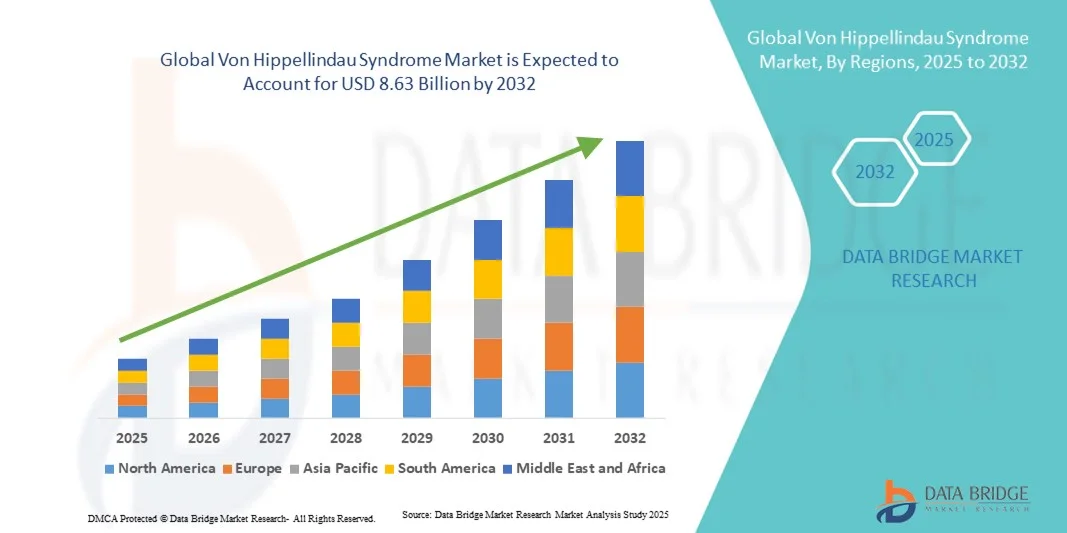
Von Hippellindau Syndrome Market Size
- The global von hippellindau syndrome market size was valued at USD 4.70 billion in 2024 and is expected to reach USD 8.63 billion by 2032, at a CAGR of 7.90% during the forecast period
- The market growth is largely fueled by the increasing advancements in genetic diagnostics, targeted therapies, and precision medicine for rare diseases, leading to improved identification and management of Von Hippel–Lindau (VHL) Syndrome across healthcare settings. The growing accessibility of next-generation sequencing (NGS) and early screening programs is enabling faster detection of VHL-associated tumors, thereby supporting better clinical outcomes and long-term patient care
- Furthermore, rising investments in oncogenetic research, awareness programs, and clinical trials focused on VHL-related cancers such as renal cell carcinoma and hemangioblastomas are establishing precision oncology as the cornerstone of treatment. These converging factors are accelerating the adoption of VHL Syndrome diagnostic and therapeutic solutions, significantly boosting the industry’s growth and driving innovation in genetic testing and personalized medicine
Von Hippellindau Syndrome Market Analysis
- Von Hippel–Lindau (VHL) Syndrome, a rare hereditary condition characterized by the formation of tumors and cysts in multiple organs, is becoming an important focus area in rare disease research and oncology due to rising awareness and advancements in molecular diagnostics. Increasing availability of genetic testing, precision oncology programs, and targeted treatment options has made early detection and disease management more effective in both developed and emerging healthcare markets
- The growing demand for advanced diagnostic assays, genomic sequencing tools, and novel therapeutic drugs is primarily fueled by the rising incidence of inherited cancer syndromes and the expansion of specialized rare disease research centers. These factors are contributing significantly to the overall growth of the Von Hippel–Lindau Syndrome market worldwide
- North America dominated the von hippel–lindau syndrome market with the largest revenue share of 41.8% in 2024, supported by strong genetic research infrastructure, a large patient registry base, and early adoption of gene-targeted diagnostic and therapeutic approaches. The U.S. remains the central hub for clinical trials, government-backed research initiatives, and awareness programs, driving early diagnosis and advanced care for VHL patients
- Asia-Pacific is expected to be the fastest-growing region in the von hippel–lindau syndrome market, registering a CAGR from 2025 to 2032, driven by increasing investments in genomics, improving healthcare accessibility, and growing government focus on rare disease management in countries such as China, Japan, and India. Collaborative research efforts and awareness campaigns are further supporting market expansion across the region
- The MRI scan segment dominated the largest market revenue share of 49.3% in 2024, owing to its superior imaging sensitivity for soft tissue structures and ability to detect multiple lesions in a single scan. MRI remains the gold standard for identifying CNS hemangioblastomas, retinal angiomas, and visceral cysts associated with VHL
Report Scope and Von Hippellindau Syndrome Market Segmentation
|
Attributes |
Von Hippellindau Syndrome Key Market Insights |
|
Segments Covered |
|
|
Countries Covered |
North America
Europe
Asia-Pacific
Middle East and Africa
South America
|
|
Key Market Players |
|
|
Market Opportunities |
|
|
Value Added Data Infosets |
In addition to the insights on market scenarios such as market value, growth rate, segmentation, geographical coverage, and major players, the market reports curated by the Data Bridge Market Research also include in-depth expert analysis, patient epidemiology, pipeline analysis, pricing analysis, and regulatory framework. |
Von Hippellindau Syndrome Market Trends
Advancements in Genetic Research and Targeted Therapy Development
- A significant and accelerating trend in the global von hippel–lindau (VHL) syndrome market is the rapid advancement of genetic research and precision medicine, which is transforming disease diagnosis and management. The growing understanding of VHL gene mutations and their role in tumor formation across organs is enabling earlier, more accurate detection and personalized treatment approaches
- For instance, in May 2023, the U.S. FDA expanded approval for Belzutifan (Welireg, Merck & Co.) for the treatment of patients with von Hippel–Lindau disease–associated renal cell carcinoma and central nervous system hemangioblastomas. This approval marked a major breakthrough in targeted therapy for VHL patients, significantly improving treatment options
- Continuous innovation in genetic sequencing and molecular diagnostics is improving early identification of VHL carriers. Advanced next-generation sequencing (NGS) tools help detect germline mutations efficiently, supporting proactive monitoring and prevention of related malignancies
- Research institutions and biotechnology companies are increasingly collaborating to explore novel therapeutic targets aimed at halting or reversing tumor growth caused by VHL mutations. Academic–industry partnerships are focusing on developing HIF-2α inhibitors and gene therapy–based interventions, with several candidates currently in early-stage clinical trials
- The integration of AI-assisted genetic analytics and data-driven patient registries is also advancing personalized care. These technologies enable researchers to map mutation patterns across populations, leading to refined prognostic insights and better management strategies for VHL-associated tumors
- The trend toward targeted therapies, enhanced genetic testing accessibility, and cross-border research collaborations is reshaping the VHL Syndrome treatment landscape, improving patient outcomes and paving the way for precision oncology applications in rare diseases
Von Hippellindau Syndrome Market Dynamics
Driver
Rising Awareness and Therapeutic Advancements in Rare Genetic Disorders
- The global rise in awareness of rare genetic disorders and increasing efforts toward early diagnosis are major drivers of the Von Hippel–Lindau Syndrome market. Healthcare systems and advocacy groups are emphasizing genetic counseling and family screening to identify at-risk individuals early
- For instance, in September 2024, the VHL Alliance partnered with multiple research centers across North America and Europe to expand its VHL Patient Natural History Database, improving real-world insights into treatment response and long-term disease progression
- Advancements in precision medicine, particularly the success of HIF-2α inhibitors like Belzutifan, are encouraging more biopharmaceutical firms to invest in VHL and related rare tumor syndromes. Such innovations offer effective, less invasive alternatives to repeated surgeries, which historically dominated VHL management
- The increasing availability of molecular diagnostics and integration of genetic panels into newborn screening programs are enhancing early detection rates. This shift toward preventive care reduces tumor burden and improves quality of life for VHL patients
- Furthermore, favorable regulatory support, including orphan drug designations and funding for rare disease trials, continues to accelerate the approval pipeline. This, coupled with a growing global patient registry base, is expected to sustain market momentum throughout the forecast period
Restraint/Challenge
High Cost of Treatment and Limited Clinical Awareness in Emerging Regions
- Despite scientific progress, high treatment costs and disparities in access to advanced therapies remain a major challenge in the Von Hippel–Lindau Syndrome market. The high expense of targeted therapies like Belzutifan (Welireg) and the requirement for continuous imaging surveillance place a financial burden on patients and healthcare systems, particularly in developing countries
- In March 2023, a report by the National Organization for Rare Disorders (NORD) highlighted that over 60% of patients with rare diseases, including VHL, face difficulties accessing affordable genetic testing and ongoing care due to limited insurance coverage and high out-of-pocket expenses
- Limited clinical awareness among healthcare providers also leads to delayed or missed diagnoses, especially in regions where rare genetic disease education is lacking. Misdiagnosis or late detection often results in advanced tumor progression before intervention, reducing the effectiveness of available treatments
- For instance, a 2024 publication in The Journal of Medical Genetics revealed that the average diagnostic delay for VHL patients in Latin America and parts of Southeast Asia exceeds 4.8 years, emphasizing the urgent need for better clinician training and awareness campaigns
- Diagnostic inequality persists due to uneven distribution of specialized centers capable of genetic sequencing and MRI-based tumor monitoring. In several low- and middle-income countries, only a few tertiary care hospitals have the infrastructure for comprehensive genetic analysis, limiting access to early detection
- High equipment and maintenance costs for MRI scanners and next-generation sequencing (NGS) systems further hinder adoption, creating a significant gap between developed and emerging markets
- Regulatory delays and limited availability of approved therapies in certain countries also restrict patient access. For instance, while Belzutifan was approved by the U.S. FDA in August 2021, several European and Asian nations only began reviewing applications in late 2023, delaying availability to local patients
- Moreover, emotional and psychological challenges associated with long-term surveillance, hereditary risk, and lack of patient support programs contribute to poor adherence to follow-up care
- Addressing these issues through global rare-disease education initiatives, subsidy programs, public–private partnerships, and improved telemedicine access will be vital for reducing disparities in diagnosis and treatment outcomes worldwide
Von Hippellindau Syndrome Market Scope
The market is segmented on the basis of tumor site, diagnosis, and end user.
- By Tumor Site
On the basis of tumor site, the Von Hippel–Lindau Syndrome market is segmented into brain, spine, eyes, kidneys, adrenal glands, pancreas, liver, lungs, inner ears, and reproductive tract. The kidneys segment dominated the largest market revenue share of 38.6% in 2024, driven by the high prevalence of renal cell carcinoma (RCC) manifestations, which are among the most frequent complications in VHL patients. The strong presence of advanced nephron-sparing surgical procedures and targeted therapies, including HIF-2α inhibitors such as Belzutifan, has reinforced this segment’s dominance. Enhanced clinical surveillance programs, technological advancements in diagnostic imaging, and early-stage lesion detection have supported efficient kidney tumor management. Furthermore, the rise in government-supported rare cancer screening initiatives and expansion of multidisciplinary VHL treatment centers across the U.S. and Europe are sustaining this segment’s growth. The availability of improved long-term renal monitoring and the introduction of minimally invasive laparoscopic tumor excisions are further expected to maintain its leading position.
The brain segment is anticipated to witness the fastest growth rate of 14.8% CAGR from 2025 to 2032, fueled by increasing identification of cerebellar hemangioblastomas using AI-driven MRI imaging and enhanced neurosurgical precision. Growing research in CNS tumor biology, the development of advanced radiosurgical techniques such as Gamma Knife, and the increasing inclusion of VHL-related CNS lesions in clinical trials have elevated diagnostic and treatment outcomes. The integration of neuronavigation systems, improved intraoperative imaging, and expanding awareness about neurological screening among high-risk families further promote the segment’s rapid growth trajectory.
- By Diagnosis
On the basis of diagnosis, the Von Hippel–Lindau Syndrome market is segmented into MRI scan, CT scan, and others. The MRI scan segment dominated the largest market revenue share of 49.3% in 2024, owing to its superior imaging sensitivity for soft tissue structures and ability to detect multiple lesions in a single scan. MRI remains the gold standard for identifying CNS hemangioblastomas, retinal angiomas, and visceral cysts associated with VHL. Increasing use of high-field 3T and 7T MRI systems in tertiary care hospitals enhances resolution, enabling earlier detection and personalized surgical planning. The introduction of MRI-compatible contrast agents, coupled with digital image storage for long-term monitoring, supports continued segmental leadership. In 2024, collaborations between hospitals and device manufacturers such as Siemens Healthineers and Philips advanced integrated imaging protocols, improving diagnostic precision and patient outcomes. The combination of AI-assisted lesion tracking and non-invasive imaging workflows further consolidates this segment’s dominance.
The CT scan segment is expected to witness the fastest CAGR of 13.7% from 2025 to 2032, driven by its growing use in detecting abdominal and thoracic tumors, especially in kidneys, adrenal glands, and lungs. Technological improvements such as low-dose CT protocols and advanced 3D reconstruction are enhancing diagnostic safety and clarity. The cost-effectiveness and faster scanning time compared to MRI make CT an attractive option in outpatient and emergency settings. The increasing adoption of AI-based image enhancement software and rising accessibility of CT scanners in mid-sized hospitals in emerging economies are accelerating growth within this segment.
- By End User
On the basis of end user, the Von Hippel–Lindau Syndrome market is segmented into hospitals, clinics, diagnostic centers, and others. The hospitals segment dominated the largest market revenue share of 56.4% in 2024, owing to the availability of comprehensive treatment facilities integrating oncology, nephrology, neurology, and radiology departments. Hospitals remain the primary point for diagnosis, surgical intervention, targeted therapy administration, and long-term surveillance of VHL patients. The presence of advanced imaging technologies, genetic testing laboratories, and experienced clinical teams allows for accurate diagnosis and effective multidisciplinary management. The growing number of specialized rare disease programs, collaborations with genetic research institutions, and access to FDA-approved targeted drugs have bolstered this segment’s leadership. In 2024, major hospital systems such as Mayo Clinic, Cleveland Clinic, and Johns Hopkins Hospital expanded genomic testing and personalized therapy programs for hereditary cancer syndromes, including VHL, reinforcing hospital dominance in the market.
The diagnostic centers segment is anticipated to witness the fastest CAGR of 15.2% from 2025 to 2032, driven by the increasing focus on early genetic screening and non-invasive diagnostic imaging. Expanding access to comprehensive gene testing panels, such as those offered by Invitae Corporation and Blueprint Genetics, has encouraged early identification and family-based risk evaluation. The rising shift toward outpatient imaging services, shorter turnaround times, and cost-effective test options are enhancing patient preference for diagnostic centers. Moreover, public–private collaborations for genetic awareness and screening campaigns are fueling significant expansion in this segment globally.
Von Hippellindau Syndrome Market Regional Analysis
- North America dominated the von hippel–lindau syndrome market with the largest revenue share of 41.8% in 2024, supported by strong genetic research infrastructure, a large patient registry base, and early adoption of gene-targeted diagnostic and therapeutic approaches
- The region’s dominance is also reinforced by the presence of advanced genomic laboratories, robust funding for rare disease studies, and the availability of specialized treatment centers
- The market remains the central hub for clinical trials, government-backed research initiatives, and awareness programs, driving early diagnosis and advanced care for VHL patients
U.S. Von Hippel–Lindau Syndrome Market Insight
The U.S. von hippel–lindau syndrome market captured the largest share in 2024 within North America, primarily due to expanding clinical trial activity, active participation from patient advocacy organizations, and the integration of precision medicine in rare disease management. Growing federal investment in genetic sequencing programs and partnerships between biotech companies and academic institutions continue to fuel therapeutic development. Furthermore, the presence of key pharmaceutical players advancing gene-targeted therapies contributes significantly to market expansion in the U.S.
Europe Von Hippel–Lindau Syndrome Market Insight
The Europe von hippel–lindau syndrome market is projected to expand at a substantial CAGR throughout the forecast period, driven by the increasing adoption of advanced imaging techniques, development of rare disease registries, and harmonized regulatory efforts across the EU. Strong research collaborations and patient-support frameworks in countries such as Germany, the U.K., and France are improving diagnosis and disease monitoring. The growing focus on clinical genomics and biobanking initiatives further supports regional market growth.
U.K. Von Hippel–Lindau Syndrome Market Insight
The U.K. von hippel–lindau syndrome market is anticipated to grow at a notable CAGR during the forecast period, supported by government funding for genomic medicine, particularly under initiatives like the NHS Genomic Medicine Service. Enhanced screening programs and partnerships between universities and biotechnology firms are accelerating research into VHL gene mutations. Increased awareness among clinicians and improved access to genetic counseling services are also contributing to sustained market expansion.
Germany Von Hippel–Lindau Syndrome Market Insight
The Germany von hippel–lindau syndrome market is expected to witness steady growth, driven by advanced diagnostic infrastructure, widespread adoption of next-generation sequencing (NGS), and active participation in pan-European rare disease projects. The country’s focus on precision oncology and integration of genetic data into healthcare records supports the timely detection and management of VHL. In addition, government and private-sector collaborations are fostering innovation in early disease detection and targeted therapy development.
Asia-Pacific Von Hippel–Lindau Syndrome Market Insight
The Asia-Pacific von hippel–lindau syndrome market is projected to grow at the fastest CAGR from 2025 to 2032, driven by increasing investments in genomics, improving healthcare accessibility, and growing government focus on rare disease management in countries such as China, Japan, and India. National rare disease policies, rising diagnostic awareness, and collaborations between academic institutions and biotech companies are enhancing early diagnosis and patient care. The region’s rapidly advancing sequencing technologies and expanding healthcare infrastructure are key drivers of growth.
Japan Von Hippel–Lindau Syndrome Market Insight
The Japan von hippel–lindau syndrome market is gaining traction due to the country’s advanced biotechnology ecosystem, government-supported genomic projects, and growing adoption of personalized medicine. Increasing patient awareness and strong collaborations between hospitals and research centers are enhancing clinical outcomes. Furthermore, the integration of AI-based genetic analysis tools is supporting early and accurate detection of VHL mutations across medical institutions.
China Von Hippel–Lindau Syndrome Market Insight
The China von hippel–lindau syndrome market accounted for the largest share within Asia-Pacific in 2024, attributed to the country’s expanding genomic research capacity, rapid healthcare modernization, and government-driven focus on rare disease management. China’s national rare disease catalog and genetic testing reimbursement programs are improving access to diagnostic services. Domestic biotech firms are also actively partnering with international players to accelerate clinical trials and expand treatment availability, solidifying China’s role as a key growth driver in the regional VHL market.
Von Hippellindau Syndrome Market Share
The Von Hippellindau Syndrome industry is primarily led by well-established companies, including:
- Genentech (U.S.)
- Exelixis Inc. (U.S.)
- Pfizer Inc. (U.S.)
- Novartis AG (Switzerland)
- Roche Holding AG (Switzerland)
- AstraZeneca plc (U.K.)
- Bayer AG (Germany)
- Merck & Co., Inc. (U.S.)
- Bristol Myers Squibb (U.S.)
- Illumina, Inc. (U.S.)
- Foundation Medicine, Inc. (U.S.)
- Thermo Fisher Scientific Inc. (U.S.)
- AbbVie Inc. (U.S.)
- Sanofi S.A. (France)
- Regeneron Pharmaceuticals, Inc. (U.S.)
- BeiGene Ltd. (China)
- Takeda Pharmaceutical Company Limited (Japan)
- Amgen Inc. (U.S.)
- Hoffmann-La Roche Ltd. (Switzerland)
Latest Developments in Global Von Hippellindau Syndrome Market
- In August 2021, the U.S. Food and Drug Administration (FDA) approved Belzutifan (brand name Welireg) for adult patients with VHL disease who have renal cell carcinoma (RCC), central nervous system hemangioblastomas, or pancreatic neuroendocrine tumors that do not require immediate surgery. This marked the first targeted therapy specifically approved for VHL disease, significantly improving treatment options for patients
- In February 2025, the European Commission granted marketing authorization for Belzutifan to treat VHL disease-associated tumors and advanced clear cell renal cell carcinoma. This approval expanded the drug’s accessibility across Europe, reflecting its proven clinical benefits and safety profile for managing VHL-related manifestations

- Interactive Data Analysis Dashboard
- Company Analysis Dashboard for high growth potential opportunities
- Research Analyst Access for customization & queries
- Competitor Analysis with Interactive dashboard
- Latest News, Updates & Trend analysis
- Harness the Power of Benchmark Analysis for Comprehensive Competitor Tracking
Data collection and base year analysis are done using data collection modules with large sample sizes. The stage includes obtaining market information or related data through various sources and strategies. It includes examining and planning all the data acquired from the past in advance. It likewise envelops the examination of information inconsistencies seen across different information sources. The market data is analysed and estimated using market statistical and coherent models. Also, market share analysis and key trend analysis are the major success factors in the market report. To know more, please request an analyst call or drop down your inquiry.
The key research methodology used by DBMR research team is data triangulation which involves data mining, analysis of the impact of data variables on the market and primary (industry expert) validation. Data models include Vendor Positioning Grid, Market Time Line Analysis, Market Overview and Guide, Company Positioning Grid, Patent Analysis, Pricing Analysis, Company Market Share Analysis, Standards of Measurement, Global versus Regional and Vendor Share Analysis. To know more about the research methodology, drop in an inquiry to speak to our industry experts.
Data Bridge Market Research is a leader in advanced formative research. We take pride in servicing our existing and new customers with data and analysis that match and suits their goal. The report can be customized to include price trend analysis of target brands understanding the market for additional countries (ask for the list of countries), clinical trial results data, literature review, refurbished market and product base analysis. Market analysis of target competitors can be analyzed from technology-based analysis to market portfolio strategies. We can add as many competitors that you require data about in the format and data style you are looking for. Our team of analysts can also provide you data in crude raw excel files pivot tables (Fact book) or can assist you in creating presentations from the data sets available in the report.












