What is the W Band Radar Transmitter Market Size and Growth Rate?
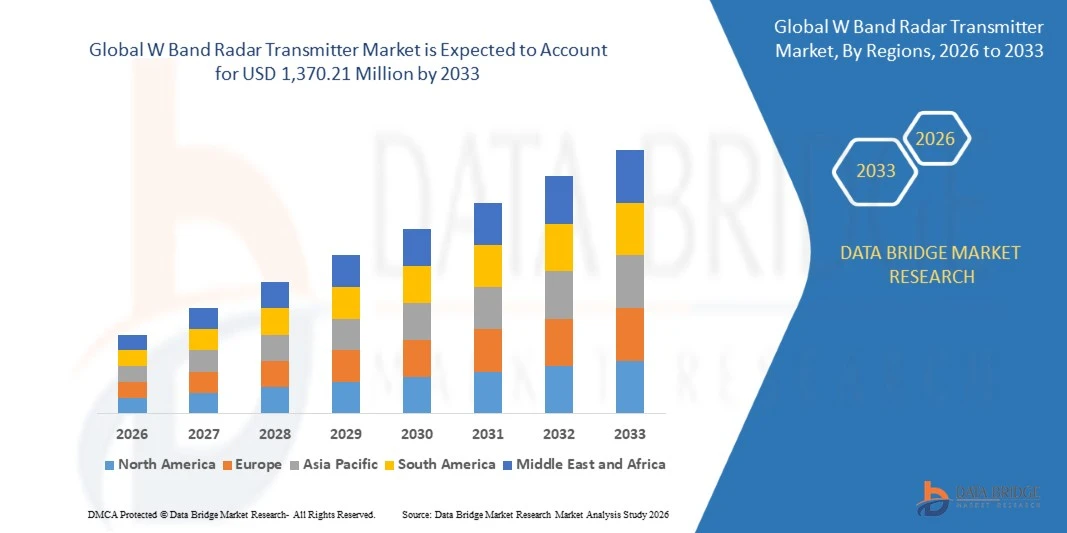
- As per Data Bridge Market Research analysis, the W band radar transmitter market was valued at USD 853.23 million in 2025 and is projected to reach USD 1,370.21 million by 2033, growing at a CAGR of 6.10% from 2026 to 2033.
- The market is experiencing consistent growth driven by rising demand for high-resolution radar systems, advancements in millimeter-wave technology, and expanding applications across defense surveillance, aerospace, security, and scientific research.
- The increasing need for precise target detection, enhanced situational awareness, and high-resolution imaging, combined with growing investments in advanced defense and sensing technologies, is encouraging the adoption of W-band radar transmitters. Operating within the 75–110 GHz frequency range, these transmitters support accurate object detection and detailed imaging, making them valuable for military surveillance, atmospheric research, and specialized radar applications.
Market Size & Forecast
- Global Market Value (2025): USD 853.23 Million
- Expected Market Value (2033): USD 1,370.21 Million
- Forecast CAGR (2026–2033): 6.10%
- Leading Region in 2025: North America
- Fastest Growing Region: Asia Pacific
What are the Major Takeaways of the W Band Radar Transmitter Market?
- North America dominated the W band radar transmitter market with the largest revenue share of 45% in 2025, supported by advanced defense infrastructure, substantial military investments, and growing demand for high-frequency radar technologies.
- Asia-Pacific is expected to be the fastest-growing region at a CAGR of 5.1% from 2026 to 2033, fueled by expanding aerospace capabilities, increasing defense spending, and investments in advanced radar technologies across China and India.
- The solid-state radar transmitters segment led the market with a 35% share in 2025, driven by its compact design, reliability, and suitability for modern high-frequency radar applications.
- GaN-based transmitters are the fastest-growing type, projected to register a CAGR of 7.2%, reflecting the surge in material's high-power density, thermal performance, and suitability for high-frequency power amplification
- The pulsed radar transmitters segment dominated the technology category with a 32% revenue share in 2025, led by its extensive suitability for target detection and range measurement
- Defense and military radar accounted for 38% of the market share in 2025, preferred by demand for high-resolution target detection, surveillance, and advanced situational awareness
- The scientific research and remote sensing segment is the fastest-growing application category, with a CAGR of 7.8%, driven by increasing investments in atmospheric research, high-resolution radar imaging, millimeter-wave sensing technologies, and advanced environmental monitoring systems.
Report Scope and W Band Radar Transmitter Market Segmentation
|
Attributes |
W Band Radar Transmitter Key Market Insights |
|
Segments Covered |
|
|
Countries Covered |
North America
Europe
Asia-Pacific
Middle East and Africa
South America
|
|
Key Market Players |
|
|
Market Opportunities |
|
|
Value Added Data Infosets |
In addition to the insights on market scenarios such as market value, growth rate, segmentation, geographical coverage, and major players, the market reports curated by the Data Bridge Market Research also include in-depth expert analysis, geographically represented company-wise production and capacity, network layouts of distributors and partners, detailed and updated price trend analysis and deficit analysis of supply chain and demand. |
What is the Key Trend in the W Band Radar Transmitter Market?
- Manufacturers are increasingly developing compact, high-output-power W-band radar transmitters using gallium nitride (GaN) semiconductor technology and monolithic microwave integrated circuits (MMICs) to improve radar performance and integration.
- For instance, in October 2024, IEEE Transactions on Microwave Theory and Techniques featured a W-band GaN MMIC single-chip transmit/receive front end operating across 75–110 GHz, achieving 29 dBm output power at 92 GHz and supporting imaging and sensing applications.
- Advanced transmitter integration enables improved output power, reduced component complexity, and more compact radar architectures for demanding sensing applications.
- Research institutions and defense technology developers are advancing high-resolution W-band radar systems for precise target detection, imaging, and long-range sensing.
- For instance, in May 2023, the Journal of Korean Institute of Electromagnetic Engineering and Science published research on a compact W-band pulse-Doppler radar solid-state power amplifier, demonstrating approximately 1 watt of output power for compact radar applications.
- As demand for compact, high-performance radar systems increases, advances in semiconductor integration and power amplification are expected to strengthen the adoption of W-band transmitters across defense, aerospace, and specialized sensing applications.
What are the Key Drivers of the W Band Radar Transmitter Market?
- The growing demand for advanced defense surveillance, high-resolution imaging, and precision target detection is increasing the need for W-band radar transmitters capable of delivering high-frequency signals and accurate measurements.
- For instance, in September 2025, NASA awarded QuinStar Technology USD 149,891 for a radiation-hardened compact W-band transceiver project designed for high-resolution space descent and landing radars operating in the 92–94 GHz range.
- Defense contractors, aerospace manufacturers, and research institutions are investing in advanced radar components to improve detection accuracy, system reliability, and performance in demanding operational environments.
- For instance, In April 2022, researchers at Tel Aviv University published a 90–98 GHz CMOS transmitter frontend designed for phase-coded frequency-modulated continuous-wave radar and simultaneous radar-communication applications. The transmitter achieved 13.7 dBm saturated output power at 94 GHz while consuming 320 mW, supporting the development of compact, energy-efficient radar systems.
- With defense modernization, space exploration, and high-precision sensing driving technological development, W-band radar transmitters are expected to remain important components in next-generation radar systems requiring compact designs and improved detection capabilities.
What Factors are Challenging the Growth of the W Band Radar Transmitter Market?
- W-band radar transmitters face technical challenges associated with high-frequency signal generation, power amplification, thermal management, and precise component integration, increasing the complexity of system development.
- For instance, in February 2024, a study published in Transactions on Electrical and Electronic Materials on a W-band power amplifier using 150-nm GaAs technology. The study identified parasitic effects and limited power performance at very high frequencies as technical challenges.
- These challenges can raise manufacturing and testing costs, restrict production scalability, and limit adoption among smaller radar developers and research organizations with constrained budgets.
- The specialized semiconductor materials, precision fabrication processes, and advanced testing equipment required for W-band operation can further increase development expenditure and complicate supply-chain management.
- These technical and cost-related barriers may slow commercialization, particularly for manufacturers developing compact, high-power transmitters for specialized radar applications and emerging markets.
- For instance, In July 2024, a study published in IEEE Solid-State Circuits Letters on a W-band power amplifier fabricated using 16-nm FinFET technology. The research addressed passive-network and power-combiner losses, achieving 13 dBm saturated output power and 19.4% peak power-added efficiency.
- As a result, improvements in semiconductor integration, manufacturing efficiency, and thermal design will remain essential to reducing system complexity and supporting wider adoption of W-band radar transmitters.
How is the W Band Radar Transmitter Market Segmented?
The W band radar transmitter market is segmented on the basis of type, technology, application, and end users.
- By Type
On the basis of type, the W band radar transmitter market is segmented into solid-state radar transmitters, traveling-wave tube (TWT) transmitters, gallium nitride (GaN)-based transmitters, gallium arsenide (GaAs)-based transmitters, and monolithic microwave integrated circuit (MMIC)-based transmitters. The solid-state radar transmitters segment dominated the market with an estimated 35% share in 2025, owing to its compact design, reliability, and suitability for modern high-frequency radar applications. These transmitters use semiconductor devices to generate and amplify radar signals, supporting integration into smaller radar architectures. Their reduced maintenance requirements compared with certain vacuum-tube systems make them attractive for advanced sensing platforms. Continuous improvements in semiconductor fabrication are enhancing their output power and energy efficiency. They are suitable for defense surveillance, aerospace research, and high-resolution imaging applications.
The GaN-based transmitters segment is projected to register the fastest growth at an estimated CAGR of 7.2% from 2026 to 2033, driven by the material's high power density, thermal performance, and suitability for high-frequency power amplification. GaN semiconductor technology enables transmitters to deliver substantial output power within compact designs. Its thermal characteristics support operation under demanding conditions, although performance depends on device architecture and thermal management. Continuous advances in millimeter-wave semiconductor fabrication are improving the feasibility of GaN-based W-band components. Growing investments in advanced defense radar, aerospace sensing, and high-resolution imaging are supporting technology development. Integration with MMIC architectures can further reduce system size and component complexity.
- By Technology
On the basis of technology, the W band radar transmitter market is segmented into direct-conversion transmitters, superheterodyne transmitters, frequency-modulated continuous-wave (FMCW) transmitters, pulsed radar transmitters, and continuous-wave (CW) transmitters. The pulsed radar transmitters segment dominated the market with an estimated 32% share in 2025, owing to its extensive suitability for target detection and range measurement. These transmitters emit short bursts of electromagnetic energy and analyze returning echoes to determine target distance. Their operating principle supports high-resolution detection when combined with suitable bandwidth, receiver sensitivity, and signal processing. Pulsed systems are relevant to defense surveillance, radar imaging, and specialized aerospace applications. Advances in high-frequency power amplifiers and timing circuits are supporting the development of compact pulsed radar architectures. environments.
The FMCW transmitters segment is projected to register the fastest growth at an estimated CAGR of 7.5% from 2026 to 2033, driven by increasing demand for continuous measurement, high-resolution sensing, and compact radar systems. FMCW technology varies the transmitted signal frequency over time and estimates distance from the difference between transmitted and received signals. This approach supports accurate range measurement and can enable simultaneous velocity estimation with appropriate signal processing. Advances in frequency synthesizers, phase-locked loops, and millimeter-wave integrated circuits are improving transmitter performance. W-band FMCW systems are suitable for short-range high-resolution imaging, precision sensing, and specialized industrial applications. Their potential for compact integration supports development in research and advanced sensing platforms.
- By Application
On the basis of application, the W band radar transmitter market is segmented into defense and military radar, aerospace radar systems, security and surveillance, automotive radar and sensing, scientific research and remote sensing, and industrial and infrastructure monitoring. The defense and military radar segment dominated the market with an estimated 38% share in 2025, supported by demand for high-resolution target detection, surveillance, and advanced situational awareness. W-band frequencies provide short wavelengths that can support detailed imaging and the detection of small objects in suitable system configurations. Defense research programs use high-frequency radar technologies to investigate target characterization and precision sensing. Improvements in semiconductor transmitters are supporting the development of compact radar front ends. Integration with advanced antennas and signal-processing systems can enhance overall radar capability.
The scientific research and remote sensing segment is projected to register the fastest growth at an estimated CAGR of 7.8% from 2026 to 2033, as research organizations increasingly investigate millimeter-wave technologies for high-resolution measurements. W-band radar can support atmospheric studies, cloud and precipitation observations, material characterization, and experimental imaging. Its short wavelength enables detailed measurements, although atmospheric attenuation and propagation conditions must be considered when designing systems. Improvements in transmitter stability, frequency control, and output power are expanding research possibilities. Universities, government laboratories, and aerospace research institutions are developing specialized radar platforms for scientific applications. Advances in compact microwave integrated circuits are also helping reduce system size and complexity.
- By End Users
On the basis of end users, the W band radar transmitter market is segmented into defense and government agencies, aerospace and aviation companies, automotive manufacturers and suppliers, research institutions and universities, industrial and technology companies, security and surveillance providers, and other end users. The defense and government agencies segment dominated the market with an estimated 40% share in 2025, driven by investment in advanced radar capabilities, surveillance infrastructure, and specialized sensing systems. Government-funded research programs support the development and evaluation of high-frequency radar components. Defense organizations require reliable transmitters that can be integrated into complex radar architectures. Advances in semiconductor fabrication are enabling more compact transmitter designs for selected applications. Procurement programs and long development cycles influence adoption across defense platforms.
The research institutions and universities segment is projected to register the fastest growth at an estimated CAGR of 8.0% from 2026 to 2033, supported by increasing research into millimeter-wave electronics, radar imaging, and high-frequency semiconductor technologies. Academic laboratories use W-band transmitters to investigate antenna design, signal propagation, material properties, and radar measurement techniques. Research grants and collaborations with semiconductor manufacturers help fund the development of experimental radar platforms. Access to advanced MMICs and evaluation modules is making certain high-frequency research projects more practical. Growing interest in autonomous sensing, atmospheric research, and advanced imaging is expanding the scope of laboratory applications. Partnerships among universities, government laboratories, and technology companies can accelerate the transfer of research into commercial systems.
Which Region Holds the Largest Share of the W Band Radar Transmitter Market?
- North America dominated the W band radar transmitter market with the largest revenue share of 45% in 2025, supported by advanced defense infrastructure, substantial military investments, and growing demand for high-frequency radar technologies.
- The region also benefits from continued military modernization, strong research and development capabilities, and growing adoption of high-frequency radar systems across defense surveillance, aerospace research, and advanced sensing applications. Increasing investments in semiconductor innovation, millimeter-wave technology, and next-generation radar platforms continue to strengthen North America's position in the global market.
U.S. W Band Radar Transmitter Market Insight
The U.S. W band radar transmitter market is witnessing steady growth due to rising investments in advanced defense radar systems, aerospace technologies, and high-resolution sensing applications. The country's established defense industry, strong research and development capabilities, and growing adoption of millimeter-wave technologies are driving demand across military, scientific, and specialized radar applications. In addition, increasing emphasis on precision target detection, advanced surveillance, and next-generation radar development is accelerating investments in high-frequency transmitter technologies.
Asia-Pacific W Band Radar Transmitter Market Insight
The Asia-Pacific W band radar transmitter market is expected to witness rapid growth, driven by increasing defense expenditure, expanding aerospace capabilities, and rising investments in advanced radar infrastructure across countries such as China, Japan, India, and South Korea. Growing interest in high-resolution imaging, millimeter-wave electronics, and semiconductor innovation is supporting regional market expansion. In addition, increasing government funding for scientific research, military modernization, and advanced sensing technologies is encouraging the development and adoption of W-band radar transmitters across defense and research applications.
Japan W Band Radar Transmitter Market Insight
The Japan W band radar transmitter market is witnessing consistent growth due to rising investments in advanced electronics, radar research, and high-frequency semiconductor technologies. Research institutions, aerospace organizations, and defense-related technology developers are exploring W-band transmitters for high-resolution imaging, precision sensing, and specialized radar applications. Moreover, Japan's strong capabilities in semiconductor engineering, microwave circuit design, and advanced manufacturing are supporting improvements in transmitter performance and integration. Continued emphasis on technological innovation and sophisticated sensing systems is contributing to market development.
China W Band Radar Transmitter Market Insight
The China W band radar transmitter market is growing due to increasing investments in defense modernization, aerospace research, and domestic semiconductor development. Growing adoption of high-frequency radar technologies for precision sensing, target detection, and advanced imaging is supporting market demand. In addition, government-backed research initiatives, expanding electronics manufacturing capabilities, and improvements in millimeter-wave integrated circuits are encouraging the development of specialized radar transmitters. China's focus on strengthening domestic technological capabilities and advancing high-performance sensing systems is supporting its position in the regional market.
U.K. W Band Radar Transmitter Market Insight
The U.K. W band radar transmitter market is experiencing steady development, supported by investments in defense technology, aerospace research, and advanced radar engineering. Research institutions, defense contractors, and technology developers are exploring high-frequency transmitters for specialized surveillance, scientific measurement, and high-resolution sensing applications. Furthermore, advancements in semiconductor integration, microwave engineering, and radar signal processing are supporting the development of compact and efficient transmitter systems. The country's established research ecosystem and focus on advanced defense capabilities are contributing to market growth.
Germany W Band Radar Transmitter Market Insight
The Germany W band radar transmitter market is developing steadily due to the country's strong engineering capabilities, advanced electronics industry, and growing research into millimeter-wave technologies. Research organizations, aerospace companies, and specialized radar developers are investigating W-band transmitters for precision measurement, high-resolution imaging, and scientific sensing applications. Continuous advances in semiconductor fabrication, integrated microwave circuits, and radar system design are supporting improvements in transmitter efficiency and reliability. In addition, Germany's emphasis on industrial innovation, applied research, and advanced sensing technologies is contributing to market development.
Which are the Top Companies in W Band Radar Transmitter Market?
The W band radar transmitter industry is primarily led by well-established companies, including:
- Honeywell International Inc. (U.S.)
- Celtonn (Ireland)
- Gotmic AB (Sweden)
- QuinStar Technology, Inc. (U.S.)
- Eravant (U.S.)
- Mi-Wave, Inc. (U.S.)
- Virginia Diodes, Inc. (U.S.)
- MMRFIC Technology Private Limited (India)
- Sivers Semiconductors AB (Sweden)
- Analog Devices, Inc. (U.S.)
- Texas Instruments Incorporated (U.S.)
- Infineon Technologies AG (Germany)
- NXP B.V. (Netherlands)
- Qorvo, Inc. (U.S.)
- MACOM Technology Solutions Inc. (U.S.)
- Keysight Technologies, Inc. (U.S.)
- Rohde & Schwarz GmbH & Co. KG (Germany)
- Mitsubishi Electric Corporation (Japan)
- Thales (France)
- Leonardo S.p.A. (Italy)
What are Latest Developments in W Band Radar Transmitter Market?
- In May 2024, Diversified Technologies, Inc. launched radar transmitter systems supporting frequencies from UHF to W-band. The turnkey systems are designed for both new radar installations and upgrades to existing sites, integrating transmitter hardware with vacuum electronic devices, waveguides, and cooling controls. The company highlighted solid-state switching, flexible pulse operation, and improved power efficiency. This launch is directly relevant to the W-band radar transmitter market because the systems explicitly support W-band applications.
- In November 2022, Infineon Technologies introduced the RASIC CTRX8181 automotive radar transceiver MMIC. Built using 28-nm CMOS technology, the device operates in the 76–81 GHz range and is designed to support radar sensors for front, corner, and short-range detection. Its improved signal-to-noise ratio, linearity, and scalable design help enable reliable object detection for advanced driver-assistance systems and automated driving. The launch represents an advancement in integrated W-band radar transmitter and receiver technology.
- In October 2022, HELLA announced the series production launch of its 77 GHz corner radar in China. The radar was introduced at HELLA Shanghai Electronics and designed to support enhanced detection performance for automotive safety and automated-driving applications. Its RF-CMOS radar system chip and antenna design enable object detection in applications such as corner monitoring. The production launch demonstrates the expansion of high-frequency radar sensor manufacturing for automotive applications
- In September 2022, NXP Semiconductors announced production of its second-generation 77 GHz RFCMOS radar transceivers. The TEF82xx family supports fast-chirp modulation and short-medium-, and long-range automotive radar applications, including high-resolution imaging radar. The devices are designed to support functions such as automatic emergency braking, adaptive cruise control, blind-spot monitoring, and cross-traffic alerts. This production announcement highlights advances in integrated W-band radar transceiver technology.
- In January 2022, Texas Instruments introduced the AWR2944 77 GHz radar sensor. The product expanded TI's automotive radar portfolio with a fourth transmitter, enabling higher resolution and improved obstacle detection compared with earlier radar sensors. Designed for advanced driver-assistance systems, the device supports applications such as blind-spot monitoring, lane changes, and navigating turns. The launch illustrates continuing product development in compact, high-resolution W-band radar sensing
- Interactive Data Analysis Dashboard
- Company Analysis Dashboard for high growth potential opportunities
- Research Analyst Access for customization & queries
- Competitor Analysis with Interactive dashboard
- Latest News, Updates & Trend analysis
- Harness the Power of Benchmark Analysis for Comprehensive Competitor Tracking
Global W Band Radar Transmitter Market, Supply Chain Analysis and Ecosystem Framework
To support market growth and help clients navigate the impact of geopolitical shifts, DBMR has integrated in-depth supply chain analysis into its Global W Band Radar Transmitter Market research reports. This addition empowers clients to respond effectively to global changes affecting their industries. The supply chain analysis section includes detailed insights such as Global W Band Radar Transmitter Market consumption and production by country, price trend analysis, the impact of tariffs and geopolitical developments, and import and export trends by country and HSN code. It also highlights major suppliers with data on production capacity and company profiles, as well as key importers and exporters. In addition to research, DBMR offers specialized supply chain consulting services backed by over a decade of experience, providing solutions like supplier discovery, supplier risk assessment, price trend analysis, impact evaluation of inflation and trade route changes, and comprehensive market trend analysis.
Data collection and base year analysis are done using data collection modules with large sample sizes. The stage includes obtaining market information or related data through various sources and strategies. It includes examining and planning all the data acquired from the past in advance. It likewise envelops the examination of information inconsistencies seen across different information sources. The market data is analysed and estimated using market statistical and coherent models. Also, market share analysis and key trend analysis are the major success factors in the market report. To know more, please request an analyst call or drop down your inquiry.
The key research methodology used by DBMR research team is data triangulation which involves data mining, analysis of the impact of data variables on the market and primary (industry expert) validation. Data models include Vendor Positioning Grid, Market Time Line Analysis, Market Overview and Guide, Company Positioning Grid, Patent Analysis, Pricing Analysis, Company Market Share Analysis, Standards of Measurement, Global versus Regional and Vendor Share Analysis. To know more about the research methodology, drop in an inquiry to speak to our industry experts.
Data Bridge Market Research is a leader in advanced formative research. We take pride in servicing our existing and new customers with data and analysis that match and suits their goal. The report can be customized to include price trend analysis of target brands understanding the market for additional countries (ask for the list of countries), clinical trial results data, literature review, refurbished market and product base analysis. Market analysis of target competitors can be analyzed from technology-based analysis to market portfolio strategies. We can add as many competitors that you require data about in the format and data style you are looking for. Our team of analysts can also provide you data in crude raw excel files pivot tables (Fact book) or can assist you in creating presentations from the data sets available in the report.