


What is the Wafer Solar Cell Market Size and Growth Rate?
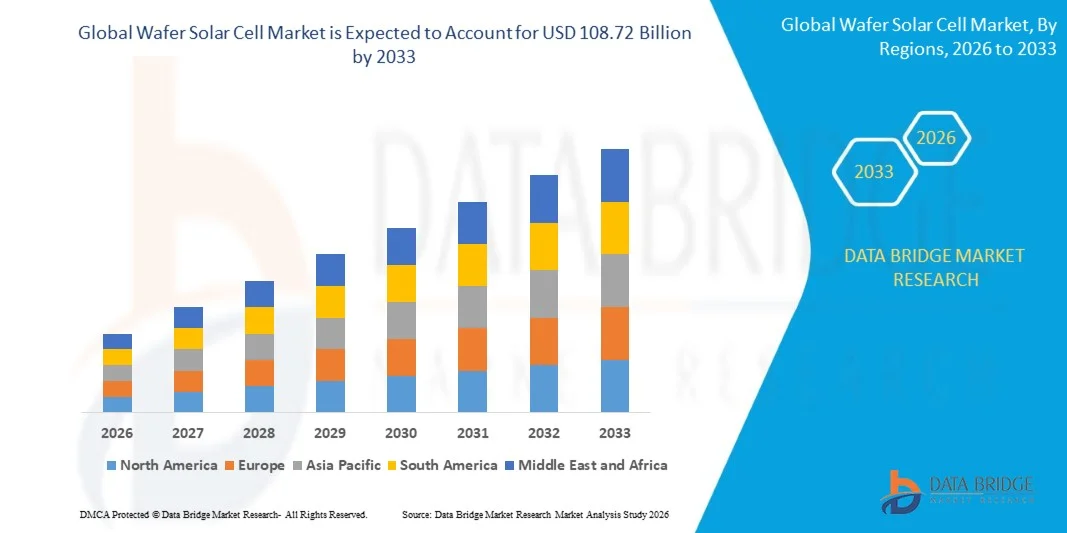
- As per Data Bridge Market Research analysis, the wafer solar cell market was valued at USD 42.15 billion in 2025 and is projected to reach USD 108.72 billion by 2033, growing at a CAGR of 12.60% from 2026 to 2033.
- The market is experiencing sustained growth driven by record-breaking global photovoltaic capacity additions, rapid conversion of cell production lines from PERC to higher-efficiency TOPCon and heterojunction architectures, and expanding diamond-wire wafer-slicing capacity across leading manufacturing hubs.
- Escalating electricity demand, combined with government incentives for domestic solar supply chains such as the U.S. Inflation Reduction Act and India's Production-Linked Incentive scheme, is compelling module manufacturers, EPC contractors, and utility developers to secure long-term wafer supply. Larger-format M10 and G12 wafers are increasingly replacing legacy M6 formats in new installations, offering higher module power output and a lower levelized cost of energy.
Market Size & Forecast
- Global Market Value (2025): USD 42.15 Billion
- Expected Market Value (2033): USD 108.72 Billion
- Forecast CAGR (2026–2033): 12.60%
- Leading Region in 2025: Asia-Pacific
- Fastest Growing Region: North America
What are the Major Takeaways of the Wafer Solar Cell Market?
- Asia-Pacific dominated the global wafer solar cell market with the largest revenue share of 68.40% in 2025, supported by China's dominant ingot, wafer, and polysilicon manufacturing base led by LONGi, TCL Zhonghuan, and GCL Technology.
- North America is expected to be the fastest-growing region at a CAGR of 15.8% from 2026 to 2033, fueled by IRA-backed reshoring of vertically integrated ingot-to-module supply chains, including Qcells' Cartersville, Georgia facility.
- The monocrystalline silicon wafers segment led the market with a 63.48% share in 2025, driven by superior conversion efficiency and exclusive compatibility with next-generation TOPCon, HJT, and IBC cell architectures.
- The TOPCon segment dominated the cell technology category with a 41.20% share in 2025, as manufacturers rapidly convert capacity away from legacy PERC architectures.
- The heterojunction (HJT) segment is the fastest-growing cell technology, projected to register a CAGR of 18.4%, reflecting rising investment in premium, high-bifaciality module production.
- The utility-scale power generation segment dominated the application category with a 52.30% revenue share in 2025, led by grid-scale developers procuring high-efficiency wafers at volume.
- The G12 (210mm) wafer size segment is the fastest-growing format, with a CAGR of 16.2%, driven by utility-scale demand for larger, higher-power wafers that lower balance-of-system costs.
Report Scope and Wafer Solar Cell Market Segmentation
|
Attributes |
Wafer Solar Cell Key Market Insights |
|
Segments Covered |
|
|
Countries Covered |
North America
Europe
Asia-Pacific
Middle East and Africa
South America
|
|
Key Market Players |
|
|
Market Opportunities |
|
|
Value Added Data Infosets |
In addition to the insights on market scenarios such as market value, growth rate, segmentation, geographical coverage, and major players, the market reports curated by the Data Bridge Market Research also include in-depth expert analysis, geographically represented company-wise production and capacity, network layouts of distributors and partners, detailed and updated price trend analysis and deficit analysis of supply chain and demand. |
What is the Key Trend in the Wafer Solar Cell Market?
- Manufacturers are rapidly converting cell production capacity from PERC to higher-efficiency n-type TOPCon architectures, reshaping demand for compatible monocrystalline wafer formats.
- For instance, in January 2025, JinkoSolar achieved 33.84% efficiency on a TOPCon-based tandem cell, underscoring the pace at which n-type wafer-based architectures are displacing legacy p-type PERC production.
- The industry is shifting decisively toward larger-format wafers to boost module power output and reduce balance-of-system costs.
- For instance, industry data indicates that more than 55% of next-generation solar panels are expected to incorporate larger M10 and G12 wafer formats, enhancing module efficiency by up to 20% compared with legacy M6-based designs.
- Reshoring of vertically integrated ingot-to-module supply chains is accelerating in policy-supported markets, reducing reliance on imported wafers.
- For instance, in June 2026, Qcells began solar cell manufacturing at its Cartersville, Georgia facility, marking a milestone toward completing the first fully vertically integrated ingot-to-panel solar plant built in the United States in nearly a decade.
What are the Key Drivers of the Wafer Solar Cell Market?
- Record global photovoltaic capacity additions are significantly increasing demand for high-efficiency wafers across utility, commercial, and residential installations.
- For instance, the International Energy Agency reported that global PV capacity additions reached approximately 601 GW in 2024, up from 465 GW in 2023, pushing cumulative installed global PV capacity beyond 2.2 terawatts by early 2025.
- Supportive government policy and reshoring incentives are accelerating investment in domestic wafer and ingot manufacturing capacity.
- For instance, in December 2024, the U.S. Department of Energy finalized a $1.45 billion loan guarantee to support Qcells' vertically integrated ingot, wafer, cell, and module facility in Cartersville, Georgia, described as the largest ingot and wafer plant ever built in the United States.
- Continuous advancement in diamond-wire slicing and thin-wafer handling technologies is lowering silicon consumption per watt, improving manufacturer margins and supporting broader adoption of next-generation cell architectures.
Which Factors are Challenging the Growth of the Wafer Solar Cell Market?
- Overcapacity and intense price competition among leading Asia-Pacific wafer producers continue to pressure margins across the global supply chain.
- The high capital investment required to establish vertically integrated ingot-to-wafer manufacturing lines outside of established Asia-Pacific hubs limits the pace of regional supply-chain diversification.
- For instance, reshoring projects such as Qcells' Cartersville facility experienced production delays in late 2025 due to customs-related supply chain disruptions, with full-scale operations not resuming until March 2026, illustrating the operational complexity of rebuilding a globalized wafer supply chain domestically.
- Volatility in polysilicon pricing and trade-policy uncertainty, including tariffs on imported wafers and cells, continues to create cost unpredictability for module manufacturers and project developers.
How is the Wafer Solar Cell Market Segmented?
The wafer solar cell market is segmented on the basis of wafer type, cell technology, wafer size, wafer thickness, application, end user, and sales channel.
- By Wafer Type
On the basis of wafer type, the global wafer solar cell market is segmented into monocrystalline silicon wafers, multicrystalline silicon wafers, and ribbon silicon wafers. The Monocrystalline Silicon Wafers segment dominated the market with a 63.48% share in 2025, owing to its superior conversion efficiency, exclusive compatibility with next-generation TOPCon, HJT, and IBC cell architectures, and continued decline in production costs achieved through diamond-wire slicing.
The Monocrystalline Silicon Wafers segment is also expected to register the fastest CAGR from 2026 to 2033, as manufacturers continue phasing out multicrystalline capacity in favor of higher-efficiency n-type monocrystalline ingots to meet next-generation cell demand.
- By Cell Technology
On the basis of cell technology, the global wafer solar cell market is segmented into PERC, TOPCon, heterojunction (HJT), interdigitated back contact (IBC), and bifacial. The TOPCon segment led the market with a 41.20% share in 2025, driven by its higher conversion efficiency and lower degradation rates compared with legacy PERC architectures, prompting rapid capacity conversion across major module manufacturers.
The heterojunction (HJT) segment is projected to register the fastest CAGR of 18.4% from 2026 to 2033, supported by its superior temperature coefficient, bifacial gain, and compatibility with thinner wafers, which is drawing growing capital investment from premium module producers.
- By Wafer Size
On the basis of wafer size, the global wafer solar cell market is segmented into M6 (166mm), M10 (182mm), G12 (210mm), and others. The M10 (182mm) segment dominated the market in 2025, reflecting its position as the current mainstream format adopted across the majority of global cell and module production lines.
The G12 (210mm) segment is expected to witness the fastest CAGR of 16.2% from 2026 to 2033, driven by rising utility-scale demand for larger-format, higher-power wafers that reduce balance-of-system costs per watt installed.
- By Wafer Thickness
On the basis of wafer thickness, the global wafer solar cell market is segmented into below 150 µm, 150–180 µm, and above 180 µm. The 150–180 µm segment dominated the market in 2025, representing the current industry-standard thickness range that balances mechanical yield with silicon consumption.
The below 150 µm segment is expected to witness the fastest CAGR from 2026 to 2033, as diamond-wire sawing and improved handling technologies allow manufacturers to reduce silicon usage and lower per-watt production costs.
- By Application
On the basis of application, the global wafer solar cell market is segmented into utility-scale power generation, commercial & industrial, and residential. The utility-scale power generation segment dominated the market with a 52.30% share in 2025, supported by large-scale procurement of high-efficiency wafers by grid-connected solar developers worldwide.
The commercial & industrial segment is expected to witness the fastest CAGR from 2026 to 2033, driven by rising rooftop and distributed generation installations among manufacturing facilities, warehouses, and corporate campuses pursuing energy cost savings and sustainability targets.
- By End User
On the basis of end user, the global wafer solar cell market is segmented into solar module manufacturers, EPC contractors & project developers, and utility companies. The solar module manufacturers segment dominated the market in 2025, as wafers remain the essential intermediate input directly consumed at scale in cell and module fabrication.
The EPC contractors & project developers segment is expected to witness the fastest CAGR from 2026 to 2033, driven by growing vertical integration among project developers seeking greater control over wafer sourcing and supply security.
- By Sales Channel
On the basis of sales channel, the global wafer solar cell market is segmented into direct/OEM sales and distributors & traders. The direct/OEM sales segment dominated the market in 2025, supported by long-term offtake agreements between wafer producers and integrated module manufacturers.
The distributors & traders segment is expected to witness the fastest CAGR from 2026 to 2033, driven by expanding regional trading networks that improve wafer accessibility for smaller and mid-sized cell manufacturers.
Which Region Holds the Largest Share of the Wafer Solar Cell Market?
- Asia-Pacific dominated the wafer solar cell market and accounted for the largest revenue share of 68.40% in 2025, supported by large-scale ingot, wafer, and polysilicon manufacturing capacity concentrated in China, alongside significant production bases in Taiwan and South Korea.
- The region benefits from an integrated upstream-to-downstream photovoltaic supply chain, low-cost manufacturing scale, and continuous capacity expansion by leading wafer producers. Rising domestic PV installations across China, India, and Southeast Asia, combined with strong government support for renewable energy targets, continue to reinforce Asia-Pacific's leadership position in the global market.
China Wafer Solar Cell Market Insight
The China wafer solar cell market remains the dominant global production hub, supported by vertically integrated polysilicon-to-wafer supply chains operated by LONGi, TCL Zhonghuan, and GCL Technology. Continued investment in diamond-wire slicing capacity, large-format G12 wafer production, and n-type monocrystalline ingot growth is reinforcing China's cost and scale leadership across the global wafer supply chain.
India Wafer Solar Cell Market Insight
The India wafer solar cell market is witnessing rapid growth, supported by the government's Production-Linked Incentive scheme for high-efficiency solar PV manufacturing. Domestic players such as Adani Solar and Waaree Energies are scaling ingot and wafer capacity to reduce import dependence and localize the upstream solar supply chain in support of national renewable energy targets.
North America Wafer Solar Cell Market Insight
The North America wafer solar cell market is expected to witness the fastest growth at a CAGR of 15.8% from 2026 to 2033, driven by IRA-backed reshoring of vertically integrated solar manufacturing supply chains and increasing investments in domestic ingot, wafer, and cell production. The expansion of large-scale manufacturing facilities, including Qcells' Cartersville, Georgia facility, along with growing efforts to reduce reliance on imported solar components, is further supporting regional market growth.
Which are the Top Companies in Wafer Solar Cell Market?
The wafer solar cell industry is primarily led by well-established companies, including:
- LONGi Green Energy Technology Co., Ltd. (China)
- TCL Zhonghuan Renewable Energy Technology Co., Ltd. (China)
- GCL Technology Holdings Limited (China)
- JinkoSolar Holding Co., Ltd. (China)
- JA Solar Technology Co., Ltd. (China)
- Trina Solar Limited (China)
- Tongwei Co., Ltd. (China)
- Daqo New Energy Corp. (China)
- Canadian Solar Inc. (Canada)
- Xinte Energy Co., Ltd. (China)
- Shin-Etsu Chemical Co., Ltd. (Japan)
- SUMCO Corporation (Japan)
- Wacker Chemie AG (Germany)
- OCI Company Ltd. (South Korea)
- NorSun AS (Norway)
What are Latest Developments in Wafer Solar Cell Market?
- In June 2026, Qcells began solar cell manufacturing at its Cartersville, Georgia facility, marking a major milestone toward completing the first fully vertically integrated ingot-to-panel solar plant built in the United States in nearly a decade, targeting 3.3 GW each of annual ingot, wafer, and cell capacity by Q3 2026.
- In December 2024, the U.S. Department of Energy finalized a $1.45 billion loan guarantee to support Qcells' vertically integrated ingot, wafer, cell, and module manufacturing facility in Cartersville, Georgia, described as the largest ingot and wafer plant ever built in the United States.
- In January 2025, JinkoSolar achieved 33.84% conversion efficiency on a TOPCon-based tandem cell, reinforcing the shift of the world's largest module shipper toward next-generation n-type wafer architectures.
- In August 2024, the U.S. Department of Energy announced a conditional loan guarantee commitment of up to $1.45 billion to back construction of Qcells' vertically integrated Cartersville campus, underscoring federal support for reshoring domestic wafer manufacturing.
- In October 2023, Hanwha Qcells expanded its Dalton, Georgia facility as part of a $2.5 billion U.S. manufacturing investment, growing combined Dalton and Cartersville capacity toward 8.4 GW of annual solar panel production.
- Industry-wide, more than 55% of next-generation solar panels are expected to incorporate larger M10 and G12 wafer formats, reflecting a broad manufacturing shift toward larger wafer sizes to enhance module efficiency by up to 20% compared with legacy designs.

- Interactive Data Analysis Dashboard
- Company Analysis Dashboard for high growth potential opportunities
- Research Analyst Access for customization & queries
- Competitor Analysis with Interactive dashboard
- Latest News, Updates & Trend analysis
- Harness the Power of Benchmark Analysis for Comprehensive Competitor Tracking
Global Wafer Solar Cell Market, Supply Chain Analysis and Ecosystem Framework
To support market growth and help clients navigate the impact of geopolitical shifts, DBMR has integrated in-depth supply chain analysis into its Global Wafer Solar Cell Market research reports. This addition empowers clients to respond effectively to global changes affecting their industries. The supply chain analysis section includes detailed insights such as Global Wafer Solar Cell Market consumption and production by country, price trend analysis, the impact of tariffs and geopolitical developments, and import and export trends by country and HSN code. It also highlights major suppliers with data on production capacity and company profiles, as well as key importers and exporters. In addition to research, DBMR offers specialized supply chain consulting services backed by over a decade of experience, providing solutions like supplier discovery, supplier risk assessment, price trend analysis, impact evaluation of inflation and trade route changes, and comprehensive market trend analysis.
Data collection and base year analysis are done using data collection modules with large sample sizes. The stage includes obtaining market information or related data through various sources and strategies. It includes examining and planning all the data acquired from the past in advance. It likewise envelops the examination of information inconsistencies seen across different information sources. The market data is analysed and estimated using market statistical and coherent models. Also, market share analysis and key trend analysis are the major success factors in the market report. To know more, please request an analyst call or drop down your inquiry.
The key research methodology used by DBMR research team is data triangulation which involves data mining, analysis of the impact of data variables on the market and primary (industry expert) validation. Data models include Vendor Positioning Grid, Market Time Line Analysis, Market Overview and Guide, Company Positioning Grid, Patent Analysis, Pricing Analysis, Company Market Share Analysis, Standards of Measurement, Global versus Regional and Vendor Share Analysis. To know more about the research methodology, drop in an inquiry to speak to our industry experts.
Data Bridge Market Research is a leader in advanced formative research. We take pride in servicing our existing and new customers with data and analysis that match and suits their goal. The report can be customized to include price trend analysis of target brands understanding the market for additional countries (ask for the list of countries), clinical trial results data, literature review, refurbished market and product base analysis. Market analysis of target competitors can be analyzed from technology-based analysis to market portfolio strategies. We can add as many competitors that you require data about in the format and data style you are looking for. Our team of analysts can also provide you data in crude raw excel files pivot tables (Fact book) or can assist you in creating presentations from the data sets available in the report.













