


Global Waldenstrom’s Macroglobulinemia (WM) Treatment Market Size
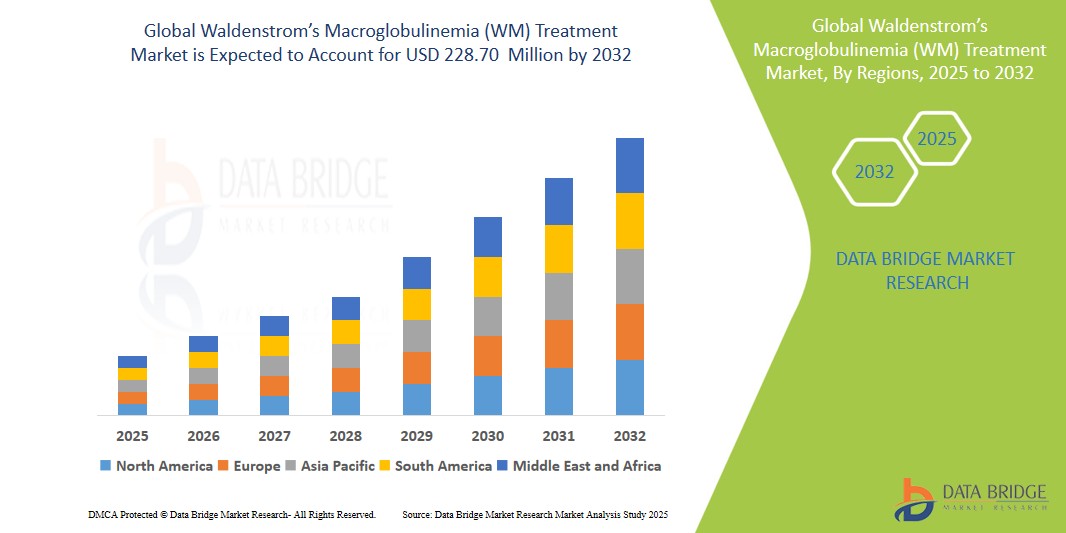
- The Global Waldenstrom’s Macroglobulinemia (WM) Treatment Market size was valued at USD 160.50 million in 2024 and is expected to reach USD 228.70 million by 2032, at a CAGR of 5.20% during the forecast period
- This growth is driven by factors such as the increasing prevalence of Waldenstrom's Macroglobulinemia (WM), rising demand for targeted therapies, and the growing focus on improving patient outcomes and treatment efficiency
Global Waldenstrom’s Macroglobulinemia (WM) Treatment Market Analysis
- The Waldenstrom's Macroglobulinemia (WM) treatment market is experiencing significant traction due to its rapid integration of novel therapies, especially in sectors emphasizing targeted treatment approaches, personalized medicine, and improved disease management, with Waldenstrom's Macroglobulinemia defined as a rare, indolent type of non-Hodgkin lymphoma characterized by the overproduction of abnormal white blood cells that secrete a monoclonal immunoglobulin M (IgM) protein, leading to symptoms such as fatigue, anemia, and hyperviscosity.
- Companies are increasingly investing in WM treatment research to enhance therapeutic efficacy, improve patient outcomes, and meet evolving demands for advanced hematologic oncology solutions
- North America is expected to dominate the Waldenstrom's Macroglobulinemia (WM) Treatment market due to advanced healthcare infrastructure and high adoption of innovative treatment modalities
- Asia-Pacific is expected to be the fastest growing region in the Waldenstrom's Macroglobulinemia (WM) Treatment market during the forecast period due to increasing healthcare investments and growing access to cancer treatment therapies
- The Ibrutinib segment is expected to dominate the Waldenstrom's Macroglobulinemia (WM) Treatment market with the largest share in 2025 due to its proven efficacy, widespread clinical use, and ability to significantly improve patient response rates
Report Scope and Global Waldenstrom’s Macroglobulinemia (WM) Treatment Market Segmentation
|
Attributes |
Waldenstrom’s Macroglobulinemia (WM) Treatment Key Market Insights |
|
Segments Covered |
|
|
Countries Covered |
North America
Europe
Asia-Pacific
Middle East and Africa
South America
|
|
Key Market Players |
• Johnson & Johnson (U.S.) |
|
Market Opportunities |
• Expanding use of targeted therapies, immunotherapy, and personalized treatment approaches to improve patient outcomes in Waldenstrom's Macroglobulinemia (WM) |
|
Value Added Data Infosets |
In addition to the insights on market scenarios such as market value, growth rate, segmentation, geographical coverage, and major players, the market reports curated by the Data Bridge Market Research also include import export analysis, production capacity overview, production consumption analysis, price trend analysis, climate change scenario, supply chain analysis, value chain analysis, raw material/consumables overview, vendor selection criteria, PESTLE Analysis, Porter Analysis, and regulatory framework. |
Waldenstrom’s Macroglobulinemia (WM) Treatment Market Trends
“Rising Use of Advanced Therapies in Waldenstrom's Macroglobulinemia (WM) Treatment”
- Waldenstrom's Macroglobulinemia (WM) treatment is gaining momentum as a transformative approach due to its ability to enhance patient outcomes and disease management
- It is increasingly being integrated into targeted therapies, immunotherapy platforms, and personalized treatment regimens, improving patient care and overall treatment effectiveness
- For instance, novel drugs like Ibrutinib and Rituximab are being used to effectively manage symptoms and improve survival rates in WM patients
- The demand for advanced treatments and precision medicine is pushing healthcare providers to explore innovative therapies for managing WM
- As treatment options continue to evolve, WM therapies are becoming a top choice for improving disease control and patient quality of life
Global Waldenstrom’s Macroglobulinemia (WM) Treatment Market Dynamics
Driver
“Growing Demand for Targeted and Advanced Treatments in Waldenstrom's Macroglobulinemia (WM)”
- Increasing global focus on improving treatment outcomes and survival rates for WM patients is driving the adoption of advanced therapies and targeted treatment
- WM treatments offer novel therapies, precision medicine, and personalized treatment plans, making them ideal for enhancing disease management and patient care
- For instance, companies such as AbbVie and Johnson & Johnson are already developing innovative WM treatment options like Ibrutinib and Rituximab to improve patient outcomes
- Regulatory approvals and healthcare policies promoting the use of advanced therapies for hematologic cancers are accelerating the shift toward more effective WM treatment solutions, creating strong market momentum
- Healthcare providers are actively adopting advanced WM treatments to improve patient outcomes, reduce relapse rates, and meet the growing demand for precision oncology solutions
- In conclusion, the shift toward targeted and personalized therapies in the treatment of Waldenstrom's Macroglobulinemia (WM) is driving the market’s growth and shaping its future
Opportunity
“Expansion into Targeted Therapies and Personalized Treatment Approaches for Waldenstrom's Macroglobulinemia (WM)”
- Waldenstrom's Macroglobulinemia (WM) treatments are emerging as a promising solution in hematology due to their ability to improve patient outcomes, provide real-time treatment adjustments, and offer personalized care plan
- WM treatment therapies are being integrated into targeted drug regimens, immunotherapy platforms, and precision medicine systems to enhance clinical workflows and patient care
- Advances in immunotherapy and targeted therapies, including the use of artificial intelligence (AI) to predict treatment responses and improve patient-specific protocols, are gaining traction in the WM treatment landscape
- Researchers are leveraging big data and genetic profiling to drive innovations in personalized WM therapies, enabling tailored treatments and improved patient response
- For instance, companies like Gilead Sciences and Roche are developing innovative WM treatment solutions like Ibrutinib and Rituximab for more effective disease management and personalized care
- In conclusion, Waldenstrom's Macroglobulinemia (WM) treatments hold strong potential for future innovations in hematologic oncology. Their combination of precision therapies and individualized treatment options makes them essential for advancing the care of WM patients
Restraint/Challenge
“High Treatment Costs and Limited Accessibility to Advanced Therapies”
- Extracting value from Waldenstrom's Macroglobulinemia (WM) treatment options often requires substantial investment in advanced therapies, diagnostic tools, and specialized medical staff. Implementing targeted treatments such as BTK inhibitors, immunotherapy, and personalized regimens involves high operational costs, including drug pricing and continuous patient monitoring
- The initial cost of WM therapies remains significantly higher than traditional chemotherapy, making it challenging for smaller healthcare centers or facilities in low-income regions to adopt and administer these treatments. For instance, companies like Johnson & Johnson and AbbVie face challenges in ensuring widespread access to high-cost drugs like Ibrutinib while maintaining affordability and efficacy
- Access disparities, complex diagnostic requirements, and reimbursement limitations further complicate the availability of WM treatments. Healthcare systems often face challenges in delivering specialized care without compromising treatment timelines or insurance compliance
- For instance, the adoption of novel WM therapies has been slower in certain countries due to difficulties in providing genetic testing, drug funding, and regulatory approvals in a cost-effective and timely manner
- Inconsistent healthcare infrastructure and varying clinical guidelines continue to delay large-scale access to advanced WM treatments. Lack of standardization and limited specialist availability hinder broader treatment adoption across diverse healthcare settings
- In conclusion, the high treatment costs and limited accessibility to advanced therapies are hindering the widespread adoption of effective Waldenstrom's Macroglobulinemia (WM) treatments. Industry collaboration, regulatory support, and continued innovation are essential for overcoming these barriers and expanding patient access globally
Global Waldenstrom’s Macroglobulinemia (WM) Treatment Market Scope
The market is segmented on the basis of:-
|
Segmentation |
Sub-Segmentation |
|
By Treatment Type |
|
|
By Drugs |
|
|
By Route of Administration
|
|
|
By Distribution Channels |
|
|
By End User |
|
In 2025, the Ibrutinib segment is projected to dominate the market with the largest share in the drugs segment.
The Ibrutinib segment is expected to dominate the Waldenstrom's Macroglobulinemia (WM) Treatment market with the largest share in 2025 due to its proven clinical efficacy, targeted mechanism of action, and widespread adoption as a first-line treatment option, supported by FDA approval specifically for WM, a favorable safety profile in long-term studies, and its inclusion in multiple international treatment guidelines, making it a preferred choice among hematologists globally, particularly in regions with advanced healthcare infrastructure and strong reimbursement policies
The Hospital segment is expected to account for the largest share during the forecast period in the Waldenstrom's Macroglobulinemia (WM) Treatment market.
In 2025, the Hospital segment is expected to dominate the market with the largest market share due to the increasing number of WM diagnoses, availability of specialized care, and preference for hospital-based administration of advanced therapies, supported by the presence of multidisciplinary teams, including oncologists, hematologists, and pharmacists, who are equipped to manage complex treatment regimens. Additionally, hospitals are better positioned to provide comprehensive diagnostic services, advanced monitoring, and access to cutting-edge therapies, which enhances patient outcomes, particularly in regions with established healthcare infrastructure and robust insurance coverage
Global Waldenstrom’s Macroglobulinemia (WM) Treatment Country Analysis
“North America Holds the Largest Share in the Waldenstrom's Macroglobulinemia (WM) Treatment Market”
- North America leads the Waldenstrom's Macroglobulinemia (WM) Treatment market due to its advanced healthcare infrastructure and early adoption of novel cancer therapies.
- The presence of key pharmaceutical companies and biotech firms actively investing in hematologic oncology drives innovation and large-scale treatment availability
- Strong demand from hospitals, specialty clinics, and cancer care centers supports widespread adoption of advanced WM treatments across healthcare settings
- Government initiatives promoting cancer research, early diagnosis programs, and access to breakthrough therapies strengthen market development
- Collaborations between academic research institutions, pharmaceutical companies, and oncology networks in the United States and Canada help accelerate clinical trials and bring innovative WM treatments to market
“Asia-Pacific is Projected to Register the Highest CAGR in the Waldenstrom's Macroglobulinemia (WM) Treatment Market”
- Asia-Pacific is the fastest-growing market, driven by expanding healthcare infrastructure and increasing adoption of advanced cancer treatment solutions
- Countries such as China, Japan, and India are investing in WM treatment research and development for novel therapies, immunotherapy, and precision medicine application
- Rising healthcare reforms and a shift toward targeted and personalized treatments encourage the adoption of advanced WM therapies across public and private healthcare sectors
- Growing patient populations and increasing awareness among healthcare providers push market adoption in hospitals, specialty clinics, and research institutions
- Academic research partnerships and digital innovation hubs across Asia-Pacific are accelerating the development and implementation of cutting-edge Waldenstrom's Macroglobulinemia (WM) treatment solutions
Global Waldenstrom’s Macroglobulinemia (WM) Treatment Market Share
The market competitive landscape provides details by competitor. Details included are company overview, company financials, revenue generated, market potential, investment in research and development, new market initiatives, global presence, production sites and facilities, production capacities, company strengths and weaknesses, product launch, product width and breadth, application dominance. The above data points provided are only related to the companies' focus related to market.
The Major Market Leaders Operating in the Market Are:
• Johnson & Johnson (U.S.)
• AbbVie Inc. (U.S.)
• Roche Holding AG (Switzerland)
• Amgen Inc. (U.S.)
• Gilead Sciences, Inc. (U.S.)
• Novartis AG (Switzerland)
• Bristol-Myers Squibb (U.S.)
• Celgene Corporation (U.S.)
• Sanofi S.A. (France)
• Merck & Co., Inc. (U.S.)
• Eli Lilly and Company (U.S.)
• AstraZeneca PLC (U.K.)
• Regeneron Pharmaceuticals, Inc. (U.S.)
• BeiGene, Ltd. (China)
• Teva Pharmaceutical Industries Ltd. (Israel)
• Karyopharm Therapeutics Inc. (U.S.)
• Seagen Inc. (U.S.)
• Genmab A/S (Denmark)
• F. Hoffmann-La Roche AG (Switzerland)
• Ferring Pharmaceuticals (Switzerland)
• MediGene AG (Germany)
• Bluebird Bio, Inc. (U.S.)
• Mallinckrodt Pharmaceuticals (Ireland)
• Immunomedics, Inc. (U.S.)
• OncoOne, Inc. (U.S.)
Latest Developments in Global Waldenstrom’s Macroglobulinemia (WM) Treatment Market
- In December 2024, a phase II study evaluated the combination of ibrutinib and ixazomib in patients with newly diagnosed and relapsed/refractory WM. The study demonstrated a 76.2% overall response rate and a median progression-free survival of 22.9 months, indicating the potential of combining Bruton's tyrosine kinase inhibition with proteasome inhibition in WM treatment
- At the 2024 American Society of Hematology (ASH) Annual Meeting, long-term data from the ASPEN trial revealed that zanubrutinib, a Bruton's tyrosine kinase inhibitor, offers superior tolerability and sustained efficacy compared to ibrutinib in patients with WM, including those with MYD88 wild-type mutations. This positions zanubrutinib as a promising alternative for WM patients
- In December 2024, a study presented at ASH 2024 reported on the two-year follow-up of treatment-naive WM patients who had previously received a combination of ibrutinib and venetoclax. The follow-up data indicated that the combination therapy led to durable responses, although the study was halted due to safety concerns, including ventricular arrhythmia events.

- Interactive Data Analysis Dashboard
- Company Analysis Dashboard for high growth potential opportunities
- Research Analyst Access for customization & queries
- Competitor Analysis with Interactive dashboard
- Latest News, Updates & Trend analysis
- Harness the Power of Benchmark Analysis for Comprehensive Competitor Tracking
Data collection and base year analysis are done using data collection modules with large sample sizes. The stage includes obtaining market information or related data through various sources and strategies. It includes examining and planning all the data acquired from the past in advance. It likewise envelops the examination of information inconsistencies seen across different information sources. The market data is analysed and estimated using market statistical and coherent models. Also, market share analysis and key trend analysis are the major success factors in the market report. To know more, please request an analyst call or drop down your inquiry.
The key research methodology used by DBMR research team is data triangulation which involves data mining, analysis of the impact of data variables on the market and primary (industry expert) validation. Data models include Vendor Positioning Grid, Market Time Line Analysis, Market Overview and Guide, Company Positioning Grid, Patent Analysis, Pricing Analysis, Company Market Share Analysis, Standards of Measurement, Global versus Regional and Vendor Share Analysis. To know more about the research methodology, drop in an inquiry to speak to our industry experts.
Data Bridge Market Research is a leader in advanced formative research. We take pride in servicing our existing and new customers with data and analysis that match and suits their goal. The report can be customized to include price trend analysis of target brands understanding the market for additional countries (ask for the list of countries), clinical trial results data, literature review, refurbished market and product base analysis. Market analysis of target competitors can be analyzed from technology-based analysis to market portfolio strategies. We can add as many competitors that you require data about in the format and data style you are looking for. Our team of analysts can also provide you data in crude raw excel files pivot tables (Fact book) or can assist you in creating presentations from the data sets available in the report.












