


Walking Aids Market Overview
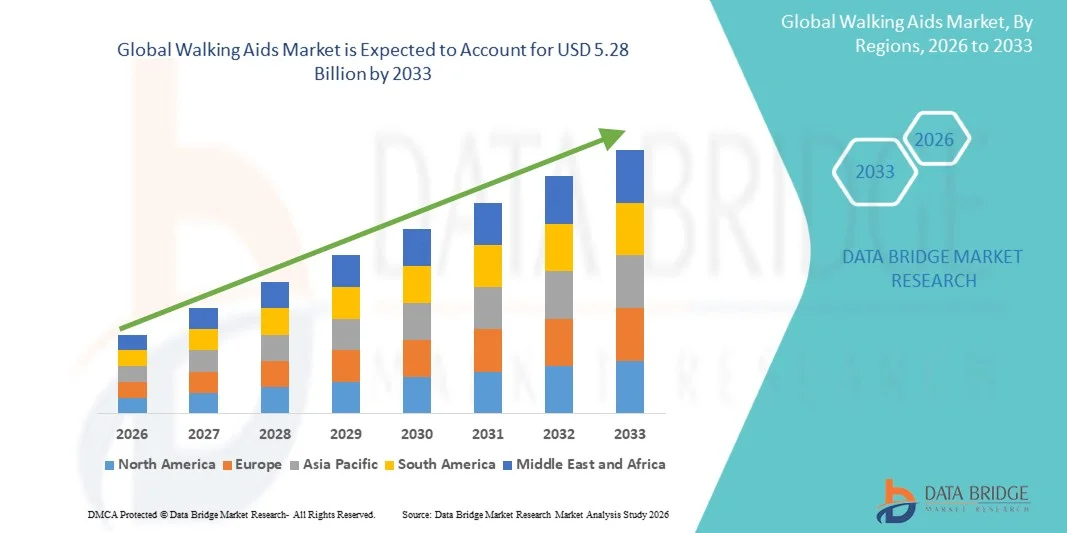
The Walking Aids Market was valued at USD 2.94 billion in 2025 and is projected to reach USD 5.28 billion by 2033, growing at a CAGR of 7.60% from 2026 to 2033. The market is witnessing steady growth driven by the rising geriatric population, increasing prevalence of mobility-related disorders, and growing awareness regarding rehabilitation and independent living solutions.
The increasing incidence of orthopedic conditions, neurological disorders, disabilities, and age-related mobility impairments is encouraging hospitals, rehabilitation centers, and homecare settings to adopt advanced walking assistance products. Canes, walkers, rollators, and crutches are increasingly being integrated with lightweight materials, ergonomic designs, and smart monitoring technologies to improve patient comfort and mobility support. In addition, rising healthcare expenditure, expanding home healthcare services, and supportive government initiatives for elderly care and disability assistance are further accelerating the adoption of walking aids across both developed and emerging markets.
Key Market Trends & Insights
- North America dominated the Walking Aids Market with the largest revenue share of 36.42% in 2025, supported by a large aging population, advanced healthcare infrastructure, and strong adoption of mobility assistance devices across homecare and rehabilitation settings.
- The Rollators segment led the market with a 43.28% share in 2025, driven by increasing demand among elderly and mobility-impaired individuals for enhanced balance support and independent movement assistance.
- Asia-Pacific is expected to be the fastest-growing region at a CAGR of 7.1% from 2026 to 2033, fueled by rising healthcare expenditure, expanding elderly population, and growing awareness regarding mobility assistance products in China, India, and Japan.
- Walkers are the fastest-growing type, projected to register a CAGR of 6.8%, reflecting the surge in demand for stable and affordable mobility assistance solutions across rehabilitation and post-surgical recovery applications.
- The Manual segment dominated the technology category with a 71.64% revenue share in 2025, led by its affordability, wide product availability, and strong adoption across hospitals, rehabilitation centers, and homecare settings
- Elderly Assistance accounted for 38.94% of the market, preferred by the rapidly expanding global geriatric population and increasing prevalence of age-related mobility disorders.
- The Post-Surgical Recovery segment is the fastest-growing application category, with a CAGR of 7.0%, driven by the increasing number of orthopedic surgeries, joint replacement procedures, and rehabilitation treatments worldwide.
Market Size & Forecast
- Global Market Value (2025): USD 2.94 Billion
- Expected Market Value (2033): USD 5.28 Billion
- Forecast CAGR (2026–2033): 7.60%
- Leading Region in 2025: North America
- Fastest Growing Region: Asia Pacific
Report Scope and Walking Aids Market Segmentation
|
Attributes |
Walking Aids Key Market Insights |
|
Segments Covered |
|
|
Countries Covered |
North America · U.S. · Canada · Mexico Europe · Germany · France · U.K. · Netherlands · Switzerland · Belgium · Russia · Italy · Spain · Turkey · Rest of Europe Asia-Pacific · China · Japan · India · South Korea · Singapore · Malaysia · Australia · Thailand · Indonesia · Philippines · Rest of Asia-Pacific Middle East and Africa · Saudi Arabia · U.A.E. · South Africa · Egypt · Israel · Rest of Middle East and Africa South America · Brazil · Argentina · Rest of South America |
|
Key Market Players |
· Drive DeVilbiss Healthcare (U.S.) · Invacare Corporation (U.S.) · Sunrise Medical (Germany) · Etac AB (Sweden) · GF Health Products, Inc. (U.S.) · Human Care HC AB (Sweden) · Karma Medical Products Co., Ltd. (Taiwan) · MEYRA GmbH (Germany) · Medline Industries, LP (U.S.) · NOVA Medical Products (U.S.) · Performance Health Supply, Inc. (U.S.) · Permobil AB (Sweden) · Pride Mobility Products Corp. (U.S.) · Rollz International BV (Netherlands) · TOPRO Industri AS (Norway) · Bischoff & Bischoff GmbH (Germany) · Rehasense Sp. z o.o. (Poland) · Kaye Products, Inc. (U.S.) · Benmor Medical (U.K.) · Graham-Field Health Products, Inc. (U.S.) |
|
Market Opportunities |
· Growing adoption of smart and sensor-integrated walking aids · Rising expansion of home healthcare services worldwide · Increasing government support programs and reimbursement policies |
|
Value Added Data Infosets |
In addition to the insights on market scenarios such as market value, growth rate, segmentation, geographical coverage, and major players, the market reports curated by the Data Bridge Market Research also include in-depth expert analysis, patient epidemiology, pipeline analysis, pricing analysis, and regulatory framework. |
Walking Aids Market Trends
Trend: Rising Demand for Smart & Ergonomic Mobility Assistance Devices
Healthcare providers and elderly consumers are increasingly adopting smart walking aids equipped with sensors, GPS tracking, fall detection, and posture monitoring technologies to improve patient safety and independent mobility. Manufacturers are also focusing on lightweight materials, foldable structures, and ergonomic handle designs that enhance comfort, portability, and long-term usability. Rehabilitation centers and homecare providers are similarly integrating connected mobility aids into patient recovery programs, while digital health platforms enable caregivers to monitor movement patterns and mobility performance remotely in real time.
Walking Aids Market Dynamics
Key Market Driver: Growing Aging Population and Increasing Mobility Impairments
The rapid growth of the global geriatric population and the increasing prevalence of orthopedic disorders, neurological conditions, and disability-related mobility limitations are creating substantial demand for walking aids across hospitals, rehabilitation centers, and homecare settings. Healthcare providers and long-term care facilities are deploying advanced mobility support products to improve patient independence, reduce fall risks, and enhance recovery outcomes while lowering long-term healthcare costs associated with mobility-related injuries.
For instance, in March 2025, Drive DeVilbiss Healthcare expanded its mobility assistance portfolio with lightweight rollators and smart walkers designed specifically for elderly patients requiring long-term mobility support.
Key Restraint/Challenge: High Cost of Advanced and Smart Walking Aids
A significant restraint in the Walking Aids Market is the high cost associated with technologically advanced mobility devices. Modern smart walking aids integrate sensor technologies, electronic monitoring systems, lightweight composite materials, and ergonomic engineering, requiring considerable investment in manufacturing, distribution, and maintenance. The overall ownership cost also includes repairs, battery replacements, and product customization, making adoption difficult for low-income elderly populations and healthcare providers in developing regions.
For instance, in September 2024, Invacare Corporation introduced an upgraded smart mobility walker equipped with digital monitoring features and lightweight carbon-frame technology, reflecting the increasing cost challenges associated with premium mobility assistance devices.
Key Market Opportunity: Expansion of Home Healthcare and Remote Patient Monitoring
The expansion of home healthcare services and remote patient monitoring solutions presents a significant market opportunity. Connected walking aids integrated with IoT-enabled tracking systems can support caregiver supervision, monitor patient movement patterns, and provide real-time alerts for fall prevention and emergency response. The growing development of telehealth ecosystems and affordable smart mobility devices is further improving accessibility to advanced walking aids, creating growth opportunities across aging populations in Asia-Pacific, Latin America, and the Middle East. For instance, in January 2025, Sunrise Medical launched connected mobility support solutions integrated with remote monitoring capabilities to enhance elderly patient care and home-based rehabilitation programs.
Walking Aids Market Scope
The walking aids market is segmented on the basis of type, technology, and application.
- By Type
On the basis of type, the Walking Aids Market is segmented into rollators, walkers, and others. The Rollators segment dominated the market with a 43.28% share in 2025, driven by increasing demand among elderly and mobility-impaired individuals for enhanced balance support and independent movement assistance. Rollators are widely preferred due to their wheeled mobility, ergonomic seating options, storage convenience, and ease of maneuverability in both indoor and outdoor environments. Healthcare providers and rehabilitation centers extensively recommend rollators for long-term mobility support and fall prevention among geriatric patients. The growing prevalence of arthritis, osteoporosis, and musculoskeletal disorders is further accelerating adoption globally. Manufacturers are increasingly introducing lightweight aluminum and foldable rollators with adjustable features to improve portability and user comfort. Rising home healthcare adoption and supportive reimbursement programs are also strengthening the segment’s market dominance.
The Walkers segment is projected to register the fastest growth at a CAGR of 6.8% from 2026 to 2033, driven by rising demand for stable and affordable mobility assistance solutions across rehabilitation and post-surgical recovery applications. Walkers provide superior balance support for patients with severe mobility limitations, making them highly suitable for neurological rehabilitation and elderly care. Increasing cases of stroke, spinal injuries, and orthopedic surgeries are significantly contributing to segment expansion. Technological advancements such as smart walkers integrated with sensors, posture monitoring, and fall detection systems are further enhancing adoption. Healthcare institutions are increasingly utilizing walkers in physiotherapy and clinical rehabilitation programs to improve patient recovery outcomes. Growing awareness regarding mobility assistance devices in emerging economies is also supporting rapid segment growth globally.
- By Technology
On the basis of technology, the Walking Aids Market is segmented into manual and automated. The Manual segment dominated the market with a 71.64% share in 2025, owing to its affordability, wide product availability, and strong adoption across hospitals, rehabilitation centers, and homecare settings. Manual walking aids such as standard walkers, canes, and crutches remain highly preferred due to their simple design, low maintenance requirements, and ease of use among elderly populations. These products are extensively utilized in developing and developed markets where cost-effective mobility support solutions are essential. The segment also benefits from broad distribution through pharmacies, medical equipment suppliers, and retail healthcare channels. Lightweight materials and ergonomic product innovations are further improving patient comfort and portability. Their accessibility and reliability continue to maintain strong demand across long-term mobility support applications.
The Automated segment is expected to witness the fastest growth at a CAGR of 7.1% from 2026 to 2033, driven by rising demand for technologically advanced mobility assistance products integrated with smart monitoring capabilities. Automated walking aids equipped with sensors, AI-assisted navigation, GPS tracking, and fall detection technologies are gaining traction among elderly and disabled users seeking improved safety and independence. Continuous advancements in digital healthcare infrastructure and connected medical devices are significantly enhancing product adoption. Healthcare providers are increasingly integrating automated mobility aids into remote patient monitoring and home healthcare programs. Growing investment in assistive robotics and smart rehabilitation technologies is also accelerating innovation within the segment. Rising consumer preference for premium mobility assistance solutions is further supporting market growth worldwide.
- By Application
On the basis of application, the Walking Aids Market is segmented into neurologically impaired patients, handicap patients, post-surgical recovery, clinical rehabilitation, long-term mobility support, indoor mobility, outdoor mobility, elderly assistance, and disability assistance. The Elderly Assistance segment dominated the market with a 38.94% revenue share in 2025, driven by the rapidly expanding global geriatric population and increasing prevalence of age-related mobility disorders. Walking aids are extensively used among elderly individuals to improve balance, reduce fall risks, and maintain independence in daily activities. Rising incidences of arthritis, osteoporosis, and joint degeneration are significantly increasing demand for mobility support devices across homecare and assisted living facilities. Healthcare organizations and caregivers are also promoting the use of walking aids to minimize hospitalization risks associated with falls and mobility injuries. Product innovations focused on lightweight structures, ergonomic grips, and foldable mobility aids are further improving elderly adoption rates. Supportive government healthcare initiatives and elderly care programs continue to strengthen segment growth globally.
The Post-Surgical Recovery segment is projected to register the fastest growth at a CAGR of 7.0% from 2026 to 2033, driven by the increasing number of orthopedic surgeries, joint replacement procedures, and rehabilitation treatments worldwide. Walking aids play a critical role in supporting patient mobility, improving recovery speed, and reducing physical strain during rehabilitation phases. Hospitals and physiotherapy centers are increasingly incorporating walkers, crutches, and rollators into structured post-operative recovery programs. Rising healthcare expenditure and growing awareness regarding early mobility rehabilitation are further contributing to segment expansion. Technological advancements such as smart rehabilitation walkers and sensor-enabled gait monitoring systems are also improving patient recovery outcomes. Increasing demand for home-based rehabilitation services is expected to further accelerate adoption across both developed and emerging healthcare markets.
Walking Aids Market Regional Analysis
North America dominated the Walking Aids Market with the largest revenue share of 36.42% in 2025, supported by a large aging population, advanced healthcare infrastructure, and strong adoption of mobility assistance devices across homecare and rehabilitation settings. The region also benefits from favorable reimbursement policies, high healthcare expenditure, and the presence of established medical device manufacturers offering technologically advanced mobility solutions. Increasing prevalence of orthopedic disorders, neurological conditions, and age-related mobility impairments is further driving demand for walking aids across hospitals, elderly care facilities, and long-term rehabilitation centers. Growing focus on independent living support and smart mobility assistance technologies continues to strengthen North America’s leadership position in the global market.
U.S. Walking Aids Market Insight
The U.S. walking aids market is witnessing strong growth due to rising prevalence of mobility disorders, increasing geriatric population, and growing demand for home healthcare solutions. The country’s advanced healthcare infrastructure, along with increasing adoption of smart mobility assistance products integrated with sensors and monitoring technologies, is driving demand across hospitals, rehabilitation centers, and elderly care facilities. In addition, growing emphasis on independent living, fall prevention, and post-surgical rehabilitation is accelerating walking aid adoption across healthcare providers and homecare settings.
Europe Walking Aids Market Insight
The Europe walking aids market remains a major contributor to global revenue, driven by strong healthcare systems, rising aging population, and high demand for mobility support solutions. The widespread use of walkers, rollators, and canes in rehabilitation centers, nursing homes, and elderly assistance programs is supporting market expansion across the region. Increasing investments in ergonomic and lightweight mobility devices, coupled with supportive reimbursement policies and growing focus on elderly independence, continue to enhance the adoption of walking aids throughout Europe.
U.K. Walking Aids Market Insight
The U.K. walking aids market is experiencing steady growth, supported by rising adoption of mobility assistance devices in elderly care, rehabilitation programs, and home healthcare applications. Increasing investments in advanced walking aid technologies and growing demand for lightweight, portable, and user-friendly mobility products are contributing to market growth. Furthermore, integration of smart monitoring systems, ergonomic product designs, and digital healthcare technologies is improving patient mobility and safety, positioning the U.K. as a key innovation hub in the walking aids industry.
Germany Walking Aids Market Insight
The Germany walking aids market is expanding steadily due to the country’s advanced healthcare infrastructure, growing elderly population, and increasing adoption of technologically advanced mobility support products. Healthcare providers, rehabilitation centers, and long-term care facilities are increasingly utilizing walking aids for patient recovery, balance support, and mobility enhancement activities. Continuous advancements in lightweight materials, smart mobility technologies, and ergonomic product development, along with strong government focus on elderly healthcare and rehabilitation, are further driving market growth in Germany.
Asia-Pacific Walking Aids Market Insight
The Asia-Pacific walking aids market is expected to witness rapid growth, driven by increasing healthcare expenditure, expanding elderly population, and rising investments in rehabilitation infrastructure across countries such as China, India, and Japan. Growing awareness regarding mobility assistance solutions, rising adoption of advanced walking aid technologies, and increasing demand for affordable and accessible mobility products are supporting regional market expansion. In addition, the growing presence of home healthcare services and improving healthcare accessibility is accelerating walking aid adoption across hospitals and residential care sectors.
Japan Walking Aids Market Insight
The Japan walking aids market is witnessing consistent growth due to rising aging population, increasing healthcare investments, and growing focus on elderly mobility and independent living solutions. Healthcare providers, rehabilitation facilities, and elderly care institutions are increasingly adopting advanced walking aids for mobility assistance, fall prevention, and recovery support purposes. Moreover, increasing integration of lightweight materials, smart monitoring technologies, and ergonomic product designs, along with the country’s focus on high-quality elderly care services, are further contributing to market growth.
China Walking Aids Market Insight
The China walking aids market is growing rapidly, driven by increasing elderly population, expanding healthcare infrastructure, and rising government focus on rehabilitation and disability support services. Growing adoption of smart mobility assistance products across hospitals, homecare settings, and elderly care facilities is significantly boosting market demand. In addition, rising investments in healthcare modernization, increasing awareness regarding mobility support solutions, and rapid advancements in assistive medical technologies are positioning China as one of the fastest-growing markets for walking aids globally.
Walking Aids Market Share
The walking aids industry is primarily led by well-established companies, including:
- Drive DeVilbiss Healthcare (U.S.)
- Invacare Corporation (U.S.)
- Sunrise Medical (Germany)
- Etac AB (Sweden)
- GF Health Products, Inc. (U.S.)
- Human Care HC AB (Sweden)
- Karma Medical Products Co., Ltd. (Taiwan)
- MEYRA GmbH (Germany)
- Medline Industries, LP (U.S.)
- NOVA Medical Products (U.S.)
- Performance Health Supply, Inc. (U.S.)
- Permobil AB (Sweden)
- Pride Mobility Products Corp. (U.S.)
- Rollz International BV (Netherlands)
- TOPRO Industri AS (Norway)
- Bischoff & Bischoff GmbH (Germany)
- Rehasense Sp. z o.o. (Poland)
- Kaye Products, Inc. (U.S.)
- Benmor Medical (U.K.)
- Graham-Field Health Products, Inc. (U.S.)
Latest Developments in Walking Aids Market
- In July 2025, Zeal Lifestyle announced the launch of its new “Zeal” walker, a stylish and lightweight mobility aid designed with customizable features, ergonomic support, and sustainable materials to improve independence and reduce the stigma associated with traditional walking aids. The walker incorporates aircraft-grade aluminum, shock-absorbing wheels, adjustable handles, and recyclable components, reflecting the growing industry focus on smart design and user-centric mobility solutions
- In April 2025, Arjo introduced the new Maxi Move 5 patient floor lift, featuring advanced mobility assistance technologies aimed at improving patient handling safety and caregiver efficiency in hospitals and long-term care settings. The launch highlights the increasing emphasis on innovation, ergonomic functionality, and advanced mobility support systems within the global walking aids and rehabilitation market
- In April 2025, researchers from University of Sheffield and collaborating institutions published a study titled “Reimagining Assistive Walkers,” focusing on the development of next-generation walking aids with enhanced ergonomics, fall detection systems, and user-centered designs for elderly individuals. The study emphasized the growing demand for safer and more technologically advanced mobility devices capable of improving user comfort and reducing fall-related risks in aging populations
- In January 2025, WeWALK unveiled the AI-powered WeWALK Smart Cane 2 at CES 2025, integrating advanced MEMS sensors, voice-assisted navigation, and obstacle detection technologies to improve mobility and independence for visually impaired users. The launch reflects the increasing integration of artificial intelligence, sensor technologies, and connected healthcare features within the Walking Aids Market
- In September 2024, Sunrise Medical announced the launch of the Empulse R90 push assist device, designed to enhance manual wheelchair mobility through lightweight engineering, ergonomic docking systems, and energy-saving support features. The product launch highlights the growing industry focus on smart mobility assistance solutions that improve user comfort, maneuverability, and long-term mobility independence

- Interactive Data Analysis Dashboard
- Company Analysis Dashboard for high growth potential opportunities
- Research Analyst Access for customization & queries
- Competitor Analysis with Interactive dashboard
- Latest News, Updates & Trend analysis
- Harness the Power of Benchmark Analysis for Comprehensive Competitor Tracking
Data collection and base year analysis are done using data collection modules with large sample sizes. The stage includes obtaining market information or related data through various sources and strategies. It includes examining and planning all the data acquired from the past in advance. It likewise envelops the examination of information inconsistencies seen across different information sources. The market data is analysed and estimated using market statistical and coherent models. Also, market share analysis and key trend analysis are the major success factors in the market report. To know more, please request an analyst call or drop down your inquiry.
The key research methodology used by DBMR research team is data triangulation which involves data mining, analysis of the impact of data variables on the market and primary (industry expert) validation. Data models include Vendor Positioning Grid, Market Time Line Analysis, Market Overview and Guide, Company Positioning Grid, Patent Analysis, Pricing Analysis, Company Market Share Analysis, Standards of Measurement, Global versus Regional and Vendor Share Analysis. To know more about the research methodology, drop in an inquiry to speak to our industry experts.
Data Bridge Market Research is a leader in advanced formative research. We take pride in servicing our existing and new customers with data and analysis that match and suits their goal. The report can be customized to include price trend analysis of target brands understanding the market for additional countries (ask for the list of countries), clinical trial results data, literature review, refurbished market and product base analysis. Market analysis of target competitors can be analyzed from technology-based analysis to market portfolio strategies. We can add as many competitors that you require data about in the format and data style you are looking for. Our team of analysts can also provide you data in crude raw excel files pivot tables (Fact book) or can assist you in creating presentations from the data sets available in the report.













