


Walnut Milk Market Overview
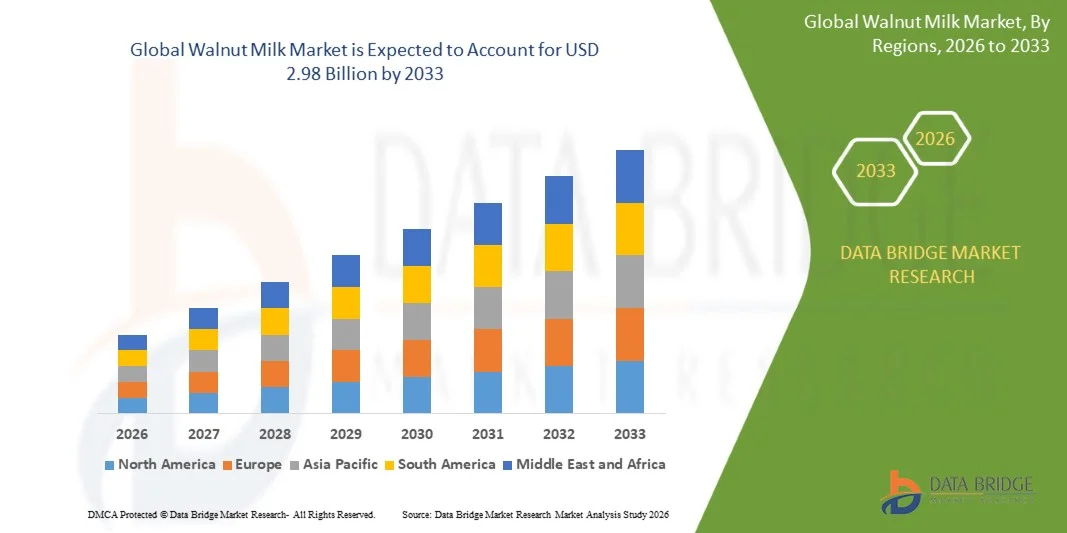
The Walnut Milk Market was valued at USD 1.72 Billion in 2025 and is projected to reach USD 2.98 Billion by 2033, growing at a CAGR of 7.15% from 2026 to 2033. The market is experiencing consistent growth driven by rising consumer preference for plant-based dairy alternatives, increasing lactose intolerance cases, and growing adoption of clean-label and functional beverages. Expanding retail penetration of nut-based milk products and continuous innovation in flavored and fortified walnut milk formulations are further supporting global market growth across developed and emerging economies.
The increasing global shift toward healthier lifestyles and sustainable food consumption, combined with rising awareness of plant-based nutrition, is significantly driving demand for walnut milk. Consumers are increasingly replacing conventional dairy with nutrient-rich alternatives that offer allergen-free, cholesterol-free, and eco-friendly benefits. In addition, growing investments by food and beverage companies in product diversification and e-commerce expansion are further accelerating market adoption worldwide.
Key Market Trends & Insights
- North America dominated the Walnut Milk Market with the largest revenue share of 36.6% in 2025, supported by high consumer awareness of plant-based nutrition, strong penetration of dairy alternatives, and well-established retail distribution networks
- The adult segment led the market with a 72% share in 2025, driven by higher consumption among health-conscious working populations and fitness-focused consumers
- Asia-Pacific is expected to be the fastest-growing region at a CAGR of 6.51% from 2026 to 2033, fueled by rising disposable incomes, expanding urbanization, and increasing adoption of Western dietary patterns
- Mixed walnut milk is the fastest-growing type, projected to register a CAGR of 14.5% from 2026 to 2033, supported by increasing innovation in blended plant-based formulations combining walnuts with almonds, oats, and other nuts
- The pure walnut milk segment dominated the category with a 58% revenue share in 2025, led by strong consumer demand for single-nut, minimally processed plant-based beverages
- Vanilla accounted for 34% of the market in 2025, preferred by strong consumer preference for mild taste profiles and high compatibility with coffee-based beverages and breakfast applications
- The unsweetened segment is the fastest-growing flavour category, with a CAGR of 13.2% from 2026 to 2033, driven by rising health consciousness and increasing demand for low-sugar plant-based alternatives
Market Size & Forecast
- Global Market Value (2025): USD 1.72 Billion
- Expected Market Value (2033): USD 2.98 Billion
- Forecast CAGR (2026–2033): 7.15%
- Leading Region in 2025: North America
- Fastest Growing Region: Asia-Pacific
Report Scope and Walnut Milk Market Segmentation
|
Attributes |
Walnut Milk Key Market Insights |
|
Segments Covered |
|
|
Countries Covered |
North America · U.S. · Canada · Mexico Europe · Germany · France · U.K. · Netherlands · Switzerland · Belgium · Russia · Italy · Spain · Turkey · Rest of Europe Asia-Pacific · China · Japan · India · South Korea · Singapore · Malaysia · Australia · Thailand · Indonesia · Philippines · Rest of Asia-Pacific Middle East and Africa · Saudi Arabia · U.A.E. · South Africa · Egypt · Israel · Rest of Middle East and Africa South America · Brazil · Argentina · Rest of South America |
|
Key Market Players |
· RITA Food & Drink Co., Ltd. (Vietnam) · Elmhurst Milked Direct LLC (U.S.) · YILI.COM INC. (China) · Mariani Nut Company (U.S.) · ADM (U.S.) · Royal Nut Company (U.S.) · Kanegrade (U.K.) · Blue Diamond Growers (U.S.) · Barry Callebaut (Switzerland) · Kashmir Walnut Group (India) · OLOMOMO Nut Company (U.S.) · Olam International (Singapore) · BORGES AGRICULTURAL & INDUSTRIAL NUTS, S.A (Spain) · Fruisec (France) · Lusha Ltd. (U.K.) · Terri Lynn (U.S.) · HBS Foods Ltd. (U.K.) · Poindexter Nut Company (U.S.) · GoldRiver Orchards, Inc. (U.S.) · California Walnuts (U.S.) · Sacramento Valley Walnut Growers LLC (U.S.) |
|
Market Opportunities |
· Fortified Walnut Milk Product Expansion · E-Commerce Growth in Plant-Based Beverages · Increasing Café and Foodservice Adoption |
|
Value Added Data Infosets |
In addition to the insights on market scenarios such as market value, growth rate, segmentation, geographical coverage, and major players, the market reports curated by the Data Bridge Market Research also include in-depth expert analysis, pricing analysis, brand share analysis, consumer survey, demography analysis, supply chain analysis, value chain analysis, raw material/consumables overview, vendor selection criteria, PESTLE Analysis, Porter Analysis, and regulatory framework. |
Walnut Milk Market Trends
Trend: Growing Demand for Clean-Label Plant-Based Beverages
The Walnut Milk Market is witnessing strong growth in clean-label and minimally processed plant-based beverages, driven by increasing consumer preference for dairy-free, additive-free, and nutrient-rich alternatives. Rising health awareness, lactose intolerance, and demand for functional nutrition are pushing manufacturers to develop walnut milk products with simple ingredient lists and no artificial additives. Retailers are also expanding plant-based dairy sections, supporting wider product visibility and adoption across urban markets.
Companies such as Elmhurst 1925 are reinforcing this trend through its “no gums, no oils” walnut milk formulations and Maple Walnut dairy-free latte line, which highlight clean-label positioning and functional beverage innovation in the plant-based segment.
Walnut Milk Market Dynamics
Key Market Driver: Rising Lactose Intolerance and Dairy-Free Adoption
The increasing prevalence of lactose intolerance and growing shift toward dairy-free diets are significantly driving demand for walnut milk globally. Consumers are actively replacing traditional dairy with plant-based alternatives that offer better digestibility, cholesterol-free nutrition, and perceived health benefits. Rising vegan and flexitarian population segments are further strengthening consumption across retail and foodservice channels.
Companies such as Blue Diamond Growers and ADM are expanding their plant-based beverage portfolios, supporting wider availability of nut-based milk alternatives, including walnut blends, across mainstream supermarkets and online platforms.
Key Restraint/Challenge: High Production Costs and Raw Material Constraints
A major challenge in the Walnut Milk market is the high cost of walnut sourcing, processing, and plant-based beverage manufacturing, which limits price competitiveness compared to almond and oat milk. Walnut cultivation is regionally concentrated, leading to supply fluctuations and cost volatility in raw material procurement. In addition, processing requirements for maintaining flavor stability and shelf life further increase production complexity and operational costs.
California Walnut Commission-backed supply chains in the U.S. highlight how dependency on limited geographic production zones creates pricing pressure and supply-side constraints for large-scale walnut milk commercialization.
Key Market Opportunity: Increasing Café and Foodservice Adoption
The growing inclusion of walnut milk in cafés, coffee chains, and foodservice menus is creating strong expansion opportunities for the market. Barista-style plant-based beverages are gaining traction as consumers increasingly prefer dairy alternatives in coffee, smoothies, and ready-to-drink applications. This shift is enabling walnut milk to move beyond retail into high-volume commercial beverage channels.
Companies such as Elmhurst 1925 and niche plant-based beverage brands are actively partnering with cafés and specialty coffee outlets to introduce walnut milk-based lattes and functional drinks, strengthening product visibility and consumer trial in foodservice environments.
Walnut Milk Market Scope
The walnut milk market is segmented on the basis of flavour, type, downstream fields, and distribution channel.
- By Flavour
On the basis of flavour, the Walnut Milk Market is segmented into chocolate, vanilla, unsweetened, original, and others. The Vanilla segment dominated the market with the largest share of 34% in 2025, driven by strong consumer preference for mild taste profiles and high compatibility with coffee-based beverages and breakfast applications. Its widespread acceptance across both developed and emerging markets supports consistent demand in retail and foodservice channels. Manufacturers increasingly position vanilla variants as a standard entry product for new plant-based milk consumers. The segment benefits from strong product availability and continuous formulation improvements enhancing texture and taste stability.
The Unsweetened segment is projected to register the fastest growth at a CAGR of 13.2% from 2026 to 2033, driven by rising health consciousness and increasing demand for low-sugar plant-based alternatives. Consumers are shifting toward clean-label beverages with minimal additives, which strengthens adoption of unsweetened walnut milk across fitness-oriented and diabetic-friendly diets. Growing awareness of metabolic health and calorie control is further accelerating consumption in urban populations. Food brands are expanding unsweetened portfolios to align with functional nutrition trends. Regulatory focus on sugar reduction in packaged foods also supports sustained segment expansion.
- By Type
On the basis of type, the Walnut Milk Market is segmented into pure walnut milk and mixed walnut milk. The Pure Walnut Milk segment dominated the market with a share of 58% in 2025, supported by strong consumer demand for single-nut, minimally processed plant-based beverages. Its perceived purity, allergen-friendly positioning, and clean-label appeal contribute to widespread adoption across premium retail categories. Producers emphasize natural extraction methods and nutrient retention to strengthen product positioning. Expanding availability in supermarkets and health-focused outlets further reinforces its market leadership.
The Mixed Walnut Milk segment is projected to register the fastest growth at a CAGR of 14.5% from 2026 to 2033, driven by increasing innovation in blended plant-based formulations combining walnuts with almonds, oats, and other nuts. These blends enhance taste balance, nutritional density, and affordability, making them attractive to mainstream consumers. Rising demand for diversified flavor experiences is accelerating product experimentation among manufacturers. Strong adoption in café chains and ready-to-drink formats further supports segment expansion. Continuous product innovation and cross-category positioning strengthen long-term growth momentum.
- By Downstream Fields
On the basis of downstream fields, the Walnut Milk Market is segmented into adult and children. The Adult segment dominated the market with a share of 72% in 2025, driven by higher consumption among health-conscious working populations and fitness-focused consumers. Increasing preference for dairy alternatives in daily diets supports strong penetration in morning beverages, smoothies, and functional nutrition applications. Busy urban lifestyles and rising lactose intolerance further reinforce adoption among adults. Brands continue to target this group through premium and fortified product offerings. The segment remains central to overall market revenue contribution.
The Children segment is projected to register the fastest growth at a CAGR of 12.8% from 2026 to 2033, driven by growing parental preference for plant-based and allergen-friendly nutrition options. Rising concerns regarding dairy sensitivities and digestive health are encouraging substitution with fortified walnut milk products. Manufacturers are introducing child-friendly formulations with added vitamins and minerals to support growth and immunity. Expanding school nutrition awareness programs also contribute to increased acceptance. Continuous product development tailored to taste and nutrition needs supports sustained expansion.
- By Distribution Channel
On the basis of distribution channel, the Walnut Milk Market is segmented into supermarkets/hypermarkets, convenience stores, and online stores. The Supermarkets/Hypermarkets segment dominated the market with a share of 46% in 2025, driven by strong product visibility, wide assortment availability, and consumer preference for physical product evaluation before purchase. These outlets provide extensive shelf space for plant-based beverage categories, supporting brand competition and promotional activities. Strategic placement in health and organic sections enhances consumer accessibility. Established retail networks across urban centers further strengthen segment leadership.
The Online Stores segment is projected to register the fastest growth at a CAGR of 15% from 2026 to 2033, driven by rapid expansion of e-commerce platforms and increasing consumer shift toward doorstep delivery. Digital channels enable wider product variety, subscription models, and targeted promotions for plant-based beverages. Rising smartphone penetration and improved logistics infrastructure further accelerate online purchasing behavior. Direct-to-consumer brands are leveraging digital platforms to strengthen brand engagement and retention. Continuous growth in online grocery ecosystems supports long-term segment expansion.
Walnut Milk Market Regional Analysis
North America dominated the walnut milk market and accounted for the largest revenue share of 36.6% in 2025, driven by high consumer awareness of plant-based nutrition, strong penetration of dairy alternatives, and well-established retail distribution networks. The region benefits from a mature health and wellness food ecosystem, where consumers actively prefer clean-label, lactose-free, and functional beverages. Rising adoption of vegan and flexitarian diets is further strengthening demand across supermarkets, cafés, and online grocery platforms. In addition, strong presence of leading plant-based beverage manufacturers and continuous product innovation continues to reinforce North America’s leadership in the global market.
U.S. Walnut Milk Market Insight
The U.S. Walnut Milk market is witnessing strong growth driven by increasing demand for dairy-free alternatives, rising lactose intolerance, and expanding vegan population. Consumers are increasingly shifting toward nutrient-rich plant-based beverages, particularly in urban centers where health-conscious lifestyles are more prominent. Strong innovation in flavored and fortified walnut milk products is further supporting market penetration across retail and foodservice channels. In addition, widespread availability across mainstream supermarkets and rapid growth of e-commerce grocery platforms are accelerating adoption across the country.
Canada Walnut Milk Market Insight
The Canada Walnut Milk market is experiencing steady growth supported by rising awareness of plant-based diets and increasing demand for allergen-friendly dairy substitutes. Consumers are showing strong preference for clean-label and organic beverages, which is boosting walnut milk adoption in premium retail segments. Growing penetration of health-focused grocery chains and online delivery platforms is further improving product accessibility. In addition, increasing investments in sustainable food production and functional beverage innovation are contributing to market expansion in Canada.
Europe Walnut Milk Market Insight
The Europe Walnut Milk market is expanding steadily due to strong consumer inclination toward plant-based diets, sustainability-driven food choices, and rising lactose intolerance. Regulatory support for clean-label and low-sugar food products is further encouraging adoption of walnut-based dairy alternatives. Retailers across major economies are expanding plant-based beverage offerings to meet growing demand from health-conscious consumers. In addition, increasing innovation in fortified and blended nut milk formulations continues to support regional market growth.
U.K. Walnut Milk Market Insight
The U.K. Walnut Milk market is growing steadily, driven by increasing vegan population, high demand for dairy alternatives, and strong retail penetration of plant-based beverages. Consumers are increasingly adopting walnut milk as a functional beverage for breakfast and coffee-based applications. Expansion of premium grocery chains and strong online grocery adoption are further supporting market accessibility. In addition, rising focus on sustainable food consumption and clean-label nutrition is strengthening market expansion in the U.K.
Germany Walnut Milk Market Insight
The Germany Walnut Milk market is expanding due to strong consumer preference for organic and natural food products, coupled with rising awareness of plant-based nutrition benefits. Demand is increasing across retail and specialty health stores where consumers prioritize quality and nutritional value. The country’s strong sustainability culture is encouraging substitution of dairy with plant-based alternatives such as walnut milk. In addition, growing innovation in fortified and protein-enriched formulations is supporting long-term market development in Germany.
Asia-Pacific Walnut Milk Market Insight
The Asia-Pacific Walnut Milk market is projected to register the fastest growth with a CAGR of 6.51% from 2026 to 2033, driven by rising disposable incomes, expanding urbanization, and increasing adoption of Western dietary patterns. Growing awareness of lactose intolerance and rising demand for plant-based nutrition are significantly boosting product acceptance. Countries such as China, India, Japan, and South Korea are witnessing rapid expansion of health-focused beverage categories supported by e-commerce growth and modern retail penetration. In addition, increasing investments in functional and fortified plant-based beverages are accelerating regional market expansion.
Japan Walnut Milk Market Insight
The Japan Walnut Milk market is witnessing steady growth supported by high health consciousness, aging population, and strong preference for functional beverages. Consumers are increasingly adopting plant-based milk alternatives for digestive health and nutritional balance. The country’s advanced retail ecosystem and strong presence of convenience stores are enhancing product accessibility. In addition, rising innovation in premium and fortified plant-based beverages is further supporting market growth in Japan.
China Walnut Milk Market Insight
The China Walnut Milk market is growing rapidly due to expanding middle-class population, strong e-commerce penetration, and rising demand for health-oriented beverages. Consumers are increasingly shifting toward plant-based dairy alternatives driven by wellness trends and lactose intolerance awareness. Major domestic food and beverage companies are actively expanding product portfolios to include walnut milk in flavored and fortified formats. In addition, strong digital retail ecosystems and aggressive online marketing strategies are accelerating market adoption across urban and semi-urban regions.
Walnut Milk Market Share
The walnut milk industry is primarily led by well-established companies, including:
- RITA Food & Drink Co., Ltd. (Vietnam)
- Elmhurst Milked Direct LLC (U.S.)
- COM INC. (China)
- Mariani Nut Company (U.S.)
- ADM (U.S.)
- Royal Nut Company (U.S.)
- Kanegrade (U.K.)
- Blue Diamond Growers (U.S.)
- Barry Callebaut (Switzerland)
- Kashmir Walnut Group (India)
- OLOMOMO Nut Company (U.S.)
- Olam International (Singapore)
- BORGES AGRICULTURAL & INDUSTRIAL NUTS, S.A (Spain)
- Fruisec (France)
- Lusha Ltd. (U.K.)
- Terri Lynn (U.S.)
- HBS Foods Ltd. (U.K.)
- Poindexter Nut Company (U.S.)
- GoldRiver Orchards, Inc. (U.S.)
- California Walnuts (U.S.)
- Sacramento Valley Walnut Growers LLC (U.S.)
Latest Developments in Walnut Milk Market
- In September 2024, Blue Diamond Growers expanded its plant-based beverage portfolio by introducing a blended Almond & Walnut Milk variant in select U.S. retail chains, aiming to diversify its non-dairy offerings beyond almond-only formulations. The product was designed to combine the creamy texture of almonds with the nutrient density of walnuts, targeting consumers seeking enhanced taste and functional benefits in plant-based milk. This strategic launch strengthened the company’s competitiveness in the rapidly growing alternative dairy segment and supported increased shelf penetration across premium grocery stores. The move also reflected rising industry focus on hybrid nut-based formulations to attract broader consumer adoption of plant milk alternatives
- In August 2024, Hebei Yangyuan Zhihui Beverage Co., Ltd., a leading player in the walnut beverage market, advanced its strategic diversification by expanding into a broader plant protein drink portfolio. The company integrated a dedicated plant milk series alongside its established walnut beverage products, strengthening its position in the rapidly evolving plant-based beverage segment. This expansion was driven by rising consumer demand for varied and health-focused dairy alternatives in China, enabling the company to reduce product concentration risk while capturing new demand pockets. The firm reported revenue of 2.942 billion yuan in H1 2024, reflecting stable performance and successful market acceptance of its broadened product strategy
- In July 2024, The Australian Walnut Company strengthened its footprint in the plant-based dairy space with the launch of Vitality Walnut Milk in Melbourne, expanding availability across independent grocers, health food stores, and IGA supermarkets. The product, made from 100% Australian walnuts, was positioned as a clean-label, shelf-stable beverage free from lactose, gluten, soy, and cholesterol, directly targeting growing demand for allergen-free nutrition. This launch reinforced the company’s sustainability-driven branding while improving accessibility of walnut milk in mainstream retail channels. The move contributed to increased consumer awareness of locally produced plant-based milk alternatives in Australia
- In March 2024, Elmhurst 1925 expanded its functional beverage portfolio by introducing a new line of dairy-free Multi-Serve Lattes, including a Maple Walnut variant. The product combined walnut milk with cold brew coffee and natural maple syrup, targeting consumers seeking convenient, café-style beverages at home. This development strengthened the company’s position in the premium ready-to-drink segment by addressing demand for clean-label and lower-sugar functional drinks. The innovation also enhanced category penetration by merging plant-based nutrition with mainstream coffee consumption trends
- In February 2024, PLANTSTRONG expanded its presence in the plant-based milk market through the national rollout of its shelf-stable Oat & Walnut blend across Whole Foods Market locations in the U.S. The product was positioned as a clean-label alternative free from gums, oils, and phosphates, aligning with growing consumer demand for minimally processed nutrition. Fortification with calcium and Vitamin D3 further enhanced its appeal among health-conscious consumers seeking functional dairy substitutes. This expansion strengthened the brand’s visibility in the competitive alternative milk category and supported broader adoption of walnut-based beverages in mainstream retail

- Interactive Data Analysis Dashboard
- Company Analysis Dashboard for high growth potential opportunities
- Research Analyst Access for customization & queries
- Competitor Analysis with Interactive dashboard
- Latest News, Updates & Trend analysis
- Harness the Power of Benchmark Analysis for Comprehensive Competitor Tracking
Global Walnut Milk Market, Supply Chain Analysis and Ecosystem Framework
To support market growth and help clients navigate the impact of geopolitical shifts, DBMR has integrated in-depth supply chain analysis into its Global Walnut Milk Market research reports. This addition empowers clients to respond effectively to global changes affecting their industries. The supply chain analysis section includes detailed insights such as Global Walnut Milk Market consumption and production by country, price trend analysis, the impact of tariffs and geopolitical developments, and import and export trends by country and HSN code. It also highlights major suppliers with data on production capacity and company profiles, as well as key importers and exporters. In addition to research, DBMR offers specialized supply chain consulting services backed by over a decade of experience, providing solutions like supplier discovery, supplier risk assessment, price trend analysis, impact evaluation of inflation and trade route changes, and comprehensive market trend analysis.
Data collection and base year analysis are done using data collection modules with large sample sizes. The stage includes obtaining market information or related data through various sources and strategies. It includes examining and planning all the data acquired from the past in advance. It likewise envelops the examination of information inconsistencies seen across different information sources. The market data is analysed and estimated using market statistical and coherent models. Also, market share analysis and key trend analysis are the major success factors in the market report. To know more, please request an analyst call or drop down your inquiry.
The key research methodology used by DBMR research team is data triangulation which involves data mining, analysis of the impact of data variables on the market and primary (industry expert) validation. Data models include Vendor Positioning Grid, Market Time Line Analysis, Market Overview and Guide, Company Positioning Grid, Patent Analysis, Pricing Analysis, Company Market Share Analysis, Standards of Measurement, Global versus Regional and Vendor Share Analysis. To know more about the research methodology, drop in an inquiry to speak to our industry experts.
Data Bridge Market Research is a leader in advanced formative research. We take pride in servicing our existing and new customers with data and analysis that match and suits their goal. The report can be customized to include price trend analysis of target brands understanding the market for additional countries (ask for the list of countries), clinical trial results data, literature review, refurbished market and product base analysis. Market analysis of target competitors can be analyzed from technology-based analysis to market portfolio strategies. We can add as many competitors that you require data about in the format and data style you are looking for. Our team of analysts can also provide you data in crude raw excel files pivot tables (Fact book) or can assist you in creating presentations from the data sets available in the report.













