What is the Washing Appliances Market Size and Overview?
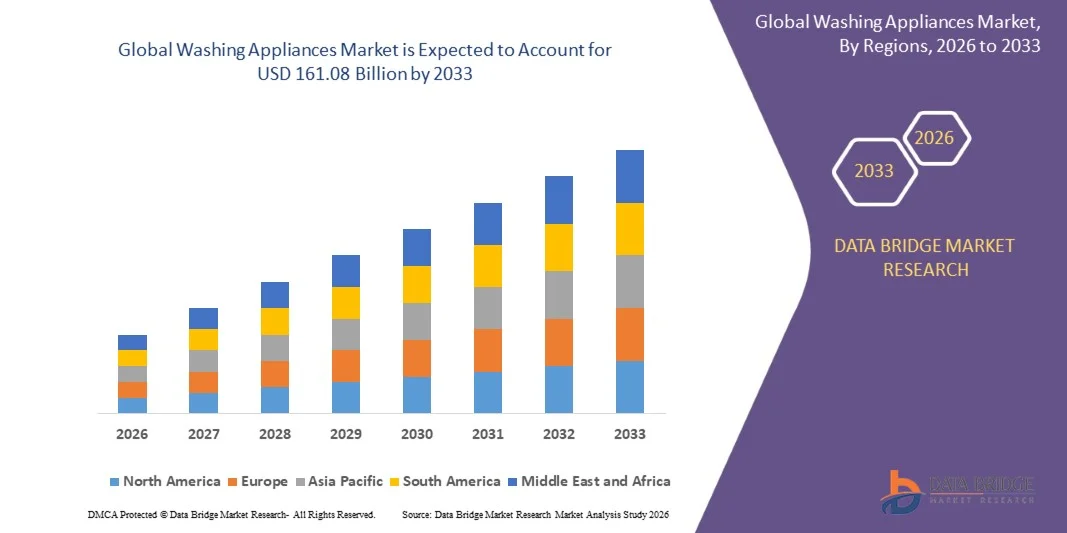
As per Data Bridge Market Research Analysis the Washing Appliances Market was valued at USD billion in 2025 and is projected to reach USD 161.08 Billion by 2033, growing at a CAGR of 11% from 2026 to 2033. The market is experiencing consistent growth driven by rising urbanization, increasing disposable income, and growing demand for energy-efficient and smart home laundry solutions. Rapid adoption of fully automatic washing machines, expansion of e-commerce distribution channels, and continuous product innovation in AI-enabled and IoT-integrated appliances are further supporting market growth across global regions.
The increasing consumer shift toward convenience-driven lifestyles, combined with growing awareness of water and energy conservation, is accelerating demand for advanced washing appliances. Manufacturers are increasingly focusing on smart connectivity, sustainability, and compact designs to cater to urban households and space-constrained living environments, further strengthening long-term market expansion.
Key Market Trends & Insights
- Asia-Pacific dominated the Washing Appliances Market with the largest revenue share of 48% in 2025, supported by rapid urbanization, rising household appliance penetration, and strong demand for automated laundry solutions across densely populated economies
- The residential segment led the market with a 78.4% share in 2025, driven by high household penetration of washing machines across urban and semi-urban regions
- North America is expected to be the fastest-growing region at a CAGR of 9.6% from 2026 to 2033, fueled by strong adoption of smart home technologies, rising demand for high-capacity washing systems, and increasing preference for energy-efficient appliances
- Via e-commerce is the fastest-growing sales channel type, projected to register a CAGR of 14.3% from 2026 to 2033, supported by increasing digital adoption and expanding online retail infrastructure
- The front load fully automatic washing machine segment dominated the type category with a 38.5% revenue share in 2025, led by rising consumer preference for energy efficiency and superior wash quality
- Through retail chains accounted for 46.2% of the market in 2025, preferred by strong consumer reliance on in-store product experience and brand-assisted purchasing
- The commercial segment is the fastest-growing application category, with a CAGR of 10.6% from 2026 to 2033, driven by increasing demand from hotels, hospitals, laundromats, and institutional facilities
Market Size & Forecast
- Global Market Value (2025): USD 69.90 Billion
- Expected Market Value (2033): USD 161.08 Billion
- Forecast CAGR (2026–2033): 11%
- Leading Region in 2025: Asia-Pacific
- Fastest Growing Region: North America
Report Scope and Washing Appliances Market Segmentation
|
Attributes |
Washing Appliances Key Market Insights |
|
Segments Covered |
|
|
Countries Covered |
North America · U.S. · Canada · Mexico Europe · Germany · France · U.K. · Netherlands · Switzerland · Belgium · Russia · Italy · Spain · Turkey · Rest of Europe Asia-Pacific · China · Japan · India · South Korea · Singapore · Malaysia · Australia · Thailand · Indonesia · Philippines · Rest of Asia-Pacific Middle East and Africa · Saudi Arabia · U.A.E. · South Africa · Egypt · Israel · Rest of Middle East and Africa South America · Brazil · Argentina · Rest of South America |
|
Key Market Players |
· Whirlpool Corporation (U.S.) · LG Electronics (South Korea) · IFB Industries Limited (India) · Samsung Electronics (South Korea) · MIRC Electronics Limited (India) · AB Electrolux (Sweden) · Panasonic India (India) · Haier Inc. (China) · Videocon Group (India) · BSH Hausgeräte GmbH (Germany) · Alliance Laundry Systems LLC (U.S.) · Girbau, S.A. (Spain) · Godrej (India) · Toshiba Lifestyle Products & Services Corporation (Japan) |
|
Market Opportunities |
· Expansion of Smart Home Ecosystems and Connected Appliance Integration · Growth in Urban Housing and Rising Penetration of Automated Laundry Systems · Increasing Demand from Commercial Laundry and Hospitality Sectors |
|
Value Added Data Infosets |
In addition to the insights on market scenarios such as market value, growth rate, segmentation, geographical coverage, and major players, the market reports curated by the Data Bridge Market Research also include in-depth expert analysis, pricing analysis, brand share analysis, consumer survey, demography analysis, supply chain analysis, value chain analysis, raw material/consumables overview, vendor selection criteria, PESTLE Analysis, Porter Analysis, and regulatory framework. |
What is the Key Trend in the Washing Appliances Market?
Trend: Increasing Adoption of Smart and IoT-Enabled Washing Appliances
The washing appliances market is witnessing a strong shift toward smart, connected, and IoT-enabled washing machines that enhance user convenience, automation, and energy optimization. Consumers are increasingly adopting AI-based wash programs, remote monitoring, and app-controlled appliances integrated into smart home ecosystems. Leading manufacturers are embedding sensors for load detection, fabric care optimization, and predictive maintenance to improve efficiency and user experience.
Companies such as Samsung Electronics have expanded SmartThings ecosystem integration, enabling washing machines to connect with other smart home devices for real-time monitoring and energy management, strengthening the shift toward fully connected laundry solutions.
Washing Appliances Market Dynamics
Key Market Driver: Rising Demand for Energy-Efficient and Water-Saving Laundry Solutions
The increasing global focus on sustainability and utility cost reduction is significantly driving demand for energy-efficient and water-saving washing appliances. Consumers are shifting toward inverter-based motors, high-efficiency front-load machines, and eco-wash technologies that reduce electricity and water consumption. Governments in regions such as Europe and Asia-Pacific are also enforcing stricter energy labeling standards, accelerating replacement cycles of older appliances.
Companies such as LG Electronics and Whirlpool Corporation are actively launching energy-efficient washing machines with AI-based wash optimization and heat pump drying technologies, helping reduce operational consumption while improving wash performance and sustainability compliance.
Key Restraint/Challenge: High Cost Sensitivity and Intense Price-Based Competition
A major challenge in the washing appliances market is strong price sensitivity, particularly in emerging economies where consumers prioritize affordability over advanced features. Intense competition among global and regional players is leading to aggressive pricing strategies, limiting margins for manufacturers. In addition, fluctuating raw material costs and supply chain pressures further increase production challenges, especially for premium smart appliances.
Brands such as Haier Inc. and IFB Industries Limited face strong competition in mid-range segments, where balancing affordability with advanced features remains a key challenge in maintaining market share across price-sensitive regions.
Key Market Opportunity: Expansion of Smart Home Ecosystems and Connected Appliance Integration
The rapid expansion of smart home ecosystems is creating significant growth opportunities for connected washing appliances integrated with IoT platforms and voice-assisted technologies. Consumers are increasingly preferring appliances that can be controlled through unified smart home systems, improving convenience and energy management. Integration with platforms such as Google Home, Amazon Alexa, and proprietary ecosystems is strengthening product adoption in premium segments.
Companies such as BSH Hausgeräte GmbH and Samsung Electronics are actively expanding connected appliance portfolios, enabling seamless interoperability across smart home devices and driving long-term adoption of ecosystem-based washing solutions in global markets.
How is the Washing Appliances Market Segmented?
The washing appliances market is segmented on the basis of type, sales channel, and application.
- By Type
On the basis of type, the Washing Appliances Market is segmented into Top Load Fully Automatic Washing Machine, Top Load Semi-Automatic Washing Machine, Front Load Fully Automatic Washing Machine, Dryers, and Others. The Front Load Fully Automatic Washing Machine segment dominated the market with a share of 38.5% in 2025, driven by rising consumer preference for energy efficiency and superior wash quality. These machines offer lower water consumption and advanced fabric care, making them highly suitable for urban households. Growing adoption in premium residential spaces and smart home ecosystems further strengthens segment leadership. Expanding product innovation with AI-based wash cycles and inverter technology continues to reinforce demand across developed and emerging markets.
The Dryers segment is projected to register the fastest growth at a CAGR of 9.8% from 2026 to 2033, supported by increasing demand for time-saving laundry solutions. Rising urban lifestyles and shrinking living spaces are accelerating adoption of compact and integrated laundry systems. Growing penetration of laundromats and shared residential facilities is further boosting usage of dryers. Technological improvements in heat pump efficiency and smart drying controls are enhancing energy optimization. Increasing preference for convenience-driven appliances continues to drive strong expansion of this segment globally.
- By Sales Channel
On the basis of sales channel, the Washing Appliances Market is segmented into Direct Selling, Through Retail Chains, and Via E-Commerce. The Through Retail Chains segment dominated the market with a share of 46.2% in 2025, driven by strong consumer reliance on in-store product experience and brand-assisted purchasing. Retail outlets provide hands-on demonstration, installation support, and financing options that improve buyer confidence. Established distribution networks of major appliance brands further strengthen offline dominance. High penetration of multi-brand electronics stores across urban and semi-urban regions continues to support sustained sales volume.
The Via E-Commerce segment is projected to register the fastest growth at a CAGR of 14.3% from 2026 to 2033, driven by increasing digital adoption and expanding online retail infrastructure. Consumers are increasingly preferring doorstep delivery, discounted pricing, and easy comparison of multiple models. Rapid expansion of quick commerce and improved logistics networks is enhancing product accessibility in tier-2 and tier-3 cities. Integration of virtual product visualization tools and customer reviews is further improving purchase confidence. Growing smartphone penetration continues to accelerate online appliance sales across global markets.
- By Application
On the basis of application, the Washing Appliances Market is segmented into Residential and Commercial. The Residential segment dominated the market with a share of 78.4% in 2025, driven by high household penetration of washing machines across urban and semi-urban regions. Rising disposable income and increasing demand for automated home solutions are strengthening adoption. Continuous product upgrades focusing on energy efficiency and smart connectivity are further enhancing household replacement cycles. Expanding nuclear families and urban housing developments continue to support sustained residential demand globally.
The Commercial segment is projected to register the fastest growth at a CAGR of 10.6% from 2026 to 2033, driven by increasing demand from hotels, hospitals, laundromats, and institutional facilities. Growing outsourcing of laundry services in urban centers is significantly boosting commercial appliance adoption. Rising hygiene standards and operational efficiency requirements are further supporting large-scale installations. Advancements in high-capacity, durable washing systems are improving operational performance for commercial users. Expanding hospitality and healthcare infrastructure continues to accelerate segment growth worldwide.
Which Region Holds the Largest Share of the Washing Appliances Market?
Asia-Pacific dominated the washing appliances market and accounted for the largest revenue share of 48% in 2025, supported by rapid urbanization, rising household appliance penetration, and strong demand for automated laundry solutions across densely populated economies. The region benefits from large-scale manufacturing bases, cost-efficient production, and expanding middle-class income levels driving appliance adoption. Increasing smart home penetration, growing residential construction activities, and rising preference for energy-efficient washing machines are accelerating regional market expansion. Strong presence of leading consumer electronics manufacturers and continuous product innovation further reinforce Asia-Pacific’s leadership position.
China Washing Appliances Market Insight
China held the largest share in the Asia-Pacific Washing Appliances market in 2025, driven by its strong domestic manufacturing ecosystem and high production capacity for both export and local consumption. The country benefits from advanced industrial infrastructure and large-scale appliance brands that support continuous product innovation and affordability. Rising urban household demand for smart, inverter-based, and water-efficient washing machines is further strengthening market growth. In addition, strong e-commerce penetration and organized retail expansion are improving product accessibility across tier-2 and tier-3 cities, reinforcing China’s dominance in the regional market.
India Washing Appliances Market Insight
India is witnessing the fastest growth in the Asia-Pacific region, projected at a CAGR of 12.4% from 2026 to 2033, driven by rising disposable income, rapid urbanization, and increasing adoption of semi-automatic and fully automatic washing machines. Growing nuclear families and expanding residential housing projects are significantly boosting appliance penetration. Demand is further supported by increasing awareness of hygiene, convenience-driven lifestyles, and improved access to financing options for durable goods. In addition, expanding e-commerce platforms and aggressive brand marketing strategies are accelerating long-term market expansion across urban and semi-urban regions.
Europe Washing Appliances Market Insight
The Europe Washing Appliances market is expanding steadily, supported by strong demand for energy-efficient, compact, and technologically advanced washing systems. Consumers across the region are increasingly shifting toward sustainable appliances that reduce water and electricity consumption, aligning with strict environmental regulations. High replacement rates of aging appliances and strong demand from apartment-based urban living are further driving market growth. In addition, increasing adoption of smart washing machines integrated with IoT-enabled features is enhancing convenience and operational efficiency across residential users.
Germany Washing Appliances Market Insight
Germany accounted for the largest share in the Europe Washing Appliances market in 2025, driven by strong demand for premium, energy-efficient, and technologically advanced washing appliances. The country has a well-established consumer electronics industry with high adoption of smart home-enabled washing machines. Rising consumer preference for sustainability, low-energy consumption appliances, and long product lifecycle durability is further strengthening market demand. In addition, strong retail distribution networks and high purchasing power are reinforcing Germany’s leadership position in the regional market.
U.K. Washing Appliances Market Insight
The U.K. market is supported by increasing demand for compact, smart, and energy-efficient washing appliances across urban households. Rising consumer focus on sustainability and utility cost reduction is driving adoption of high-efficiency front-load washing machines. Growing penetration of rental housing and smaller living spaces is further boosting demand for space-saving appliance designs. In addition, expanding online retail channels and promotional financing options are enhancing accessibility and accelerating market growth across residential users.
North America Washing Appliances Market Insight
North America is projected to grow at the fastest CAGR of 9.6% from 2026 to 2033, driven by strong adoption of smart home technologies, rising demand for high-capacity washing systems, and increasing preference for energy-efficient appliances. Consumers in the region are increasingly investing in advanced washing machines with AI-based wash cycles and remote monitoring features. Strong residential replacement demand and high disposable income levels are further supporting market expansion. In addition, growing emphasis on sustainability and water conservation is accelerating adoption of next-generation washing appliances.
U.S. Washing Appliances Market Insight
The U.S. accounted for the largest share in the North America Washing Appliances market in 2025, supported by strong demand from high-income households and widespread adoption of smart, connected washing machines. The country benefits from a well-developed retail and e-commerce ecosystem that enables easy access to premium appliance brands. Increasing focus on energy-efficient home appliances and smart home integration is further strengthening market growth. In addition, frequent product upgrades and high replacement cycles are reinforcing the U.S. leadership position in the regional market.
Which are the Top Companies in Washing Appliances Market?
The washing appliances industry is primarily led by well-established companies, including:
- Whirlpool Corporation (U.S.)
- LG Electronics (South Korea)
- IFB Industries Limited (India)
- Samsung Electronics (South Korea)
- MIRC Electronics Limited (India)
- AB Electrolux (Sweden)
- Panasonic India (India)
- Haier Inc. (China)
- Videocon Group (India)
- BSH Hausgeräte GmbH (Germany)
- Alliance Laundry Systems LLC (U.S.)
- Girbau, S.A. (Spain)
- Godrej (India)
- Toshiba Lifestyle Products & Services Corporation (Japan)
What are Latest Developments in Washing Appliances Market?
- In January 2024, Samsung Electronics expanded its washing appliance portfolio with the introduction of the Bespoke AI Laundry Combo at CES 2024, integrating washer and dryer functionality with AI-driven wash optimization. This development strengthened the premium smart laundry segment by accelerating demand for space-saving, energy-efficient, all-in-one appliances. It also reinforced Samsung’s market position in connected home ecosystems, pushing competitors toward higher automation and AI integration in laundry systems
- In January 2024, LG Electronics launched its WashCombo all-in-one heat pump washer-dryer at CES 2024, focusing on energy efficiency and advanced fabric care using AI-based sensing technology. The launch impacted the market by intensifying competition in the premium washer-dryer category and accelerating adoption of heat pump-based laundry systems. It further supported the industry shift toward sustainable appliances with reduced water and electricity consumption
- In January 2024, Whirlpool Corporation introduced upgraded AI-enabled smart washing machine solutions at CES 2024, enhancing load detection, fabric care precision, and connected home functionality. This development strengthened Whirlpool’s competitiveness in the smart appliance segment and contributed to rising consumer expectations for intelligent laundry automation. It also supported broader market movement toward IoT-enabled washing appliances across developed economies
- In January 2024, Bosch Home Appliances showcased its advanced Serie 8 washing machine innovations at CES 2024, highlighting improved energy efficiency systems and automated wash optimization features. The development reinforced Bosch’s focus on sustainability-led innovation and strengthened demand for premium European washing appliances. It also increased competitive pressure in the high-efficiency washing machine segment, especially in urban residential markets
- In January 2024, Samsung Electronics enhanced its SmartThings ecosystem at CES 2024 by expanding Matter-enabled connectivity for washing appliances, improving interoperability across smart home devices. This development significantly impacted the market by accelerating the convergence of laundry appliances with integrated smart home platforms. It also increased consumer adoption of fully connected washing systems, strengthening demand for ecosystem-based appliance purchasing decisions

- Interactive Data Analysis Dashboard
- Company Analysis Dashboard for high growth potential opportunities
- Research Analyst Access for customization & queries
- Competitor Analysis with Interactive dashboard
- Latest News, Updates & Trend analysis
- Harness the Power of Benchmark Analysis for Comprehensive Competitor Tracking
Data collection and base year analysis are done using data collection modules with large sample sizes. The stage includes obtaining market information or related data through various sources and strategies. It includes examining and planning all the data acquired from the past in advance. It likewise envelops the examination of information inconsistencies seen across different information sources. The market data is analysed and estimated using market statistical and coherent models. Also, market share analysis and key trend analysis are the major success factors in the market report. To know more, please request an analyst call or drop down your inquiry.
The key research methodology used by DBMR research team is data triangulation which involves data mining, analysis of the impact of data variables on the market and primary (industry expert) validation. Data models include Vendor Positioning Grid, Market Time Line Analysis, Market Overview and Guide, Company Positioning Grid, Patent Analysis, Pricing Analysis, Company Market Share Analysis, Standards of Measurement, Global versus Regional and Vendor Share Analysis. To know more about the research methodology, drop in an inquiry to speak to our industry experts.
Data Bridge Market Research is a leader in advanced formative research. We take pride in servicing our existing and new customers with data and analysis that match and suits their goal. The report can be customized to include price trend analysis of target brands understanding the market for additional countries (ask for the list of countries), clinical trial results data, literature review, refurbished market and product base analysis. Market analysis of target competitors can be analyzed from technology-based analysis to market portfolio strategies. We can add as many competitors that you require data about in the format and data style you are looking for. Our team of analysts can also provide you data in crude raw excel files pivot tables (Fact book) or can assist you in creating presentations from the data sets available in the report.