


Waste Paper Management Market Overview
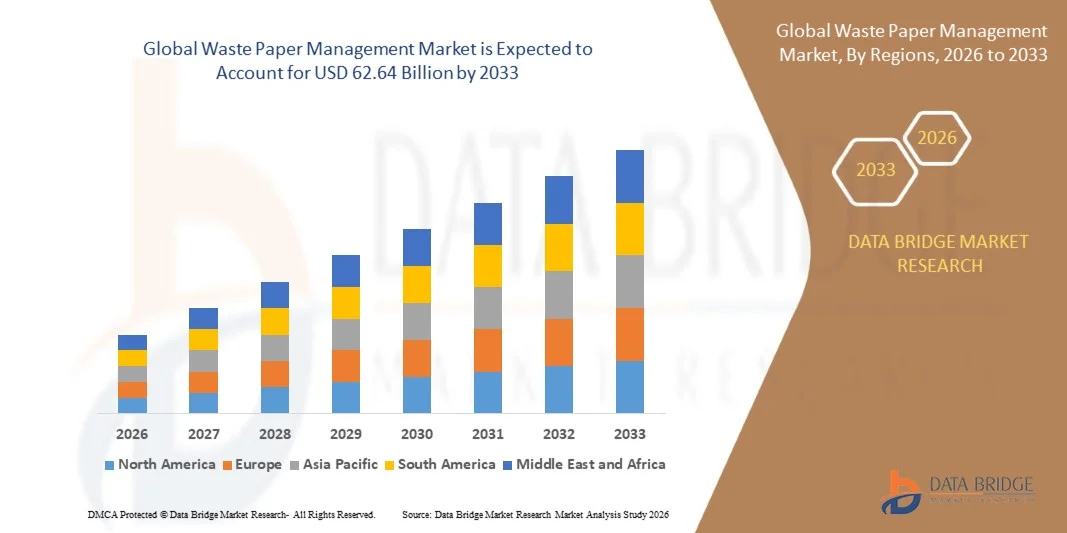
As per Data Bridge Market Research analysis the global waste paper management market was valued at USD 48.69 billion in 2025 and is projected to reach USD 62.64 billion by 2033, growing at a CAGR of 3.20% from 2026 to 2033. The waste paper management market is experiencing steady growth driven by increasing paper recycling initiatives, rising demand for sustainable raw materials, and stringent government regulations promoting circular economy practices. Growing consumption of paper and paperboard across packaging, printing, and tissue industries, coupled with increasing awareness regarding landfill reduction and resource conservation, is accelerating investments in efficient waste paper collection, sorting, and recycling infrastructure.
The increasing generation of post-consumer and post-industrial paper waste, combined with stringent environmental regulations on waste disposal and rising corporate sustainability commitments, is compelling municipalities, recycling companies, and paper manufacturers to adopt advanced waste paper management solutions. Automated sorting systems, AI-enabled material recovery technologies, and high-efficiency recycling processes are replacing conventional manual waste handling methods, enabling higher recovery rates, improved fiber quality, and lower operational costs. Furthermore, the growing demand for recycled paper in packaging, tissue products, newsprint, and containerboard manufacturing, along with expanding investments in smart recycling facilities and waste collection infrastructure, continues to drive the growth of the waste paper management market.
Market Size & Forecast
- Market Value (2025): USD 48.69 Billion
- Expected Market Value (2033): USD 62.64 Billion
- Forecast CAGR (2026–2033): 3.20%
- Leading Region in 2025: North America
- Fastest Growing Region: Asia-Pacific
Key Market Trends & Insights
- North America dominated the global waste paper management market with an estimated revenue share of 38.74% in 2025, supported by well-established paper collection and recycling infrastructure, high recovery rates, strong demand for recycled fiber across the packaging and paper industries, favorable government recycling initiatives, and increasing investments in sustainable waste management and circular economy practices.
- The recycle segment dominated the market with an estimated 47.54% share in 2025 owing to the widespread adoption of paper recycling programs across residential, commercial, and industrial sectors.
- Asia-Pacific is expected to be the fastest-growing region at an estimated CAGR of 6.48% from 2026 to 2033, fueled by rapid urbanization, expanding e-commerce and packaging industries, increasing paper consumption, growing investments in recycling infrastructure, supportive government policies, and rising environmental awareness across China, India, Japan, and Southeast Asia.
- The high-grade de-inked paper segment is expected to witness the fastest CAGR of 6.9% from 2026 to 2033, driven by rising demand for premium recycled fiber used in high-quality printing paper, tissue products, office paper, and specialty paper applications.
- The industrial segment is expected to witness the fastest CAGR of 6.7% from 2026 to 2033, driven by increasing paper waste generation from manufacturing facilities, packaging plants, printing operations, food processing industries, and logistics companies
Report Scope and Waste Paper Management Market Segmentation
|
Attributes |
Waste Paper Management Key Market Insights |
|
Segments Covered |
|
|
Countries Covered |
North America
Europe
Asia-Pacific
Middle East and Africa
South America
|
|
Key Market Players |
|
|
Market Opportunities |
|
|
Value Added Data Infosets |
In addition to the insights on market scenarios such as market value, growth rate, segmentation, geographical coverage, and major players, the market reports curated by the Data Bridge Market Research also include in-depth expert analysis, geographically represented company-wise production and capacity, network layouts of distributors and partners, detailed and updated price trend analysis and deficit analysis of supply chain and demand. |
Waste Paper Management Market Trends
Trend: AI-Powered Optical Sorting and Automation in Waste Paper Recycling
Waste paper recycling facilities are increasingly deploying AI-enabled optical sorting systems, robotic sorters, and digital monitoring platforms to improve fiber recovery, reduce contamination, and increase the purity of recovered paper. These technologies automatically identify different paper grades such as OCC, mixed paper, and de-inked paper while separating contaminants like plastics and metals. This improves mill productivity and supports circular economy objectives. For Instance, In May 2024, TOMRA Recycling showcased its latest GAINnext deep-learning technology at IFAT 2024, expanding AI-powered optical sorting capabilities to improve material recognition and recovery efficiency for recycling facilities, including paper recycling operations. The adoption of AI-enabled optical sorting technologies is transforming waste paper management by improving recycled fiber quality, reducing operational costs, and increasing recovery efficiency across material recovery facilities. https://www.tomra.com/waste-metal-recycling/media-center/news
Waste Paper Management Market Dynamics
Key Market Driver: Rising Demand for Recycled Fiber in Sustainable Packaging
Global packaging manufacturers are increasingly replacing virgin pulp with recycled fiber to meet corporate sustainability targets and comply with tightening environmental regulations. The rapid growth of e-commerce and consumer goods packaging is significantly increasing demand for OCC and other recovered paper grades, encouraging investments in waste paper collection and recycling infrastructure. For Instance, Smurfit Westrock continues to expand its circular packaging business by manufacturing packaging products using recovered paper as a primary raw material. In November 2024, the company introduced its EasySplit Bag-in-Box solution designed to improve recyclability and comply with the upcoming European Packaging and Packaging Waste Regulation (PPWR), reinforcing demand for high-quality recycled paper. Growing consumption of recycled fiber by paper and packaging manufacturers is driving long-term investments across collection, sorting, and waste paper recycling infrastructure worldwide. https://www.smurfitwestrock.com
Key Restraint/Challenge: Paper Contamination Reducing Recycling Efficiency
A major challenge in the waste paper management market is contamination from food waste, plastics, wax coatings, adhesives, and mixed municipal waste. Contaminated paper lowers recycled fiber quality, increases processing costs, and reduces paper mill yields, making efficient recycling more difficult. For instance, The U.S. Environmental Protection Agency (EPA) identifies contamination as one of the primary barriers to successful paper recycling and emphasizes that clean, properly segregated paper is essential for producing high-quality recycled fiber suitable for manufacturing new paper products. Unless contamination rates are reduced through improved source segregation and advanced sorting technologies, recycling efficiency and profitability across the waste paper management market will remain under pressure.
Key Market Opportunity: Government Circular Economy Policies Supporting Paper Recycling
Governments worldwide are strengthening circular economy regulations that promote recycled-content packaging and higher paper recovery rates. These policies are encouraging municipalities, waste management companies, and paper manufacturers to invest in modern recycling infrastructure, automated sorting technologies, and recovered fiber utilization. For instance, in April 2024, the European Parliament adopted the Packaging and Packaging Waste Regulation (PPWR), introducing stricter recyclability requirements for packaging and encouraging greater use of recycled paper, thereby strengthening investments in waste paper collection and recycling systems across Europe.
Waste Paper Management Market Scope
The global waste paper management market is segmented on the basis of paper grade, type, source, recycled product, waste type, process, end market, collection method, and scale of operation.
-
By Paper Grade
On the basis of paper grade, the global waste paper management market is segmented into old corrugated containers (OCC), mixed paper, old newspaper (ONP), high-grade de-inked paper, and pulp substitutes. The old corrugated containers (OCC) segment dominated the market with an estimated 42.86% share in 2025 due to its extensive availability from commercial distribution networks, warehouses, retail stores, manufacturing facilities, and the rapidly expanding e-commerce industry. OCC possesses high fiber strength and excellent recyclability, making it the preferred raw material for producing recycled containerboard and corrugated packaging products. Growing demand for sustainable packaging solutions and increasing restrictions on single-use plastics have further increased the consumption of recycled corrugated materials. Paper mills continue to prioritize OCC because of its consistent fiber quality, lower contamination levels, and high recovery rates compared to mixed paper grades. Well-established collection systems and mature recycling infrastructure across developed economies further strengthen its market position. Rising investments in circular economy initiatives and packaging waste recovery programs continue to support the availability of OCC feedstock. Additionally, increasing demand from food & beverage, consumer goods, and logistics industries reinforces its leadership in the global waste paper management market.
The high-grade de-inked paper segment is expected to witness the fastest CAGR of 6.9% from 2026 to 2033, driven by rising demand for premium recycled fiber used in high-quality printing paper, tissue products, office paper, and specialty paper applications. Increasing investments in advanced de-inking technologies are significantly improving fiber recovery efficiency and paper quality while reducing contaminants. Growing corporate sustainability initiatives and environmental regulations encouraging recycled paper utilization are further accelerating adoption. Paper manufacturers are increasingly utilizing de-inked pulp to reduce dependence on virgin wood fiber and lower carbon emissions. Technological advancements in flotation, washing, and chemical de-inking processes are enhancing production efficiency and expanding application areas. Increasing consumer preference for environmentally friendly paper products is creating additional growth opportunities. The expansion of high-quality recycled paper manufacturing across Europe and Asia-Pacific is further supporting market growth. Rising government incentives promoting recycled fiber utilization are expected to strengthen long-term demand for this segment.
-
By Type
On the basis of type, the global waste paper management market is segmented into reduce, replace, reuse, recycle, recover, and others. The recycle segment dominated the market with an estimated 47.54% share in 2025 owing to the widespread adoption of paper recycling programs across residential, commercial, and industrial sectors. Recycling enables valuable fiber recovery, reduces landfill waste, lowers greenhouse gas emissions, and minimizes dependence on virgin pulp production. Governments worldwide continue implementing strict recycling regulations and extended producer responsibility policies to improve paper recovery rates and strengthen circular economy initiatives. Growing investments in automated sorting facilities, advanced recycling plants, and fiber recovery technologies are improving recycling efficiency while increasing processing capacity. Packaging manufacturers increasingly utilize recycled fiber to meet sustainability commitments and customer demand for environmentally responsible products. Rising awareness regarding resource conservation and sustainable waste management practices further supports market expansion. Strong demand from paperboard, tissue, and packaging manufacturers continues to reinforce the dominance of the recycling segment across the global waste paper management market.
The recover segment is projected to register the fastest CAGR of 6.6% from 2026 to 2033, driven by increasing emphasis on maximizing resource utilization through energy recovery and secondary material extraction from non-recyclable paper waste. Advanced waste-to-energy technologies and thermal recovery systems are enabling organizations to reduce landfill dependency while generating renewable energy from residual paper waste streams. Growing environmental regulations encouraging integrated waste management solutions are accelerating investments in recovery infrastructure worldwide. Municipal authorities and industrial facilities are increasingly adopting recovery technologies to improve waste diversion rates and reduce disposal costs. Continuous technological advancements in combustion efficiency and emission control systems are enhancing operational performance and environmental compliance. Expanding circular economy initiatives and sustainable resource management policies are expected to create long-term growth opportunities for recovery-based waste management solutions. Increasing global focus on zero-waste strategies further supports the rapid expansion of this segment.
-
By Source
On the basis of source, the global waste paper management market is segmented into commercial and institutional, industrial, and residential. The commercial and institutional segment dominated the market with an estimated 46.82% share in 2025 due to the large volume of recoverable paper waste generated from offices, educational institutions, retail stores, government buildings, healthcare facilities, hotels, financial institutions, and corporate campuses. These facilities generate a consistent supply of office paper, corrugated packaging, newspapers, magazines, and mixed paper that can be efficiently collected and recycled through organized waste management systems. Increasing corporate sustainability initiatives, zero-waste programs, and regulatory compliance requirements are encouraging businesses to strengthen paper recovery efforts. Commercial establishments also benefit from well-developed collection contracts and recycling infrastructure, ensuring high recovery rates and improved operational efficiency. Growing adoption of ESG practices and circular economy strategies among enterprises further supports segment growth. Rising investments in smart waste collection technologies and automated sorting facilities continue to improve recycling efficiency. The steady generation of high-quality recyclable paper makes this segment the leading contributor to the global waste paper management market.
The industrial segment is expected to witness the fastest CAGR of 6.7% from 2026 to 2033, driven by increasing paper waste generation from manufacturing facilities, packaging plants, printing operations, food processing industries, and logistics companies. Rapid industrialization and expanding production activities across emerging economies are significantly increasing demand for organized paper waste collection and recycling services. Manufacturers are increasingly adopting closed-loop recycling systems to reduce raw material costs and improve resource efficiency. Government regulations promoting industrial waste recycling and sustainability reporting are encouraging companies to invest in advanced waste management solutions. Growing use of recycled paperboard and packaging materials across manufacturing industries is creating additional demand for recovered fiber. Technological advancements in industrial waste segregation, baling, and automated recycling processes are improving operational efficiency. Increasing investments in circular manufacturing practices and carbon reduction initiatives are expected to further accelerate the growth of the industrial segment.
-
By Recycled Product
On the basis of recycled product, the global waste paper management market is segmented into containerboard, other paper and paperboard, newsprint, tissue, and pulp substitute. The containerboard segment dominated the market with an estimated 43.96% share in 2025 owing to the rapidly growing demand for corrugated boxes and sustainable packaging solutions across e-commerce, retail, food & beverage, consumer goods, and logistics industries. Recycled containerboard utilizes a high proportion of recovered paper fibers, particularly old corrugated containers (OCC), making it one of the largest end-use applications for waste paper. Increasing global trade, rising online shopping activities, and growing demand for environmentally friendly packaging continue to strengthen market demand. Packaging manufacturers are expanding production capacity to meet sustainability commitments and reduce dependence on virgin pulp. Government regulations encouraging recyclable packaging materials and restrictions on plastic packaging further support segment expansion. Continuous improvements in recycled fiber processing technologies are enhancing product quality and production efficiency. Strong demand from shipping, warehousing, and distribution industries reinforces the dominant position of the containerboard segment within the global waste paper management market.
The tissue segment is projected to register the fastest CAGR of 6.8% from 2026 to 2033, driven by increasing consumer demand for sustainable hygiene products and growing utilization of recycled fiber in tissue manufacturing. Rising environmental awareness is encouraging manufacturers to replace virgin pulp with high-quality recycled paper in facial tissues, toilet paper, napkins, paper towels, and industrial wipes. Continuous technological advancements in fiber processing and de-inking technologies are significantly improving softness, strength, and product quality. Expanding urban populations, improving hygiene awareness, and rising disposable incomes are further increasing global tissue consumption. Government initiatives promoting sustainable manufacturing and responsible forest resource utilization are supporting recycled tissue production. Investments in modern tissue mills equipped with advanced recycled fiber processing technologies continue to expand production capacity. Growing demand from residential, healthcare, hospitality, and commercial sectors is expected to accelerate the long-term growth of the tissue segment.
- By Waste Type
On the basis of waste type, the global waste paper management market is segmented into corrugated cardboard, mixed paper, newspapers and magazines, high-grade paper, and other grades. The corrugated cardboard segment dominated the market with an estimated 34.6% share in 2025, owing to its position as the single largest and most consistently generated waste paper stream across retail, industrial, and e-commerce packaging channels. Corrugated cardboard recovery spans collection from warehouses, distribution centers, retail outlets, and residential doorsteps, making it the most widely available and easily sortable waste paper category globally. The explosive growth of e-commerce and online retail has dramatically increased corrugated packaging consumption, directly translating into higher volumes of recoverable cardboard waste entering the recycling stream. Paper and packaging manufacturers rely heavily on recovered corrugated fiber as a primary feedstock for producing new containerboard, linerboard, and corrugated medium, reducing dependence on virgin pulp. Stringent government regulations mandating minimum recycled content in packaging materials are compelling manufacturers to secure consistent, high-volume supplies of recovered corrugated cardboard. Advanced baling, compaction, and sorting technologies deployed at material recovery facilities are improving the purity and market value of collected corrugated cardboard, encouraging higher collection rates. Corporate sustainability commitments among major retailers and logistics companies are driving structured cardboard take-back and recycling programs that further reinforce this segment's dominant position. Growing consumer preference for sustainable packaging and rising awareness of the environmental impact of landfilled cardboard are pushing municipalities to prioritize corrugated waste diversion.
The high-grade paper segment is expected to witness the fastest CAGR of 7.4% from 2026 to 2033, driven by rising demand for premium recycled fiber in printing paper, office paper, and specialty packaging applications. High-grade waste paper, including sorted white ledger, computer printout, and coated book stock, commands a significant price premium due to its superior fiber quality and lower contamination levels. Growing corporate and institutional demand for sustainably sourced, high-quality recycled paper products is accelerating collection and processing investment in this segment. Paper manufacturers producing premium tissue, writing paper, and specialty packaging are increasingly seeking high-grade recovered fiber to meet stringent quality and brand sustainability requirements. Expanding office paper recovery programs across corporate campuses, educational institutions, and government facilities are improving the volume and consistency of high-grade paper supply. Technological advancements in optical sorting and fiber classification systems are enabling recyclers to more accurately segregate high-grade paper from mixed waste streams, improving yield and quality. Rising global demand for premium recycled printing and writing paper, particularly in markets with strict recycled-content labeling requirements, is fueling faster adoption of high-grade paper recovery. Increasing brand-level sustainability commitments among publishers, printers, and packaging companies are creating long-term offtake agreements that support high-grade paper segment expansion. The relatively limited global supply of high-grade recovered fiber compared to demand is incentivizing recyclers to expand dedicated high-grade paper sorting and processing capacity. Growing e-commerce and digital transformation trends are simultaneously reducing certain paper waste streams while increasing the relative value and demand for high-grade recovered fiber in specialty applications. Continuous innovation in de-inking and bleaching technologies tailored specifically for high-grade paper streams is expected to sustain the segment's rapid growth throughout the forecast period.
- By Process
On the basis of process, the global waste paper management market is segmented into collection and sorting, pulping and recycling, composting, and incineration. The pulping and recycling segment dominated the market with an estimated 41.8% share in 2025, reflecting its central role in converting collected waste paper into reusable pulp for new paper and packaging production. Pulping and recycling processes break down recovered paper fibers, remove contaminants, and prepare pulp stock suitable for reintroduction into virgin paper manufacturing lines. Rising global demand for recycled paperboard, tissue, and packaging products has significantly increased processing volumes across pulping and recycling facilities worldwide. Government mandates promoting circular economy principles and minimum recycled fiber content in paper products are directly boosting investment in pulping and recycling capacity. Paper manufacturers are increasingly integrating on-site pulping and recycling operations to secure stable, cost-effective fiber supply while reducing dependence on virgin wood pulp. Continuous advancements in pulping technology, including energy-efficient repulping systems and improved contaminant removal, are enhancing fiber recovery rates and processing economics. Growing corporate sustainability initiatives across the packaging and printing industries are reinforcing long-term demand for pulping and recycling services.
The incineration segment is expected to witness the fastest CAGR of 7.6% from 2026 to 2033, driven by rising adoption of waste-to-energy technologies for non-recyclable and low-grade waste paper streams. Incineration allows municipalities and industrial operators to recover energy value from contaminated, low-quality, or heavily degraded waste paper that is unsuitable for conventional recycling. Growing government support for waste-to-energy infrastructure, particularly in regions facing landfill capacity constraints, is accelerating investment in incineration facilities. Advanced incineration technologies incorporating emissions control and energy recovery systems are improving environmental compliance while generating usable electricity and heat. Rising landfill diversion targets across Europe and parts of Asia-Pacific are pushing municipalities to adopt incineration as a complementary disposal pathway alongside traditional recycling. Increasing volumes of composite, coated, and heavily contaminated paper waste that cannot be economically recycled are driving demand for incineration-based disposal solutions. Waste-to-energy incineration facilities are increasingly being integrated into broader municipal solid waste management systems, creating synergies with existing waste paper collection networks. Growing investment in combined heat and power incineration plants is enhancing the economic viability of processing residual waste paper streams through incineration. Regulatory frameworks encouraging renewable energy generation from waste are creating financial incentives that support incineration facility expansion. Technological improvements in flue gas cleaning and ash management are reducing the environmental footprint of incineration, improving public and regulatory acceptance. As landfill restrictions tighten globally and energy recovery gains policy support, the incineration segment is expected to expand at the fastest rate among all process categories through 2033.
- By End Market
On the basis of end market, the global waste paper management market is segmented into paper and paperboard manufacturing, packaging, construction, agriculture, and others (energy and chemicals). The paper and paperboard manufacturing segment dominated the market with an estimated 43.9% share in 2025, as recovered waste paper remains the primary raw material input for producing new paper and paperboard products. Paper and paperboard manufacturers rely extensively on recovered fiber to reduce virgin pulp consumption, lower production costs, and meet increasingly stringent recycled-content regulations. Growing global demand for tissue, packaging paper, printing paper, and specialty paperboard products continues to drive consistent offtake of recovered waste paper by manufacturing facilities. Government regulations mandating minimum recycled fiber content in paper and paperboard products are compelling manufacturers to secure long-term, reliable waste paper supply agreements. Expanding investment in recycled fiber processing lines within integrated paper mills is strengthening the direct linkage between waste paper collection and paperboard manufacturing demand.
The packaging segment is expected to witness the fastest CAGR of 7.5% from 2026 to 2033, driven by surging demand for recycled paper-based packaging across e-commerce, food and beverage, and consumer goods industries. Growing consumer and regulatory pressure to replace plastic packaging with recyclable, paper-based alternatives is significantly increasing demand for recovered waste paper within the packaging end market. The rapid expansion of e-commerce logistics and last-mile delivery networks is driving substantial growth in corrugated and paper-based packaging consumption, directly boosting recovered fiber demand. Rising corporate commitments to sustainable packaging, including recycled-content targets and plastic-reduction pledges, are accelerating adoption of recovered waste paper in packaging applications. Government regulations restricting single-use plastics in several regions are prompting packaging manufacturers to shift toward paper-based solutions derived from recycled fiber. Increasing investment in recycled paperboard and molded fiber packaging production lines is expanding the range of applications for recovered waste paper within the packaging segment. Growing demand for sustainable food-grade and industrial packaging solutions is encouraging manufacturers to increase their use of recycled paper fiber over virgin materials. Technological improvements in barrier coatings and moisture-resistant treatments for recycled paper packaging are expanding its applicability across a wider range of end uses. Expanding retail and logistics sectors across emerging economies are creating new demand centers for recycled paper-based packaging materials. Rising brand-level sustainability marketing, emphasizing recyclable and recycled-content packaging, is further strengthening demand growth within this segment. As sustainability regulations and consumer preferences continue to favor recyclable materials, the packaging segment is expected to remain the fastest-growing end market throughout the forecast period.
- By Collection Method
On the basis of collection method, the global waste paper management market is segmented into curbside collection, drop-off centers, business and commercial collection, and e-commerce collection. The curbside collection segment dominated the market with an estimated 34.8% share in 2025, supported by well-established municipal collection infrastructure across developed economies. Curbside collection programs provide consistent, large-scale access to residential waste paper streams, making them the most widely implemented and reliable collection method globally. Municipal governments across North America and Europe have invested heavily in expanding curbside recycling infrastructure, including standardized bins, collection vehicles, and sorting facilities. Rising public awareness of recycling benefits and mandatory participation policies in several municipalities are reinforcing high collection volumes through curbside programs. The convenience and low participation barrier associated with curbside collection continue to make it the preferred method for capturing residential mixed paper and cardboard waste.
The e-commerce collection segment is expected to witness the fastest CAGR of 7.7% from 2026 to 2033, driven by the rapid expansion of online retail and the resulting surge in packaging waste generation. The explosive growth of e-commerce platforms has significantly increased the volume of corrugated cardboard and paper-based packaging requiring dedicated collection and recovery systems. Logistics companies, fulfillment centers, and last-mile delivery hubs are increasingly implementing structured waste paper collection programs to manage rising packaging waste volumes. Growing corporate sustainability commitments among major e-commerce and logistics companies are driving investment in dedicated packaging waste recovery infrastructure. Rising consumer awareness of packaging waste and increasing demand for responsible disposal options are encouraging households to participate more actively in e-commerce-related collection programs. Technological innovations, including smart bins and digital collection scheduling platforms, are improving the efficiency of e-commerce waste paper collection at both residential and commercial levels. Expanding partnerships between e-commerce companies and waste management providers are creating dedicated reverse logistics channels for packaging material recovery.
- By Scale of Operation
On the basis of scale of operation, the global waste paper management market is segmented into small-scale (less than 500 tons per year), medium-scale (500–5,000 tons per year), and large-scale (over 5,000 tons per year). The large-scale segment dominated the market with an estimated 46.9% share in 2025, owing to significant economies of scale in collection, sorting, and processing operations. Large-scale facilities benefit from higher processing capacity, advanced automation, and lower per-ton operating costs compared to smaller operations, making them attractive investments for major waste management and paper manufacturing companies. Integrated paper mills and multinational recycling companies increasingly favor large-scale operations to secure consistent, high-volume feedstock supply for continuous production processes. Growing global demand for recycled paper and packaging products is encouraging investment in expanding large-scale processing capacity to meet rising fiber requirements efficiently. Advanced sorting technologies, including optical scanners and automated baling systems, are increasingly deployed within large-scale facilities to maximize throughput and material recovery rates. Government incentives supporting large-scale recycling infrastructure investment, particularly in regions with ambitious circular economy targets, are reinforcing this segment's dominant position. Large-scale operations benefit from stronger negotiating power with suppliers and end buyers, enabling more stable pricing and long-term supply contracts for recovered fiber. Consolidation trends within the waste paper management industry, including mergers and acquisitions among major recyclers, are further expanding the footprint of large-scale processing facilities. The capital-intensive nature of advanced recycling technologies, including de-inking and pulping systems, favors large-scale operations capable of justifying significant upfront investment. Expanding industrial and municipal waste paper generation in urbanized regions continues to support consistent feedstock supply for large-scale processing facilities. As global recycled fiber demand continues to rise, the large-scale segment is expected to remain the dominant operational category throughout the forecast period.
The medium-scale segment is expected to witness the fastest CAGR of 7.3% from 2026 to 2033, driven by rising regional investment in decentralized recycling infrastructure. Medium-scale facilities offer a balance between operational flexibility and processing efficiency, making them increasingly attractive for regional and emerging market recyclers. Growing government support for regional recycling infrastructure development, particularly in emerging economies, is encouraging investment in medium-scale processing facilities. Rising municipal and industrial waste paper generation in secondary cities and semi-urban regions is creating demand for medium-scale facilities capable of efficiently serving localized markets. Medium-scale operations require comparatively lower capital investment than large-scale facilities, making them accessible entry points for new market participants and regional recyclers. Expanding small and mid-sized paper manufacturing operations are increasingly partnering with medium-scale recyclers to secure regional, cost-effective recovered fiber supply. Technological advancements are increasingly enabling medium-scale facilities to adopt automated sorting and processing systems previously limited to larger operations, improving efficiency and output quality. Growing decentralization trends within the waste management industry, aimed at reducing transportation costs and emissions, are favoring the expansion of medium-scale processing capacity closer to waste generation sources. Rising demand for regional supply chain resilience is encouraging paper manufacturers to diversify sourcing across a broader network of medium-scale recycling facilities. Government incentives supporting small and medium enterprise participation in recycling infrastructure development are further accelerating growth within this segment. As regional recycling infrastructure continues to develop and decentralization trends gain momentum, the medium-scale segment is expected to grow at the fastest rate among all operational scale categories through 2033.
Waste Paper Management Market Regional Analysis
North America dominated the waste paper management market and accounted for the largest revenue share of 38.74% in 2025, supported by well-established paper collection and recycling infrastructure, high recovery rates, strong demand for recycled fiber across the packaging and paper industries, favorable government recycling initiatives, and increasing investments in sustainable waste management and circular economy practices. The region also benefits from advanced recycling technologies, stringent environmental regulations, and strong participation from municipalities, commercial establishments, and paper manufacturers in organized recycling programs. Rising adoption of recycled packaging materials and continuous investments in modern material recovery facilities continue to strengthen North America's leadership position in the global waste paper management market.
U.S. Waste Paper Management Market Insight
The U.S. waste paper management market is witnessing strong growth due to the country's highly developed recycling infrastructure, increasing demand for recycled paper products, and growing corporate commitments toward sustainability and circular economy initiatives. The widespread adoption of paper recycling programs across residential, commercial, and industrial sectors is driving consistent recovery of waste paper for reuse in packaging, tissue, and paperboard manufacturing. In addition, favorable government policies, expanding e-commerce activities, and rising investments in advanced sorting and recycling technologies are accelerating market growth across the United States.
Europe Waste Paper Management Market Insight
The Europe waste paper management market remains a significant contributor to global revenue, driven by stringent environmental regulations, ambitious circular economy targets, and high recycling rates across member countries. Governments and private organizations continue investing in advanced waste collection, sorting, and recycling infrastructure to improve resource efficiency and reduce landfill disposal. Increasing demand for recycled fiber in packaging, printing, and tissue manufacturing, along with strict waste management policies, continues to support the expansion of the waste paper management market throughout Europe.
U.K. Waste Paper Management Market Insight
The U.K. waste paper management market is experiencing steady growth, supported by increasing recycling awareness, expanding paper recovery programs, and growing demand for sustainable packaging materials. Businesses and municipalities are increasingly implementing efficient waste segregation and recycling initiatives to improve paper recovery rates and meet environmental compliance requirements. Furthermore, continued investments in recycling infrastructure and circular economy practices are strengthening the country's waste paper management capabilities.
Germany Waste Paper Management Market Insight
The Germany waste paper management market is expanding steadily due to the country's highly efficient recycling systems, strong environmental policies, and well-established paper manufacturing industry. High recovery rates of waste paper, increasing utilization of recycled fiber in paper production, and continuous technological advancements in sorting and processing facilities are supporting market growth. In addition, strong government support for resource conservation and sustainable waste management continues to reinforce Germany's position as one of Europe's leading recycling markets.
Asia-Pacific Waste Paper Management Market Insight
The Asia-Pacific waste paper management market is expected to witness the fastest growth, registering an estimated CAGR of 6.48% from 2026 to 2033, driven by rapid urbanization, expanding e-commerce and packaging industries, increasing paper consumption, growing investments in recycling infrastructure, supportive government policies, and rising environmental awareness across China, India, Japan, and Southeast Asia. Increasing industrialization, expanding manufacturing activities, and rising demand for recycled packaging materials are creating substantial opportunities for paper collection, recycling, and resource recovery across the region.
Japan Waste Paper Management Market Insight
The Japan waste paper management market is witnessing consistent growth due to the country's advanced recycling infrastructure, high paper recovery rates, and strong emphasis on resource conservation. Paper manufacturers are increasingly utilizing recycled fiber to produce packaging materials, tissue products, and printing paper while reducing dependence on virgin pulp. Furthermore, government initiatives promoting sustainable resource utilization and technological advancements in recycling processes continue to support long-term market expansion.
China Waste Paper Management Market Insight
The China waste paper management market is growing rapidly, driven by expanding urban populations, increasing paper and packaging consumption, and significant investments in domestic recycling infrastructure. Rising demand for recycled fiber from the packaging, paperboard, and tissue industries, coupled with government initiatives promoting waste reduction and circular economy development, is accelerating market growth. In addition, rapid expansion of e-commerce, manufacturing, and logistics sectors continues to generate substantial volumes of recoverable paper waste, positioning China as one of the fastest-growing markets for the waste paper managementmarket globally.
Waste Paper Management Market Share
The waste paper management industry is primarily led by well-established companies, including:
- DS Smith (U.K.)
- Smurfit Westrock (Ireland)
- International Paper (U.S.)
- Nine Dragons Worldwide (China) Investment Group Co., Ltd. (China)
- Nippon Paper Industries Co., Ltd. (Japan)
- Oji Holdings Corporation (Japan)
- UPM (Finland)
- Sappi Ltd (South Africa)
- Stora Enso (South Africa)
- Saica (Spain)
- Georgia-Pacific (U.S.)
- Republic Services (U.S.)
- WM Intellectual Property Holdings, L.L.C. (U.S.)
- Veolia (France)
Latest Developments in Waste Paper Management Market
- In November 2024, DS Smith announced the opening of its new packaging and recycling facility in Castelfranco Emilia, Italy, following an investment of over €13 million. The facility incorporates advanced recycling and production technologies designed to improve recovered paper utilization, increase recycling efficiency, and support the company's circular economy strategy. The investment strengthens regional waste paper collection, processing, and recycled fiber supply for sustainable packaging production
- In May 2023, DS Smith, in partnership with E.ON, officially inaugurated a new combined heat and power (CHP) plant at its Kemsley Paper Mill in the U.K., one of Europe's largest recovered paper recycling facilities. The plant is designed to manufacture approximately 830,000 tonnes of recycled paper annually while reducing carbon emissions by around 36,000 tonnes per year, improving the sustainability and efficiency of waste paper recycling operations
- In February 2024, DS Smith announced a £48 million investment in a new fibre preparation line at its Kemsley Paper Mill in the U.K. The project introduces advanced drum pulping and contaminant removal systems to maximize recovered fibre yield, improve recycled paper quality, reduce waste sent to landfill, and lower water and energy consumption. The investment reinforces the company's commitment to strengthening waste paper recycling infrastructure and supporting the circular economy

- Interactive Data Analysis Dashboard
- Company Analysis Dashboard for high growth potential opportunities
- Research Analyst Access for customization & queries
- Competitor Analysis with Interactive dashboard
- Latest News, Updates & Trend analysis
- Harness the Power of Benchmark Analysis for Comprehensive Competitor Tracking
Global Waste Paper Management Market, Supply Chain Analysis and Ecosystem Framework
To support market growth and help clients navigate the impact of geopolitical shifts, DBMR has integrated in-depth supply chain analysis into its Global Waste Paper Management Market research reports. This addition empowers clients to respond effectively to global changes affecting their industries. The supply chain analysis section includes detailed insights such as Global Waste Paper Management Market consumption and production by country, price trend analysis, the impact of tariffs and geopolitical developments, and import and export trends by country and HSN code. It also highlights major suppliers with data on production capacity and company profiles, as well as key importers and exporters. In addition to research, DBMR offers specialized supply chain consulting services backed by over a decade of experience, providing solutions like supplier discovery, supplier risk assessment, price trend analysis, impact evaluation of inflation and trade route changes, and comprehensive market trend analysis.
Data collection and base year analysis are done using data collection modules with large sample sizes. The stage includes obtaining market information or related data through various sources and strategies. It includes examining and planning all the data acquired from the past in advance. It likewise envelops the examination of information inconsistencies seen across different information sources. The market data is analysed and estimated using market statistical and coherent models. Also, market share analysis and key trend analysis are the major success factors in the market report. To know more, please request an analyst call or drop down your inquiry.
The key research methodology used by DBMR research team is data triangulation which involves data mining, analysis of the impact of data variables on the market and primary (industry expert) validation. Data models include Vendor Positioning Grid, Market Time Line Analysis, Market Overview and Guide, Company Positioning Grid, Patent Analysis, Pricing Analysis, Company Market Share Analysis, Standards of Measurement, Global versus Regional and Vendor Share Analysis. To know more about the research methodology, drop in an inquiry to speak to our industry experts.
Data Bridge Market Research is a leader in advanced formative research. We take pride in servicing our existing and new customers with data and analysis that match and suits their goal. The report can be customized to include price trend analysis of target brands understanding the market for additional countries (ask for the list of countries), clinical trial results data, literature review, refurbished market and product base analysis. Market analysis of target competitors can be analyzed from technology-based analysis to market portfolio strategies. We can add as many competitors that you require data about in the format and data style you are looking for. Our team of analysts can also provide you data in crude raw excel files pivot tables (Fact book) or can assist you in creating presentations from the data sets available in the report.













