


Waste to Energy Market Analysis
The global waste-to-energy market is rapidly growing due to the increasing need for waste management solutions and the rising demand for renewable energy sources. Waste-to-energy technologies convert non-recyclable waste into usable energy, such as electricity or heat, contributing to waste reduction and sustainable energy production. Key market drivers include stringent environmental regulations, the shift toward circular economies, and the growing adoption of waste-to-energy plants by governments and private companies. Recent developments include the increasing investment in advanced technologies such as gasification and pyrolysis, which offer more efficient waste conversion methods. Companies such as Veolia and Covanta are at the forefront of expanding waste-to-energy infrastructure worldwide. In addition, rising awareness about environmental sustainability and the potential for waste-to-energy systems to address both energy and waste disposal needs are further propelling market growth. As the market evolves, technological advancements, government initiatives, and sustainability trends are likely to shape its future expansion.
Waste to Energy Market Size
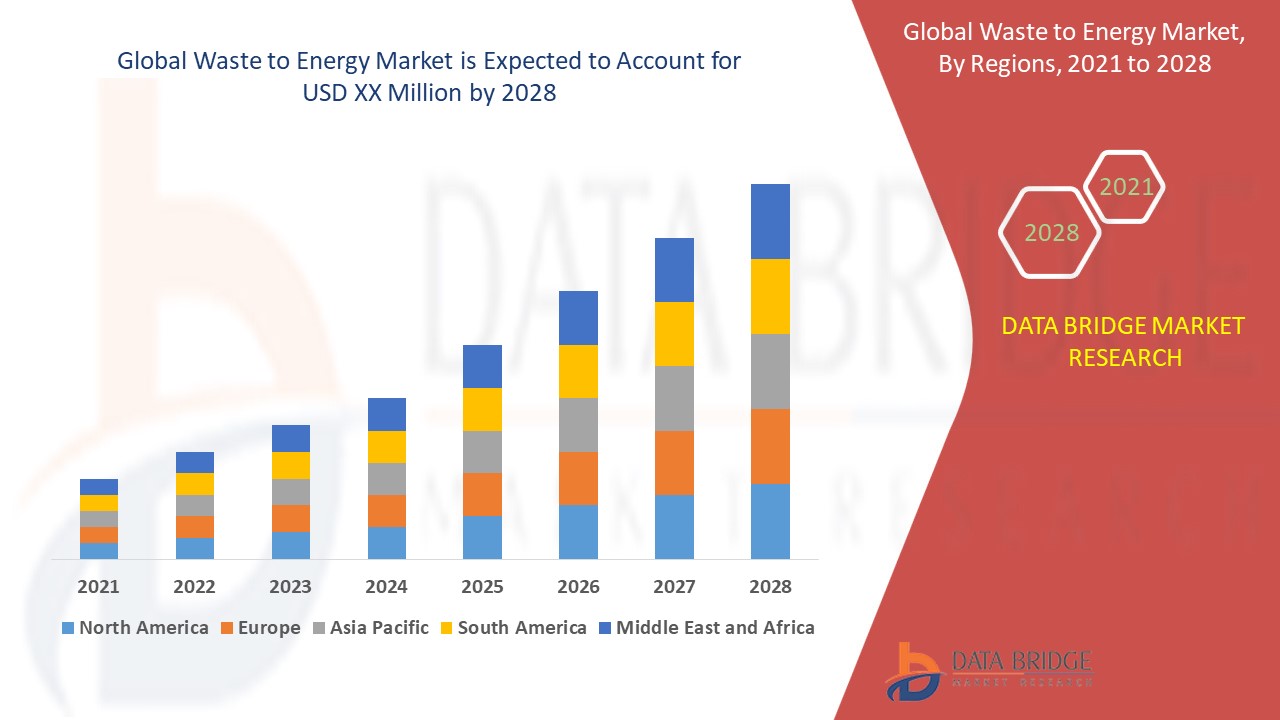
The global waste to energy market size was valued at USD 36.64 billion in 2024 and is projected to reach USD 59.28 billion by 2032, with a CAGR of 6.20% during the forecast period of 2025 to 2032. In addition to the insights on market scenarios such as market value, growth rate, segmentation, geographical coverage, and major players, the market reports curated by the Data Bridge Market Research also include import export analysis, production capacity overview, production consumption analysis, price trend analysis, climate change scenario, supply chain analysis, value chain analysis, raw material/consumables overview, vendor selection criteria, PESTLE Analysis, Porter Analysis, and regulatory framework.
Waste to Energy Market Trends
“Focus on Sustainability”
A significant trend in the waste-to-energy market is the growing emphasis on reducing landfill waste and improving recycling initiatives. Governments and businesses are increasingly prioritizing sustainable waste management practices, recognizing the environmental impact of landfills and the need for resource recovery. As a result, there is a notable shift towards adopting waste-to-energy technologies, which convert non-recyclable waste into usable energy, thus reducing landfill volume while contributing to cleaner energy generation. This trend is further amplified by stringent regulations and the global push for a circular economy, encouraging the development and implementation of waste-to-energy systems. The adoption of these solutions is gaining traction as companies seek to improve their environmental footprint and meet sustainability targets.
Report Scope and Waste to Energy Market Segmentation
|
Attributes |
Waste to Energy Key Market Insights |
|
Segments Covered |
|
|
Countries Covered |
U.S., Canada and Mexico in North America, Germany, France, U.K., Netherlands, Switzerland, Belgium, Russia, Italy, Spain, Turkey, Rest of Europe in Europe, China, Japan, India, South Korea, Singapore, Malaysia, Australia, Thailand, Indonesia, Philippines, Rest of Asia-Pacific (APAC) in the Asia-Pacific (APAC), Saudi Arabia, U.A.E, South Africa, Egypt, Israel, Rest of Middle East and Africa (MEA) as a part of Middle East and Africa (MEA), Brazil, Argentina and Rest of South America as part of South America |
|
Key Market Players |
Kanadevia Inova AG (Switzerland), SUEZ Worldwide (France), Reworld (U.S.), Veolia (France), China Everbright Environment Group Limited (China), Abu Dhabi National Energy Company PJSC (TAQA) (UAE), Ramboll (Denmark), Babcock & Wilcox Enterprises, Inc. (U.S.), Norican Group (Denmark), Xcel Energy Inc. (U.S.), WM Intellectual Property Holdings, L.L.C. (U.S.), CNIM (France), MITSUBISHI HEAVY INDUSTRIES, LTD. (Japan), A2A S.p.A. (Italy), Jinjiang Environment (China), Jansen Combustion and Boiler Technologies, Inc. (U.S.), Keppel Seghers (Singapore), OMNI Conversion Technologies Inc. (Canada), Velocys plc (U.K.) |
|
Market Opportunities |
|
|
Value Added Data Infosets |
In addition to the insights on market scenarios such as market value, growth rate, segmentation, geographical coverage, and major players, the market reports curated by the Data Bridge Market Research also include import export analysis, production capacity overview, production consumption analysis, price trend analysis, climate change scenario, supply chain analysis, value chain analysis, raw material/consumables overview, vendor selection criteria, PESTLE Analysis, Porter Analysis, and regulatory framework. |
Waste to Energy Market Definition
Waste to energy (WTE) refers to the process of converting non-recyclable waste materials into usable forms of energy, such as electricity, heat, or biofuels. This is typically achieved through various technologies, including combustion, gasification, pyrolysis, and anaerobic digestion. WTE systems help reduce the volume of waste sent to landfills, decrease environmental pollution, and provide an alternative renewable energy source, contributing to sustainability goals. By utilizing waste as a resource, WTE helps manage waste effectively and plays a vital role in energy generation and the transition towards a circular economy.
Waste to Energy Market Dynamics
Drivers
- Increasing Waste Generation
As urbanization and industrialization continue to accelerate globally, the volume of waste generated is significantly increasing. This growing waste challenge is driving the need for efficient and sustainable waste management solutions. Waste-to-energy technologies offer a viable solution by converting non-recyclable waste into valuable energy sources, such as electricity and heat. With more waste being generated, there is an urgent need to manage and reduce landfill waste, and waste-to-energy systems are increasingly being adopted to address this issue. This trend is a major driver for the growth of the waste-to-energy market, as it helps manage waste while also contributing to renewable energy generation.
- Renewable Energy Demand
The rising global demand for clean and renewable energy has created an urgent need to explore alternative energy sources. Waste-to-energy systems have emerged as a sustainable solution, offering a way to generate power from non-recyclable waste. These systems contribute to diversifying the energy mix by converting waste into electricity, heat, or biofuels, thus reducing reliance on traditional fossil fuels. As countries seek to reduce their carbon footprint and meet renewable energy targets, waste-to-energy technologies play an important role in creating a more sustainable and resilient energy infrastructure. This growing demand for renewable energy is a key driver for the expansion of the waste-to-energy market.
Opportunities
- Circular Economy Focus
The increasing focus on the circular economy, which promotes recycling, reuse, and sustainable resource management, is driving the adoption of waste-to-energy systems. These systems align with the principles of a circular economy by turning non-recyclable waste into valuable energy, such as electricity and heat. As companies and governments look for ways to minimize environmental impact and reduce waste sent to landfills, waste-to-energy technologies offer a practical solution. This growing emphasis on sustainability presents significant market opportunities for the expansion of waste-to-energy systems, as they play a crucial role in achieving a more sustainable and resource-efficient future.
- Technological Advancements
Advancements in waste-to-energy technologies, such as gasification, pyrolysis, and anaerobic digestion, present significant opportunities for market growth. These cutting-edge processes improve the efficiency and cost-effectiveness of converting waste into energy by reducing environmental impacts and increasing energy output. Gasification and pyrolysis enable the conversion of a wide range of waste materials into cleaner fuels, while anaerobic digestion is a proven method for turning organic waste into biogas. As these technologies become more sophisticated and commercially viable, they open new growth avenues for the waste-to-energy market, attracting investments and facilitating broader adoption across industries looking for sustainable energy solutions.
Restraints/Challenges
- Fluctuating Waste Composition
The variability in waste composition presents a significant challenge for waste-to-energy systems. Waste streams often consist of a mix of materials, some of which may not be suitable for energy generation, such as wet or contaminated waste. This non-homogeneity can impact the efficiency of conversion processes, leading to inconsistent energy output. For instance, some waste materials may require additional processing, increasing operational costs and reducing the overall cost-effectiveness of waste-to-energy facilities. As a result, waste-to-energy operators face difficulties in maintaining stable energy production rates, making it crucial to develop technologies that can handle diverse waste types efficiently.
- High Initial Capital Investment
The significant upfront capital required to install waste-to-energy facilities is a major restraint for the market. Establishing these facilities involves high investments in infrastructure, technology, and specialized equipment, which can be a barrier for investors, particularly in developing regions with limited access to funding. The long-term return on investment may also appear uncertain, especially when compared to other energy generation methods with lower initial costs. This financial challenge can slow the adoption of waste-to-energy projects, particularly in areas that are still building their renewable energy infrastructure, and may limit the market’s expansion in these regions.
This market report provides details of new recent developments, trade regulations, import-export analysis, production analysis, value chain optimization, market share, impact of domestic and localized market players, analyses opportunities in terms of emerging revenue pockets, changes in market regulations, strategic market growth analysis, market size, category market growths, application niches and dominance, product approvals, product launches, geographic expansions, technological innovations in the market. To gain more info on the market contact Data Bridge Market Research for an Analyst Brief, our team will help you take an informed market decision to achieve market growth.
Impact and Current Market Scenario of Raw Material Shortage and Shipping Delays
Data Bridge Market Research offers a high-level analysis of the market and delivers information by keeping in account the impact and current market environment of raw material shortage and shipping delays. This translates into assessing strategic possibilities, creating effective action plans, and assisting businesses in making important decisions. Apart from the standard report, we also offer in-depth analysis of the procurement level from forecasted shipping delays, distributor mapping by region, commodity analysis, production analysis, price mapping trends, sourcing, category performance analysis, supply chain risk management solutions, advanced benchmarking, and other services for procurement and strategic support.
Expected Impact of Economic Slowdown on the Pricing and Availability of Products
When economic activity slows, industries begin to suffer. The forecasted effects of the economic downturn on the pricing and accessibility of the products are taken into account in the market insight reports and intelligence services provided by DBMR. With this, our clients can typically keep one step ahead of their competitors, project their sales and revenue, and estimate their profit and loss expenditures.
Waste to Energy Market Scope
The market is segmented on the basis of energy technology, form, and application. The growth amongst these segments will help you analyse meagre growth segments in the industries and provide the users with a valuable market overview and market insights to help them make strategic decisions for identifying core market applications.
Energy Technology
- Thermal
- Biological
Form
- Steam
- Electricity
- Hot Water
Application
- Treatment of Waste
- Reduction of Waste Volume
- Generation of Energy
Waste to Energy Market Regional Analysis
The market is analysed and market size insights and trends are provided by country, energy technology, form, and application as referenced above.
The countries covered in the market report are U.S., Canada and Mexico in North America, Germany, France, U.K., Netherlands, Switzerland, Belgium, Russia, Italy, Spain, Turkey, Rest of Europe in Europe, China, Japan, India, South Korea, Singapore, Malaysia, Australia, Thailand, Indonesia, Philippines, Rest of Asia-Pacific (APAC) in the Asia-Pacific (APAC), Saudi Arabia, U.A.E, South Africa, Egypt, Israel, Rest of Middle East and Africa (MEA) as a part of Middle East and Africa (MEA), Brazil, Argentina and Rest of South America as part of South America.
Europe dominates the waste-to-energy market, driven by the presence of key market players and supportive regulatory frameworks. These include policies such as landfill taxes, carbon taxes, and direct subsidies to waste-to-energy facilities, which encourage investment and expansion. The combination of strong industry players and favorable regulations makes Europe a dominant region in the global market.
Asia-Pacific is the fastest growing region in waste-to-energy market, experience the highest CAGR from 2025 to 2032, driven by increased government funding for municipal solid waste management and growing awareness of waste-to-energy solutions. The region's commitment to sustainable waste management practices is fostering the development of waste-to-energy plants. This, coupled with heightened public and private sector support, positions Asia-Pacific for substantial growth in the waste-to-energy market.
The country section of the report also provides individual market impacting factors and changes in regulation in the market domestically that impacts the current and future trends of the market. Data points such as down-stream and upstream value chain analysis, technical trends and porter's five forces analysis, case studies are some of the pointers used to forecast the market scenario for individual countries. Also, the presence and availability of global brands and their challenges faced due to large or scarce competition from local and domestic brands, impact of domestic tariffs and trade routes are considered while providing forecast analysis of the country data.
Waste to Energy Market Share
The market competitive landscape provides details by competitor. Details included are company overview, company financials, revenue generated, market potential, investment in research and development, new market initiatives, global presence, production sites and facilities, production capacities, company strengths and weaknesses, product launch, product width and breadth, application dominance. The above data points provided are only related to the companies' focus related to market.
Waste to Energy Market Leaders Operating in the Market Are:
- Kanadevia Inova AG (Switzerland)
- SUEZ Worldwide (France)
- Reworld (U.S.)
- Veolia (France)
- China Everbright Environment Group Limited (China)
- Abu Dhabi National Energy Company PJSC (TAQA) (UAE)
- Ramboll (Denmark)
- Babcock & Wilcox Enterprises, Inc. (U.S.)
- Norican Group (Denmark)
- Xcel Energy Inc. (U.S.)
- WM Intellectual Property Holdings, L.L.C. (U.S.)
- CNIM (France)
- MITSUBISHI HEAVY INDUSTRIES, LTD. (Japan)
- A2A S.p.A. (Italy)
- Jinjiang Environment (China)
- Jansen Combustion and Boiler Technologies, Inc. (U.S.)
- Keppel Seghers (Singapore)
- OMNI Conversion Technologies Inc. (Canada)
- Velocys plc, (U.K.)
Latest Developments in Waste to Energy Market
- In June 2022, AVR explored a collaboration with Swedish company HaloSep AB to locally manage hazardous flue gas cleaning residues. HaloSep offers a unique solution that transforms hazardous waste into safe, valuable materials. This partnership aims to make AVR’s Rotterdam facility more sustainable by recovering material resources, reducing environmental impact, and supporting a circular economy. By implementing HaloSep’s technology, AVR is working towards minimizing waste and improving overall sustainability at its plant
- In June 2022, Veolia initiated the sale of Suez’s U.K. waste business, marking a significant step in building a global leader in ecological transformation. The merger focuses on integrating Veolia with much of Suez’s international operations, enhancing the company’s technological capabilities and geographical reach. This strategic move is expected to accelerate Veolia’s Impact 2023 program, strengthen its international presence, and expand its capacity to implement sustainable waste and energy solutions across more regions
- In April 2022, Veolia announced two major projects aimed at fostering local, sustainable, and low-carbon energy sources. The first, located in Finland, is the world’s largest bio-refinery project, producing CO2-neutral bio-methanol from the pulp manufacturing process. In addition, Veolia is partnering with Waga Energy to build the largest biomethane production unit in France, which will extract biogas from a non-hazardous landfill. These projects reflect Veolia’s commitment to advancing the transition to sustainable energy solutions
- In April 2022, Viridor completed the sale of its landfill and landfill gas business to Frank Solutions Limited, which encompasses the operation and management of 44 sites across the U.K. This move aligns with Viridor’s strategy to focus on expanding its core business areas, such as energy recovery and polymer reprocessing. The transaction supports Viridor’s ambitious goal of achieving net-zero emissions by 2040, further strengthening its commitment to sustainable waste management practices and renewable energy solutions
- In January 2022, AVR’s Duiven Waste-to-Energy (WtE) plant, a 30MW biopower project, was developed in several phases and is expected to generate 263GWh of electricity annually. This facility will significantly contribute to reducing CO2 emissions, offsetting 400,000 tons of CO2 per year. The project highlights AVR’s ongoing efforts to support clean energy production while addressing waste management needs and contributing to the fight against climate change

- Interactive Data Analysis Dashboard
- Company Analysis Dashboard for high growth potential opportunities
- Research Analyst Access for customization & queries
- Competitor Analysis with Interactive dashboard
- Latest News, Updates & Trend analysis
- Harness the Power of Benchmark Analysis for Comprehensive Competitor Tracking
Global Waste To Energy Market, Supply Chain Analysis and Ecosystem Framework
To support market growth and help clients navigate the impact of geopolitical shifts, DBMR has integrated in-depth supply chain analysis into its Global Waste To Energy Market research reports. This addition empowers clients to respond effectively to global changes affecting their industries. The supply chain analysis section includes detailed insights such as Global Waste To Energy Market consumption and production by country, price trend analysis, the impact of tariffs and geopolitical developments, and import and export trends by country and HSN code. It also highlights major suppliers with data on production capacity and company profiles, as well as key importers and exporters. In addition to research, DBMR offers specialized supply chain consulting services backed by over a decade of experience, providing solutions like supplier discovery, supplier risk assessment, price trend analysis, impact evaluation of inflation and trade route changes, and comprehensive market trend analysis.
Data collection and base year analysis are done using data collection modules with large sample sizes. The stage includes obtaining market information or related data through various sources and strategies. It includes examining and planning all the data acquired from the past in advance. It likewise envelops the examination of information inconsistencies seen across different information sources. The market data is analysed and estimated using market statistical and coherent models. Also, market share analysis and key trend analysis are the major success factors in the market report. To know more, please request an analyst call or drop down your inquiry.
The key research methodology used by DBMR research team is data triangulation which involves data mining, analysis of the impact of data variables on the market and primary (industry expert) validation. Data models include Vendor Positioning Grid, Market Time Line Analysis, Market Overview and Guide, Company Positioning Grid, Patent Analysis, Pricing Analysis, Company Market Share Analysis, Standards of Measurement, Global versus Regional and Vendor Share Analysis. To know more about the research methodology, drop in an inquiry to speak to our industry experts.
Data Bridge Market Research is a leader in advanced formative research. We take pride in servicing our existing and new customers with data and analysis that match and suits their goal. The report can be customized to include price trend analysis of target brands understanding the market for additional countries (ask for the list of countries), clinical trial results data, literature review, refurbished market and product base analysis. Market analysis of target competitors can be analyzed from technology-based analysis to market portfolio strategies. We can add as many competitors that you require data about in the format and data style you are looking for. Our team of analysts can also provide you data in crude raw excel files pivot tables (Fact book) or can assist you in creating presentations from the data sets available in the report.













