


Wastewater Secondary Treatment Equipment Market Size
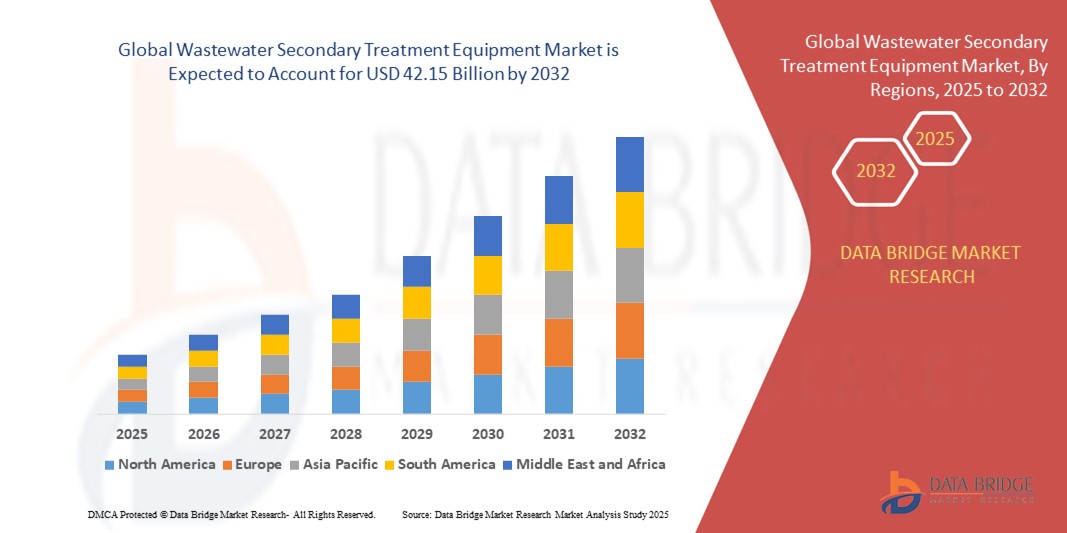
- The global wastewater secondary treatment equipment market size was valued at USD 30.33 billion in 2024 and is projected to reach USD 42.15 billion by 2032, with a CAGR of 4.20% during the forecast period
- The market growth is primarily driven by increasing urbanization, rising environmental regulations, and growing awareness regarding sustainable water management, leading to heightened demand for effective wastewater treatment solutions across industries and municipalities
- Furthermore, advancements in treatment technologies and the integration of automation and monitoring systems are enhancing operational efficiency, driving adoption. These factors collectively contribute to the steady expansion of the wastewater secondary treatment equipment market worldwide
Wastewater Secondary Treatment Equipment Market Analysis
- Wastewater secondary treatment equipment, essential for removing organic matter and suspended solids through biological processes, plays a critical role in ensuring compliance with environmental regulations and safeguarding public health in municipal and industrial wastewater treatment applications
- The market’s steady growth is primarily fueled by increasing regulatory pressure to reduce water pollution, rising urban populations, and the urgent need for sustainable water reuse solutions in water-stressed regions
- Asia-Pacific dominated the wastewater secondary treatment equipment market with the largest revenue share in 39.5% 2023, driven by rapid industrialization, population growth, and increasing governmental efforts to improve wastewater infrastructure across developing countries
- North America is expected to grow at the fastest rate of 10.12%, underpinned by aging infrastructure, increasing regulatory pressures, and heightened environmental awareness
- The activated sludge systems segment dominated the market with the largest revenue share of 38.7% in 2024, owing to their widespread adoption in municipal wastewater treatment and proven efficiency in removing organic pollutants
Report Scope and Market Segmentation
|
Attributes |
Wastewater Secondary Treatment Equipment Key Market Insights |
|
Segments Covered |
|
|
Countries Covered |
North America
Europe
Asia-Pacific
Middle East and Africa
South America
|
|
Key Market Players |
|
|
Market Opportunities |
|
|
Value Added Data Infosets |
In addition to the insights on market scenarios such as market value, growth rate, segmentation, geographical coverage, and major players, the market reports curated by the Data Bridge Market Research also include in-depth expert analysis, pricing analysis, brand share analysis, consumer survey, demography analysis, supply chain analysis, value chain analysis, raw material/consumables overview, vendor selection criteria, PESTLE Analysis, Porter Analysis, and regulatory framework. |
Wastewater Secondary Treatment Equipment Market Trends
Technological Advancements Driving Process Efficiency and Automation
- A major and evolving trend in the global wastewater secondary treatment equipment market is the growing integration of advanced technologies such as automation, real-time monitoring systems, and AI-powered analytics to enhance treatment efficiency, reduce operational costs, and ensure regulatory compliance
- For instance, GE and Xylem have developed treatment systems equipped with smart sensors and digital platforms that monitor parameters such as Biological Oxygen Demand (BOD), Total Suspended Solids (TSS), and nutrient loads in real time, enabling operators to make timely and informed process adjustments
- AI and machine learning technologies are increasingly being applied to optimize aeration control, sludge management, and energy usage—historically the most energy-intensive aspects of secondary treatment. Siemens’ SIMATIC PCS 7 system, for instance, leverages AI algorithms to predict influent fluctuations and automate process responses, leading to improved stability and cost efficiency
- The incorporation of Supervisory Control and Data Acquisition (SCADA) systems and IoT-based remote management tools allows for centralized control and diagnostics, minimizing manual intervention and enabling predictive maintenance strategies. This enhances system reliability and extends equipment lifespan
- These technological innovations are transforming conventional treatment plants into smart, adaptive facilities capable of addressing evolving environmental challenges and stricter effluent standards. Municipalities and industrial users asuch as are increasingly adopting these solutions to meet sustainability goals and reduce their environmental footprint
- As demand rises for more intelligent, efficient, and resilient wastewater treatment solutions, equipment manufacturers are focusing on modular, AI-integrated systems with enhanced automation and real-time control capabilities reshaping the future of secondary wastewater treatment globally
Wastewater Secondary Treatment Equipment Market Dynamics
Driver
Rising Environmental Regulations and Growing Demand for Water Reuse
- The global push for stricter environmental regulations and sustainable water management practices is a major driver fueling demand for secondary wastewater treatment equipment across municipal and industrial sectors. Governments and environmental agencies worldwide are mandating stricter discharge limits on organic pollutants, nutrients, and suspended solids, thereby accelerating the adoption of advanced treatment solutions
- For instance, the European Union’s Urban Waste Water Treatment Directive and similar national policies in countries such as China and India have increased compliance requirements, prompting investments in modern treatment infrastructure
- This regulatory landscape is compelling municipalities and industries to upgrade or replace outdated systems with more efficient secondary treatment technologies
- At the same time, the growing urgency of water scarcity and the increasing cost of freshwater supplies are driving the need for treated wastewater reuse. Secondary treatment plays a critical role in producing water suitable for non-potable reuse in agriculture, industry, and even indirect potable use in some regions
- In response, public and private sector stakeholders are ramping up spending on wastewater infrastructure to meet both regulatory obligations and sustainability goals. The integration of modular systems, energy-efficient designs, and automation also adds value, making advanced equipment more appealing to end users seeking operational efficiency and compliance
Restraint/Challenge
High Operational Costs and Infrastructure Limitations in Developing Regions
- One of the key challenges hindering the widespread deployment of secondary wastewater treatment equipment is the high capital and operational costs associated with installing and maintaining advanced systems, especially in low-income or developing regions
- Secondary treatment processes such as activated sludge systems require significant energy input, skilled labor, and continuous monitoring, all of which contribute to long-term operational expenses. For resource-constrained municipalities, these financial and technical demands can be prohibitive
- Infrastructure limitations, including aging sewage networks, lack of centralized treatment facilities, and insufficient funding, further restrict market penetration in rural or underdeveloped areas. For instance, in parts of Sub-Saharan Africa and Southeast Asia, many communities still rely on basic sanitation systems with limited or no access to centralized wastewater treatment
- In addition, limited public awareness about the importance of wastewater treatment and the absence of strong policy enforcement in some regions continue to slow down market growth. While global initiatives and funding from international agencies (e.g., World Bank, UNDP) aim to bridge these gaps, progress remains uneven
- To address these challenges, industry stakeholders must focus on cost-effective, decentralized, and scalable treatment solutions that are easier to operate and maintain, along with increased investment in public-private partnerships to modernize wastewater infrastructure in underserved areas
Wastewater Secondary Treatment Equipment Market Scope
The market is segmented on the basis of equipment type, process type, application, and end user.
- By Equipment Type
On the basis of equipment type, the wastewater secondary treatment equipment market is segmented into activated sludge systems, biofilters, membrane bioreactors (MBRs), sequencing batch reactors (SBRs), and others. The activated sludge systems segment dominated the market with the largest revenue share of 38.7% in 2024, owing to their widespread adoption in municipal wastewater treatment and proven efficiency in removing organic pollutants. These systems are favored for their scalability, cost-effectiveness, and compatibility with various treatment infrastructures. The ability to integrate with nutrient removal and energy recovery processes further supports their dominant market position.
The membrane bioreactors (MBRs) segment is expected to witness the fastest growth rate of 20.3% from 2025 to 2032, driven by rising demand for advanced treatment technologies in water-scarce regions and industries with stringent effluent discharge standards. MBRs combine biological treatment with membrane filtration, offering superior effluent quality, compact design, and reduced sludge production, making them ideal for decentralized and space-constrained applications.
- By Process
On the basis of process, the market is segmented into suspended growth, attached growth, and combined systems. The suspended growth segment held the largest market revenue share in 2024, largely due to the dominance of activated sludge-based processes that are versatile and cost-efficient. This process type is widely used in both municipal and industrial facilities for its high treatment efficiency and flexibility in handling varying loads.
The combined systems segment is expected to register the fastest CAGR from 2025 to 2032, driven by the need for hybrid solutions that can address complex wastewater characteristics. Combining suspended and attached growth processes enhances nutrient removal, minimizes footprint, and improves overall operational stability, appealing to facilities with fluctuating influent quality.
- By Treatment Method
On the basis of treatment method, the market is segmented into aerobic and anaerobic treatment. The aerobic treatment segment accounted for the largest revenue share in 2024, supported by its widespread use in conventional wastewater treatment plants and superior performance in organic matter degradation. Aerobic systems are often preferred for their reliability and lower odor production, making them suitable for urban environments.
The anaerobic treatment segment is expected to see the fastest CAGR from 2025 to 2032, propelled by growing interest in energy-efficient and sustainable solutions. Anaerobic systems generate biogas during treatment, offering energy recovery potential and reduced sludge handling costs, making them increasingly attractive for industrial applications and circular economy initiatives.
- By Application
On the basis of application, the market is segmented into municipal, industrial, and others. The municipal segment held the largest market revenue share in 2024, driven by increasing urbanization, rising population, and government mandates for environmental protection. Upgrades to aging infrastructure and investments in smart water management systems continue to support market expansion in this segment.
The industrial segment is projected to witness the fastest CAGR from 2025 to 2032, fueled by stricter discharge regulations, growing water reuse initiatives, and the need for on-site treatment solutions. Sectors such as food & beverage, pharmaceuticals, chemicals, and textiles are investing heavily in advanced secondary treatment technologies to reduce environmental impact and ensure compliance.
Wastewater Secondary Treatment Equipment Market Regional Analysis
- Asia-Pacific dominated the wastewater secondary treatment equipment market with the largest revenue share in 39.5% 2023, driven by rapid industrialization, population growth, and increasing governmental efforts to improve wastewater infrastructure across developing countries
- Countries in the region, particularly China and India, are implementing stricter environmental regulations and investing heavily in municipal and industrial treatment facilities to manage rising wastewater volumes and reduce pollution.
- This strong regional growth is further supported by expanding urbanization, growing awareness of water conservation, and the rising demand for water reuse. These factors are positioning Asia-Pacific as a key market for both conventional and advanced secondary treatment technologies in the years ahead.
China Wastewater Secondary Treatment Equipment Market Insight
The China market held the largest revenue share in Asia-Pacific in 2023, fueled by strict environmental regulations and government-led programs such as the "Beautiful China" initiative, which prioritize water pollution control. Massive investments in sewage treatment infrastructure and the widespread adoption of activated sludge and membrane technologies are boosting demand. China’s push toward sustainable urban development and smart city planning is further supporting the market.
India Wastewater Secondary Treatment Equipment Market Insight
India is anticipated to grow at the fastest CAGR in the Asia-Pacific region through 2031, driven by urban population growth, industrialization, and government programs such as the "Namami Gange" and "AMRUT" missions that aim to improve urban water and sanitation services. The adoption of modular, decentralized treatment units is gaining traction, particularly in rural and peri-urban areas, while the private sector is increasingly investing in in-house treatment systems to meet compliance standards.
North America Wastewater Secondary Treatment Equipment Market Insight
North America is expected to grow at the fastest rate of 10.12%, underpinned by aging infrastructure, increasing regulatory pressures, and heightened environmental awareness. The U.S. Environmental Protection Agency (EPA) continues to enforce strict discharge limits, prompting upgrades to outdated municipal facilities and driving the adoption of advanced secondary treatment solutions, including energy-efficient and AI-integrated systems.
U.S. Wastewater Secondary Treatment Equipment Market Insight
The U.S. accounted for the majority share of the North American market in 2023, supported by federal and state-level investments in infrastructure revitalization under programs such as the Infrastructure Investment and Jobs Act. The demand for sustainable and efficient treatment technologies is increasing, particularly in urban areas with growing populations and strained sanitation infrastructure. Industrial wastewater treatment requirements are also driving adoption in manufacturing-intensive regions.
Europe Wastewater Secondary Treatment Equipment Market Insight
Europe is projected to grow steadily throughout the forecast period, supported by stringent EU directives on wastewater discharge and a strong commitment to sustainability. Countries across the region are focusing on reducing water pollution and increasing water reuse, especially in response to climate change and water scarcity challenges. Municipalities are modernizing treatment plants, while industries are being held to tighter effluent standards.
Germany Wastewater Secondary Treatment Equipment Market Insight
Germany represents a key market in Europe, driven by its advanced environmental policies and commitment to circular economy principles. The country emphasizes high-efficiency and low-emission technologies in wastewater treatment. Strong investment in R&D, combined with the use of AI and IoT-enabled monitoring systems, is fostering innovation and enhancing system performance across both municipal and industrial sectors.
U.K. Wastewater Secondary Treatment Equipment Market Insight
The U.K. market is experiencing moderate growth, with a focus on upgrading aging infrastructure and enhancing environmental protection measures post-Brexit. Increased scrutiny of water companies’ environmental impact is leading to accelerated investment in wastewater treatment facilities. Demand is also rising in the commercial and residential real estate sectors, where sustainable water management practices are being prioritized.
Global Wastewater Secondary Treatment Equipment Market Share
Wastewater Secondary Treatment Equipment Market Leaders Operating in the Market Are:
- Danaher Corporation (U.S.)
- Xylem (U.S.)
- Aquatech (U.S.)
- GE Infrastructure Water & Process Technologies (U.S.)
- Veolia Environment SA (France)
- Pentair (U.S.)
- Evoqua Water Technologies (U.S.)
- Aquatech International (U.S.)
- SUEZ (France)
- Ecolab (U.S.)
- Calgon Carbon Corporation (U.S.)
- H2O Innovation (Canada)
- Smith and Loveless (U.S.)
Recent Developments in Global Wastewater Secondary Treatment Equipment Market
- In June 2023, SUEZ Group, a global leader in water and wastewater treatment, inaugurated a new advanced biological treatment plant in Southeast Asia, equipped with energy-efficient activated sludge systems and digital monitoring tools. This facility marks a significant step toward addressing urban water pollution and demonstrates SUEZ’s commitment to providing sustainable and scalable wastewater treatment solutions tailored to the needs of rapidly urbanizing regions.
- In May 2023, Veolia Water Technologies launched the next-generation BIOSTYR® Duo, a compact biofiltration system designed to improve nitrogen and phosphorus removal in secondary treatment processes. The technology is aimed at helping municipalities meet stringent effluent regulations while optimizing energy and footprint efficiency, reinforcing Veolia’s leadership in modular and environmentally friendly wastewater solutions.
- In April 2023, Evoqua Water Technologies announced the expansion of its partnership with Xylem Inc. following its acquisition, aiming to jointly enhance biological treatment offerings with integrated smart monitoring capabilities. This collaboration focuses on delivering end-to-end solutions for wastewater utilities, enabling predictive maintenance, improved process control, and reduced operational costs.
- In March 2023, Pentair Plc introduced a new line of automated membrane bioreactor (MBR) systems designed for secondary treatment in industrial applications. These compact systems incorporate IoT-enabled sensors and cloud-based analytics for real-time monitoring, supporting industries in achieving consistent compliance and reducing environmental impact.
- In February 2023, Fluence Corporation Limited was awarded a contract to supply decentralized secondary treatment units for rural communities in Latin America. These modular systems, utilizing MABR (Membrane Aerated Biofilm Reactor) technology, are designed for off-grid operation and minimal maintenance, highlighting Fluence’s focus on expanding access to efficient wastewater treatment in underserved areas worldwide.

- Interactive Data Analysis Dashboard
- Company Analysis Dashboard for high growth potential opportunities
- Research Analyst Access for customization & queries
- Competitor Analysis with Interactive dashboard
- Latest News, Updates & Trend analysis
- Harness the Power of Benchmark Analysis for Comprehensive Competitor Tracking
Global Wastewater Secondary Treatment Equipment Market, Supply Chain Analysis and Ecosystem Framework
To support market growth and help clients navigate the impact of geopolitical shifts, DBMR has integrated in-depth supply chain analysis into its Global Wastewater Secondary Treatment Equipment Market research reports. This addition empowers clients to respond effectively to global changes affecting their industries. The supply chain analysis section includes detailed insights such as Global Wastewater Secondary Treatment Equipment Market consumption and production by country, price trend analysis, the impact of tariffs and geopolitical developments, and import and export trends by country and HSN code. It also highlights major suppliers with data on production capacity and company profiles, as well as key importers and exporters. In addition to research, DBMR offers specialized supply chain consulting services backed by over a decade of experience, providing solutions like supplier discovery, supplier risk assessment, price trend analysis, impact evaluation of inflation and trade route changes, and comprehensive market trend analysis.
Data collection and base year analysis are done using data collection modules with large sample sizes. The stage includes obtaining market information or related data through various sources and strategies. It includes examining and planning all the data acquired from the past in advance. It likewise envelops the examination of information inconsistencies seen across different information sources. The market data is analysed and estimated using market statistical and coherent models. Also, market share analysis and key trend analysis are the major success factors in the market report. To know more, please request an analyst call or drop down your inquiry.
The key research methodology used by DBMR research team is data triangulation which involves data mining, analysis of the impact of data variables on the market and primary (industry expert) validation. Data models include Vendor Positioning Grid, Market Time Line Analysis, Market Overview and Guide, Company Positioning Grid, Patent Analysis, Pricing Analysis, Company Market Share Analysis, Standards of Measurement, Global versus Regional and Vendor Share Analysis. To know more about the research methodology, drop in an inquiry to speak to our industry experts.
Data Bridge Market Research is a leader in advanced formative research. We take pride in servicing our existing and new customers with data and analysis that match and suits their goal. The report can be customized to include price trend analysis of target brands understanding the market for additional countries (ask for the list of countries), clinical trial results data, literature review, refurbished market and product base analysis. Market analysis of target competitors can be analyzed from technology-based analysis to market portfolio strategies. We can add as many competitors that you require data about in the format and data style you are looking for. Our team of analysts can also provide you data in crude raw excel files pivot tables (Fact book) or can assist you in creating presentations from the data sets available in the report.













