What is the Water Desalination Equipment Market Size and Growth Rate?
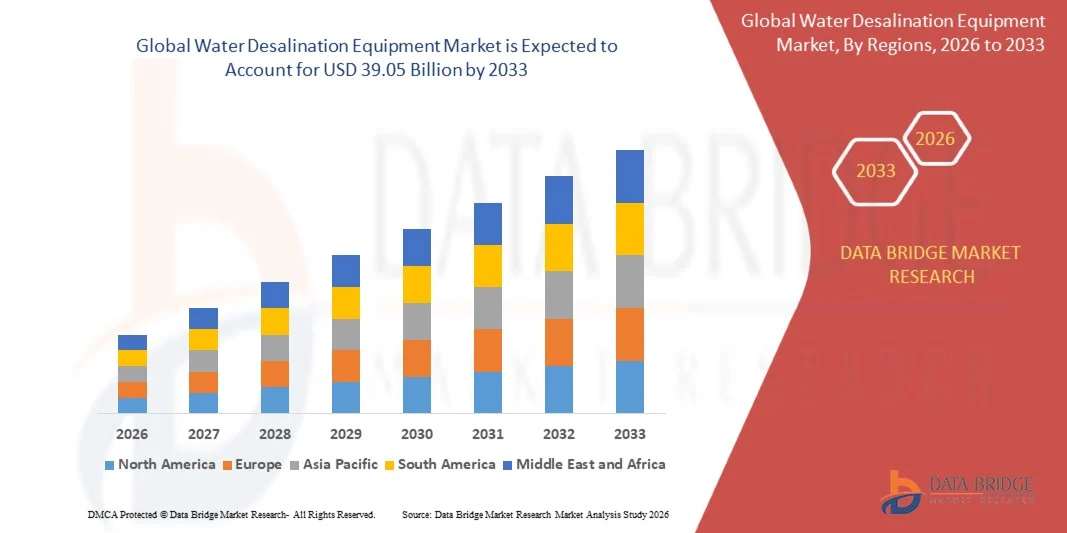
- As per Data Bridge Market Research analysis, the water desalination equipment market was valued at USD 19.96 billion in 2025 and is projected to reach USD 39.05 billion by 2033, growing at a CAGR of 8.75% from 2026 to 2033.
- The market is experiencing consistent growth driven by rising freshwater scarcity, expanding coastal urbanization, large-scale investments in seawater reverse osmosis capacity, and increasing demand for reliable process water across municipal, industrial, power generation, and agricultural users.
- The increasing shift toward membrane-based processes, energy recovery, renewable-powered plants, and independent water producer (IWP) project models, combined with growing integration of digital monitoring and brine-management systems, is supporting market adoption. Desalination equipment is being applied across municipal water supply, industrial process water, and power generation, offering utilities and industries a dependable source of potable and process water independent of rainfall.
Market Size & Forecast
- Global Market Value (2025): USD 19.96 Billion
- Expected Market Value (2033): USD 39.05 Billion
- Forecast CAGR (2026–2033): 8.75%
- Leading Region in 2025: Middle East and Africa
- Fastest Growing Region: Asia-Pacific
What are the Major Takeaways of the Water Desalination Equipment Market?
- Middle East and Africa dominated the water desalination equipment market with the largest revenue share of 46.84% in 2025, supported by chronic freshwater scarcity, state-backed procurement programs, and the world’s largest concentration of seawater desalination capacity.
- Asia-Pacific is expected to be the fastest-growing region at a CAGR of 10.21% from 2026 to 2033, fueled by industrial water demand, coastal megacity expansion, and rising investments in water-security infrastructure across China, India, and Southeast Asia.
- The reverse osmosis segment led the technology category with a 69.60% share in 2025, driven by lower specific energy consumption, modular scalability, and continuous improvements in membrane performance.
- Electrodialysis is the fastest-growing technology type, projected to register a CAGR of 9.84%, reflecting rising demand for brackish-water treatment and selective ion removal with lower energy use.
- The membranes segment dominated the equipment type category with a 38.24% revenue share in 2025, led by recurring replacement demand and the large installed base of reverse osmosis trains.
- Seawater accounted for 61.37% of the market share in 2025, preferred by coastal cities and industrial clusters seeking a drought-proof water source.
- The industrial application segment is the fastest-growing category, with a CAGR of 9.93%, driven by increasing demand for high-purity process water and zero-liquid-discharge systems.
Report Scope and Water Desalination Equipment Market Segmentation
|
Attributes |
Water Desalination Equipment Key Market Insights |
|
Segments Covered |
|
|
Countries Covered |
North America
Europe
Asia-Pacific
Middle East and Africa
South America
|
|
Key Market Players |
|
|
Market Opportunities |
|
|
Value Added Data Infosets |
In addition to the insights on market scenarios such as market value, growth rate, segmentation, geographical coverage, and major players, the market reports curated by the Data Bridge Market Research also include import export analysis, production capacity overview, production consumption analysis, price trend analysis, climate change scenario, supply chain analysis, value chain analysis, raw material/consumables overview, vendor selection criteria, PESTLE Analysis, Porter Analysis, and regulatory framework. |
What is the Key Trend in the Water Desalination Equipment Market?
- Desalination plants are increasingly evolving from energy-intensive utilities into low-carbon, digitally optimized water-production platforms, combining high-recovery membranes, pressure-exchange energy recovery, renewable power supply, and real-time performance analytics to cut the energy cost of every cubic meter produced.
- For instance, in May 2024, according to Veolia, its subsidiary SIDEM was awarded a USD 320 million contract to engineer and supply key technology for the Hassyan seawater desalination plant in Dubai, designed for an energy consumption of 2.9 kWh/m³, with the company stating that advances in reverse osmosis, pre-treatment, and post-treatment have cut plant energy use by a further 35% over the past ten years.
- Solar-powered and hybrid-powered reverse osmosis plants are enabling utilities to decouple water production from fossil fuel consumption, while smart controls adjust pressure, flux, and cleaning cycles to changing feedwater conditions.
- Brine is increasingly being treated as a resource rather than a waste stream, with research and pilot projects exploring salt, metal, and mineral recovery as well as aquaculture uses for concentrated discharge.
- For instance, in January 2022, according to Nature Middle East, United Nations University researchers noted that potential uses of desalination brine include fish farming of salt-tolerant species, where in one case brine use increased fish biomass by 300%, and the recovery of salts and metals contained in the discharge.
- As membrane efficiency, energy recovery, renewable integration, and brine valorization continue to advance, desalination equipment is expected to expand beyond conventional municipal supply into industrial water reuse, power generation, and resilient water infrastructure for water-stressed regions.
What are the Key Drivers of the Water Desalination Equipment Market?
- Persistent freshwater scarcity, population growth, and the concentration of demand in coastal cities have significantly increased investment in technologies that convert seawater and brackish water into dependable potable supply.
- For instance, in January 2021, according to Science of the Total Environment, a study led by the United Nations University Institute for Water, Environment and Health assessed nearly 16,000 operational desalination plants across 177 countries and territories and estimated global desalinated water production at about 95 million cubic meters per day.
- Governments, utilities, and industrial operators are committing long-term capital to desalination capacity through independent water producer contracts, public-private partnerships, and strategic water-security programs.
- For instance, in August 2025, according to Dubai Electricity and Water Authority (DEWA), the utility plans to add 240 million imperial gallons per day of seawater reverse osmosis capacity by 2030, bringing its total desalinated water production capacity to 735 million imperial gallons per day.
- With water-intensive industries such as power, petrochemicals, semiconductors, and food processing seeking secure process water, desalination equipment can support stable operations that do not depend on rainfall or shared freshwater sources.
What Factors are Challenging the Growth of the Water Desalination Equipment Market?
- Water desalination plants require substantial capital for intake and outfall structures, pre-treatment, high-pressure pumping, membranes, energy recovery, and post-treatment, and they carry continuing costs for energy, chemicals, membrane replacement, and maintenance.
- For instance, in June 2024, according to ENR, the Hassyan seawater desalination plant in Dubai, with a capacity of 818,000 cubic meters per day, was being developed as a USD 914 million project financed through debt and equity, illustrating the capital intensity of large-scale seawater reverse osmosis.
- Brine discharge, chemical use, and marine impacts remain a regulatory and public-acceptance concern, particularly for plants that discharge concentrate directly into coastal waters.
- The need for energy-intensive operation, long permitting cycles, and dependence on volatile power prices can delay projects and constrain adoption among cost-sensitive regions and small utilities.
- For instance, in January 2022, according to Science of the Total Environment, researchers estimated that desalination plants worldwide discharge about 142 million cubic meters of brine per day, roughly 50% more than earlier estimates and about 1.5 liters of brine for every liter of freshwater produced, with four countries accounting for about 55% of the total.
- The combination of high capital cost, energy requirements, brine-management obligations, and permitting complexity can constrain adoption where conventional freshwater sources, water reuse, or conservation measures can still meet demand.
How is the Water Desalination Equipment Market Segmented?
The water desalination equipment market is segmented on the basis of technology, equipment type, water source, and application.
- By Technology
On the basis of technology, the water desalination equipment market is segmented into reverse osmosis, multi-stage flash distillation, multi-effect distillation, electrodialysis, and others. The reverse osmosis segment dominated the market with 69.60% share in 2025, supported by lower specific energy consumption than thermal processes and the modular, scalable nature of membrane trains. Reverse osmosis allows operators to expand capacity in stages and to treat both seawater and brackish feedwater. Improvements in membrane permeability, rejection, and fouling resistance are further strengthening demand. Integration with energy recovery devices and digital control systems also lowers the operating cost per cubic meter.
The electrodialysis segment is projected to register the fastest growth at a CAGR of 9.84% from 2026 to 2033, driven by increasing demand for brackish-water treatment, selective ion removal, and high water recovery. Electrodialysis can reduce energy use where feedwater salinity is moderate and supports industrial reuse applications. Its applications include food and beverage processing, mining water, agricultural water, and municipal brackish supply. Advances in ion-exchange membrane materials and reversal operation are improving durability and reducing scaling. Growing interest in zero-liquid-discharge and brine concentration is creating additional demand.
- By Equipment Type
On the basis of equipment type, the water desalination equipment market is segmented into membranes, pumps, energy recovery devices, pre-treatment and post-treatment systems, and others. The membranes segment dominated the market with 38.24% share in 2025, supported by the large installed base of reverse osmosis trains and recurring replacement cycles. Membranes determine salt rejection, flux, and energy demand, which makes them the most performance-critical component. Manufacturers are developing higher-rejection and lower-fouling elements for harsh seawater conditions. Standardized element sizes also allow operators to source replacements from multiple suppliers.
The energy recovery devices segment is projected to register the fastest growth at a CAGR of 10.12% from 2026 to 2033, driven by increasing pressure to reduce the energy consumed per cubic meter of desalinated water. Pressure-exchanger technology can return a large share of hydraulic energy from the concentrate stream to the feed. These devices are being specified in new large-scale plants and retrofitted in older facilities. Lower electricity use also reduces the carbon footprint of desalinated water. Rising power costs and sustainability targets are strengthening the business case for recovery equipment.
- By Water Source
On the basis of water source, the water desalination equipment market is segmented into seawater, brackish water, and others. The seawater segment dominated the market with 61.37% share in 2025, supported by the proximity of major population and industrial centers to coastlines. Seawater provides a virtually unlimited and drought-proof feed source. Large-scale seawater reverse osmosis plants are being commissioned in the Gulf, the Mediterranean, and the Red Sea region. Dedicated intake, pre-treatment, and outfall design remain central to project performance. Co-location with power plants and industrial complexes further improves project economics.
The brackish water segment is projected to register the fastest growth at a CAGR of 9.46% from 2026 to 2033, driven by depleting and salinizing groundwater in inland and agricultural regions. Brackish feedwater needs less pressure than seawater and therefore lower energy per cubic meter. Applications include municipal supply for inland towns, irrigation, and industrial use. Smaller, containerized plants allow rapid deployment in remote locations. Improved concentrate handling and higher recovery rates are also improving project feasibility.
- By Application
On the basis of application, the water desalination equipment market is segmented into municipal, industrial, power generation, and others. The municipal segment dominated the application category with 64.82% share in 2025, supported by population growth, urbanization, and government programs to secure drinking-water supply. Municipal projects are typically large, long-term, and procured through utility tenders or independent water producer contracts. Utilities value reliability, water quality, and predictable lifecycle cost. Rising per-capita consumption and shrinking conventional supplies are sustaining procurement pipelines.
The industrial segment is projected to register the fastest growth at a CAGR of 9.93% from 2026 to 2033, driven by increasing demand for high-purity process water in power, petrochemicals, electronics, mining, and food processing. Industrial users need a consistent water supply and are increasingly required to limit freshwater withdrawals and effluent discharge. On-site desalination and reuse systems reduce exposure to municipal shortages. Integration with zero-liquid-discharge and brine-concentration equipment is creating further demand. Corporate water-stewardship commitments are also supporting investment.
Which Region Holds the Largest Share of the Water Desalination Equipment Market?
- Middle East and Africa dominated the water desalination equipment market with the largest revenue share of 46.84% in 2025, supported by chronic freshwater scarcity, state-backed procurement programs, and the world’s largest concentration of seawater desalination capacity.
- The region also benefits from long-term independent water producer contracts, the presence of established developers and engineering, procurement, and construction contractors, and strong government commitment to water security. Increasing use of reverse osmosis, renewable-powered plants, and large conveyance networks continues to strengthen the region’s position in the global market.
U.S. Water Desalination Equipment Market Insight
The U.S. water desalination equipment market is experiencing steady growth, supported by increasing water scarcity, prolonged drought conditions in the western states, and rising demand for reliable water supplies across municipal and industrial applications. Coastal desalination projects, brackish groundwater treatment facilities, and industrial water purification systems are driving demand for reverse osmosis membranes, high-pressure pumps, and energy recovery devices. In addition, growing investment in water infrastructure modernization, advanced membrane technologies, and sustainable brine management is strengthening the adoption of efficient desalination equipment across the country.
Asia-Pacific Water Desalination Equipment Market Insight
The Asia-Pacific water desalination equipment market is witnessing significant growth, driven by increasing freshwater demand, rapid urbanization, industrial expansion, and rising investments in water security across China, India, Australia, and Singapore. Coastal industries, power generation facilities, and municipalities are increasingly adopting desalination technologies to diversify water supplies and address regional water shortages. Furthermore, technological advancements in reverse osmosis membranes, energy-efficient pumping systems, and renewable-powered desalination facilities are supporting market expansion. Government initiatives focused on seawater utilization, industrial water security, and sustainable water management are further contributing to regional demand for desalination equipment.
China Water Desalination Equipment Market Insight
The China water desalination equipment market is expanding due to increasing industrial water requirements, freshwater scarcity in coastal regions, and government initiatives promoting seawater utilization. Desalination facilities serving petrochemical complexes, power plants, coastal industrial parks, and island communities are supporting demand for reverse osmosis membranes, pumps, pretreatment systems, and energy recovery equipment. In addition, domestic manufacturing capabilities and continued technological development in membrane separation and desalination system integration are supporting equipment adoption. Growing emphasis on industrial water security, technological localization, and efficient seawater utilization is further strengthening China's position in the Asia-Pacific water desalination equipment market.
India Water Desalination Equipment Market Insight
The India water desalination equipment market is witnessing consistent growth, supported by increasing water stress in coastal regions, expanding industrial activity, and rising demand for dependable municipal and industrial water supplies. Desalination projects in water-stressed coastal areas, particularly Tamil Nadu and Gujarat, are creating demand for reverse osmosis membranes, high-pressure pumps, pretreatment equipment, and water treatment systems. Power plants, refineries, petrochemical facilities, and other water-intensive industries are also encouraging the adoption of desalination technologies to secure process water supplies. Moreover, increasing investment in urban water infrastructure, industrial water management, and advanced treatment technologies is supporting market development across the country.
Germany Water Desalination Equipment Market Insight
The Germany water desalination equipment market is supported by increasing industrial demand for high-quality process water, investments in advanced water treatment technologies, and the need to improve water resource efficiency. Chemical manufacturing, pharmaceuticals, food processing, and other industrial sectors are driving demand for membrane-based separation systems and specialized water purification equipment. Although Germany relies primarily on conventional freshwater resources rather than large-scale seawater desalination, desalination and membrane concentration technologies have applications in industrial water treatment, brackish water processing, and specialized treatment processes. Furthermore, growing emphasis on energy efficiency, water reuse, and sustainable industrial operations is supporting the adoption of advanced separation and treatment equipment.
U.K. Water Desalination Equipment Market Insight
The U.K. water desalination equipment market is developing in response to increasing concerns about water security, regional supply pressures, and the need to diversify water resources amid changing climatic conditions. Municipal water utilities and industrial users are evaluating desalination and advanced membrane treatment technologies to improve supply resilience, particularly in areas exposed to seasonal water shortages. Demand for reverse osmosis systems, pretreatment equipment, energy-efficient pumps, and monitoring technologies is also supported by applications requiring reliable water quality. In addition, continued investment in water infrastructure modernization, water reuse, and resource efficiency is contributing to interest in desalination equipment, although conventional freshwater abstraction and water transfer remain important components of the country's water supply system.
Which are the Top Companies in Water Desalination Equipment Market?
The water desalination equipment industry is primarily led by well-established companies, including:
- Veolia Environnement S.A. (France)
- SUEZ (France)
- DuPont de Nemours, Inc. (U.S.)
- Xylem Inc. (U.S.)
- Toray Industries, Inc. (Japan)
- Hitachi Zosen Corporation (Japan)
- Doosan Enerbility Co., Ltd. (South Korea)
- ACCIONA (Spain)
- IDE Technologies (Israel)
- Energy Recovery, Inc. (U.S.)
- Danfoss A/S (Denmark)
- Aquatech International LLC (U.S.)
- Kurita Water Industries Ltd. (Japan)
- Lenntech B.V. (Netherlands)
- Fisia Italimpianti S.p.A. (Italy)
- Abengoa (Spain)
- ACWA Power (Saudi Arabia)
- Mitsubishi Heavy Industries, Ltd. (Japan)
- Kovalus Separation Solutions (U.S.)
- Genesis Water Technologies, Inc. (U.S.)
What are Latest Developments in Water Desalination Equipment Market?
- In February 2025, Saudi Water Authority achieved the Guinness World Record for the largest reverse osmosis water desalination plant, recognizing the Al Khobar RO2 plant on the country’s east coast with a capacity of 670,852.4 cubic meters per day, reinforcing the Kingdom’s position in large-scale membrane desalination.
- In January 2025, a consortium led by Meridiam and SUEZ signed a 30-year concession agreement with the Jordanian government to develop the Aqaba–Amman desalination and conveyance project, comprising a reverse osmosis plant with a capacity of 851,000 cubic meters per day and a pipeline network of 445 km to supply Amman and Aqaba.
- In August 2025, Dubai Electricity and Water Authority reported that the first phase of its Hassyan seawater desalination plant, a 180 million imperial gallons per day project under the independent water producer model with investment of AED 3.377 billion, was about 78% complete, with full completion scheduled for the first quarter of 2027.
- In September 2024, Veolia and its subsidiary SIDEM took the engineering, procurement, and construction package for the Hamriyah independent water producer project in Sharjah, a seawater reverse osmosis plant of 90 million imperial gallons per day, or about 400,000 cubic meters per day, valued at about USD 682 million and developed by ACWA Power.
- In May 2024, Veolia announced that SIDEM had won a USD 320 million contract to engineer and supply technology for the first phase of the Hassyan plant, with a capacity of 818,000 cubic meters per day, expected to begin operating in 2026 and ramp up to full capacity in 2027 to supply drinking water to about two million people.
- Interactive Data Analysis Dashboard
- Company Analysis Dashboard for high growth potential opportunities
- Research Analyst Access for customization & queries
- Competitor Analysis with Interactive dashboard
- Latest News, Updates & Trend analysis
- Harness the Power of Benchmark Analysis for Comprehensive Competitor Tracking
Global Water Desalination Equipment Market, Supply Chain Analysis and Ecosystem Framework
To support market growth and help clients navigate the impact of geopolitical shifts, DBMR has integrated in-depth supply chain analysis into its Global Water Desalination Equipment Market research reports. This addition empowers clients to respond effectively to global changes affecting their industries. The supply chain analysis section includes detailed insights such as Global Water Desalination Equipment Market consumption and production by country, price trend analysis, the impact of tariffs and geopolitical developments, and import and export trends by country and HSN code. It also highlights major suppliers with data on production capacity and company profiles, as well as key importers and exporters. In addition to research, DBMR offers specialized supply chain consulting services backed by over a decade of experience, providing solutions like supplier discovery, supplier risk assessment, price trend analysis, impact evaluation of inflation and trade route changes, and comprehensive market trend analysis.
Data collection and base year analysis are done using data collection modules with large sample sizes. The stage includes obtaining market information or related data through various sources and strategies. It includes examining and planning all the data acquired from the past in advance. It likewise envelops the examination of information inconsistencies seen across different information sources. The market data is analysed and estimated using market statistical and coherent models. Also, market share analysis and key trend analysis are the major success factors in the market report. To know more, please request an analyst call or drop down your inquiry.
The key research methodology used by DBMR research team is data triangulation which involves data mining, analysis of the impact of data variables on the market and primary (industry expert) validation. Data models include Vendor Positioning Grid, Market Time Line Analysis, Market Overview and Guide, Company Positioning Grid, Patent Analysis, Pricing Analysis, Company Market Share Analysis, Standards of Measurement, Global versus Regional and Vendor Share Analysis. To know more about the research methodology, drop in an inquiry to speak to our industry experts.
Data Bridge Market Research is a leader in advanced formative research. We take pride in servicing our existing and new customers with data and analysis that match and suits their goal. The report can be customized to include price trend analysis of target brands understanding the market for additional countries (ask for the list of countries), clinical trial results data, literature review, refurbished market and product base analysis. Market analysis of target competitors can be analyzed from technology-based analysis to market portfolio strategies. We can add as many competitors that you require data about in the format and data style you are looking for. Our team of analysts can also provide you data in crude raw excel files pivot tables (Fact book) or can assist you in creating presentations from the data sets available in the report.