What is the Water Soluble Fertilizers Market Size and Growth Rate?
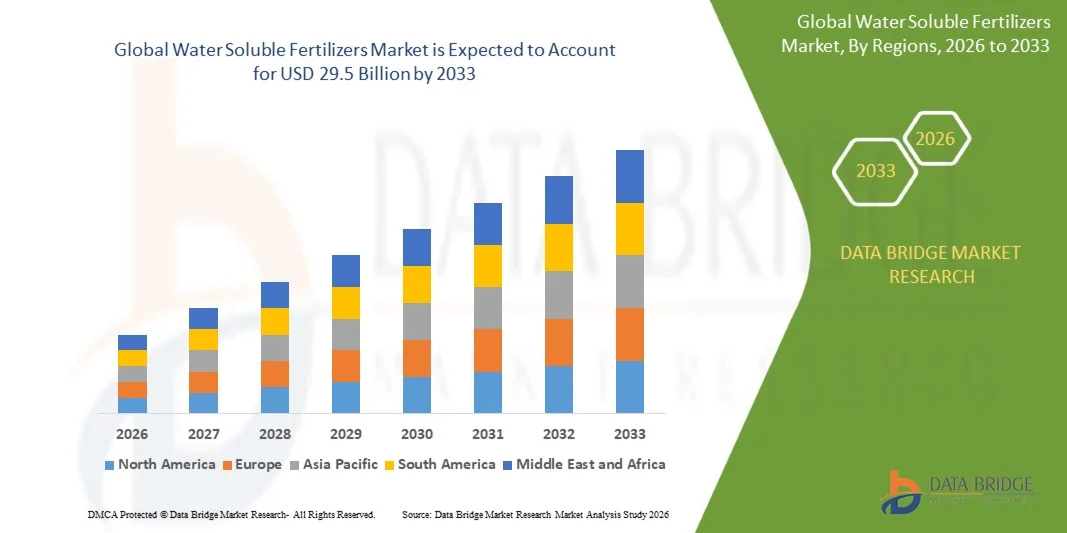
- As per Data Bridge Market Research analysis, the water soluble fertilizers market was valued at USD 17.1 billion in 2025 and is projected to reach USD 29.5 billion by 2033, growing at a CAGR of 7.20% from 2026 to 2033.
- The market is experiencing consistent growth driven by rising demand for high-efficiency, precision-applied crop nutrition, rapid advancements in fertigation and chelation technologies, and expanding applications across horticulture, greenhouse cultivation, and high-value field crop production.
- The increasing incidence of soil nutrient depletion globally, combined with stricter government regulations on fertilizer runoff and water-use efficiency, is compelling commercial farms, greenhouse operators, and agricultural extension bodies to adopt advanced water soluble fertilizer solutions. Fertigation and foliar-based nutrient delivery are replacing traditional broadcast fertilization in many markets, offering precise, resource-efficient, and yield-optimizing nutrient management for modern agriculture.
Market Size & Forecast
- Global Market Value (2025): USD 17.1 Billion
- Expected Market Value (2033): USD 29.5 Billion
- Forecast CAGR (2026–2033): 7.20%
- Leading Region in 2025: North America
- Fastest Growing Region: Asia-Pacific
What are the Major Takeaways of the Water Soluble Fertilizers Market?
- North America dominated the water soluble fertilizers market with the largest revenue share of 42.50% in 2025, supported by widespread adoption of precision agriculture, advanced fertigation systems, and strong regulatory focus on nutrient-use efficiency.
- Asia-Pacific is expected to be the fastest-growing region at a CAGR of 7.0% from 2026 to 2033, fueled by rising farm mechanization, increasing horticultural cultivation, and growing adoption in China, India, and Southeast Asia.
- The NPK WSF segment led the market with a 34.80% share in 2025, driven by cost-effectiveness, balanced nutrient delivery, and widespread use in fertigation and foliar feeding across field and horticultural crops.
- Micronutrient WSF is the fastest-growing product type, projected to register a CAGR of 7.6%, reflecting the surge in demand for chelated, deficiency-correcting nutrient formulations in high-value crop production.
- The horticultural crops segment dominated the crop type category with a 38.70% revenue share in 2025, led by fruit and vegetable growers adopting water soluble fertilizers for precise nutrient management and quality-driven yield optimization.
- Fertigation accounted for 38.20% of the market share in 2025, preferred by commercial farms and greenhouse operators that require targeted, low-wastage nutrient delivery integrated with irrigation systems.
Report Scope and Water Soluble Fertilizers Market Segmentation
Attributes |
Water Soluble Fertilizers Market Insights |
|
Segments Covered |
|
|
Countries Covered |
North America
Europe
Asia-Pacific
Middle East and Africa
South America
|
|
Key Market Players |
|
|
Market Opportunities |
|
|
Value Added Data Infosets |
In addition to the insights on market scenarios such as market value, growth rate, segmentation, geographical coverage, and major players, the market reports curated by the Data Bridge Market Research also include in-depth expert analysis, geographically represented company-wise production and capacity, network layouts of distributors and partners, detailed and updated price trend analysis and deficit analysis of supply chain and demand. |
What is the Key Trend in the Water Soluble Fertilizers Market?
- Leading crop nutrition companies are increasingly launching specialty fertigation-grade formulations to improve nutrient-use efficiency, optimize crop quality, and develop water-scarce farming solutions while reducing the cost and risk associated with nutrient wastage in field application.
- For instance, in September 2025, ICL Group introduced its Poly-Feed Soluble 20-20-20 formula optimized for fertigation across California’s vegetable belts, featuring chelated micronutrients designed to improve nutrient efficiency in water-scarce growing regions.
- Real-time soil and water testing enables agronomists to analyze nutrient uptake, salinity levels, and irrigation demand with high precision.
- Commercial farms and greenhouse operators are leveraging fertigation-based nutrient delivery to provide standardized, data-driven crop management in precision agriculture and controlled-environment growing systems.
- For instance, in October 2025, Nutrien launched HydroMax, a premium water-soluble potassium nitrate blend tailored for high-value crops such as tomatoes and strawberries, emphasizing rapid nutrient uptake and reduced leaching in U.S. hydroponic operations.
- As commercial growers and agribusinesses continue to prioritize yield optimization and cost-effective nutrient management, the adoption of advanced water soluble fertilizers is expected to accelerate, reinforcing fertigation as a core component of precision agriculture and sustainable crop nutrition.
What are the Key Drivers of the Water Soluble Fertilizers Market?
- The rapid advancement of precision agriculture and controlled irrigation systems has significantly increased demand for high-efficiency water soluble fertilizers capable of delivering targeted nutrition across millions of hectares of field and horticultural crops.
- For instance, in November 2025, Yara International expanded its water-soluble NPK fertilizer production capacity in North America with a facility upgrade, enhancing solubility for drip irrigation systems to boost crop yields amid rising precision farming adoption.
- Commercial farms, agri-input distributors, and government agricultural bodies are integrating water soluble fertilizers into their crop nutrition programs to reduce nutrient runoff, shorten growing cycles, and enhance produce quality.
- For instance, in February 2025, Haifa Group launched Haifa Soluble DUA, a fertigation-grade product balancing potassium and calcium while reducing nitrogen input for more sustainable and efficient nutrient uptake.
- With the agriculture industry increasingly relying on precision nutrient management to accelerate yield gains and ensure environmental compliance, water soluble fertilizers will remain indispensable for the development of high-value crop production and sustainable farming practices.
Which Factors are Challenging the Growth of the Water Soluble Fertilizers Market?
- Advanced water soluble fertilizers require significant upfront investment due to the integration of chelation technology, high-purity raw materials, and specialized fertigation infrastructure.
- These high costs limit adoption among smallholder farmers, cooperatives, and organizations in emerging economies.
- For instance, in 2025, industry data indicated that approximately 30 to 35 percent of farmers in several emerging Southeast Asian markets remained unaware of the benefits and proper application methods of water soluble fertilizers, demonstrating the substantial awareness and adoption gap that continues to limit deployment of next-generation crop nutrition solutions.
- The high capital investment and recurring input costs associated with advanced water soluble fertilizers continue to restrict adoption, particularly among small and medium-sized farms, cooperatives, and research institutions.
- This cost barrier slows market penetration in price-sensitive and emerging regions, limiting the widespread deployment of advanced fertigation technologies despite growing demand.
How is the Water Soluble Fertilizers Market Segmented?
The water soluble fertilizers market is segmented on the basis of product type, crop type, application, end user, manufacturing technology, nutrient composition, solubility grade, distribution channel, form, and support & services.
- By Product Type
On the basis of product type, the global water soluble fertilizers market is segmented into nitrogenous WSF, phosphatic WSF, potassic WSF, NPK WSF, and micronutrient WSF. The NPK WSF segment dominated the market with a 34.80% share in 2025, owing to cost-effectiveness, balanced nutrient delivery, and extensive use across fertigation and foliar feeding programs for field and horticultural crops. These systems deliver high-solubility, multi-nutrient formulations without complex blending infrastructure, making them the preferred choice for commercial farms, greenhouse operators, and agri-input distributors.
The micronutrient WSF segment is projected to register the fastest growth at a CAGR of 7.6% from 2026 to 2033, driven by rising demand for chelated, deficiency-correcting nutrient formulations. Advances in chelation technology, combined with declining production costs and growing adoption in horticulture and high-value crop cultivation, are accelerating segment expansion.
- By Crop Type
On the basis of crop type, the global water soluble fertilizers market is segmented into field crops, horticultural crops, turf & ornamentals, and plantation crops. The horticultural crops segment led the market with a 38.70% share in 2025, supported by extensive use in fruit and vegetable cultivation, precision nutrient management, and quality-driven yield optimization programs by commercial growers and agribusinesses globally.
The plantation crops segment is expected to experience the fastest growth at a CAGR of 6.9% from 2026 to 2033, driven by increasing demand for consistent nutrient delivery in tea, coffee, and rubber cultivation, particularly across expanding plantation operations in Asia-Pacific and South America.
- By Application
On the basis of application, the global water soluble fertilizers market is segmented into fertigation, foliar spray, soil application, hydroponics, and greenhouse cultivation. The fertigation segment dominated the market with a share of 38.20% in 2025 due to its widespread adoption by commercial farms, government irrigation programs, and agricultural cooperatives, increasing demand for water-efficient nutrient delivery, and growing integration with advanced drip and micro-irrigation technologies. additionally, rising focus on water conservation, nutrient-use efficiency, and precision crop management further supports the strong adoption of fertigation-based fertilizer solutions.
The hydroponics segment is anticipated to witness the fastest CAGR of 7.4% from 2026 to 2033, driven by this growth is fueled by the increasing reliance on water soluble fertilizers for controlled-environment agriculture, vertical farming, and soilless cultivation systems. commercial growers, urban farming enterprises, and research institutions are adopting precisely formulated nutrient solutions to conduct cost-effective, controlled, and repeatable crop production. additionally, the integration of real-time nutrient monitoring and automated dosing technologies is enhancing the accuracy and efficiency of hydroponic fertilizer application, further driving segment growth.
- By End User
On the basis of end user, the global water soluble fertilizers market is segmented into commercial farms, greenhouse & nursery operators, government & agricultural extension bodies, research institutions & universities, and home & kitchen gardening. The commercial farms segment dominated the market with a share of 46.30% in 2025 due to its critical role in large-scale crop production, yield optimization, and adoption of advanced fertigation systems for input-efficient farming. the widespread adoption of high-solubility fertilizers, drip irrigation integration, and data-driven nutrient management for precision crop nutrition, deficiency correction, and yield validation is driving strong demand for fertilizer solutions. additionally, increasing focus on input cost efficiency, regulatory compliance, and sustainable farming practices is reinforcing the dominance of this segment across global markets.
The greenhouse & nursery operators segment is expected to witness the fastest CAGR of 7.1% from 2026 to 2033, driven by the rising need for precise, controlled-environment nutrient delivery solutions for high-value ornamental and horticultural crops. Operators are increasingly integrating water soluble fertilizers into propagation, transplant, and crop-cycle nutrition programs to reduce input waste and improve produce quality. additionally, the growing emphasis on protected cultivation, export-grade quality standards, and yield consistency in commercial nursery operations is further accelerating the adoption of fertilizer technologies across this segment.
- By Manufacturing Technology
On the basis of manufacturing technology, the global water soluble fertilizers market is segmented into chelation technology, granulation & compaction, spray drying, crystallization, and blending & mixing systems. The crystallization segment dominated the market with a share of 31.90% in 2025 due to its critical role in producing high-purity, fully soluble crystalline fertilizers for fertigation and foliar applications. high adoption is driven by the increasing need for consistent solubility, integration with precision-dosing equipment, and enhanced nutrient stability. additionally, growing investment by fertilizer manufacturers, agri-input distributors, and research organizations to improve production yield, reduce impurities, and support large-scale processing is reinforcing the leading position of this segment in the market.
The chelation technology segment is expected to witness the fastest CAGR of 7.5% from 2026 to 2033, this growth is driven by increasing demand for micronutrient formulations that resist soil fixation and improve plant absorption efficiency. advanced chelating agents, including EDTA and amino-acid based complexes, are improving nutrient bioavailability and application accuracy. additionally, the adoption of these technologies in horticulture, hydroponics, and export-oriented crop production is further accelerating market expansion.
- By Nutrient Composition
On the basis of nutrient composition, the global water soluble fertilizers market is segmented into primary macronutrients, secondary macronutrients, micronutrients, biostimulant-enriched blends, and chelated micronutrient complexes. The primary macronutrients segment dominated the market with a share of 44.60% in 2025 due to its widespread use in basic crop nutrition, yield-building fertigation programs, and cost-effective large-scale field application. rising adoption of nitrogen-phosphorus-potassium blended formulations, real-time nutrient monitoring, and precision-dosing systems is enabling growers to enhance nutrient-use efficiency, improve crop uniformity, and optimize input costs. additionally, increasing investment by commercial farms, cooperatives, and government agricultural programs is accelerating adoption and reinforcing this segment’s leading position in the market.
The biostimulant-enriched blends segment is expected to witness the fastest CAGR of 7.8% from 2026 to 2033, driven by this growth is driven by the increasing adoption of nutrient formulations that combine soluble fertilizers with amino acids, seaweed extracts, and microbial inoculants for enhanced stress tolerance and root development. these products improve nutrient efficiency, support soil health, and allow tailored crop nutrition programs, making fertilizers more efficient, sustainable, and valuable for premium, export, and organic-transition farming applications.
- By Solubility Grade
On the basis of solubility grade, the global water soluble fertilizers market is segmented into fully soluble grade, technical grade, and fertigation grade. the fully soluble grade segment dominated the market with a share of 47.90% in 2025 due to its widespread adoption in commercial fertigation programs, greenhouse cultivation, and export-oriented horticulture, which require rapid dissolution and consistent nutrient concentration for precision application. high adoption is supported by commercial farms, nursery operators, and cooperative supply networks that rely on high-purity, low-residue formulations to ensure consistency, efficiency, and measurable yield outcomes. additionally, increasing integration with drip irrigation systems, automated dosing equipment, and digital agronomy platforms enhances application accuracy and reinforces the dominance of the fully soluble grade segment.
the fertigation grade segment is expected to witness the fastest CAGR of 7.3% from 2026 to 2033, driven by the growth is primarily driven by the increasing demand for irrigation-compatible, low-residue fertilizer formulations that can integrate seamlessly with micro-irrigation and drip systems across diverse crop types. by offering precise, dissolvable, and residue-free nutrient delivery, this grade enhances water-use efficiency, nutrient uptake, and yield consistency, making it highly attractive for precision agriculture, hydroponics, and water-scarce farming regions.
- By Distribution Channel
On the basis of distribution channel, the global water soluble fertilizers market is segmented into direct/institutional sales, agri-input retailers & dealers, and online & e-commerce platforms. The agri-input retailers & dealers segment dominated the market with a share of 51.60% in 2025 due to its critical role in enabling last-mile access to fertilizers for smallholder and mid-sized farms, agricultural cooperatives, and regional distributors. additionally, established partnerships with fertilizer manufacturers, agronomic advisory providers, and government extension bodies are expanding reach, improving accessibility, and reinforcing the adoption of retail-based distribution across global markets.
The online & e-commerce platforms segment is expected to witness the fastest CAGR of 7.7% from 2026 to 2033, driven by this growth is primarily driven by the increasing demand for convenient, doorstep-delivered fertilizer solutions among small-scale farmers, home gardeners, and specialty crop growers. suppliers are leveraging digital agri-commerce platforms and direct-to-farmer channels to enhance product accessibility, enable smaller order quantities, and support niche organic and specialty formulations, thereby accelerating adoption across small-scale and premium buyer segments.
- By Form
On the basis of form, the global water soluble fertilizers market is segmented into powder/crystalline and liquid concentrate. The powder/crystalline segment dominated the market with a share of 63.40% in 2025 due to its preference among commercial farms, cooperatives, and agri-input distributors that require longer shelf life, lower transport weight, and established handling infrastructure for large-scale fertigation programs. additionally, established distribution channels, regional dealers, and cold-storage-free logistics are facilitating faster delivery and adoption of powder/crystalline solutions, while strong quality assurance and traceability systems are improving accessibility, reliability, and trust, further reinforcing this segment’s leading market position.
The liquid concentrate segment is expected to witness the fastest CAGR of 7.4% from 2026 to 2033, driven by this growth is primarily driven by the increasing adoption of ready-to-use liquid formats, which enable faster dissolution, simplified dosing, and easier integration with automated fertigation systems. liquid water soluble fertilizers offer scalable, cost-effective solutions for greenhouse, hydroponic, and foliar applications, while providing precise nutrient concentration, reduced handling labor, and seamless integration with digital dosing platforms, enhancing overall application efficiency and flexibility.
- By Support & Services
On the basis of support & services, the global water soluble fertilizers market is segmented into agronomic advisory services, soil & water testing, application equipment & fertigation systems, and training & certification. The agronomic advisory services segment dominated the market with a share of 33.50% in 2025 due to its critical role in ensuring optimal nutrient scheduling, crop-specific formulation guidance, and yield outcomes across commercial farms, greenhouse operators, and agricultural cooperatives. the widespread presence of regional distributors, agronomists, and value-added resellers facilitates faster advisory delivery, localized recommendations, and timely in-season support. additionally, collaborations with research institutions, digital agronomy platforms, and fertilizer manufacturers are enhancing product accessibility, reliability, and trust, further reinforcing the leading position of the agronomic advisory services segment in the global market.
The application equipment & fertigation systems segment is expected to witness the fastest CAGR of 7.6% from 2026 to 2033, driven by this growth is primarily driven by the increasing need for automated dosing units, drip-compatible injectors, and precision fertigation controllers to ensure accurate, efficient, and traceable nutrient delivery. as commercial farms and greenhouse operators adopt advanced water soluble fertilizers, integrated application equipment becomes essential for maximizing nutrient-use efficiency, reducing labor costs, and enabling digital, sensor-based crop nutrition management.
Which Region Holds the Largest Share of the Water Soluble Fertilizers Market?
- North America dominated the water soluble fertilizers market and accounted for the largest revenue share of 42.50% in 2025, supported by widespread use of advanced fertigation systems, strong investments in precision agriculture technologies, and the presence of established crop nutrition and irrigation industries.
- The region also benefits from stringent water-use and nutrient-runoff regulations, high adoption of drip-irrigation-compatible fertilizer formulations, and growing use of water soluble fertilizers across commercial farms, greenhouses, and controlled-environment agriculture applications. Increasing focus on soil health and sustainable nutrient management continues to strengthen North America’s leadership position in the global market.
U.S. Water Soluble Fertilizers Market Insight
The U.S. water soluble fertilizers market is experiencing steady growth, supported by rising adoption of fertigation technologies in commercial farming, horticultural production, and controlled-environment agriculture applications. Increasing investments in advanced irrigation infrastructure and growing demand for cost-effective, resource-efficient nutrient solutions are contributing to market growth. Furthermore, integration of digital agronomy, precision dosing, and soil analytics technologies is improving nutrient-use efficiency and yield outcomes, positioning the U.S. as a key innovation hub in the water soluble fertilizers industry.
Germany Water Soluble Fertilizers Market Insight
The Germany water soluble fertilizers market is expanding steadily due to the country’s strong agricultural research base, advanced irrigation capabilities, and increasing adoption of next-generation crop nutrition technologies. Commercial farms, horticultural producers, and research institutes are increasingly utilizing water soluble fertilizers for precision crop nutrition, quality-driven yield management, and R&D activities. Continuous advancements in chelation technology, biostimulant integration, and sustainable nutrient formulations, along with strong government focus on environmental compliance and agricultural innovation, are further driving market growth in Germany.
Asia-Pacific Water Soluble Fertilizers Market Insight
The Asia-Pacific water soluble fertilizers market is expected to witness rapid growth, driven by increasing farm mechanization, expanding horticultural cultivation, and rising investments in irrigation infrastructure across countries such as China, India, and Japan. Growing awareness regarding soil health and nutrient-use efficiency, rising adoption of fertigation technologies, and increasing demand for scalable and cost-effective crop nutrition solutions are supporting regional market expansion. Additionally, the growing presence of commercial farming operations and export-oriented horticulture is accelerating water soluble fertilizer adoption across large-scale and smallholder sectors.
Japan Water Soluble Fertilizers Market Insight
The Japan water soluble fertilizers market is witnessing consistent growth due to rising investments in advanced crop nutrition technologies, greenhouse cultivation, and soil health initiatives. Commercial growers, horticultural producers, and research institutes are increasingly adopting high-purity water soluble fertilizers for precision nutrient management, yield enhancement, and R&D purposes. Moreover, increasing integration of chelation and biostimulant technologies and the country’s focus on efficient and sustainable farming practices are further contributing to market growth.
China Water Soluble Fertilizers Market Insight
The China water soluble fertilizers market is growing rapidly, driven by increasing farm modernization, expanding irrigation infrastructure, and rising government focus on soil health and agricultural sustainability. Growing adoption of fertigation- and hydroponics-based nutrient delivery across commercial, horticultural, and greenhouse sectors is significantly boosting market demand. In addition, rising investments in agricultural R&D, increasing awareness regarding precision crop nutrition, and rapid technological advancements are positioning China as one of the fastest-growing markets for water soluble fertilizers globally.
Which are the Top Companies in Water Soluble Fertilizers Market?
The water soluble fertilizers industry is primarily led by well-established companies, including:
- Yara International ASA (Norway)
- Nutrien Ltd. (Canada)
- ICL Group Ltd. (Israel)
- Sociedad Química y Minera de Chile (SQM) (Chile)
- K+S Aktiengesellschaft (Germany)
- Haifa Group (Israel)
- The Mosaic Company (U.S.)
- EuroChem Group AG (Switzerland)
- Coromandel International Limited (India)
- Indian Farmers Fertiliser Cooperative Limited (India)
- CF Industries Holdings, Inc. (U.S.)
- OCP Group (Morocco)
- Sinofert Holdings Limited (China)
- Compass Minerals International, Inc. (U.S.)
- Tata Chemicals Limited (India)
- Hebei Monband Water Soluble Fertilizer Co., Ltd. (China)
- Omex Agrifluids Ltd. (U.K.)
- Qatar Fertiliser Company (Qatar)
- Zuari Agro Chemicals Ltd. (India)
- Van Iperen International (Netherlands)
- Aries Agro Limited (India)
- Rashtriya Chemicals and Fertilizers Limited (India)
- Gujarat State Fertilizers & Chemicals Limited (India)
- Israel Chemicals Ltd. (Israel)
- Koch Fertilizer, LLC (U.S.)
- Tessenderlo Kerley International (Belgium)
- Nufarm Limited (Australia)
- Shanxi Lanhua Sci-Tech Co., Ltd. (China)
- OCI N.V. (Netherlands)
- PT Pupuk Indonesia (Persero) (Indonesia)
What are Latest Developments in Water Soluble Fertilizers Market?
- In September 2025, ICL Group introduced its Poly-Feed Soluble 20-20-20 formula optimized for fertigation across California’s vegetable belts, featuring chelated micronutrients designed to improve nutrient efficiency for growers operating in water-scarce regions. This development strengthens ICL’s position in the water soluble fertilizers market, enabling the company to deliver precision-formulated nutrition solutions to commercial vegetable producers facing tightening water allocations.
- In November 2025, Yara International expanded its water-soluble NPK fertilizer production capacity in North America through a facility upgrade, enhancing product solubility for compatibility with drip irrigation systems and boosting crop yields amid rising precision farming adoption across the region.
- In October 2025, Nutrien launched HydroMax, a premium water-soluble potassium nitrate blend tailored for high-value crops such as tomatoes and strawberries, emphasizing rapid nutrient uptake and reduced leaching for hydroponic growing operations in the United States.
- In February 2025, Haifa Group launched Haifa Soluble DUA, a fertigation-grade product balancing potassium and calcium while reducing nitrogen input, supporting more sustainable and efficient nutrient uptake for fertigation-based crop nutrition programs.
- In September 2025, The Mosaic Company introduced MicroEssentials Soluble DUO, a micronutrient-enriched water soluble fertilizer designed to improve yield and crop quality, backed by continued investment in expanded production capacity to meet rising fertigation demand.

- Interactive Data Analysis Dashboard
- Company Analysis Dashboard for high growth potential opportunities
- Research Analyst Access for customization & queries
- Competitor Analysis with Interactive dashboard
- Latest News, Updates & Trend analysis
- Harness the Power of Benchmark Analysis for Comprehensive Competitor Tracking
Data collection and base year analysis are done using data collection modules with large sample sizes. The stage includes obtaining market information or related data through various sources and strategies. It includes examining and planning all the data acquired from the past in advance. It likewise envelops the examination of information inconsistencies seen across different information sources. The market data is analysed and estimated using market statistical and coherent models. Also, market share analysis and key trend analysis are the major success factors in the market report. To know more, please request an analyst call or drop down your inquiry.
The key research methodology used by DBMR research team is data triangulation which involves data mining, analysis of the impact of data variables on the market and primary (industry expert) validation. Data models include Vendor Positioning Grid, Market Time Line Analysis, Market Overview and Guide, Company Positioning Grid, Patent Analysis, Pricing Analysis, Company Market Share Analysis, Standards of Measurement, Global versus Regional and Vendor Share Analysis. To know more about the research methodology, drop in an inquiry to speak to our industry experts.
Data Bridge Market Research is a leader in advanced formative research. We take pride in servicing our existing and new customers with data and analysis that match and suits their goal. The report can be customized to include price trend analysis of target brands understanding the market for additional countries (ask for the list of countries), clinical trial results data, literature review, refurbished market and product base analysis. Market analysis of target competitors can be analyzed from technology-based analysis to market portfolio strategies. We can add as many competitors that you require data about in the format and data style you are looking for. Our team of analysts can also provide you data in crude raw excel files pivot tables (Fact book) or can assist you in creating presentations from the data sets available in the report.