


What is the Water-Soluble Packaging Market Size and Growth Rate?
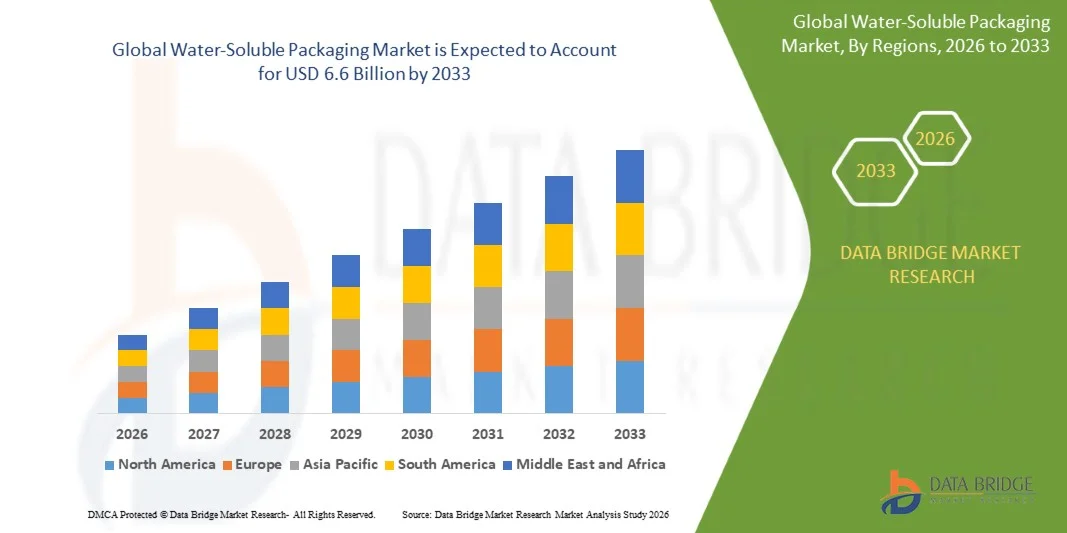
- As per Data Bridge Market Research analysis, the Water-Soluble Packaging market was valued at USD 3.85 billion in 2025 and is projected to reach USD 6.6 billion by 2033, growing at a CAGR of 7.10 % from 2026 to 2033
- The market is experiencing steady growth as a result of increasing environmental awareness, stringent regulations on single-use plastics, and rising consumer preference for sustainable packaging solutions.
- The global water-soluble packaging market has evolved significantly, with consumers becoming more environmentally conscious and demanding packaging solutions that dissolve completely in water without leaving harmful residues. Water-Soluble packaging refers to packaging materials that dissolve completely in water without leaving harmful residues, primarily made from biodegradable polymers such as polyvinyl alcohol (PVA). The global Water-Soluble packaging market is poised for continued expansion in the coming years, driven by the escalating demand for sustainable packaging solutions and the rapid growth of the eco-friendly packaging industry worldwide.
Market Size & Forecast
- Global Market Value (2025): USD 3.85 Billion
- Expected Market Value (2033): USD 6.6 Billion
- Forecast CAGR (2026 to 2033): 7.10 %
- Leading Region in 2025: Asia Pacific
- Fastest Growing Region: Asia Pacific
What are the Major Takeaways of the Water-Soluble Packaging Market?
- Asia Pacific dominated the global Water-Soluble packaging market with the largest revenue share of 42.18% in 2025, supported by deep manufacturing capacity, technical know-how, and strong demand from detergent, agrochemical, and healthcare industries across the region.
- Asia Pacific is also expected to be the fastest-growing region during the forecast period, fuelled by increasing environmental regulations, rising awareness of sustainable films, and growing investments in eco-packaging in countries such as China and India. The global Water-Soluble packaging market was valued at USD 4.02 billion in 2025 and is projected to reach USD 6.41 billion by 2034
- The films segment accounted for the largest market share of 48.73% in 2025, driven by their widespread use in detergent pods, agrochemical packaging, and food applications due to their excellent solubility, film-forming capability, and compatibility with a variety of active ingredients.
- The detergents application segment accounted for the largest market share of 37.42% in 2025, driven by the growing demand for single-use detergent pods and the convenience they offer in preventing wastage, spillage, and overdosing.
- The pods and capsules packaging type is the fastest-growing segment, projected to register a CAGR of 7.40% from 2026 to 2033, driven by increasing demand for single-use and unit-dose packaging solutions in household detergents, personal care, and food applications.
Report Scope and Water-Soluble Packaging Market Segmentation
|
Attributes |
Water-Soluble Packaging Key Market Insights |
|
Segments Covered |
|
|
Countries Covered |
North America
Europe
Asia-Pacific
Middle East and Africa
South America
|
|
Key Market Players |
|
|
Market Opportunities |
|
|
Value Added Data Infosets |
In addition to the insights on market scenarios such as market value, growth rate, segmentation, geographical coverage, and major players, the market reports curated by the Data Bridge Market Research also include in-depth expert analysis, pricing analysis, brand share analysis, consumer survey, demography analysis, supply chain analysis, value chain analysis, raw material/consumables overview, vendor selection criteria, PESTLE Analysis, Porter Analysis, and regulatory framework. |
What is the Key Trend in the Water-Soluble Packaging Market?
- The Water-Soluble packaging market is experiencing significant transformation as a result of growing environmental concerns, stringent sustainability regulations, and rising consumer preference for environmentally friendly packaging solutions. The global Water-Soluble packaging market was valued at USD 4.02 billion in 2025 and is projected to reach USD 6.41 billion by 2034, registering a CAGR of 5.34% during the forecast period (2026–2034).
- For instance, in October 2025, SmartSolve launched PureNil 0, the world's first plastic-free, 100% bio-based, and flushable packaging substrate designed to help brands achieve advanced sustainability goals.
- For instance, Kuraray offers biodegradable PVA resins and films for Water-Soluble packaging applications in detergents, agrochemicals, and industrial products, significantly expanding the application scope beyond traditional uses.
- For instance, in December 2025, Navico Group announced it is using Aquapak's Hydropol water-soluble bags to protect its marine electronics during shipping, as Hydropol is dissolvable, biodegradable, and non-toxic to marine life.
- As manufacturers continue to prioritize sustainability and invest in innovative technologies, the adoption of Water-Soluble packaging is expected to accelerate, reinforcing its position as a core component of the sustainable packaging industry.
What are the Key Drivers of the Water-Soluble Packaging Market?
- Growing environmental concerns and stringent regulations on single-use plastics are primary drivers of Water-Soluble packaging demand. Governments worldwide are implementing bans on single-use plastics, encouraging industries to shift toward biodegradable alternatives.
- For instance, regulatory frameworks such as the EU's Single-Use Plastics Directive and increasing bans on non-biodegradable packaging in North America are significant growth catalysts. The United States shows momentum via EPA endorsements for water-soluble pesticide packaging and state-level Extended Producer Responsibility (EPR) laws.
- The convenience and efficiency that Water-Soluble packaging provides in application is significantly driving market growth. Industries such as detergents and agrochemicals benefit from the precise dosing and ease of use that these packages offer, which enhances product safety by preventing human contact with potentially harmful substances.
- For instance, the detergents segment accounted for the largest market share of 37.42% in 2025, driven by the growing demand for single-use detergent pods and the convenience they offer in preventing wastage, spillage, and overdosing.
- The rising demand for sustainable packaging solutions across multiple industries is driving widespread adoption. For instance, the agricultural sector currently dominates the Water-Soluble packaging market, accounting for approximately 38.0% of the global share in 2025, with Water-Soluble films and pouches preferred for delivering pesticides, fertilizers, and seeds.
- As environmental regulations continue to tighten and consumer awareness of plastic pollution grows, Water-Soluble packaging will remain indispensable for meeting sustainability goals across multiple industries.
Which Factors are Challenging the Growth of the Water-Soluble Packaging Market?
- High production costs and limited availability of specialized materials and machinery serve as significant restraints on market growth. Water-Soluble packaging often requires specialized materials and manufacturing processes, which can be more expensive than conventional plastic packaging.
- For instance, manufacturing Water-Soluble polymers remains 2-3 times more expensive than conventional plastics, creating adoption resistance in price-sensitive markets and limiting adoption among price-sensitive consumers, particularly in emerging economies.
- Limited material strength and durability for all applications pose significant challenges. Certain formulations lack the necessary resistance to moisture, heat, and mechanical stress, affecting usability in specific sectors.
- For instance, poor gas barrier performance limits shelf life to under a year, restricting their use in applications requiring long-term stability and limiting their adoption in certain food and pharmaceutical applications.
- Overcoming these challenges requires increased investment in research and development to improve performance and cost-effectiveness, collaboration with startups to codevelop solutions, and effective marketing strategies to promote the benefits of Water-Soluble packaging.
How is the Water-Soluble Packaging Market Segmented?
The Water-Soluble Packaging market is segmented on the basis of material, packaging type, and application.
-
By Material
On the basis of material, the global Water-Soluble packaging market is segmented into polyvinyl alcohol (PVOH/PVA), starch-based polymers, cellulose-based polymers, and others. The polyvinyl alcohol (PVOH/PVA) segment dominated the market with a 58.50% share in 2025, driven by excellent film-forming properties, superior water solubility, and widespread adoption across detergents, agrochemicals, and industrial applications. These materials deliver high tensile strength and complete dissolution without leaving toxic residues, making them the preferred choice for packaging manufacturers and end-use industries.
The cellulose-based polymers segment is projected to register the fastest growth at a CAGR of 8.40% from 2026 to 2033, driven by increasing consumer preference for bio-based and renewable packaging materials. Advances in cellulose extraction technologies, growing environmental awareness, and rising demand for sustainable packaging solutions are accelerating segment expansion.
-
By Packaging Type
On the basis of packaging type, the global Water-Soluble packaging market is segmented into films & bags, pouches, sachets, capsules, and others. The films & bags segment dominated the market with a 41.25% share in 2025, owing to extensive use in industrial applications, agricultural chemicals, and unit-dose packaging for detergents and cleaning products. These packaging formats deliver superior functionality, ease of handling, and complete dissolution, making them the preferred choice for manufacturers across various industries.
The pods & capsules segment is expected to witness the fastest growth at a CAGR of 7.40% from 2026 to 2033, driven by increasing demand for single-use and unit-dose packaging solutions in household detergents, personal care, and food applications. Growing consumer preference for convenient, pre-measured formats and rising adoption of water-soluble capsules are accelerating segment expansion.
-
By Application
On the basis of application, the global Water-Soluble packaging market is segmented into detergents and cleaning products, agrochemicals, water treatment chemicals, food and beverages, and others. The detergents and cleaning products segment dominated the market with a 39.40% share in 2025, supported by widespread adoption of unit-dose detergent pods and increasing consumer demand for convenient, pre-measured cleaning solutions. Growing environmental concerns and preference for eco-friendly packaging alternatives are reinforcing the leading position of this segment.
The water treatment chemicals segment is expected to witness the fastest growth at a CAGR of 8.60% from 2026 to 2033, driven by increasing demand for safe and efficient chemical dosing solutions in industrial and municipal water treatment applications. Rising environmental regulations regarding chemical handling, growing adoption of water-soluble packaging in chemical industries, and increasing investments in water infrastructure projects are accelerating market expansion across this segment.
Which Region Holds the Largest Share of the Water-Soluble Packaging Market?
- Asia Pacific dominated the global Water-Soluble packaging market and accounted for the largest revenue share of 42.18% in 2025, supported by deep manufacturing capacity, technical know-how, and strong demand from detergent, agrochemical, and healthcare industries across the region.
- The region also benefits from increasing environmental regulations, rising awareness of sustainable films, and growing investments in eco-packaging in countries such as China and India. Increasing focus on sustainable packaging solutions and government bans on single-use plastics continues to strengthen Asia Pacific's leadership position in the global market.
U.S. Water-Soluble Packaging Market Insight
The U.S. Water-Soluble packaging market is experiencing steady growth, supported by strong environmental regulations, high consumer awareness regarding sustainable packaging, and the widespread adoption of single-dose laundry pods and dishwasher tablets in American households. The market is projected to continue its steady growth trajectory, driven by EPA endorsements for water-soluble pesticide packaging and state-level Extended Producer Responsibility (EPR) laws. Furthermore, integration of advanced polymer technologies and increasing investments in sustainable packaging are improving product performance and environmental benefits, positioning the U.S. as a key innovation hub in the Water-Soluble packaging industry.
China Water-Soluble Packaging Market Insight
The China Water-Soluble packaging market is expanding rapidly due to the country's strong manufacturing base, increasing environmental awareness, and rising government focus on reducing plastic waste. Government bans on single-use plastics, agricultural modernization, and the growing presence of international brands expanding their sustainable packaging initiatives are significantly driving market demand. Continuous advancements in biodegradable polymer technologies, along with strong government focus on sustainability and innovation, are further driving market growth in China.
India Water-Soluble Packaging Market Insight
The India Water-Soluble packaging market is witnessing a surge in demand, driven by multiple factors including agricultural modernization, packaging reforms, and the modernization of agriculture in India and Southeast Asia. Rising awareness of sustainable packaging, increasing environmental regulations, and growing demand for eco-friendly packaging solutions across detergents, agrochemicals, and healthcare sectors are supporting regional market expansion. Additionally, the growing presence of international brands and expanding e-commerce penetration are accelerating market adoption across commercial and industrial sectors.
Japan Water-Soluble Packaging Market Insight
The Japan Water-Soluble packaging market is witnessing consistent growth due to rising environmental concerns, stringent regulations on single-use plastics, and the country's expertise in polymer technology and specialty product development. Japan's strong position in specialty chemical and pharmaceutical packaging, combined with its emphasis on product innovation, continues to support market expansion. Moreover, increasing integration of advanced materials and the country's focus on sustainable and efficient packaging solutions are further contributing to market growth.
Which are the Top Companies in Water-Soluble Packaging Market?
The Water-Soluble Packaging industry is primarily led by well-established companies, including:
- Kuraray Co., Ltd. (Japan)
- MonoSol LLC (U.S.)
- Sekisui Chemical Co., Ltd. (Japan)
- Mitsubishi Chemical Group Corporation (Japan)
- Aicello Corporation (Japan)
- Aquapak Polymers Ltd. (U.K.)
- Cortec Corporation (U.S.)
- Arrow GreenTech Ltd. (India)
- Lactips (France)
- Changzhou Water-Soluble Co., Ltd. (China)
- Nippon Synthetic Chemical Industry Co., Ltd. (Japan)
- AMC (UK) Ltd. (U.K.)
- Soltec Development SA (Switzerland)
- Aqua Pack Technologies, Inc. (U.S.)
- Lithey Inc. (U.S.)
What are Latest Developments in Water-Soluble Packaging Market?
- In June 2026, Lactips (France) and SmartSolve (U.S.) unveiled water-soluble, microplastic-free packaging solutions at Edition Spéciale by Luxe Pack in Paris, designed for the beauty, cosmetics, and personal care sectors. The applications are based on PureNil 0, a bio-based functionalized paper that enables plastic-free flexible packaging which rapidly disperses in water without leaving microplastic residues. This collaboration combines Lactips' natural polymer technology with SmartSolve's water-soluble paper materials to accelerate the adoption of plastic-free packaging worldwide.
- In June 2026, Aicello Corporation (Japan) was issued a U.S. patent for "Water-soluble film for liquid detergent package capsule, and liquid detergent package capsule" (Patent No. EP4674786A1). The patent covers a water-soluble film for molding packaging capsules capable of enclosing chemical agents, especially detergents, with robust leakage prevention properties.
- In May 2026, TerraSafe announced the launch of two groundbreaking plastic-free products following its merger with DisSolves: water-soluble laundry detergent sheets and edible pod packaging, now available for pre-order. The edible, water-soluble pods are crafted from natural, food-safe ingredients that dissolve cleanly in beverages without residue or plastic waste, designed for powdered products like protein, coffee, and supplements. This merger unites DisSolves' pioneering water-soluble film technology with TerraSafe's platform to accelerate the mission of making plastic-free consumer packaged goods the simpler, smarter choice.
- In March 2026, Kuraray America showcased sustainable packaging innovation at Sustainability in Packaging US 2026, presenting its KURARAY POVAL and EXCEVAL polyvinyl alcohol (PVOH)-based barrier coatings. These coatings are designed to enable recyclability in mono-material flexible packaging without compromising performance, providing water, grease, and gas barrier performance even under high-humidity conditions. Rooted in PVOH technology, the polymer is inherently biodegradable and provides high-performance solutions for sustainable paper and flexible packaging applications.
- In January 2026, Aquapak Polymers Ltd. (U.K.) secured a strategic investment from London-based private equity fund ADM Capital Europe's Cibus Enterprise Fund to accelerate the development of its Hydropol polymer and expand its application within the global food sector. Hydropol is a novel biodegradable, non-toxic, and water-soluble polymer that is three times stronger than alternatives and can be easily processed into films, coatings, laminates, and injection molds. The investment enables Aquapak to accelerate development and expand application within the global food sector.
- In January 2026, SmartSolve (U.S.) announced the commercial launch of PureNil 0, the world's first plastic-free, 100% bio-based, printable, and flushable flexible packaging substrate. The material entered ramp production on January 8, 2026, following successful validation and production readiness. PureNil 0 runs on standard form-fill-seal equipment, enabling manufacturers to adopt plastic-free packaging without equipment modifications, and is certified for direct food contact. The product applications span home cleaning, beauty, personal care, agriculture, and specific healthcare applications.

- Interactive Data Analysis Dashboard
- Company Analysis Dashboard for high growth potential opportunities
- Research Analyst Access for customization & queries
- Competitor Analysis with Interactive dashboard
- Latest News, Updates & Trend analysis
- Harness the Power of Benchmark Analysis for Comprehensive Competitor Tracking
Global Water Soluble Packaging Market, Supply Chain Analysis and Ecosystem Framework
To support market growth and help clients navigate the impact of geopolitical shifts, DBMR has integrated in-depth supply chain analysis into its Global Water Soluble Packaging Market research reports. This addition empowers clients to respond effectively to global changes affecting their industries. The supply chain analysis section includes detailed insights such as Global Water Soluble Packaging Market consumption and production by country, price trend analysis, the impact of tariffs and geopolitical developments, and import and export trends by country and HSN code. It also highlights major suppliers with data on production capacity and company profiles, as well as key importers and exporters. In addition to research, DBMR offers specialized supply chain consulting services backed by over a decade of experience, providing solutions like supplier discovery, supplier risk assessment, price trend analysis, impact evaluation of inflation and trade route changes, and comprehensive market trend analysis.
Data collection and base year analysis are done using data collection modules with large sample sizes. The stage includes obtaining market information or related data through various sources and strategies. It includes examining and planning all the data acquired from the past in advance. It likewise envelops the examination of information inconsistencies seen across different information sources. The market data is analysed and estimated using market statistical and coherent models. Also, market share analysis and key trend analysis are the major success factors in the market report. To know more, please request an analyst call or drop down your inquiry.
The key research methodology used by DBMR research team is data triangulation which involves data mining, analysis of the impact of data variables on the market and primary (industry expert) validation. Data models include Vendor Positioning Grid, Market Time Line Analysis, Market Overview and Guide, Company Positioning Grid, Patent Analysis, Pricing Analysis, Company Market Share Analysis, Standards of Measurement, Global versus Regional and Vendor Share Analysis. To know more about the research methodology, drop in an inquiry to speak to our industry experts.
Data Bridge Market Research is a leader in advanced formative research. We take pride in servicing our existing and new customers with data and analysis that match and suits their goal. The report can be customized to include price trend analysis of target brands understanding the market for additional countries (ask for the list of countries), clinical trial results data, literature review, refurbished market and product base analysis. Market analysis of target competitors can be analyzed from technology-based analysis to market portfolio strategies. We can add as many competitors that you require data about in the format and data style you are looking for. Our team of analysts can also provide you data in crude raw excel files pivot tables (Fact book) or can assist you in creating presentations from the data sets available in the report.













