


What is the Water Testing Equipment Market Size and Growth Rate?
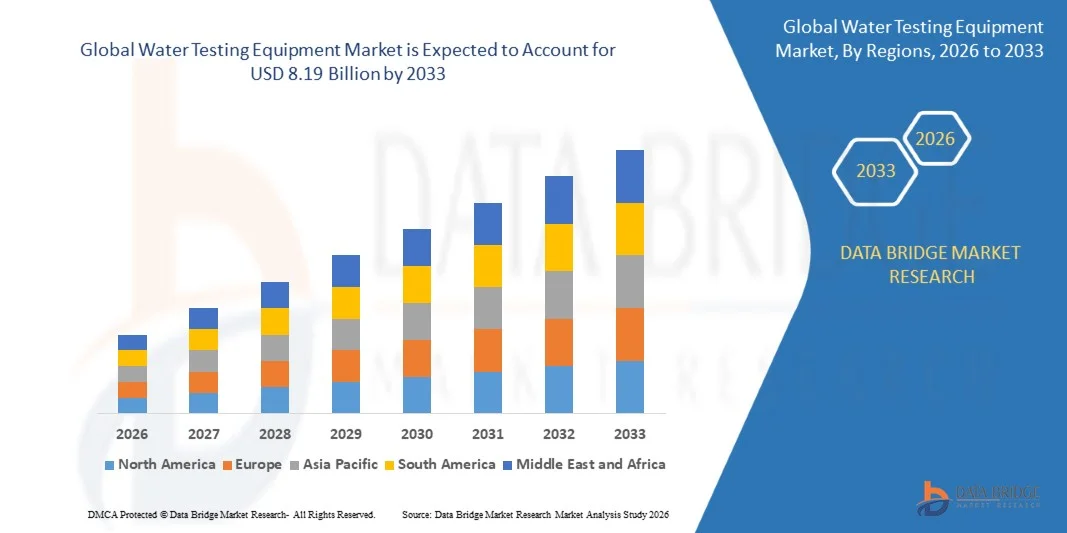
- As per Data Bridge Market Research analysis the water testing equipment market was valued at USD 5.14 billion in 2025 and is projected to reach USD 8.19 billion by 2033, growing at a CAGR of 6.00% from 2026 to 2033.
- The market is experiencing steady growth driven by increasing concerns over water quality and public health, stringent environmental regulations, and rising demand for advanced water monitoring technologies across municipal, industrial, and commercial sectors.
- The growing incidence of water contamination, expanding investments in wastewater treatment infrastructure, and increasing adoption of real-time water quality monitoring systems are encouraging utilities, industries, and regulatory agencies to deploy advanced water testing equipment for accurate and efficient water analysis.
Market Size & Forecast
- Market Value (2025): USD 5.14 Billion
- Expected Market Value (2033): USD 8.19 Billion
- Forecast CAGR (2026–2033): 6.00%
- Leading Region in 2025: North America
- Fastest Growing Region: Asia-Pacific
What are the Major Takeaways of the Water Testing Equipment Market?
- North America dominated the water testing equipment market in 2025, supported by stringent water quality regulations, advanced water treatment infrastructure, and increasing investments in smart water management technologies.
- Asia-Pacific water testing equipment market is expected to witness the fastest growth rate from 2026 to 2033, supported by rapid industrialization, urbanization, rising concerns over water pollution, and increasing government investments in drinking water and wastewater treatment infrastructure.
- The electrochemistry segment dominated the market in 2025, driven by its widespread use in measuring pH, conductivity, dissolved oxygen, and other key water quality parameters across municipal, industrial, and environmental applications. Its high accuracy, cost-effectiveness, and ease of deployment continue to support broad adoption.
- The process analysers segment is expected to witness the fastest growth during the forecast period of 2026 to 2033, driven by increasing demand for continuous online monitoring, industrial automation, and real-time water quality management across water treatment and manufacturing facilities.
- The pH test segment dominated the market in 2025, driven by its essential role in drinking water, wastewater, industrial process control, and environmental monitoring. pH testing remains one of the most frequently performed analyses for maintaining regulatory compliance and water quality standards.
- The turbidity test segment is expected to witness the fastest growth during the forecast period of 2026 to 2033, driven by growing investments in drinking water treatment, stricter water quality regulations, and increasing demand for continuous monitoring of suspended particles.
Report Scope and Water Testing Equipment Market Segmentation
|
Attributes |
Water Testing Equipment Key Market Insights |
|
Segments Covered |
|
|
Countries Covered |
North America
Europe
Asia-Pacific
Middle East and Africa
South America
|
|
Key Market Players |
|
|
Market Opportunities |
|
|
Value Added Data Infosets |
In addition to the market insights such as market value, growth rate, market segments, geographical coverage, market players, and market scenario, the market report curated by the Data Bridge Market Research team includes in-depth expert analysis, import/export analysis, pricing analysis, production consumption analysis, and pestle analysis. |
What is the Key Trend in the Water Testing Equipment Market?
- Water utilities and industrial facilities are increasingly adopting smart water testing equipment integrated with IoT, cloud connectivity, and real-time analytics to continuously monitor water quality and ensure regulatory compliance.
- For instance, in May 2024, Xylem introduced the next generation of its YSI IQ Series online water quality monitoring solutions, enabling continuous remote monitoring and advanced digital water management for utilities and industrial users.
- Manufacturers are focusing on portable, automated, and multi-parameter testing systems that deliver faster, more accurate results while reducing manual intervention and operational costs.
- For instance, in June 2024, Thermo Fisher Scientific expanded its water analysis portfolio with advanced laboratory and field testing solutions designed to improve contaminant detection and water quality assessment across environmental and industrial applications.
- As regulatory agencies continue to strengthen water quality standards and utilities increasingly invest in digital monitoring infrastructure, the adoption of advanced water testing equipment is expected to accelerate, making continuous water quality monitoring a critical component of modern water management.
What are the Key Drivers of the Water Testing Equipment Market?
- The increasing occurrence of water contamination, stricter environmental regulations, and rising investments in drinking water and wastewater infrastructure are significantly driving demand for advanced water testing equipment worldwide.
- For instance, in April 2024, Hach launched the EZ Series online analyzers to improve automated nutrient and water quality monitoring for municipal and industrial water treatment applications.
- Water utilities, industrial facilities, environmental agencies, and research laboratories are increasingly deploying advanced testing instruments to improve regulatory compliance, operational efficiency, and public health protection.
- For instance, in March 2024, HORIBA expanded its portfolio of water quality analyzers with enhanced digital monitoring capabilities for environmental and industrial applications, supporting faster and more reliable water analysis.
- With governments worldwide increasing investments in water infrastructure modernization and environmental protection, water testing equipment will remain essential for ensuring safe drinking water, wastewater treatment efficiency, and sustainable water resource management.
Which Factors are Challenging the Growth of the Water Testing Equipment Market?
- Advanced water testing equipment requires substantial upfront investment due to sophisticated sensors, analytical technologies, calibration systems, and digital monitoring capabilities.
- These high costs limit adoption among small municipalities, laboratories, and industrial facilities, particularly across developing economies with limited infrastructure budgets.
- For instance, in October 2024, the U.S. Environmental Protection Agency (EPA) continued expanding requirements for drinking water monitoring under new regulatory frameworks, highlighting the need for advanced analytical equipment and increased investment by water utilities.
- High capital costs, ongoing calibration and maintenance requirements, shortage of skilled personnel, and the complexity of integrating advanced monitoring systems with existing infrastructure continue to restrict market growth. These challenges slow adoption, particularly among small and medium-sized utilities despite growing global demand for accurate and continuous water quality monitoring.
How is the Water Testing Equipment Market Segmented?
The market is segmented on the basis of technology, test type, device type, and application.
- By Technology
On the basis of technology, the water testing equipment market is segmented into electrochemistry, molecular spectroscopy, atomic spectroscopy, chromatography and mass spectrometry, and process analysers. The electrochemistry segment dominated the market in 2025, driven by its widespread use in measuring pH, conductivity, dissolved oxygen, and other key water quality parameters across municipal, industrial, and environmental applications. Its high accuracy, cost-effectiveness, and ease of deployment continue to support broad adoption.
The process analysers segment is expected to witness the fastest growth during the forecast period of 2026 to 2033, driven by increasing demand for continuous online monitoring, industrial automation, and real-time water quality management across water treatment and manufacturing facilities.
- By Test Type
On the basis of test type, the water testing equipment market is segmented into pH test, dissolved oxygen test, conductivity test, turbidity test, and T.D.C. tests. The pH test segment dominated the market in 2025, driven by its essential role in drinking water, wastewater, industrial process control, and environmental monitoring. pH testing remains one of the most frequently performed analyses for maintaining regulatory compliance and water quality standards.
The turbidity test segment is expected to witness the fastest growth during the forecast period of 2026 to 2033, driven by growing investments in drinking water treatment, stricter water quality regulations, and increasing demand for continuous monitoring of suspended particles.
- By Device Type
On the basis of device type, the water testing equipment market is segmented into stationery or bench-top and portable. The stationery or bench-top segment dominated the market in 2025, driven by its high analytical precision, multi-parameter testing capabilities, and widespread adoption across laboratories, research institutes, and water treatment facilities for comprehensive water analysis.
The portable segment is expected to witness the fastest growth during the forecast period of 2026 to 2033, driven by increasing field testing requirements, rapid emergency water quality assessments, and growing demand for on-site environmental and industrial monitoring solutions.
- By Application
On the basis of application, the water testing equipment market is segmented into industrial, environmental, laboratory, and government. The industrial segment dominated the market in 2025, driven by increasing water quality monitoring requirements across manufacturing, food and beverage, pharmaceuticals, power generation, and chemical processing industries. Growing regulatory compliance and process optimization initiatives continue to support segment growth.
The environmental segment is expected to witness the fastest growth during the forecast period of 2026 to 2033, driven by rising investments in environmental protection programs, expanding surface and groundwater monitoring initiatives, and increasing focus on sustainable water resource management by government agencies and environmental organizations.
Which Region Holds the Largest Share of the Water Testing Equipment Market?
- North America dominated the water testing equipment market in 2025, supported by stringent water quality regulations, advanced water treatment infrastructure, and increasing investments in smart water management technologies.
- Utilities, industrial facilities, and environmental agencies across the region prioritize continuous water quality monitoring to ensure regulatory compliance and public health. Strong adoption of digital monitoring solutions and laboratory automation further supports regional market growth.
U.S. Water Testing Equipment Market Insight
The U.S. water testing equipment market captured the largest share within North America in 2025, fueled by increasing investments in drinking water and wastewater infrastructure, stringent Environmental Protection Agency (EPA) regulations, and growing adoption of real-time water quality monitoring technologies. Rising industrial water reuse initiatives and modernization of municipal water systems continue to drive demand for advanced testing equipment.
Europe Water Testing Equipment Market Insight
Europe water testing equipment market is expected to witness the fastest growth rate from 2026 to 2033, primarily driven by stringent environmental regulations, increasing focus on water conservation, and expanding investments in sustainable water infrastructure. Growing adoption of digital water monitoring technologies across industrial, municipal, and environmental applications is accelerating market expansion throughout the region.
U.K. Water Testing Equipment Market Insight
U.K. water testing equipment market is expected to witness the fastest growth rate from 2026 to 2033, driven by increasing investments in water infrastructure modernization, stricter water quality standards, and rising adoption of smart monitoring technologies by utilities and industrial operators. Growing emphasis on environmental sustainability and pollution control is further supporting market growth.
Germany Water Testing Equipment Market Insight
Germany water testing equipment market is expected to witness the fastest growth rate from 2026 to 2033, fueled by strong environmental protection policies, advanced industrial manufacturing, and increasing demand for precision analytical instruments. The country's focus on sustainable water management and industrial process optimization continues to encourage widespread adoption of advanced water testing technologies.
Asia-Pacific Water Testing Equipment Market Insight
The Asia-Pacific water testing equipment market is expected to witness the fastest growth rate from 2026 to 2033, supported by rapid industrialization, urbanization, rising concerns over water pollution, and increasing government investments in drinking water and wastewater treatment infrastructure. Expanding smart city initiatives and growing awareness of water quality are accelerating the adoption of advanced testing equipment across the region.
Japan Water Testing Equipment Market Insight
Japan water testing equipment market is expected to witness the fastest growth rate from 2026 to 2033 due to the country's advanced water treatment technologies, strict environmental regulations, and strong emphasis on public health and water quality. Increasing adoption of automated and high-precision analytical instruments across industrial and municipal applications continues to support market expansion.
China Water Testing Equipment Market Insight
The China water testing equipment market accounted for the largest market share in Asia-Pacific in 2025, attributed to rapid industrialization, expanding urban infrastructure, and increasing government initiatives to improve water quality. Rising investments in wastewater treatment facilities, environmental monitoring programs, and smart water management systems continue to drive strong demand for advanced water testing equipment across the country.
Which are the Top Companies in Water Testing Equipment Market?
The water testing equipment industry is primarily led by well-established companies, including:
- Thermo Fisher Scientific Inc. (U.S.)
- Danaher Corporation (U.S.)
- Xylem Inc. (U.S.)
- Agilent Technologies, Inc. (U.S.)
- Honeywell International Inc. (U.S.)
- Emerson Electric Co. (U.S.)
- AMETEK, Inc. (U.S.)
- General Electric Company (U.S.)
- Teledyne Technologies Incorporated (U.S.)
- HORIBA, Ltd. (Japan)
- Shimadzu Corporation (Japan)
- Endress+Hauser Group (Switzerland)
- Mettler-Toledo International Inc. (U.S.)
- Metrohm AG (Switzerland)
- Yokogawa Electric Corporation (Japan)
What are Latest Developments in Water Testing Equipment Market?
- In February 2025, Thermo Fisher Scientific launched a new series of electrochemistry bench meters featuring advanced touchscreen controls, simplified calibration, and integrated data logging for accurate measurement of pH, conductivity, and dissolved oxygen. The launch enhances laboratory efficiency, improves regulatory compliance, and supports reliable water quality analysis across environmental, industrial, and quality control applications.
- In November 2024, Veralto announced a strategic minority investment in Axine Water Technologies through its Trojan Technologies business to accelerate the deployment of advanced electrochemical wastewater treatment solutions. The partnership expands the removal of persistent contaminants such as PFAS and complex organic compounds, strengthening water treatment capabilities for municipal and industrial customers while supporting innovation in the global water testing equipment market.

- Interactive Data Analysis Dashboard
- Company Analysis Dashboard for high growth potential opportunities
- Research Analyst Access for customization & queries
- Competitor Analysis with Interactive dashboard
- Latest News, Updates & Trend analysis
- Harness the Power of Benchmark Analysis for Comprehensive Competitor Tracking
Data collection and base year analysis are done using data collection modules with large sample sizes. The stage includes obtaining market information or related data through various sources and strategies. It includes examining and planning all the data acquired from the past in advance. It likewise envelops the examination of information inconsistencies seen across different information sources. The market data is analysed and estimated using market statistical and coherent models. Also, market share analysis and key trend analysis are the major success factors in the market report. To know more, please request an analyst call or drop down your inquiry.
The key research methodology used by DBMR research team is data triangulation which involves data mining, analysis of the impact of data variables on the market and primary (industry expert) validation. Data models include Vendor Positioning Grid, Market Time Line Analysis, Market Overview and Guide, Company Positioning Grid, Patent Analysis, Pricing Analysis, Company Market Share Analysis, Standards of Measurement, Global versus Regional and Vendor Share Analysis. To know more about the research methodology, drop in an inquiry to speak to our industry experts.
Data Bridge Market Research is a leader in advanced formative research. We take pride in servicing our existing and new customers with data and analysis that match and suits their goal. The report can be customized to include price trend analysis of target brands understanding the market for additional countries (ask for the list of countries), clinical trial results data, literature review, refurbished market and product base analysis. Market analysis of target competitors can be analyzed from technology-based analysis to market portfolio strategies. We can add as many competitors that you require data about in the format and data style you are looking for. Our team of analysts can also provide you data in crude raw excel files pivot tables (Fact book) or can assist you in creating presentations from the data sets available in the report.













