


Global Waterjet Cutting Machine Market
Market Size in USD Billion
CAGR :
% 
 USD
1.31 Billion
USD
2.28 Billion
2025
2033
USD
1.31 Billion
USD
2.28 Billion
2025
2033
 Forecast Period Forecast Period |
2026 –2033 |
 Market Size (Base Year) Market Size (Base Year) |
USD 1.31 Billion |
 Market Size (Forecast Year) Market Size (Forecast Year) |
USD 2.28 Billion |
 CAGR CAGR |
% |
| Major Markets Players |
|
Waterjet Cutting Machine Market Size
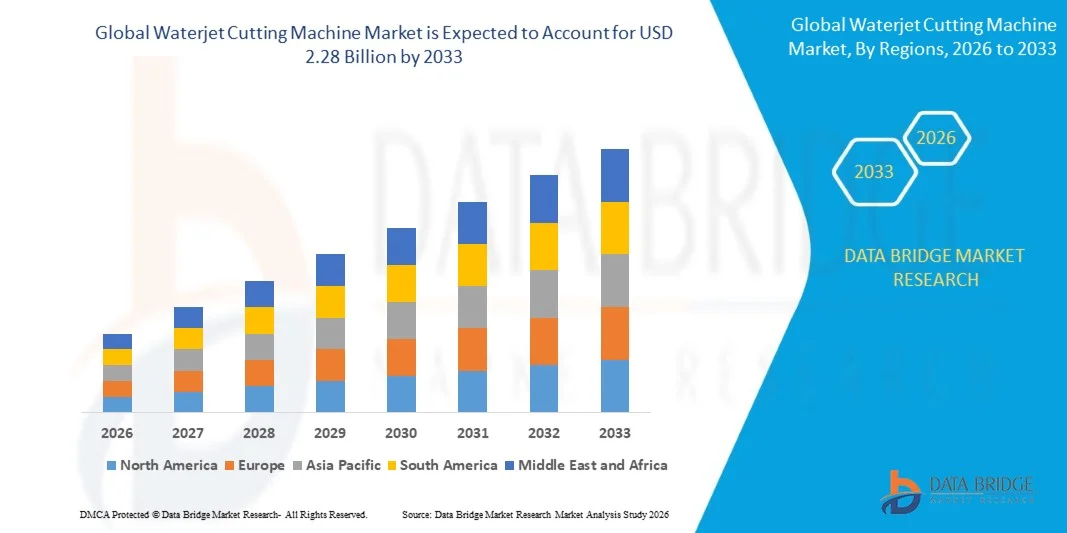
- The global waterjet cutting machine market size was valued at USD 1.31 billion in 2025 and is expected to reach USD 2.28 billion by 2033, at a CAGR of 7.20% during the forecast period
- The market growth is largely fuelled by the rising demand for high-precision cutting technologies across industries such as aerospace, automotive, and metal fabrication, where accuracy and clean cutting edges are critical
- Increasing preference for cold cutting processes that eliminate heat-affected zones and maintain material integrity is further accelerating market adoption across advanced manufacturing sectors
Waterjet Cutting Machine Market Analysis
- The market is witnessing strong adoption due to its ability to cut a wide range of materials, including metals, composites, glass, and ceramics, making it highly versatile for industrial applications
- Increasing focus on precision engineering, reduced material wastage, and environmentally friendly cutting processes is driving demand for waterjet technology over conventional cutting methods
- North America dominated the waterjet cutting machine market with the largest revenue share in 2025, driven by strong industrial automation, advanced manufacturing infrastructure, and high adoption of precision cutting technologies across aerospace, automotive, and metal fabrication industries
- The Asia-Pacific region is expected to witness the highest growth rate in the global waterjet cutting machine market, driven by expanding manufacturing activities, rising automation adoption, and increasing demand for cost-effective and high-precision cutting solutions across emerging economies
- The 0 to 50 horsepower segment held the largest market revenue share in 2025 driven by its wide usage in small to medium-scale manufacturing units and light-duty cutting applications. These systems are preferred due to their lower operational cost, ease of installation, and suitability for precision-based cutting tasks involving thinner materials. They are widely adopted in workshops and fabrication units where moderate cutting pressure is sufficient for achieving accurate results. In addition, their compact design and energy efficiency further support demand across cost-sensitive industries
Report Scope and Waterjet Cutting Machine Market Segmentation
|
Attributes |
Waterjet Cutting Machine Key Market Insights |
|
Segments Covered |
|
|
Countries Covered |
North America
Europe
Asia-Pacific
Middle East and Africa
South America
|
|
Key Market Players |
• DARDI International Corporation (China) |
|
Market Opportunities |
• Expansion Of Aerospace And Automotive Manufacturing |
|
Value Added Data Infosets |
In addition to the insights on market scenarios such as market value, growth rate, segmentation, geographical coverage, and major players, the market reports curated by the Data Bridge Market Research also include in-depth expert analysis, geographically represented company-wise production and capacity, network layouts of distributors and partners, detailed and updated price trend analysis and deficit analysis of supply chain and demand. |
Waterjet Cutting Machine Market Trends
“Rising Demand For High-Precision And Cold Cutting Technologies”
• The growing focus on precision manufacturing and material integrity is significantly shaping the global waterjet cutting machine market, as industries increasingly prefer cutting solutions that do not generate heat-affected zones. Waterjet cutting machines are gaining traction due to their ability to deliver accurate, smooth, and burr-free cuts across a wide range of materials, including metals, composites, glass, and ceramics. This trend is strongly driven by the need for superior surface finish quality and minimal post-processing requirements in advanced manufacturing. It is further encouraging adoption across aerospace, automotive, defense, and precision engineering industries where accuracy is critical and material distortion is unacceptable. Manufacturers are increasingly investing in next-generation systems with enhanced pressure capabilities and multi-axis cutting heads to improve performance and flexibility
• Increasing adoption of automation and CNC-integrated machining systems has accelerated the demand for waterjet cutting machines in modern production environments. Manufacturers are actively seeking solutions that enhance operational efficiency, reduce manual intervention, and improve production consistency across high-volume manufacturing setups. This has also led to integration of smart controls, software-based optimization, and IoT-enabled monitoring systems in waterjet cutting equipment, enabling real-time performance tracking and predictive maintenance. In addition, automated nesting software and digital design integration are improving material utilization and reducing operational downtime, making these systems more efficient and cost-effective in long-term industrial use
• Growing emphasis on sustainability and reduced material wastage is further supporting market expansion, as waterjet cutting eliminates the need for secondary finishing processes and minimizes scrap generation. Industries are increasingly focusing on eco-friendly manufacturing processes that reduce energy consumption and environmental impact, making waterjet technology a preferred alternative to traditional cutting methods such as laser or plasma cutting. The absence of heat-affected zones also reduces material deformation, leading to higher yield and lower rework rates. Moreover, increasing regulatory pressure on emissions and industrial waste management is pushing manufacturers toward cleaner and more efficient cutting technologies
• For instance, in 2024, Flow International Corporation in the U.S. and OMAX Corporation expanded their advanced waterjet cutting systems with enhanced automation and precision control features for aerospace and automotive applications. These systems were introduced to improve cutting accuracy, reduce operational downtime, and support high-volume industrial production requirements. The upgraded machines also included improved software integration and energy-efficient pump systems to optimize overall operational costs. These developments reflect the growing industry shift toward intelligent and high-performance manufacturing solutions that combine precision with sustainability
• While demand is rising, sustained market growth depends on high initial investment costs, maintenance requirements, and continuous technological advancements to improve cutting speed, efficiency, and operational reliability. The complexity of high-pressure systems and abrasive handling also requires skilled operators and regular maintenance, which can increase overall operational expenses. In addition, competition from alternative cutting technologies such as laser cutting continues to challenge market penetration in certain high-speed applications. However, ongoing innovation in pump technology, automation, and energy efficiency is expected to gradually improve adoption across diverse industrial sectors
Waterjet Cutting Machine Market Dynamics
Driver
“Growing Demand For Precision Manufacturing And Material Versatility”
• Rising demand for high-precision manufacturing across aerospace, automotive, and metal fabrication industries is a major driver for the waterjet cutting machine market. Manufacturers are increasingly adopting waterjet technology to achieve complex geometries and high-quality finishes without thermal distortion, which is essential for sensitive and high-value components. The ability to cut thick and layered materials with consistent accuracy is further strengthening its adoption in heavy engineering and industrial fabrication. In addition, growing demand for customized manufacturing solutions is pushing industries to invest in flexible cutting systems that can handle diverse production requirements with minimal setup changes
• Expanding applications across diverse materials such as metals, stone, glass, and composites are further accelerating market growth, as waterjet systems offer unmatched versatility compared to conventional cutting technologies. This flexibility allows manufacturers to use a single machine for multiple applications, reducing capital investment and improving operational efficiency. Industries such as construction, aerospace, automotive, and electronics are increasingly leveraging waterjet technology for precision shaping and intricate designs. Furthermore, the ability to cut heat-sensitive and reflective materials without damage is significantly expanding its industrial applicability
• Increasing adoption of automation and CNC-based manufacturing systems is supporting integration of advanced waterjet machines into smart production lines, improving productivity and reducing human error. Automated systems enable continuous operation, better process control, and higher repeatability in industrial manufacturing environments. Integration with digital design tools and manufacturing execution systems is also improving workflow efficiency and production planning. Moreover, the rise of Industry 4.0 initiatives is encouraging manufacturers to adopt connected and intelligent cutting systems that support data-driven decision-making and predictive maintenance strategies
• For instance, in 2023, KMT Waterjet Systems in Sweden and Jet Edge in the U.S. reported increased demand for high-pressure waterjet cutting systems in industrial manufacturing and aerospace sectors, driven by the need for precision, efficiency, and reduced material waste. These companies expanded their product portfolios with advanced pump technologies and multi-axis cutting heads to meet evolving industry requirements. The adoption of these systems also helped manufacturers improve throughput, reduce operational costs, and achieve higher production accuracy in complex applications
• Although demand is increasing, wider adoption depends on reducing operational costs, improving energy efficiency, and enhancing machine durability for continuous industrial use. High maintenance requirements and abrasive consumption costs remain key challenges for end-users, particularly in small and medium-scale industries. In addition, improving cutting speed without compromising precision is essential to compete with faster alternative cutting technologies. However, ongoing technological advancements and improved system optimization are expected to gradually overcome these limitations
Restraint/Challenge
“High Equipment Cost And Maintenance Complexity”
• The relatively high cost of waterjet cutting machines remains a key challenge, limiting adoption among small and medium-sized manufacturers. High-pressure pumps, precision components, and advanced control systems contribute significantly to overall system cost, making initial investment a major barrier for price-sensitive industries. In addition, installation requires specialized infrastructure and trained personnel, further increasing setup expenses. These cost-related challenges often delay procurement decisions, especially in developing markets where budget constraints are significant
• Maintenance complexity and operational requirements also restrict adoption, as waterjet systems require specialized handling of abrasives, water filtration, and high-pressure components to ensure consistent performance. Regular replacement of wear parts such as nozzles and seals adds to operational downtime and maintenance costs. Improper handling or lack of skilled technicians can lead to reduced machine efficiency and performance issues. Furthermore, dependency on consumables such as garnet abrasives increases recurring operational expenses for end-users
• Slower cutting speeds compared to some thermal cutting technologies can also impact productivity in high-volume manufacturing environments, making it less suitable for certain mass-production applications. While waterjet cutting offers superior precision and material versatility, its relatively lower speed can limit throughput in industries requiring rapid production cycles. This creates a trade-off between quality and speed that manufacturers must carefully evaluate based on application needs. As a result, some industries continue to rely on laser or plasma cutting for faster operations despite lower precision in certain cases
• For instance, in 2024, small fabrication units in Southeast Asia reported delayed adoption of waterjet systems from suppliers such as Dardi International and WardJet due to high installation costs and ongoing maintenance expenses, which limited widespread deployment in cost-sensitive industries. Limited access to skilled technicians and service support further complicated operational efficiency in these regions. These challenges also led some manufacturers to prefer lower-cost conventional cutting methods despite lower accuracy. However, increasing availability of service networks is gradually improving adoption potential in emerging markets
• Overcoming these challenges will require cost-efficient system designs, improved pump durability, reduced energy consumption, and enhanced service support networks to expand adoption across emerging industrial markets. Manufacturers are increasingly focusing on modular machine designs that reduce maintenance complexity and lower operational costs. Development of energy-efficient high-pressure pumps is also expected to significantly reduce long-term expenses. In addition, expanding training programs and after-sales service infrastructure will be crucial in improving user confidence and accelerating market penetration globally
Waterjet Cutting Machine Market Scope
The market is segmented on the basis of horsepower, machine size, structure, product type, technology, application, and end-user.
• By Horsepower
On the basis of horsepower, the waterjet cutting machine market is segmented into 0 to 50 horsepower, 51 to 100 horsepower, and others. The 0 to 50 horsepower segment held the largest market revenue share in 2025 driven by its wide usage in small to medium-scale manufacturing units and light-duty cutting applications. These systems are preferred due to their lower operational cost, ease of installation, and suitability for precision-based cutting tasks involving thinner materials. They are widely adopted in workshops and fabrication units where moderate cutting pressure is sufficient for achieving accurate results. In addition, their compact design and energy efficiency further support demand across cost-sensitive industries.
The 51 to 100 horsepower segment is expected to witness the fastest growth rate from 2026 to 2033, driven by increasing demand for high-performance cutting systems in heavy industrial applications. These machines offer greater cutting power, improved efficiency, and the ability to handle thicker and more complex materials across aerospace, automotive, and metal fabrication sectors. Growing adoption of advanced manufacturing processes and automation is further accelerating demand for mid-range horsepower systems. In addition, their ability to balance power consumption with high productivity is making them increasingly popular among large-scale manufacturers.
• By Machine Size
On the basis of machine size, the waterjet cutting machine market is segmented into small, medium, and large. The small machine segment held the largest market revenue share in 2025 driven by increasing demand from SMEs and job shops requiring compact and cost-effective cutting solutions. These machines are widely used for precision cutting of small components and are preferred due to their lower space requirements and operational flexibility. Their affordability and ease of maintenance further support adoption across developing manufacturing environments.
The large machine segment is expected to witness the fastest growth rate from 2026 to 2033, driven by rising demand from heavy industries such as aerospace, automotive, and shipbuilding. Large waterjet systems enable cutting of oversized materials and complex industrial components with high precision and efficiency. Increasing investments in large-scale manufacturing facilities and automated production lines are further supporting segment expansion. In addition, their ability to support continuous, high-volume production makes them essential for industrial-scale operations.
• By Structure
On the basis of structure, the waterjet cutting machine market is segmented into integral gantry type, split gantry type, large gantry type, cantilever type, and others. The integral gantry type segment held the largest market revenue share in 2025 driven by its stability, precision, and widespread use in industrial cutting applications. These systems provide high rigidity and accuracy, making them suitable for consistent performance in metal fabrication and manufacturing environments. Their robust construction also ensures durability under high-pressure cutting conditions.
The large gantry type segment is expected to witness the fastest growth rate from 2026 to 2033, driven by increasing demand for large-format cutting applications across aerospace and heavy engineering industries. These machines support cutting of oversized components with enhanced precision and flexibility. Growing adoption of automated production systems and complex industrial designs is further boosting demand. In addition, their ability to handle multi-axis operations makes them highly suitable for advanced manufacturing requirements.
• By Product Type
On the basis of product type, the waterjet cutting machine market is segmented into 3-dimensional, micro, and robotic. The 3-dimensional segment held the largest market revenue share in 2025 driven by its extensive use in complex industrial applications requiring multi-axis cutting and high precision. These systems are widely used in aerospace and automotive industries for intricate component manufacturing. Their ability to perform angled and curved cuts enhances production flexibility and accuracy.
The robotic segment is expected to witness the fastest growth rate from 2026 to 2033, driven by increasing integration of robotics and automation in manufacturing processes. Robotic waterjet systems enable high-speed, precise, and repeatable cutting operations with minimal human intervention. Growing adoption of smart factories and Industry 4.0 technologies is further accelerating demand. In addition, their ability to operate in hazardous environments is expanding their industrial applicability.
• By Technology
On the basis of technology, the waterjet cutting machine market is segmented into pure waterjet cutting technology and abrasive waterjet cutting technology. The abrasive waterjet cutting technology segment held the largest market revenue share in 2025 driven by its ability to cut hard and thick materials such as metals, ceramics, and composites. This technology is widely used across industrial manufacturing due to its versatility and high cutting strength.
The abrasive waterjet cutting technology segment is expected to witness the fastest growth rate from 2026 to 2033, driven by increasing demand for precision cutting in heavy-duty industrial applications. It enables efficient cutting without thermal distortion, making it suitable for advanced engineering sectors. Rising adoption in aerospace and automotive industries is further supporting growth.
• By Application
On the basis of application, the waterjet cutting machine market is segmented into glass/metal art, ceramic/stone cutting, fiberglass cutting, gasket cutting, and foam product cutting. The ceramic/stone cutting segment held the largest market revenue share in 2025 driven by strong demand from construction and architectural industries. Waterjet machines are widely used for precise shaping and finishing of hard materials without cracking or damage.
The fiberglass cutting segment is expected to witness the fastest growth rate from 2026 to 2033, driven by increasing demand from aerospace, automotive, and marine industries. Waterjet technology provides clean, precise cuts without delamination, making it ideal for composite materials. Growing use of lightweight materials in manufacturing is further boosting segment expansion.
• By End User
On the basis of end user, the waterjet cutting machine market is segmented into automotive, machine manufacturing, metal fabrication, textile, food processing, and medical devices. The metal fabrication segment held the largest market revenue share in 2025 driven by widespread use of waterjet machines for cutting, shaping, and processing metal components across industrial applications. Increasing demand for precision engineering and custom fabrication is further supporting growth.
The medical devices segment is expected to witness the fastest growth rate from 2026 to 2033, driven by rising demand for precision cutting of delicate components used in surgical instruments and medical equipment. Waterjet technology ensures contamination-free and highly accurate cutting, making it suitable for sensitive applications. Increasing healthcare manufacturing advancements are further accelerating adoption.
Waterjet Cutting Machine Market Regional Analysis
• North America dominated the waterjet cutting machine market with the largest revenue share in 2025, driven by strong industrial automation, advanced manufacturing infrastructure, and high adoption of precision cutting technologies across aerospace, automotive, and metal fabrication industries
• Manufacturers in the region highly value the accuracy, material versatility, and cold cutting advantages offered by waterjet systems, which enable high-quality cutting without thermal distortion and reduce post-processing requirements
• This widespread adoption is further supported by strong R&D investments, high labor productivity standards, and the growing preference for CNC-integrated and automated machining solutions, establishing waterjet cutting machines as a key technology in modern industrial production
U.S. Waterjet Cutting Machine Market Insight
The U.S. waterjet cutting machine market captured the largest revenue share in 2025 within North America, driven by rapid industrial automation and strong demand for high-precision manufacturing solutions. Industries are increasingly adopting waterjet systems for aerospace components, automotive parts, and complex metal fabrication applications. The growing shift toward smart factories and CNC-based production systems is further boosting market expansion. In addition, strong presence of leading manufacturers and continuous technological innovation in high-pressure pump systems are significantly supporting market growth.
Europe Waterjet Cutting Machine Market Insight
The Europe waterjet cutting machine market is expected to witness the fastest growth rate from 2026 to 2033, primarily driven by strict industrial efficiency standards, sustainability regulations, and increasing adoption of advanced manufacturing technologies. The region’s strong focus on energy-efficient and low-waste production processes is encouraging industries to adopt waterjet cutting solutions. Growth in automotive, aerospace, and precision engineering sectors is further supporting demand. Moreover, rising investments in smart manufacturing and Industry 4.0 initiatives are accelerating market penetration across European countries.
U.K. Waterjet Cutting Machine Market Insight
The U.K. waterjet cutting machine market is expected to witness the fastest growth rate from 2026 to 2033, driven by increasing demand for advanced fabrication technologies and high-precision engineering solutions. Industries are adopting waterjet systems to enhance production efficiency and achieve superior cutting quality in metal and composite materials. Growing emphasis on automation and digital manufacturing is further supporting adoption. In addition, expansion of aerospace and defense manufacturing activities is contributing significantly to market growth.
Germany Waterjet Cutting Machine Market Insight
The Germany waterjet cutting machine market is expected to witness the fastest growth rate from 2026 to 2033, fueled by strong industrial engineering capabilities, high adoption of automation, and emphasis on precision manufacturing. German manufacturers are increasingly integrating waterjet systems into smart factory setups to improve efficiency and reduce material wastage. The country’s focus on technological innovation and sustainable production practices is further driving demand. In addition, expansion of automotive and machinery manufacturing industries is supporting continuous market growth.
Asia-Pacific Waterjet Cutting Machine Market Insight
The Asia-Pacific waterjet cutting machine market is expected to witness the fastest growth rate from 2026 to 2033, driven by rapid industrialization, expanding manufacturing bases, and increasing adoption of advanced cutting technologies in countries such as China, Japan, and India. The region is witnessing strong growth in automotive, construction, and metal fabrication industries. Government initiatives promoting industrial automation and smart manufacturing are further supporting market expansion. In addition, the availability of cost-effective machines and growing export-oriented manufacturing activities are boosting adoption across the region.
Japan Waterjet Cutting Machine Market Insight
The Japan waterjet cutting machine market is expected to witness the fastest growth rate from 2026 to 2033 due to high demand for precision engineering, advanced manufacturing technologies, and automation in industrial production. The country’s strong focus on robotics and smart factories is driving adoption of waterjet systems for high-accuracy cutting applications. Industries such as automotive, electronics, and aerospace are increasingly integrating these machines for complex component manufacturing. In addition, Japan’s emphasis on quality and efficiency is further supporting steady market growth.
China Waterjet Cutting Machine Market Insight
The China waterjet cutting machine market accounted for the largest market revenue share in Asia Pacific in 2025, attributed to rapid industrial expansion, strong manufacturing capabilities, and widespread adoption of advanced production technologies. Waterjet systems are increasingly used in automotive, construction, and heavy machinery industries for precise and efficient cutting operations. Government initiatives supporting smart manufacturing and industrial modernization are further accelerating market growth. In addition, the presence of strong domestic manufacturers and cost-competitive solutions is enhancing market penetration across multiple sectors.
Waterjet Cutting Machine Market Share
The Waterjet Cutting Machine industry is primarily led by well-established companies, including:
• DARDI International Corporation (China)
• WARDJet (U.S.)
• Bystronic Group (Switzerland)
• Colfax Corporation (U.S.)
• OMAX Corporation (U.S.)
• Resato International (Netherlands)
• Koike Aronson, Inc. (U.S.)
• Waterjet Systems International (U.S.)
• Shape Technologies Group (U.S.)
• Hypertherm, Inc. (U.S.)
• Waterjet Corporation s.r.l. (Italy)
• BFT GmbH (Germany)
• thyssenkrupp (Germany)
• Innovative International Ltd. (India)
• Pressurejet (India)
• NLB Corporation (U.S.)
• TECHNI Waterjet (Australia)
• OH Precision Corporation (U.S.)
• Hughes Pumps Ltd (U.K.)
• STM waterjet GmbH (Germany)
• Semyx Cutting Solutions (U.S.)
• Hornet Cutting System (U.S.)
Latest Developments in Global Waterjet Cutting Machine Market
- In December 2024, Hypertherm Associates acquired a minority stake in BLM Group, a strategic investment aimed at integrating plasma, waterjet, and tube-processing technologies to expand its global product portfolio. This move is expected to strengthen cross-technology capabilities, improve manufacturing synergies, and enhance geographic reach, thereby increasing competitiveness in the advanced cutting systems market. It also enables better R&D collaboration and faster commercialization of integrated cutting solutions across multiple industrial sectors. In addition, the acquisition is likely to accelerate innovation in hybrid cutting platforms and support long-term expansion in high-precision manufacturing applications
- In November 2024, BLM GROUP entered a comprehensive distribution partnership with Hypertherm, a collaboration designed to expand market access while maintaining operational independence. The agreement is expected to improve global distribution efficiency, strengthen customer reach, and accelerate adoption of integrated cutting solutions across industrial applications. It also enhances supply chain coordination and ensures faster delivery of advanced cutting systems to end users. Furthermore, the partnership is likely to support stronger after-sales service networks and improve customer support capabilities across key regional markets
- In October 2024, MAKEEN and Kongsberg Maritime signed a Memorandum of Understanding to localize waterjet assembly and training programs in Saudi Arabia, supporting regional industrial development initiatives. This partnership is expected to enhance local manufacturing capabilities, improve workforce training, and support Saudi Arabia’s Vision 2030 goals by boosting advanced production infrastructure. It also promotes knowledge transfer and skill development in high-precision cutting technologies. In addition, the initiative is likely to reduce dependency on imports and strengthen domestic industrial ecosystems in the region
- In June 2023, Flow International Corporation introduced Mach 200c and EchoJet waterjet systems, representing a major advancement in precision cutting technology with bevel and five-axis capabilities. These innovations are expected to enable complex part fabrication, improve cutting accuracy, and expand application possibilities in aerospace, automotive, and industrial manufacturing sectors, thereby strengthening Flow’s competitive position in the global market. The systems also enhance automation capabilities and reduce operational downtime through advanced control features. Furthermore, they support higher production efficiency, improved design flexibility, and better material utilization across manufacturing operations
SKU-
Get online access to the report on the World's First Market Intelligence Cloud

- Interactive Data Analysis Dashboard
- Company Analysis Dashboard for high growth potential opportunities
- Research Analyst Access for customization & queries
- Competitor Analysis with Interactive dashboard
- Latest News, Updates & Trend analysis
- Harness the Power of Benchmark Analysis for Comprehensive Competitor Tracking
Global Waterjet Cutting Machine Market, Supply Chain Analysis and Ecosystem Framework
To support market growth and help clients navigate the impact of geopolitical shifts, DBMR has integrated in-depth supply chain analysis into its Global Waterjet Cutting Machine Market research reports. This addition empowers clients to respond effectively to global changes affecting their industries. The supply chain analysis section includes detailed insights such as Global Waterjet Cutting Machine Market consumption and production by country, price trend analysis, the impact of tariffs and geopolitical developments, and import and export trends by country and HSN code. It also highlights major suppliers with data on production capacity and company profiles, as well as key importers and exporters. In addition to research, DBMR offers specialized supply chain consulting services backed by over a decade of experience, providing solutions like supplier discovery, supplier risk assessment, price trend analysis, impact evaluation of inflation and trade route changes, and comprehensive market trend analysis.
Research Methodology
Data collection and base year analysis are done using data collection modules with large sample sizes. The stage includes obtaining market information or related data through various sources and strategies. It includes examining and planning all the data acquired from the past in advance. It likewise envelops the examination of information inconsistencies seen across different information sources. The market data is analysed and estimated using market statistical and coherent models. Also, market share analysis and key trend analysis are the major success factors in the market report. To know more, please request an analyst call or drop down your inquiry.
The key research methodology used by DBMR research team is data triangulation which involves data mining, analysis of the impact of data variables on the market and primary (industry expert) validation. Data models include Vendor Positioning Grid, Market Time Line Analysis, Market Overview and Guide, Company Positioning Grid, Patent Analysis, Pricing Analysis, Company Market Share Analysis, Standards of Measurement, Global versus Regional and Vendor Share Analysis. To know more about the research methodology, drop in an inquiry to speak to our industry experts.
Customization Available
Data Bridge Market Research is a leader in advanced formative research. We take pride in servicing our existing and new customers with data and analysis that match and suits their goal. The report can be customized to include price trend analysis of target brands understanding the market for additional countries (ask for the list of countries), clinical trial results data, literature review, refurbished market and product base analysis. Market analysis of target competitors can be analyzed from technology-based analysis to market portfolio strategies. We can add as many competitors that you require data about in the format and data style you are looking for. Our team of analysts can also provide you data in crude raw excel files pivot tables (Fact book) or can assist you in creating presentations from the data sets available in the report.












