What is the Waterless Body Cleansing Products Market Size and Growth Rate?
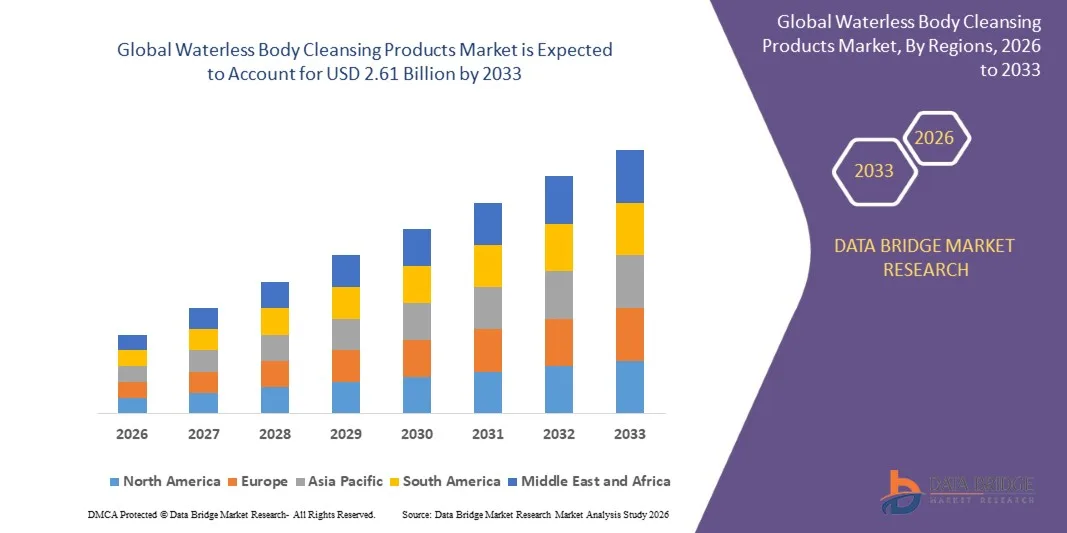
- As per Data Bridge Market Research analysis, the waterless body cleansing products market was valued at USD 1.15 billion in 2025 and is projected to reach USD 2.61 billion by 2033, growing at a CAGR of 10.80% from 2026 to 2033.
- The market is experiencing consistent growth driven by rising demand for water-saving personal care products, increasing adoption of no-rinse cleansing solutions in healthcare facilities, and expanding applications across home care, travel, and outdoor activities. Advancements in cleansing foams, body wipes, lotions, and rinse-free body washes are further supporting product innovation and market adoption.
- The growing focus on water conservation, rising demand for convenient hygiene products, and increasing use of rinse-free cleansing solutions among patients, older adults, and individuals with limited mobility are encouraging manufacturers to develop innovative formulations. The expansion of e-commerce and the availability of portable, skin-friendly cleansing products are further strengthening market penetration across residential and institutional settings
Market Size & Forecast
- Global Market Value (2025): USD 1.15 Billion
- Expected Market Value (2033): USD 2.61 Billion
- Forecast CAGR (2026–2033): 10.80%
- Leading Region in 2025: North America
- Fastest Growing Region: Asia Pacific
What are the Major Takeaways of the Waterless Body Cleansing Products Market?
- North America dominated the waterless body cleansing products market with the largest revenue share of 33.5% in 2025, supported by established healthcare infrastructure, high consumer awareness, and growing demand for convenient personal hygiene products.
- Asia-Pacific is expected to be the fastest-growing region at a CAGR of 10.7% from 2026 to 2033, fueled by rising hygiene awareness, increasing disposable incomes, and growing demand for water-efficient personal care products.
- The no-rinse body washes and cleansing lotions segment led the market with a 38.7% share in 2025, driven by demand for convenient cleansing solutions across healthcare, elderly care, and personal hygiene applications
- Waterless body wipes are the fastest-growing product type, projected to register a CAGR of 10.9%, reflecting the surge in demand for portable and convenient cleansing products
- The alcohol-free segment dominated the formulation category with a 35% revenue share in 2025, led by growing consumer preference for gentle cleansing products suitable for frequent use.
- Full-body cleansing accounted for 38.0% of the market share in 2025, preferred by consumers and healthcare providers seeking convenient, effective hygiene solutions that allow full-body cleansing without conventional bathing facilities,
- The healthcare and patient cleansing segment is the fastest-growing application category, with a CAGR of 11.3%, driven by increasing demand for convenient hygiene solutions in hospitals and long-term care facilities.
Report Scope and Waterless Body Cleansing Products Market Segmentation
|
Attributes |
Waterless Body Cleansing Products Key Market Insights |
|
Segments Covered |
|
|
Countries Covered |
North America
Europe
Asia-Pacific
Middle East and Africa
South America
|
|
Key Market Players |
|
|
Market Opportunities |
|
|
Value Added Data Infosets |
In addition to the insights on market scenarios such as market value, growth rate, segmentation, geographical coverage, and major players, the market reports curated by the Data Bridge Market Research also include in-depth expert analysis, pricing analysis, brand share analysis, consumer survey, demography analysis, supply chain analysis, value chain analysis, raw material/consumables overview, vendor selection criteria, PESTLE Analysis, Porter Analysis, and regulatory framework. |
What is the Key Trend in the Waterless Body Cleansing Products Market?
- Manufacturers are increasingly developing rinse-free body cleansing products to support convenient personal hygiene, reduce dependence on conventional bathing, and meet demand across healthcare, travel, and everyday personal care.
- For instance, in October 2021, Everist launched its Waterless Body Wash Concentrate, a water-activated paste formulated with plant-based ingredients and packaged in recyclable aluminum to reduce packaging waste and support more sustainable personal care routines.
- Concentrated formulations, compact packaging, and refill systems enable manufacturers to reduce the amount of water transported in finished products and improve portability for consumers.
- Healthcare providers are increasingly adopting rinse-free cleansing products to support patient hygiene, particularly for older adults, individuals with limited mobility, and patients requiring bedside care.
- For instance, in August 2026, VINNER Health launched its Personal Care and Rinse-Free Cleansing Collection under the VINNERLOVE and HOMEKEEP brands, targeting hospitals, nursing homes, long-term care facilities, and home-care settings.
- As consumers and healthcare providers prioritize convenient hygiene and resource-conscious personal care, innovation in rinse-free formulations, skin-friendly ingredients, and practical dispensing formats is expected to strengthen demand across residential and institutional markets.
What are the Key Drivers of the Waterless Body Cleansing Products Market?
- The growing demand for convenient hygiene solutions and water conservation has increased interest in rinse-free body cleansing products for healthcare, travel, outdoor activities, and everyday personal care.
- For instance, in December 2023, the British Journal of Nursing published a clinical article on waterless bathing for inpatients with neurological conditions and complex care needs. The article discussed case studies using Conti waterless bathing products, highlighting their practical application in patient hygiene and specialized hospital care
- Healthcare facilities, elderly care centers, and home-care providers are increasingly using no-rinse cleansing foams, body wipes, and cleansing lotions to support patient hygiene and simplify assisted bathing routines.
- For instance, in October 2024, the Journal of Hospital Infection published a study examining the implementation of waterless care in healthcare settings. The research explored healthcare professionals' perspectives on waterless bathing alternatives, including cleansing wipes and dry shampoo, highlighting the relevance of patient hygiene needs and infection-prevention practices in evaluating adoption.
- As demand for convenient hygiene and patient-centered care continues to expand, waterless body cleansing products are expected to gain traction through improved formulations, wider institutional adoption, and increasing availability across consumer and healthcare channels.
What Factors are Challenging the Growth of the Waterless Body Cleansing Products Market?
- Waterless body cleansing products can face higher production costs due to specialized formulations, skin-compatible ingredients, concentrated active components, and sustainable packaging requirements.
- For instance, in October 2023, a study published in Science of the Total Environment found that more than 50% of wipes marketed as biodegradable and flushable contained both cellulose-based fibers and less-degradable synthetic fibers. Chemical additives and inadequate environmental conditions could further restrict degradation, highlighting sustainability challenges for disposable waterless cleansing products.
- These costs can limit adoption among price-sensitive consumers and healthcare providers, particularly in emerging economies where conventional soaps and bathing products remain more affordable.
- In addition, disposable body wipes can create environmental challenges when they contain synthetic fibers or are improperly discarded, increasing concerns about plastic pollution, landfill waste, and sewer blockages.
- For instance, in January 2026, a study published in Environmental Pollution examined cellulose-based wipes marketed as biodegradable across 10 urban rivers and streams. The findings showed that most tested wipes persisted after five weeks, challenging biodegradability claims and highlighting the difficulty of developing disposable cleansing products that break down reliably in real-world environments.
- The combined impact of price sensitivity, formulation complexity, and waste-disposal concerns can constrain market penetration, encouraging manufacturers to develop affordable, skin-friendly products with recyclable packaging and demonstrably biodegradable materials.
How is the Waterless Body Cleansing Products Market Segmented?
The waterless body cleansing products market is segmented on the basis of product type, formulation, application, and end user.
- By Product Type
On the basis of product type, the waterless body cleansing products market is segmented into waterless cleansing foams and gels, no-rinse body washes and cleansing lotions, waterless body wipes, cleansing sprays and mists, cleansing powders, solid cleansing bars and concentrates, and other waterless cleansing products. The no-rinse body washes and cleansing lotions segment dominated the market with an estimated 38.7% share in 2025, supported by demand for convenient cleansing solutions across healthcare, elderly care, and personal hygiene applications. These products enable users to cleanse their bodies without conventional bathing, making them suitable for patients with limited mobility and individuals requiring assisted care. Their availability in moisturizing, antibacterial, and sensitive-skin formulations supports broader adoption. Healthcare facilities and home-care providers value their ease of application and ability to simplify routine hygiene. Increasing product availability through pharmacies, medical suppliers, and online retail channels further supports demand.
The waterless body wipes segment is projected to register the fastest growth at an estimated CAGR of 10.9% from 2026 to 2033, driven by rising demand for portable and convenient cleansing products. These wipes allow users to maintain personal hygiene during travel, outdoor activities, emergencies, and situations where bathing facilities are unavailable. Their practical format also supports assisted cleansing for older adults and patients with restricted mobility. Manufacturers are developing larger wipes, skin-friendly formulations, and biodegradable substrates to broaden their applications. Increasing use by healthcare providers and humanitarian organizations may further support demand. However, affordability, skin compatibility, and environmental concerns related to disposable materials remain important considerations.
- By Formulation
On the basis of formulation, the waterless body cleansing products market is segmented into alcohol-based, alcohol-free, antibacterial and antimicrobial, moisturizing and nourishing, natural and botanical, fragrance-free and hypoallergenic, and pH-balanced and sensitive-skin formulations. The alcohol-free segment is estimated to dominate the market with 35% share in 2025, supported by growing consumer preference for gentle cleansing products suitable for frequent use. These formulations can reduce the drying effects associated with certain alcohol-containing products and are suitable for consumers seeking everyday personal hygiene solutions. Their use in healthcare and elderly care also supports demand for skin-compatible cleansing alternatives. Manufacturers are incorporating mild surfactants, moisturizing agents, and soothing ingredients to improve product performance. Increasing awareness of skin-barrier health and ingredient transparency further supports adoption.
The natural and botanical formulation segment is projected to register the fastest growth at an estimated CAGR of 11.2% from 2026 to 2033, driven by increasing consumer interest in plant-derived ingredients and environmentally conscious personal care products. Manufacturers are incorporating botanical extracts, aloe vera, and plant-derived cleansing ingredients into rinse-free formulations. These products appeal to consumers seeking gentle cleansing experiences and alternatives to conventional personal care products. Demand for ingredient transparency and responsible sourcing is encouraging product innovation. The development of fragrance-free and sensitive-skin variants further broadens the potential customer base. Continued investment in formulation research and sustainable product positioning is expected to support segment growth.
- By Application
On the basis of application, the waterless body cleansing products market is segmented into full-body cleansing, personal hygiene and freshening, healthcare and patient cleansing, facial and sensitive-skin cleansing, intimate hygiene, travel and outdoor hygiene, post-exercise and sports hygiene, and emergency and disaster relief hygiene. The full-body cleansing segment dominated the market with an estimated 38.0% share in 2025, reflecting demand for alternatives to conventional bathing across residential and institutional environments. No-rinse body washes, cleansing foams, and body wipes enable users to maintain personal hygiene without relying on traditional showering facilities. These products are particularly useful for people with limited mobility and individuals requiring assisted bathing. Their application across homes, healthcare facilities, and travel settings supports widespread adoption.
The healthcare and patient cleansing segment is projected to register the fastest growth at an estimated CAGR of 11.3% from 2026 to 2033, driven by increasing demand for convenient hygiene solutions in hospitals and long-term care facilities. Waterless cleansing foams, medical bathing wipes, and no-rinse lotions help caregivers clean patients who are bedridden or have limited mobility. These products can simplify bathing routines and reduce dependence on conventional washing facilities. Growing demand for elderly care and home healthcare services further supports adoption. Healthcare providers increasingly prioritize skin compatibility, ease of use, and efficient patient-care routines. Product innovation and broader institutional availability are expected to strengthen segment growth.
- By End User
On the basis of end user, the waterless body cleansing products market is segmented into individual consumers, hospitals and healthcare facilities, elderly care and long-term care facilities, military and defense, travel and tourism, sports and fitness centers, commercial and institutional facilities, and emergency response and humanitarian organizations. The individual consumers segment dominated the market with an estimated 63.0% share in 2025, supported by growing demand for convenient personal hygiene products for everyday use, travel, and outdoor activities. Consumers increasingly use rinse-free cleansing foams, body wipes, and concentrated body washes when conventional bathing is inconvenient. Product portability and ease of application support purchasing decisions. Online retail and specialty personal care stores improve accessibility to different formulations. Growing awareness of water conservation and demand for compact hygiene products further encourage adoption.
The hospitals and healthcare facilities segment is projected to register the fastest growth at an estimated CAGR of 11.3% from 2026 to 2033, driven by the need for efficient patient hygiene and convenient bathing alternatives. Waterless cleansing products support daily care for bedridden patients, older adults, and individuals recovering from illness or surgery. No-rinse foams, medical bathing wipes, and cleansing lotions can facilitate assisted bathing when conventional washing is difficult. Their ease of application can help caregivers manage routine hygiene requirements. Expanding long-term care services and growing demand for home-based healthcare are further supporting adoption. Increasing attention to patient comfort, skin compatibility, and efficient care delivery is expected to strengthen demand across healthcare institutions.
Which Region Holds the Largest Share of the Waterless Body Cleansing Products Market?
- North America dominated the waterless body cleansing products market with the largest revenue share of 33.5% in 2025, supported by established healthcare infrastructure, high consumer awareness, and growing demand for convenient personal hygiene products.
- The region also benefits from strong adoption of waterless cleansing products across healthcare, elderly care, travel, and everyday personal hygiene applications, alongside the presence of established personal care brands and extensive distribution networks. Increasing interest in water conservation, portable hygiene solutions, and skin-friendly formulations continues to strengthen North America’s leading position in the global market.
U.S. Waterless Body Cleansing Products Market Insight
The U.S. waterless body cleansing products market is witnessing strong growth due to rising demand for convenient personal hygiene solutions, increasing awareness of skin health, and expanding adoption of rinse-free cleansing products across healthcare and consumer applications. The country’s established personal care industry, along with growing demand for body wipes, cleansing foams, and no-rinse body washes, is driving market expansion across residential and institutional settings. In addition, increasing demand for elderly care products, portable hygiene solutions, and convenient cleansing alternatives is accelerating product adoption among consumers and healthcare providers.
Asia-Pacific Waterless Body Cleansing Products Market Insight
The Asia-Pacific waterless body cleansing products market is expected to witness rapid growth, driven by rising urbanization, expanding healthcare infrastructure, and increasing awareness of personal hygiene across countries such as China, India, and Japan. Growing demand for convenient cleansing solutions, rising elderly populations, and increasing adoption of personal care products are supporting regional market expansion. In addition, expanding e-commerce distribution, growing healthcare needs, and rising interest in portable hygiene products are accelerating product adoption across consumer and institutional applications.
Japan Waterless Body Cleansing Products Market Insight
The Japan waterless body cleansing products market is witnessing consistent growth due to rising demand for convenient hygiene solutions, an aging population, and increasing emphasis on elderly care and patient hygiene. Healthcare facilities, long-term care providers, and individual consumers are increasingly adopting no-rinse body washes, cleansing wipes, and moisturizing cleansing foams for situations where conventional bathing is difficult. Moreover, growing interest in skin-friendly formulations, easy-to-use personal care products, and efficient hygiene practices is further contributing to market growth in Japan.
China Waterless Body Cleansing Products Market Insight
The China waterless body cleansing products market is growing rapidly, driven by increasing urbanization, expanding healthcare services, and rising consumer awareness of personal hygiene and convenient cleansing solutions. Growing adoption of body wipes, rinse-free cleansing lotions, and portable hygiene products across households, hospitals, and elderly care facilities is boosting market demand. In addition, expanding e-commerce platforms, rising demand for specialized personal care products, and increasing focus on convenient hygiene practices are positioning China as an important growth market for waterless body cleansing products.
U.K. Waterless Body Cleansing Products Market Insight
The U.K. waterless body cleansing products market is experiencing steady growth, supported by rising adoption of rinse-free hygiene solutions across healthcare, elderly care, travel, and personal care applications. Increasing demand for convenient patient cleansing products and growing awareness of skin-friendly formulations are contributing to market expansion. Furthermore, the availability of body wipes, cleansing foams, and no-rinse lotions through pharmacies, supermarkets, and online retail channels is improving product accessibility, supporting wider adoption across individual consumers and institutional users.
Germany Waterless Body Cleansing Products Market Insight
The Germany waterless body cleansing products market is expanding steadily due to the country’s established healthcare infrastructure, growing elderly care requirements, and increasing demand for convenient personal hygiene products. Hospitals, long-term care facilities, and individual consumers are increasingly utilizing waterless cleansing foams, body wipes, and no-rinse lotions to support everyday hygiene and assisted patient care. Continuous product development focused on skin compatibility, moisturizing ingredients, and sustainable materials, along with growing interest in convenient cleansing alternatives, is further driving market growth in Germany.
Which are the Top Companies in Waterless Body Cleansing Products Market?
The waterless body cleansing products industry is primarily led by well-established companies, including:
- Waterless Limited (U.K.)
- CleanLife Products (U.S.)
- ABENA Holding A/S (Denmark)
- Medline Industries, LP (U.S.)
- Cardinal Health, Inc. (U.S.)
- Essity AB (Sweden)
- Coloplast A/S (Denmark)
- Arjo AB (Sweden)
- Ecolab Inc. (U.S.)
- Dukal Corporation (U.S.)
- K2 Health Products (U.S.)
- Avadim Health, Inc. (U.S.)
- Central Solutions (U.S.)
- PAUL HARTMANN AG (Germany)
- Ontex BV (Belgium)
- Kimberly-Clark Corporation (U.S.)
- Nice-Pak Products, Inc. (U.S.)
- Schülke & Mayr GmbH (Germany)
- McKesson Corporation (U.S.)
What are Latest Developments in Waterless Body Cleansing Products Market?
- In June 2025, Rugged Revive introduced its Rinse-Free Sponge Bath Wipes, designed for campers, vanlifers, overlanders, and outdoor enthusiasts who need body-cleansing solutions without conventional shower facilities. The oversized, dry-packed sponges contain a cleanser activated with a small amount of water and are designed to clean without rinsing. The launch highlights the use of portable, rinse-free cleansing formats for travel and outdoor hygiene applications.
- In May 2023, Vernacare announced an improved Conti Wet Wipes range, scheduled to reach the market in June 2023. The range included waterless bathing products for body and hair cleansing, alongside wipes for hands, faces, and personal care. Designed for people receiving assisted or bedbound care, the products provide cleansing alternatives that reduce reliance on conventional soap-and-water bathing. This development reflects continued product innovation in healthcare-focused waterless hygiene.
- In September 2022, Oatey Co. introduced Hercules For Body Wipes, a cleansing product developed specifically for contractors and demanding job-site conditions. The wipes were designed to remove grime, grease, oil, and odors without requiring water or rinsing. Their fragrance-free formulation includes aloe and vitamin E to help soothe and condition the skin. The launch expanded the availability of convenient cleansing products for workplaces, outdoor activities, and other settings where conventional washing may be difficult.
- In October 2021, Everist launched its Waterless Body Wash Concentrate, extending its waterless personal care portfolio beyond hair care. The product uses a concentrated paste formulation that activates with water to create a cleansing lather while conditioning the skin. Its plant-based, vegan, and cruelty-free formulation, together with recyclable aluminum packaging, was designed to reduce reliance on conventional water-filled personal care products and single-use plastic packaging. The launch demonstrated innovation in concentrated body cleansing formulations and lower-waste personal care formats.
- In February 2021, youbody launched a waterless body wash system featuring powdered cleansing essences and a reusable dispensing pod. Consumers could combine the powder with water in the pod to create a customized body wash, offering an alternative to conventional pre-diluted liquid products. The company emphasized reduced water use in product formulation, alternative packaging, and a range of customizable scents. This launch illustrated the growing development of concentrated and water-efficient body cleansing formats within the personal care sector
- Interactive Data Analysis Dashboard
- Company Analysis Dashboard for high growth potential opportunities
- Research Analyst Access for customization & queries
- Competitor Analysis with Interactive dashboard
- Latest News, Updates & Trend analysis
- Harness the Power of Benchmark Analysis for Comprehensive Competitor Tracking
Data collection and base year analysis are done using data collection modules with large sample sizes. The stage includes obtaining market information or related data through various sources and strategies. It includes examining and planning all the data acquired from the past in advance. It likewise envelops the examination of information inconsistencies seen across different information sources. The market data is analysed and estimated using market statistical and coherent models. Also, market share analysis and key trend analysis are the major success factors in the market report. To know more, please request an analyst call or drop down your inquiry.
The key research methodology used by DBMR research team is data triangulation which involves data mining, analysis of the impact of data variables on the market and primary (industry expert) validation. Data models include Vendor Positioning Grid, Market Time Line Analysis, Market Overview and Guide, Company Positioning Grid, Patent Analysis, Pricing Analysis, Company Market Share Analysis, Standards of Measurement, Global versus Regional and Vendor Share Analysis. To know more about the research methodology, drop in an inquiry to speak to our industry experts.
Data Bridge Market Research is a leader in advanced formative research. We take pride in servicing our existing and new customers with data and analysis that match and suits their goal. The report can be customized to include price trend analysis of target brands understanding the market for additional countries (ask for the list of countries), clinical trial results data, literature review, refurbished market and product base analysis. Market analysis of target competitors can be analyzed from technology-based analysis to market portfolio strategies. We can add as many competitors that you require data about in the format and data style you are looking for. Our team of analysts can also provide you data in crude raw excel files pivot tables (Fact book) or can assist you in creating presentations from the data sets available in the report.