


Waterway Transportation Software Solutions Market Overview
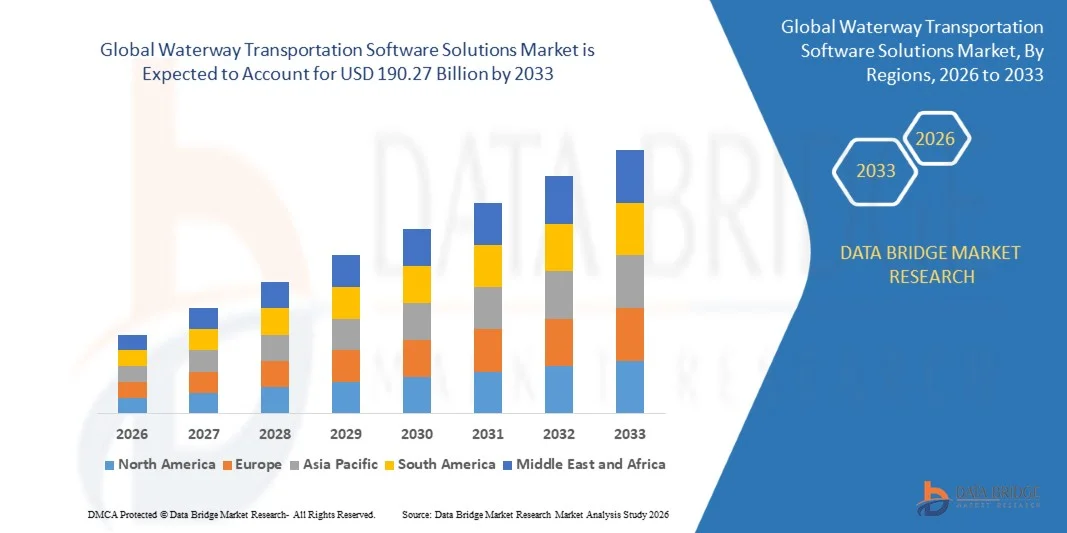
The Waterway Transportation Software Solutions Market was valued at USD 92.06 Billion in 2025 and is projected to reach USD 190.27 Billion by 2033, growing at a CAGR of 9.5% from 2026 to 2033. The market is experiencing consistent growth driven by rapid digitalization of maritime logistics, increasing adoption of AI-enabled fleet management systems, and growing demand for real-time cargo visibility across global shipping networks. Rising investments in smart port infrastructure, expansion of inland waterway transport, and integration of cloud-based maritime platforms are further accelerating market growth across developed and emerging economies.
The increasing focus on supply chain efficiency, regulatory compliance, and emissions reduction in maritime operations is significantly driving the adoption of advanced software solutions across shipping companies and port authorities. Growing deployment of vessel tracking, predictive analytics, and automated port management systems is enabling operators to optimize routing, reduce fuel consumption, and enhance operational transparency. In addition, the shift toward autonomous shipping technologies and data-driven decision-making is further strengthening the demand for integrated waterway transportation software platforms worldwide.
Key Market Trends & Insights
- Asia-Pacific dominated the Waterway Transportation Software Solutions Market with the largest revenue share of 36.82% in 2025, supported by expanding maritime trade volumes, rapid port modernization programs, and strong adoption of digital logistics platforms across major shipping economies
- The hosted segment led the market with a 49.7% share in 2025, driven by increasing adoption of cloud-based solutions across the maritime and logistics sectors
- North America is expected to be the fastest-growing region at a CAGR of 12.6% from 2026 to 2033, fueled by rising investments in smart port infrastructure, increasing adoption of autonomous shipping technologies, and strong demand for real-time logistics optimization
- Hybrid is the fastest-growing deployment type, projected to register a CAGR of 15.1% from 2026 to 2033, supported by increasing demand for deployment models that combine flexibility with enhanced data security
- The managed services segment dominated the services category with a 46.4% revenue share in 2025, led by rising preference for outsourced monitoring, maintenance, and software support solutions
- Vessel tracking accounted for 31.8% of the market in 2025, preferred by the growing need for real-time fleet visibility and operational efficiency across maritime transportation networks
- The maritime software segment is the fastest-growing solutions category, with a CAGR of 14.2% from 2026 to 2033, driven by increasing digitalization of shipping operations and port management activities
Market Size & Forecast
- Global Market Value (2025): USD 92.06 Billion
- Expected Market Value (2033): USD 190.27 Billion
- Forecast CAGR (2026–2033): 9.5%
- Leading Region in 2025: Asia-Pacific
- Fastest Growing Region: North America
Report Scope and Waterway Transportation Software Solutions Market Segmentation
|
Attributes |
Waterway Transportation Software Solutions Key Market Insights |
|
Segments Covered |
|
|
Countries Covered |
North America · U.S. · Canada · Mexico Europe · Germany · France · U.K. · Netherlands · Switzerland · Belgium · Russia · Italy · Spain · Turkey · Rest of Europe Asia-Pacific · China · Japan · India · South Korea · Singapore · Malaysia · Australia · Thailand · Indonesia · Philippines · Rest of Asia-Pacific Middle East and Africa · Saudi Arabia · U.A.E. · South Africa · Egypt · Israel · Rest of Middle East and Africa South America · Brazil · Argentina · Rest of South America |
|
Key Market Players |
· Kongsberg Digital AS (Norway) · SAP SE (Germany) · MarineTraffic Single Member P.C. (Greece) · Alfa Laval AB (Sweden) · Oracle Corporation (U.S.) · Wärtsilä Voyage Limited (Finland) · Veson Nautical LLC (U.S.) · StormGeo AS (Norway) · DNV AS (Norway) · WiseTech Global Limited (Australia) · Descartes Systems Group Inc. (Canada) · ABB Ltd. (Switzerland) · Navis LLC (U.S.) · Bureau Veritas Solutions Marine and Offshore SAS (France) · INMARSAT Global Limited (U.K.) · Tideworks Technology Inc. (U.S.) · Danaos Management Consultants S.A. (Greece) · Transas Marine Limited (U.K.) · Marorka ehf. (Iceland) · Lloyd’s Register Group Services Limited (U.K.) |
|
Market Opportunities |
· Expansion of Autonomous Shipping Technologies and Digital Navigation Platforms · Growth in Cloud-Based Maritime Software Adoption Across Global Trade Routes · Increasing Investments in Smart Port and Inland Waterway Modernization Projects |
|
Value Added Data Infosets |
In addition to the market insights such as market value, growth rate, market segments, geographical coverage, market players, and market scenario, the market report curated by the Data Bridge Market Research team includes in-depth expert analysis, import/export analysis, pricing analysis, production consumption analysis, and pestle analysis. |
Waterway Transportation Software Solutions Market Trends
Trend: Increasing Adoption of AI-Driven Maritime Analytics and Smart Port Ecosystems
Waterway transportation software solutions are witnessing rapid adoption of AI-driven analytics, IoT-enabled vessel tracking, and smart port ecosystems to improve operational efficiency and cargo visibility across global shipping networks. Shipping companies and port authorities are increasingly deploying digital platforms for predictive maintenance, route optimization, and real-time fleet monitoring to enhance supply chain resilience. Growing automation of terminal operations and integration of cloud-based maritime management systems are further strengthening digital transformation across major trade corridors such as the Singapore Port and Rotterdam Port ecosystems.
Companies such as SAP SE and Oracle Corporation are actively providing integrated maritime logistics and cloud analytics platforms that enable real-time data processing, operational optimization, and enhanced decision-making across global shipping and port operations.
Waterway Transportation Software Solutions Market Dynamics
Key Market Driver: Rising Demand for Real-Time Vessel Tracking and Supply Chain Visibility
The growing complexity of global trade and increasing container traffic volumes are significantly driving demand for real-time vessel tracking and end-to-end supply chain visibility solutions in the waterway transportation software market. Shipping operators are adopting AIS-based tracking systems, predictive analytics, and digital twin platforms to optimize fleet utilization and reduce delays in maritime logistics. Regulatory pressure for improved transparency and sustainability reporting is further accelerating adoption across ports and shipping companies.
Organizations such as MarineTraffic Single Member P.C. are widely used for global vessel tracking intelligence, providing real-time maritime traffic data that enhances fleet monitoring, route optimization, and operational transparency for logistics operators and maritime stakeholders.
Key Restraint/Challenge: High Integration Complexity with Legacy Maritime and Port IT Infrastructure
A major challenge in the waterway transportation software solutions market is the difficulty of integrating advanced digital platforms with legacy port management systems and traditional maritime IT infrastructure. Many ports and shipping operators still rely on outdated terminal operating systems, which creates interoperability issues, data fragmentation, and high implementation costs during digital transformation. Cybersecurity concerns and the need for system standardization further complicate large-scale software deployment across global maritime networks.
For instance, port modernization initiatives across older European port facilities have highlighted the operational complexity of upgrading legacy infrastructure while ensuring uninterrupted cargo handling and compliance with evolving digital maritime standards.
Key Market Opportunity: Growth in Cloud-Based Maritime Software Adoption Across Global Trade Routes
The increasing shift toward cloud-based maritime software platforms presents a significant growth opportunity in the waterway transportation software solutions market, driven by scalability, cost efficiency, and remote accessibility benefits. Cloud deployment enables shipping companies and port operators to centralize data management, improve collaboration across global fleets, and enhance real-time decision-making capabilities. Rising investments in digital port ecosystems and smart logistics corridors are further accelerating cloud adoption across international shipping routes.
Companies such as WiseTech Global Limited and Kongsberg Digital AS are supporting cloud-native maritime platforms that enable integrated freight management, vessel performance optimization, and advanced analytics across global waterway transportation networks.
Waterway Transportation Software Solutions Market Scope
The waterway transportation software solutions market is segmented on the basis of solutions, services, deployment, and end user.
- By Solutions
On the basis of solutions, the Waterway Transportation Software Solutions Market is segmented into warehousing, vessel tracking, freight security, yard management, audit and claim, ship broker software, maritime software, and others. The Vessel Tracking segment dominated the market with the largest share of 31.8% in 2025, driven by the growing need for real-time fleet visibility and operational efficiency across maritime transportation networks. Increasing adoption of GPS, AIS, and IoT-enabled monitoring systems is helping operators optimize vessel movements and reduce delays. The segment also benefits from rising international seaborne trade and the need for accurate cargo management. Integration of analytics and cloud-based platforms is improving decision-making capabilities for fleet operators. Strong emphasis on supply chain transparency and regulatory compliance continues to support segment leadership.
The Maritime Software segment is projected to register the fastest growth at a CAGR of 14.2% from 2026 to 2033, driven by increasing digitalization of shipping operations and port management activities. Growing demand for integrated platforms that support navigation, maintenance, documentation, and crew management is accelerating adoption. Advancements in AI, predictive analytics, and cloud technologies are enabling enhanced operational efficiency and reduced costs. Rising investments in smart ports and autonomous shipping technologies are further supporting market expansion. Increasing focus on improving maritime safety and optimizing fuel consumption is encouraging deployment across commercial fleets. Expanding global trade activities are expected to sustain strong growth throughout the forecast period.
- By Services
On the basis of services, the Waterway Transportation Software Solutions Market is segmented into managed services, consulting/customization services, and training services. The Managed Services segment dominated the market with a share of 46.4% in 2025, supported by rising preference for outsourced monitoring, maintenance, and software support solutions. Organizations are increasingly relying on managed service providers to ensure continuous system performance and minimize operational disruptions. The segment benefits from growing complexity of maritime logistics and increasing cybersecurity requirements. Continuous software updates and remote infrastructure management are improving operational reliability. Cost savings and reduced internal IT burden further contribute to the segment's dominant position.
The Consulting/Customization Services segment is projected to register the fastest growth at a CAGR of 13.5% from 2026 to 2033, driven by increasing demand for tailored software platforms that meet specific operational requirements. Companies are seeking customized solutions to improve fleet management, cargo tracking, and regulatory compliance processes. Rising digital transformation initiatives across shipping and logistics companies are creating strong demand for consulting expertise. Integration of advanced technologies with legacy systems is further supporting segment growth. Expansion of smart shipping ecosystems and port modernization projects is encouraging adoption of specialized services. Growing focus on maximizing software efficiency and return on investment is expected to accelerate market expansion.
- By Deployment
On the basis of deployment, the Waterway Transportation Software Solutions Market is segmented into hosted, on-premise, and hybrid. The Hosted segment dominated the market with the largest share of 49.7% in 2025, driven by increasing adoption of cloud-based solutions across the maritime and logistics sectors. Hosted deployment provides scalability, lower infrastructure costs, and easier accessibility for fleet operators and port authorities. Continuous improvements in cloud security and data management capabilities are strengthening customer confidence. The segment also benefits from the growing requirement for remote operations and real-time information sharing. Rising investments in digital supply chain infrastructure are reinforcing its market leadership.
The Hybrid segment is projected to register the fastest growth at a CAGR of 15.1% from 2026 to 2033, driven by increasing demand for deployment models that combine flexibility with enhanced data security. Hybrid environments allow organizations to retain critical data on-premise while utilizing cloud resources for analytics and collaboration. Growing concerns regarding cybersecurity and regulatory compliance are encouraging adoption of hybrid architectures. Advancements in edge computing and integrated cloud platforms are improving performance and operational efficiency. Expansion of digital maritime ecosystems and connected port infrastructure is further supporting segment growth. Increasing need for business continuity and scalable operations is expected to drive rapid adoption.
- By End User
On the basis of end user, the Waterway Transportation Software Solutions Market is segmented into consumer and retail, oil and gas, industrial and manufacturing, energy and mining, aerospace and defense, construction, chemicals, pharmaceuticals and healthcare, food and beverages, and others. The Consumer and Retail segment dominated the market with a share of 27.6% in 2025, driven by the rapid growth of global trade and rising demand for efficient cargo transportation and inventory management solutions. Increasing e-commerce activities and expanding cross-border supply chains are creating higher requirements for shipment visibility and logistics optimization. Companies are adopting advanced software platforms to improve delivery efficiency and reduce transportation costs. Rising focus on customer satisfaction and real-time tracking capabilities is strengthening adoption. Continuous growth in retail distribution networks further supports segment dominance.
The Oil and Gas segment is projected to register the fastest growth at a CAGR of 13.8% from 2026 to 2033, driven by increasing offshore exploration activities and rising demand for efficient marine logistics management. Waterway transportation software solutions are being widely adopted to coordinate vessel movements, cargo handling, and asset monitoring across offshore locations. Growing investments in digital transformation and predictive maintenance technologies are supporting operational efficiency. Rising emphasis on safety, compliance, and supply chain visibility is accelerating software deployment. Expansion of offshore energy projects and increasing complexity of maritime operations are further contributing to segment growth. Continuous modernization of marine transportation infrastructure is expected to sustain strong growth during the forecast period.
Waterway Transportation Software Solutions Market Regional Analysis
Asia-Pacific dominated the waterway transportation software solutions market and accounted for the largest revenue share of 36.82% in 2025, supported by expanding maritime trade volumes, rapid port modernization programs, and strong adoption of digital logistics platforms across major shipping economies. The region benefits from large-scale investments in smart port infrastructure, increasing containerized trade, and growing integration of AI-based fleet management systems. Rising demand for real-time cargo visibility, coupled with government-led initiatives to digitize shipping and inland waterway networks, is accelerating market expansion across the region. Increasing participation of global logistics players and technology providers is further strengthening regional adoption of advanced software solutions.
China Waterway Transportation Software Solutions Market Insight
China held the largest share in the Asia-Pacific Waterway Transportation Software Solutions market in 2025, driven by its extensive port infrastructure, dominant shipbuilding industry, and strong government focus on digital maritime transformation. The country has heavily invested in smart port initiatives across major hubs such as Shanghai and Shenzhen, enabling widespread deployment of vessel tracking, cargo optimization, and maritime analytics platforms. Rising export-import volumes and Belt and Road-linked maritime trade are further strengthening software adoption. In addition, integration of AI-enabled logistics systems and autonomous port operations is enhancing operational efficiency and reinforcing China’s leadership position in the regional market.
India Waterway Transportation Software Solutions Market Insight
India is witnessing the fastest growth in the Asia-Pacific region, driven by expanding inland waterway transport projects, increasing port automation initiatives, and rising digitalization of logistics operations. The country is investing heavily in multimodal logistics infrastructure under national connectivity programs, improving efficiency across coastal shipping and inland waterways. Growing adoption of fleet tracking, freight management, and port community systems is supporting market expansion. In addition, rising trade volumes, increasing participation of private logistics firms, and government focus on reducing transportation costs are accelerating deployment of advanced waterway transportation software solutions across the country.
Europe Waterway Transportation Software Solutions Market Insight
The Europe Waterway Transportation Software Solutions market is expanding steadily, supported by strong inland waterway networks, strict maritime regulatory frameworks, and high adoption of digital freight management systems. The region benefits from advanced logistics infrastructure across the Rhine, Danube, and North Sea shipping corridors, enabling efficient cargo movement and software integration. Increasing focus on emissions reduction, supply chain transparency, and automated port operations is driving adoption of vessel tracking and maritime analytics solutions. In addition, strong demand from industrial shipping, container transport, and intermodal logistics sectors is supporting sustained market development across Europe.
Germany Waterway Transportation Software Solutions Market Insight
Germany accounted for the largest share in the Europe Waterway Transportation Software Solutions market in 2025, driven by its strong inland waterway logistics system and highly advanced industrial shipping sector. The country’s extensive use of the Rhine River corridor for freight transport is enabling high adoption of yard management, fleet tracking, and freight optimization software. Strong integration of Industry 4.0 technologies in logistics operations is further enhancing efficiency and operational visibility. In addition, increasing investments in smart port infrastructure such as Hamburg are reinforcing Germany’s leadership position in digital maritime transportation systems.
U.K. Waterway Transportation Software Solutions Market Insight
The U.K. market is supported by strong maritime trade activity, growing port modernization programs, and increasing adoption of cloud-based logistics platforms. Rising focus on improving supply chain resilience and operational transparency is driving deployment of vessel tracking and maritime management software across ports such as Felixstowe and Southampton. The country is also witnessing increasing use of predictive analytics and AI-driven shipping solutions to optimize cargo flow. In addition, growing digital transformation initiatives in the logistics sector and expansion of e-commerce-driven freight demand are further supporting market growth.
North America Waterway Transportation Software Solutions Market Insight
North America is projected to grow at the fastest CAGR of 12.6% from 2026 to 2033, driven by rising investments in smart port infrastructure, increasing adoption of autonomous shipping technologies, and strong demand for real-time logistics optimization. Growing emphasis on supply chain digitization, cybersecurity in maritime operations, and advanced fleet management systems is significantly supporting regional expansion. The region is also witnessing strong integration of IoT, AI, and cloud-based platforms across shipping and inland waterway networks. In addition, increasing trade activities and modernization of port facilities are accelerating adoption of advanced waterway transportation software solutions.
U.S. Waterway Transportation Software Solutions Market Insight
The U.S. accounted for the largest share in the North America Waterway Transportation Software Solutions market in 2025, supported by strong maritime trade infrastructure, advanced port automation systems, and widespread adoption of digital logistics platforms. Major ports such as Los Angeles, Long Beach, and New York–New Jersey are heavily investing in vessel tracking, freight management, and predictive analytics solutions. Growing focus on improving supply chain efficiency, reducing operational costs, and enhancing shipment visibility is further strengthening demand. In addition, increasing use of cloud-based maritime software and AI-driven logistics optimization tools is reinforcing the U.S. leadership position in the regional market.
Waterway Transportation Software Solutions Market Share
The waterway transportation software solutions industry is primarily led by well-established companies, including:
- Kongsberg Digital AS (Norway)
- SAP SE (Germany)
- MarineTraffic Single Member P.C. (Greece)
- Alfa Laval AB (Sweden)
- Oracle Corporation (U.S.)
- Wärtsilä Voyage Limited (Finland)
- Veson Nautical LLC (U.S.)
- StormGeo AS (Norway)
- DNV AS (Norway)
- WiseTech Global Limited (Australia)
- Descartes Systems Group Inc. (Canada)
- ABB Ltd. (Switzerland)
- Navis LLC (U.S.)
- Bureau Veritas Solutions Marine and Offshore SAS (France)
- INMARSAT Global Limited (U.K.)
- Tideworks Technology Inc. (U.S.)
- Danaos Management Consultants S.A. (Greece)
- Transas Marine Limited (U.K.)
- Marorka ehf. (Iceland)
- Lloyd’s Register Group Services Limited (U.K.)
Latest Developments in Waterway Transportation Software Solutions Market
- In October 2025, The International Maritime Organization formally adopted its Net-Zero Framework, establishing a 20% well-to-wake greenhouse gas reduction target by 2030 and a 70% reduction by 2040, significantly accelerating demand for voyage optimization platforms and digital twin solutions across global shipping fleets. This development is driving shipowners to adopt advanced software tools that evaluate alternative fuel usage, route efficiency, and propulsion performance in real time. It is also strengthening the role of analytics-driven compliance systems that help operators align with evolving decarbonization mandates and reduce operational emissions across international trade routes
- In June 2025, Global shipping operators intensified deployment of AI-enabled autonomous navigation systems and predictive maintenance platforms across large container fleets, accelerating digital transformation within maritime logistics operations. This shift is increasing demand for integrated waterway transportation software capable of supporting real-time decision-making, equipment health monitoring, and route optimization. The development is improving fleet reliability, reducing downtime, and enhancing fuel efficiency, thereby strengthening adoption of advanced cloud-based maritime management solutions across major shipping corridors
- In April 2025, The International Maritime Organization approved the Net-Zero Framework for future enforcement, introducing binding emissions reduction requirements set to take effect in 2027 and reinforcing the shift toward data-driven maritime compliance systems. This approval is significantly boosting demand for analytics platforms capable of calculating voyage-level carbon intensity and generating automated compliance reports for regulatory inspections. It is also encouraging shipping companies to integrate emissions monitoring software into fleet management systems to ensure operational readiness ahead of regulatory enforcement deadlines
- In January 2025, The European Union’s FuelEU Maritime regulation came into force, mandating progressive reductions in greenhouse gas intensity for vessels calling at EU ports, alongside requirements for shore-power connectivity at major terminals. This regulatory change is driving strong adoption of port energy management systems and emissions tracking software across European shipping hubs. It is also accelerating investment in digital compliance platforms that enable operators to monitor fuel usage, optimize energy consumption, and align with evolving sustainability standards in maritime transportation
- In January 2025, European port authorities initiated structured compliance programs under FuelEU Maritime, deploying advanced emissions tracking and monitoring software to oversee fuel consumption and shore-power utilization across terminal operations. The Rotterdam Port Authority, among others, implemented real-time carbon intensity dashboards integrated with terminal operating systems to prioritize berthing for lower-emission vessels. This development is enhancing operational transparency, improving port efficiency, and significantly increasing demand for integrated maritime analytics and smart port management solutions across the region

- Interactive Data Analysis Dashboard
- Company Analysis Dashboard for high growth potential opportunities
- Research Analyst Access for customization & queries
- Competitor Analysis with Interactive dashboard
- Latest News, Updates & Trend analysis
- Harness the Power of Benchmark Analysis for Comprehensive Competitor Tracking
Data collection and base year analysis are done using data collection modules with large sample sizes. The stage includes obtaining market information or related data through various sources and strategies. It includes examining and planning all the data acquired from the past in advance. It likewise envelops the examination of information inconsistencies seen across different information sources. The market data is analysed and estimated using market statistical and coherent models. Also, market share analysis and key trend analysis are the major success factors in the market report. To know more, please request an analyst call or drop down your inquiry.
The key research methodology used by DBMR research team is data triangulation which involves data mining, analysis of the impact of data variables on the market and primary (industry expert) validation. Data models include Vendor Positioning Grid, Market Time Line Analysis, Market Overview and Guide, Company Positioning Grid, Patent Analysis, Pricing Analysis, Company Market Share Analysis, Standards of Measurement, Global versus Regional and Vendor Share Analysis. To know more about the research methodology, drop in an inquiry to speak to our industry experts.
Data Bridge Market Research is a leader in advanced formative research. We take pride in servicing our existing and new customers with data and analysis that match and suits their goal. The report can be customized to include price trend analysis of target brands understanding the market for additional countries (ask for the list of countries), clinical trial results data, literature review, refurbished market and product base analysis. Market analysis of target competitors can be analyzed from technology-based analysis to market portfolio strategies. We can add as many competitors that you require data about in the format and data style you are looking for. Our team of analysts can also provide you data in crude raw excel files pivot tables (Fact book) or can assist you in creating presentations from the data sets available in the report.













