


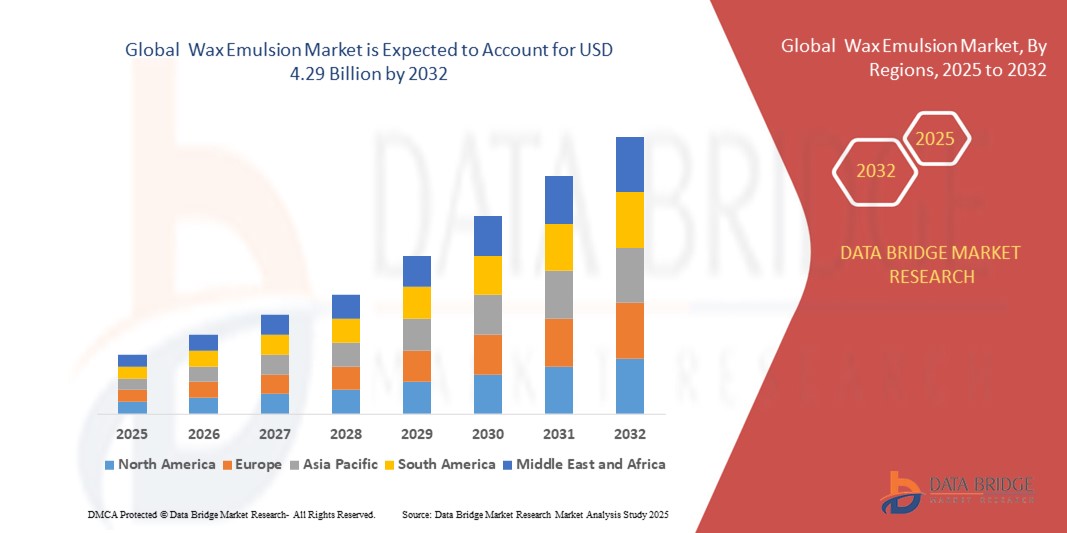
Wax Emulsion Market Size
- The global wax emulsion market size was valued at USD 3.38 billion in 2024 and is expected to reach USD 4.29 billion by 2032, at a CAGR of 3.00% during the forecast period
- The market growth is largely fuelled by the rising demand for environmentally friendly and water-based formulations in coatings, adhesives, textiles, and packaging sectors
- Increasing regulations on volatile organic compounds (VOCs), coupled with growing preference for sustainable surface treatment solutions, are contributing to the expansion of the wax emulsion market
Wax Emulsion Market Analysis
- Demand for wax emulsions is being driven by their excellent properties such as water resistance, surface gloss, abrasion resistance, and anti-blocking effects, making them highly valuable across industrial and consumer applications
- Growing usage in construction and decorative coatings, as well as expanding applications in wood and paper treatment, are reinforcing the market’s growth globally
- Asia-Pacific dominated the wax emulsion market with the largest revenue share in 2024, driven by rapid industrialization, expanding construction activity, and strong demand from textile and coating sectors
- North America region is expected to witness the highest growth rate in the global wax emulsion market, driven by technological innovations, rising focus on sustainable and bio-based formulations, and expanding applications in packaging, cosmetics, and adhesives sectors
- The synthetic base wax emulsion segment held the largest revenue share in 2024, driven by its wide availability, consistent performance, and superior resistance to heat and chemicals. These emulsions are extensively used across industrial applications such as coatings, adhesives, and polishes, where durability and precision are critical. Manufacturers also favor synthetic options for their ability to deliver stable dispersion and compatibility with diverse formulation systems
Report Scope and Wax Emulsion Market Segmentation
|
Attributes |
Wax Emulsion Key Market Insights |
|
Segments Covered |
|
|
Countries Covered |
North America
Europe
Asia-Pacific
Middle East and Africa
South America
|
|
Key Market Players |
• ALTANA (Germany) • Walker Industries (Canada) |
|
Market Opportunities |
• Expansion of Bio-Based and Sustainable Wax Emulsions |
|
Value Added Data Infosets |
In addition to the insights on market scenarios such as market value, growth rate, segmentation, geographical coverage, and major players, the market reports curated by the Data Bridge Market Research also include import export analysis, production capacity overview, production consumption analysis, price trend analysis, climate change scenario, supply chain analysis, value chain analysis, raw material/consumables overview, vendor selection criteria, PESTLE Analysis, Porter Analysis, and regulatory framework. |
Wax Emulsion Market Trends
Increasing Adoption of Wax Emulsions in Water-Based Coatings
- The shift toward eco-friendly, water-based formulations in paints and coatings is driving the demand for wax emulsions that provide surface protection, improved scratch resistance, and anti-blocking properties. This transition is significantly reshaping the coatings industry as regulatory bodies push for lower volatile organic compound (VOC) emissions
- Manufacturers are integrating wax emulsions into architectural and industrial coatings to enhance performance and durability while meeting sustainability goals. These emulsions are compatible with various binders and additives, making them suitable for flexible formulations across substrates
- The versatility of wax emulsions in delivering matting effects, water repellency, and slip resistance is appealing to formulators looking to develop high-performance coatings without compromising environmental compliance
- For instance, in 2023, several European paint manufacturers introduced water-based paints infused with polyethylene and carnauba wax emulsions, targeting residential and commercial segments. These products exhibited enhanced resistance to wear and staining
- As the coatings industry moves toward greener formulations, wax emulsions are expected to play an increasingly vital role, supported by R&D investments in bio-based and synthetic wax dispersions that can perform under diverse environmental and operational conditions
Wax Emulsion Market Dynamics
Driver
Growing Demand for Sustainable and Water-Based Formulations Across Industries
• The rising emphasis on environmental safety and sustainability is fuelling the demand for water-based systems, where wax emulsions are crucial components. Industries such as paints and coatings, adhesives, and textiles are shifting from solvent-based to water-based products to meet global regulatory standards and consumer expectations
• Wax emulsions offer low VOC content and reduced environmental impact while delivering enhanced surface properties, making them ideal for eco-conscious manufacturers. Their use in packaging, paper, and textile applications is expanding due to their non-toxic and biodegradable nature
• Government initiatives promoting green manufacturing and waste reduction are accelerating the adoption of water-based technologies, particularly in developed regions. Several countries have implemented strict VOC regulations, pushing companies to reformulate with water-compatible raw materials such as wax emulsions
• For instance, in 2022, the U.S. Environmental Protection Agency tightened VOC limits for architectural coatings, leading to a surge in demand for high-performance wax emulsions that comply with new standards
• Although this driver supports market growth, the formulation complexity of water-based systems requires ongoing innovation in emulsion chemistry to ensure stability, performance, and compatibility with other components
Restraint/Challenge
Performance Limitations in High-Stress and Extreme Conditions
• Despite their eco-friendly appeal, wax emulsions can face performance limitations under extreme temperatures, UV exposure, or high abrasion environments. This restricts their application in certain industrial or outdoor-use cases where solvent-based systems currently dominate
• The thermal stability and water resistance of wax emulsions, particularly bio-based types, may not match conventional alternatives in highly demanding settings. This creates hesitancy among end-users in sectors such as automotive and heavy-duty coatings
• Manufacturers also face challenges in achieving consistent particle size distribution, dispersion stability, and compatibility with other ingredients. These factors can affect gloss, hardness, or barrier properties, requiring more sophisticated formulation expertise
• For instance, in 2023, a leading Asian packaging company reported premature coating wear in food-grade cardboard treated with bio-based wax emulsions, prompting reevaluation of product specifications for moisture and grease resistance
• To overcome these hurdles, industry players must invest in advanced polymerization technologies and hybrid wax systems that bridge the gap between sustainability and high-performance requirements across diverse operating conditions
Wax Emulsion Market Scope
The market is segmented on the basis of material base, type, application, and end user industry.
- By Material Base
On the basis of material base, the wax emulsion market is segmented into synthetic base wax emulsion and natural base wax emulsion. The synthetic base wax emulsion segment held the largest revenue share in 2024, driven by its wide availability, consistent performance, and superior resistance to heat and chemicals. These emulsions are extensively used across industrial applications such as coatings, adhesives, and polishes, where durability and precision are critical. Manufacturers also favor synthetic options for their ability to deliver stable dispersion and compatibility with diverse formulation systems.
The natural base wax emulsion segment is expected to witness the fastest growth from 2025 to 2032, fuelled by increasing demand for bio-based and environmentally friendly materials. Derived from renewable sources such as carnauba and beeswax, these emulsions are gaining traction in cosmetics, food packaging, and textile applications. Their non-toxic, biodegradable properties align with rising consumer and regulatory preference for sustainable alternatives.
- By Type
On the basis of type, the global wax emulsion market is segmented into paraffin wax, carnauba wax, polyethylene wax, polypropylene wax, and others. The polyethylene wax segment accounted for the largest revenue share in 2024, attributed to its widespread use in paints, coatings, and inks due to excellent abrasion resistance and matting effects. Its chemical stability and compatibility with a variety of formulations make it a preferred choice in both water-based and solvent-based systems, driving its adoption across industries such as packaging and automotive.
The carnauba wax segment is expected to witness the fastest growth from 2025 to 20322, driven by increasing demand from the cosmetics and personal care sector. Derived from natural sources, carnauba wax emulsion is favored for its high melting point, gloss, and water-repellent properties, making it suitable for formulations in skincare, hair care, and lip care products. The rising consumer preference for plant-based and sustainable ingredients is further propelling the segment's growth.
- By Application
On the basis of application, the global wax emulsion market is segmented into paints and coatings, adhesives and sealants, and cosmetics. The paints and coatings segment dominated the market in 2024 with the largest revenue share, supported by growing construction and automotive activities worldwide. Wax emulsions are used to enhance scratch resistance, water repellency, and surface smoothness in architectural and industrial coatings. In addition, the demand for environmentally friendly waterborne formulations continues to push the use of wax emulsions in this segment.
The cosmetics segment is expected to witness the fastest growth from 2025 to 2032, driven by the rising demand for natural and multifunctional ingredients in personal care formulations. Wax emulsions provide film-forming, moisturizing, and sensory enhancement benefits, making them ideal for use in lotions, creams, and decorative cosmetics. The shift toward clean beauty and increasing product innovation are expected to sustain this segment’s momentum.
- By End User Industry
On the basis of end user industry, the wax emulsion market is segmented into paints and coatings, textiles, cosmetics, adhesives and sealants, construction and woodworking, food industry, and others. The paints and coatings segment dominated the market in 2024 due to the growing demand for water-based, low-VOC formulations that use wax emulsions for scratch resistance, matting, and water repellency. Their application ensures better durability and aesthetic performance in architectural and industrial coatings.
The cosmetics segment is expected to witness the fastest growth from 2025 to 2032, propelled by increasing demand for safe, skin-friendly formulations. Wax emulsions are widely used in personal care products such as lotions, creams, and hair care items for their emulsifying, film-forming, and moisturizing properties. Rising consumer awareness of natural ingredients is also driving innovation in bio-based cosmetic wax emulsions.
Wax Emulsion Market Regional Analysis
• Asia-Pacific dominated the wax emulsion market with the largest revenue share in 2024, driven by rapid industrialization, expanding construction activity, and strong demand from textile and coating sectors
• The region benefits from a well-established manufacturing base and favorable government policies supporting chemical and industrial production
• Rising investments in paints and coatings, packaging, and wood treatment, along with cost-effective raw material availability, continue to bolster market growth across countries such as China, India, and Japan
China Wax Emulsion Market Insight
The China wax emulsion market held the highest market share within Asia-Pacific in 2024, supported by robust infrastructure development, expanding textile production, and high-volume demand from paints and coatings industries. China’s manufacturing leadership, coupled with rising demand for eco-friendly and water-based formulations, is fueling product innovation in synthetic and natural wax emulsions. In addition, the presence of numerous domestic producers and a thriving export ecosystem position China as a key global supplier in the wax emulsion landscape.
Japan Wax Emulsion Market Insight
The Japan wax emulsion market is expected to witness the fastest growth from 2025 to 2032, driven by rising demand from the paints and coatings, textile, and cosmetics industries. The country’s focus on high-quality, environmentally friendly formulations is encouraging the adoption of water-based wax emulsions. In addition, Japan’s advanced manufacturing capabilities and strong R&D infrastructure support continuous innovation in both synthetic and natural wax blends. The emphasis on low-VOC and sustainable materials, especially in premium consumer and industrial applications, further fuels market expansion across the region.
North America Wax Emulsion Market Insight
The North America wax emulsion market is expected to witness the fastest growth from 2025 to 2032, driven by the rising preference for eco-friendly formulations across end-use industries. The region shows strong demand from the adhesives, coatings, and packaging sectors, particularly in the U.S., where green building trends and VOC regulations are prompting increased use of water-based emulsions. Technological advancements, along with the integration of performance-enhancing waxes in high-end applications, are supporting regional expansion.
U.S. Wax Emulsion Market Insight
The U.S. wax emulsion market is expected to witness the fastest growth from 2025 to 2032, driven by advancements in formulation technologies and increasing adoption in high-performance coating systems. The country’s mature construction and automotive industries continue to drive demand for durable, low-VOC wax emulsions. Furthermore, the focus on biodegradable and renewable sources is encouraging innovation in natural wax-based products, positioning the U.S. as a key market for sustainable development within the wax emulsion sector.
Europe Wax Emulsion Market Insight
The Europe wax emulsion market is expected to witness the fastest growth from 2025 to 2032, due to stringent environmental regulations and the rising demand for sustainable materials across sectors such as cosmetics, construction, and paper. Countries including Germany, France, and Italy are witnessing increasing incorporation of wax emulsions in premium paint systems, packaging materials, and water-repellent textile finishes. In addition, growing awareness around eco-label certification is propelling the shift toward natural and synthetic emulsions with minimal environmental impact.
Germany Wax Emulsion Market Insight
The Germany wax emulsion market is expected to witness the fastest growth from 2025 to 2032, supported by high industrial standards and sustainability initiatives. Germany's strong presence in automotive, packaging, and construction manufacturing leads to consistent demand for wax emulsions offering durability, moisture resistance, and low toxicity. Emphasis on water-based coatings and innovation in performance coatings is further shaping market momentum in the country.
U.K. Wax Emulsion Market Insight
The U.K. wax emulsion market is expected to witness the fastest growth from 2025 to 2032 driven by the country's transition to sustainable building practices and packaging solutions. As end users increasingly prioritize compliance with environmental standards, manufacturers are innovating low-VOC, bio-based wax emulsions to meet demand. The U.K.’s expanding green construction initiatives and rising consumer interest in eco-conscious personal care products are expected to drive further market uptake.
Wax Emulsion Market Share
The Wax Emulsion industry is primarily led by well-established companies, including:
• ALTANA (Germany)
• H&R GROUP (Germany)
• The Lubrizol Corporation (U.S.)
• Wacker Chemie AG (Germany)
• PMC Group, Inc. (U.S.)
• Walker Industries (Canada)
• NIPPON SEIRO CO., LTD. (Japan)
• BASF SE (Germany)
• Sasol Limited (South Africa)
• Hexion (U.S.)
• Michelman, Inc. (U.S.)
• Repsol (Spain)
• Paramelt RMC B.V. (Netherlands)
• CHT Germany GmbH (Germany)
• Micro Powders, Inc. (U.S.)
• Henry Company (U.S.)
• Govi (Belgium)
• SHAMROCK (U.S.)
• Paraffinwaxco, Inc. (Subsidiary of RAHA Group) (U.S.)
• King Honor International Ltd. (China)
• Nanjing Tianshi New Material Technologies Co., Ltd (China)
Latest Developments in Global Wax Emulsion Market
- In December 2023, PetroNaft Co. highlighted a product development emphasizing the role of wax emulsions in enhancing the texture, stability, and moisturizing properties of personal care items such as creams, lotions, and hair care products. Their inclusion in cosmetics like lipsticks and eyeshadows improves smooth application and extends product longevity. This reinforces the growing use of wax emulsions in the cosmetics sector, positively influencing market expansion
- In November 2022, Elsevier B.V. published a research update indicating the rising practical importance of finely dispersed or submicron wax emulsions in the pharmaceutical and cosmetic industries. These emulsions are being increasingly adopted in healing ointments and creams due to their enhanced homogeneity and absorption. This development is expected to boost demand in medical and skincare formulations, driving innovation in the wax emulsion market

- Interactive Data Analysis Dashboard
- Company Analysis Dashboard for high growth potential opportunities
- Research Analyst Access for customization & queries
- Competitor Analysis with Interactive dashboard
- Latest News, Updates & Trend analysis
- Harness the Power of Benchmark Analysis for Comprehensive Competitor Tracking
Global Wax Emulsion Market, Supply Chain Analysis and Ecosystem Framework
To support market growth and help clients navigate the impact of geopolitical shifts, DBMR has integrated in-depth supply chain analysis into its Global Wax Emulsion Market research reports. This addition empowers clients to respond effectively to global changes affecting their industries. The supply chain analysis section includes detailed insights such as Global Wax Emulsion Market consumption and production by country, price trend analysis, the impact of tariffs and geopolitical developments, and import and export trends by country and HSN code. It also highlights major suppliers with data on production capacity and company profiles, as well as key importers and exporters. In addition to research, DBMR offers specialized supply chain consulting services backed by over a decade of experience, providing solutions like supplier discovery, supplier risk assessment, price trend analysis, impact evaluation of inflation and trade route changes, and comprehensive market trend analysis.
Data collection and base year analysis are done using data collection modules with large sample sizes. The stage includes obtaining market information or related data through various sources and strategies. It includes examining and planning all the data acquired from the past in advance. It likewise envelops the examination of information inconsistencies seen across different information sources. The market data is analysed and estimated using market statistical and coherent models. Also, market share analysis and key trend analysis are the major success factors in the market report. To know more, please request an analyst call or drop down your inquiry.
The key research methodology used by DBMR research team is data triangulation which involves data mining, analysis of the impact of data variables on the market and primary (industry expert) validation. Data models include Vendor Positioning Grid, Market Time Line Analysis, Market Overview and Guide, Company Positioning Grid, Patent Analysis, Pricing Analysis, Company Market Share Analysis, Standards of Measurement, Global versus Regional and Vendor Share Analysis. To know more about the research methodology, drop in an inquiry to speak to our industry experts.
Data Bridge Market Research is a leader in advanced formative research. We take pride in servicing our existing and new customers with data and analysis that match and suits their goal. The report can be customized to include price trend analysis of target brands understanding the market for additional countries (ask for the list of countries), clinical trial results data, literature review, refurbished market and product base analysis. Market analysis of target competitors can be analyzed from technology-based analysis to market portfolio strategies. We can add as many competitors that you require data about in the format and data style you are looking for. Our team of analysts can also provide you data in crude raw excel files pivot tables (Fact book) or can assist you in creating presentations from the data sets available in the report.













