


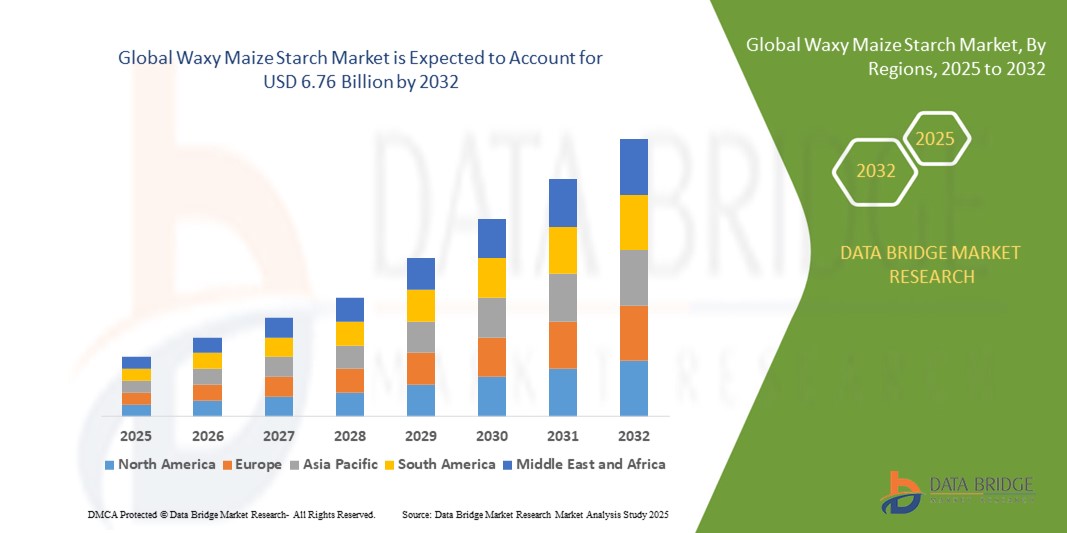
What is the Global Waxy Maize Starch Market Size and Growth Rate?
- The global waxy maize starch market size was valued at USD 4.47 billion in 2024 and is expected to reach USD 6.76 billion by 2032, at a CAGR of 5.30% during the forecast period
- Waxy maize starch's versatility in different applications, including food, pharmaceuticals, and industrial processes, contributes to its widespread use. It serves as a functional ingredient with diverse applications across various industries. Moreover, as economies develop and consumer preferences evolve, there is a growing demand for processed and convenience foods in emerging markets. This trend is driving the demand for functional ingredients such as waxy maize starch
What are the Major Takeaways of Waxy Maize Starch Market?
- The trend toward convenience and processed foods has increased the demand for ingredients such as waxy maize starch. It is commonly used in the food industry to enhance the texture, stability, and overall quality of processed and convenience products
- Asia-Pacific dominated the waxy maize starch market with the largest revenue share of 42.01% in 2024, driven by rising demand for starch-based products in food and beverages, pharmaceuticals, and industrial applications
- North America waxy maize starch market is projected to grow at the fastest CAGR of 24% from 2025 to 2032, driven by increasing demand for clean-label ingredients, functional food formulations, and bio-based industrial applications
- The Conventional segment dominated the waxy maize starch market with the largest market revenue share of 68.5% in 2024, driven by its widespread availability, cost-effectiveness, and extensive use across food, pharmaceutical, and industrial applications
Report Scope and Waxy Maize Starch Market Segmentation
|
Attributes |
Waxy Maize Starch Key Market Insights |
|
Segments Covered |
|
|
Countries Covered |
North America
Europe
Asia-Pacific
Middle East and Africa
South America
|
|
Key Market Players |
|
|
Market Opportunities |
|
|
Value Added Data Infosets |
In addition to the insights on market scenarios such as market value, growth rate, segmentation, geographical coverage, and major players, the market reports curated by the Data Bridge Market Research also include in-depth expert analysis, pricing analysis, brand share analysis, consumer survey, demography analysis, supply chain analysis, value chain analysis, raw material/consumables overview, vendor selection criteria, PESTLE Analysis, Porter Analysis, and regulatory framework. |
What is the Key Trend in the Waxy Maize Starch Market?
Rising Demand for Clean-Label and Functional Ingredients
- A significant and accelerating trend in the global waxy maize starch market is the growing demand for clean-label, non-GMO, and functional starches that cater to the rising preference for healthier and sustainable food products. This shift is driven by increasing consumer awareness about ingredient transparency and nutritional value
- For instance, food manufacturers are increasingly using clean-label Waxy Maize Starch in ready-to-eat meals, bakery products, and dairy alternatives, where it serves as a natural thickener and stabilizer without compromising taste or texture. Similarly, beverage producers are incorporating modified clean-label starches to improve product consistency
- Functional innovations are also gaining traction, with companies developing resistant and high-amylopectin starches that support digestive health and energy release, while also catering to sports nutrition and medical food applications
- The integration of sustainable sourcing and eco-friendly production methods is further fueling adoption, as brands highlight low-carbon and renewable raw material practices
- This trend toward healthier, functional, and sustainable starches is reshaping industry expectations and pushing manufacturers to innovate. Consequently, companies such as Cargill and Ingredion are launching advanced clean-label Waxy Maize Starch solutions to strengthen their competitive edge
- The demand for such products is rapidly expanding across food, beverage, pharmaceutical, and industrial applications, positioning clean-label Waxy Maize Starch as a cornerstone of the functional ingredients market
What are the Key Drivers of Waxy Maize Starch Market?
- The rising demand for convenience and processed foods, coupled with the increasing preference for clean-label and natural ingredients, is a major driver for Waxy Maize Starch adoption
- For instance, in April 2024, Ingredion Incorporated expanded its portfolio of non-GMO Waxy Maize Starches tailored for bakery and dairy applications, addressing the growing demand for transparency and natural ingredients
- Waxy Maize Starch is also gaining traction in pharmaceuticals and industrial applications, offering improved film-forming properties, stability, and viscosity control, which provide a strong alternative to synthetic additives
- Furthermore, its growing use in sports nutrition, gluten-free products, and functional foods is fueling market growth, as it provides unique nutritional and textural benefits
- The convenience of formulation versatility, extended shelf life, and cost-effectiveness makes Waxy Maize Starch highly attractive to both large-scale manufacturers and small enterprises, driving widespread adoption across multiple sectors
Which Factor is challenging the Growth of the Waxy Maize Starch Market?
- Fluctuating raw material prices and supply chain disruptions present significant challenges to market expansion, particularly for manufacturers dependent on corn production. Variability in global corn yields, influenced by climate change and trade policies, affects pricing and availability
- For instance, geopolitical tensions and export restrictions in major corn-producing regions have impacted supply reliability, raising costs for starch processors
- Additionally, competition from alternative starch sources such as tapioca and potato starch, which are often perceived as more sustainable or cost-efficient, is creating market pressure
- Addressing these challenges requires investment in resilient sourcing strategies, development of cost-optimized formulations, and consumer education to highlight the functional superiority of Waxy Maize Starch
- While innovations in clean-label processing are mitigating some cost concerns, price-sensitive markets may remain hesitant to adopt premium variants, particularly in developing economies
- Overcoming these hurdles through sustainable sourcing, technological advancements, and diversified supply chains will be critical for ensuring long-term growth
How is the Waxy Maize Starch Market Segmented?
The market is segmented on the basis of category, type, and application.
- By Category
On the basis of category, the waxy maize starch market is segmented into Conventional and Organic. The Conventional segment dominated the waxy maize starch market with the largest market revenue share of 68.5% in 2024, driven by its widespread availability, cost-effectiveness, and extensive use across food, pharmaceutical, and industrial applications. Manufacturers prefer conventional starch for mass production due to its reliable supply chain and established processing methods.
The Organic segment is anticipated to witness the fastest growth rate of 20.4% from 2025 to 2032, fueled by rising consumer demand for clean-label and chemical-free ingredients. Increasing health awareness and stringent regulations promoting organic certifications are further boosting the adoption of organic Waxy Maize Starch in premium food and nutraceutical products.
- By Type
On the basis of type, the waxy maize starch market is segmented into Native and Modified. The Modified segment held the largest market revenue share of 57.2% in 2024, driven by its enhanced functional properties such as improved stability, viscosity control, and resistance to processing conditions, making it ideal for industrial and food processing applications.
The Native segment is expected to witness the fastest CAGR of 18.9% from 2025 to 2032, supported by increasing demand for minimally processed and natural ingredients, particularly in clean-label and organic product formulations.
- By Application
On the basis of application, the waxy maize starch market is segmented into Food and Beverages, Pharmaceuticals and Nutraceuticals, Animal Feed, Textiles, and Others. The Food and Beverages segment accounted for the largest market revenue share of 62.8% in 2024, driven by its extensive use as a thickener, stabilizer, and texturizing agent in bakery products, dairy, confectionery, and beverages. Rising demand for convenience foods and functional ingredients further strengthens this segment’s dominance.
The Pharmaceuticals and Nutraceuticals segment is expected to witness the fastest CAGR of 21.1% from 2025 to 2032, fueled by the growing use of Waxy Maize Starch in drug formulation, dietary supplements, and functional health products due to its digestibility and controlled energy release properties.
Which Region Holds the Largest Share of the Waxy Maize Starch Market?
- Asia-Pacific dominated the waxy maize starch market with the largest revenue share of 42.01% in 2024, driven by rising demand for starch-based products in food and beverages, pharmaceuticals, and industrial applications
- The region benefits from abundant raw material availability, large-scale production capacities, and expanding export markets, making it the global hub for Waxy Maize Starch manufacturing
- Increasing consumption of processed foods, growing health awareness, and government initiatives supporting agricultural modernization further strengthen Asia-Pacific’s leadership in this market
China Waxy Maize Starch Market Insight
The China waxy maize starch market accounted for the largest market revenue share in Asia-Pacific in 2024, driven by high production volumes and rising domestic consumption across food processing, pharmaceuticals, and animal feed industries. Strong government support for maize cultivation and the availability of affordable starch products make China a key player in global exports, bolstering its market dominance.
Japan Waxy Maize Starch Market Insight
The Japan waxy maize starch market is gaining momentum due to high demand for premium food products, advanced pharmaceutical applications, and increasing use in nutraceuticals. Innovations in modified starch and rising interest in health-oriented functional ingredients are fueling growth, making Japan a vital market for specialized starch applications in Asia-Pacific.
Which Region is the Fastest Growing Region in the Waxy Maize Starch Market?
North America waxy maize starch market is projected to grow at the fastest CAGR of 24% from 2025 to 2032, driven by increasing demand for clean-label ingredients, functional food formulations, and bio-based industrial applications. The shift toward plant-based diets and the rising use of starch in pharmaceuticals and biodegradable materials are key growth factors.
U.S. Waxy Maize Starch Market Insight
The U.S. waxy maize starch market captured the largest revenue share in 2024 within North America, propelled by strong food and beverage processing industries and the growing demand for organic and non-GMO starch varieties. Technological advancements in starch modification and increasing applications in bioplastics and industrial adhesives further support market expansion.
Canada Waxy Maize Starch Market Insight
The Canada waxy maize starch market is expected to grow steadily, supported by rising health-conscious consumer preferences and expansion of functional foods and nutraceutical sectors. Investments in sustainable sourcing and government initiatives promoting agricultural innovation are boosting the regional market outlook.
Which are the Top Companies in Waxy Maize Starch Market?
The waxy maize starch industry is primarily led by well-established companies, including:
- Ingredion Incorporated (U.S.)
- Cargill, Incorporated (U.S.)
- Tate & Lyle PLC (U.K.)
- Roquette Frères (France)
- AGRANA Stärke GmbH (Austria)
- Archer Daniels Midland Company (ADM) (U.S.)
- Emsland Group (Germany)
- Tereos Syral (France)
- Thai Wah Starch Public Company Limited (Thailand)
- Luzhou Bio-Chem Technology Limited (China)
What are the Recent Developments in Global Waxy Maize Starch Market?
- In May 2022, Tate & Lyle launched a new Customer Innovation and Collaboration Centre in Santiago, Chile, to enhance consumer service and strengthen market reach. This initiative reflects the company’s commitment to driving innovation and expanding its footprint in Latin America
- In January 2022, AGRANA installed a large solar power system at its potato starch mill in Gmünd, Waldviertel, under a contracting agreement with RWA Solar Solutions. Featuring 890 photovoltaic modules across 1,650 m², the system generates 338,000 kWh annually—enough to power 75 households—demonstrating AGRANA’s focus on sustainability and renewable energy integration
- In May 2021, Daesang Corp. announced plans to achieve US$1 billion in sales in Indonesia by 2030, aiming to leverage the growing demand for halal products. This strategic expansion is expected to strengthen its presence in Southeast Asia and pave the way for entry into Middle Eastern markets
- In September 2019, Cargill partnered with two Indian enterprises to produce maize starch and sweeteners in India. By expanding its production capacity through collaborations in Karnataka and Andhra Pradesh, Cargill aims to meet the rising demand for starch-based products in the region

- Interactive Data Analysis Dashboard
- Company Analysis Dashboard for high growth potential opportunities
- Research Analyst Access for customization & queries
- Competitor Analysis with Interactive dashboard
- Latest News, Updates & Trend analysis
- Harness the Power of Benchmark Analysis for Comprehensive Competitor Tracking
Global Waxy Maize Starch Market, Supply Chain Analysis and Ecosystem Framework
To support market growth and help clients navigate the impact of geopolitical shifts, DBMR has integrated in-depth supply chain analysis into its Global Waxy Maize Starch Market research reports. This addition empowers clients to respond effectively to global changes affecting their industries. The supply chain analysis section includes detailed insights such as Global Waxy Maize Starch Market consumption and production by country, price trend analysis, the impact of tariffs and geopolitical developments, and import and export trends by country and HSN code. It also highlights major suppliers with data on production capacity and company profiles, as well as key importers and exporters. In addition to research, DBMR offers specialized supply chain consulting services backed by over a decade of experience, providing solutions like supplier discovery, supplier risk assessment, price trend analysis, impact evaluation of inflation and trade route changes, and comprehensive market trend analysis.
Data collection and base year analysis are done using data collection modules with large sample sizes. The stage includes obtaining market information or related data through various sources and strategies. It includes examining and planning all the data acquired from the past in advance. It likewise envelops the examination of information inconsistencies seen across different information sources. The market data is analysed and estimated using market statistical and coherent models. Also, market share analysis and key trend analysis are the major success factors in the market report. To know more, please request an analyst call or drop down your inquiry.
The key research methodology used by DBMR research team is data triangulation which involves data mining, analysis of the impact of data variables on the market and primary (industry expert) validation. Data models include Vendor Positioning Grid, Market Time Line Analysis, Market Overview and Guide, Company Positioning Grid, Patent Analysis, Pricing Analysis, Company Market Share Analysis, Standards of Measurement, Global versus Regional and Vendor Share Analysis. To know more about the research methodology, drop in an inquiry to speak to our industry experts.
Data Bridge Market Research is a leader in advanced formative research. We take pride in servicing our existing and new customers with data and analysis that match and suits their goal. The report can be customized to include price trend analysis of target brands understanding the market for additional countries (ask for the list of countries), clinical trial results data, literature review, refurbished market and product base analysis. Market analysis of target competitors can be analyzed from technology-based analysis to market portfolio strategies. We can add as many competitors that you require data about in the format and data style you are looking for. Our team of analysts can also provide you data in crude raw excel files pivot tables (Fact book) or can assist you in creating presentations from the data sets available in the report.













