


Wearable AI Market Size
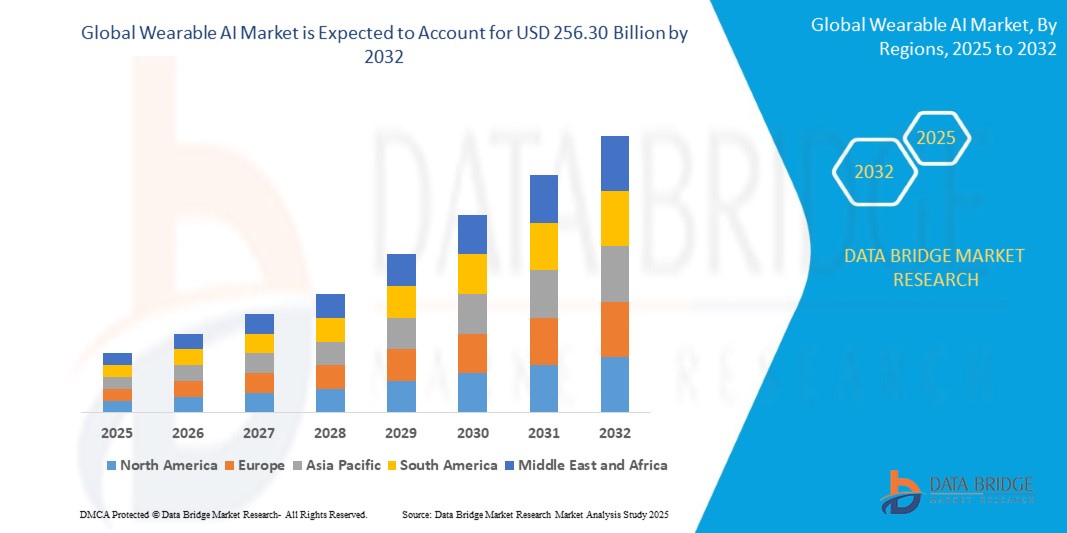
- The Global Wearable AI Market size was valued at USD 61.55 billion in 2024 and is expected to reach USD 256.30 billion by 2032, at a CAGR of 19.52% during the forecast period
- This growth is driven by increasing emergence of IoT and integration of wireless technology, rising growth prospects of wearable component technology.
Wearable AI Market Analysis
- Wearable AI is very often used to track a person’s vital signs of data those are related to location, health and fitness or even one’s biofeedback indicating emotion. Although it has some issues like privacy and the extent to which they may affect the way of social interaction and how the person looks wearing them and the issues with user-friendliness, it is being used by millions of users worldwide from smartwatches to fitness trackers, ring and bracelets, even smart glasses.
- Rising augmentation of operations in healthcare industry is a crucial factor accelerating the market growth, also increasing emergence of IoT and integration of wireless technology, rising growth prospects of wearable component technology, rise in the consumer preference and demand for advanced wearable devices, increasing disposable income of consumers in emerging economies, rising sales of smart watches, rising focus on trillion (USD) less and health monitoring, increasing technological advancement in consumer electronics and rising smartphone and internet penetration are the major factors among others boosting the wearable AI market.
- North America dominates the wearable AI market due to increasing presence of prominent players operating in the countries in the region and early adoption of technologically advanced products among individuals in this region.
- Asia-Pacific is the expected region in terms of growth in wearable AI market due to increasing demand for consumer electronics products among end-users in countries such as China and India in this region.
- The smart watch segment is expected to dominate the Wearable AI Market with the largest share of 49.47% in 2025, owing to its widespread adoption among consumers for health tracking, fitness monitoring, and real-time notifications. Integration of AI enables features such as ECG monitoring, sleep analysis, personalized coaching, and predictive health insights. Leading brands like Apple, Samsung, and Fitbit continue to innovate with AI-based functionalities, contributing to the strong demand and dominance of this segment.
Report Scope and Wearable AI Market Segmentation
|
Attributes |
Wearable AI Key Market Insights |
|
Segments Covered |
|
|
Countries Covered |
North America
Europe
Asia-Pacific
Middle East and Africa
South America
|
|
Key Market Players |
|
|
Market Opportunities |
|
|
Value Added Data Infosets |
In addition to the insights on market scenarios such as market value, growth rate, segmentation, geographical coverage, and major players, the market reports curated by the Data Bridge Market Research also include import export analysis, production capacity overview, production consumption analysis, price trend analysis, climate change scenario, supply chain analysis, value chain analysis, raw material/consumables overview, vendor selection criteria, PESTLE Analysis, Porter Analysis, and regulatory framework. |
Wearable AI Market Trends
“Rising Demand for AI Assistants in Smart Wearables”
- The growing integration of AI assistants in wearable devices such as smartwatches, earbuds, and fitness bands is significantly contributing to the expansion of the wearable AI market.
- AI-enabled wearables enhance user experience through real-time data processing, personalized recommendations, and hands-free assistance, increasing their appeal across demographics.
- This demand is particularly prominent among tech-savvy consumers seeking advanced functionality for health tracking, navigation, communication, and lifestyle management.
For instance,
- In March 2023, Apple Inc. upgraded its Siri functionality in the Apple Watch Series 8 to provide faster on-device AI response and health data insights without requiring cloud connectivity, improving privacy and performance.
- As AI-powered assistants become more refined and integrated into daily life, the wearable AI market continues to gain momentum globally.
Wearable AI Market Dynamics
Driver
“Rising Integration of IoT and Wireless Technology”
- The convergence of wearable devices with IoT platforms and wireless connectivity such as Bluetooth, Wi-Fi, and NFC has expanded the potential of wearable AI applications.
- This integration enables continuous health monitoring, seamless data transmission, and real-time analytics, especially in healthcare and industrial domains.
For instance,
- In February 2024, Fitbit (owned by Google) launched a fitness band with built-in LTE support and Google AI chip integration for remote health monitoring and automatic emergency response, improving real-time care for elderly users.
- With continued IoT expansion and 5G infrastructure development, wearable AI is poised for faster and more intelligent decision-making capabilities, creating long-term growth prospects.
Opportunity
“Emergence of Wearables for Pets and Novel Use Cases”
- Novel applications of wearable AI beyond human use, such as pet tracking and livestock monitoring, are opening up untapped market segments.
- Additionally, innovations in wearable-as-a-service (WaaS) business models are expanding accessibility for enterprise and industrial use.
For instance,
- In July 2022, a U.S.-based startup launched AI-powered pet collars that track behavior, location, and vital signs, helping owners and veterinarians proactively monitor animal health.
- Such diversified applications are expected to generate new revenue streams and drive adoption in unconventional markets during the forecast period.
Restraint/Challenge
“High Cost and Short Product Lifecycle of Consumer Electronics”
- The rapid pace of innovation in the consumer electronics industry often leads to a shortened lifecycle of wearable devices, which can deter adoption due to frequent obsolescence.
- Additionally, high development and purchase costs pose affordability challenges for users in price-sensitive regions.
For instance,
- In 2021–2022, premium AI-enabled smartwatches from brands like Garmin and Samsung priced above $400 saw lower-than-expected uptake in emerging markets due to high costs and limited upgrade incentives.
- This acts as a restraint in market expansion, especially in developing economies with lower disposable income levels.
Wearable AI Market Scope
Wearable AI market is segmented on the basis of operation, product, component and application.
|
Segmentation |
Sub-Segmentation |
|
By Operation |
|
|
By Product |
|
|
By Component |
|
|
By Application
|
|
In 2025, the smart watch segment is projected to dominate the market with the largest share in the product segment
The smart watch segment is expected to dominate the Wearable AI Market with the largest share of 49.47% in 2025, owing to its widespread adoption among consumers for health tracking, fitness monitoring, and real-time notifications. Integration of AI enables features such as ECG monitoring, sleep analysis, personalized coaching, and predictive health insights. Leading brands like Apple, Samsung, and Fitbit continue to innovate with AI-based functionalities, contributing to the strong demand and dominance of this segment.
In 2025, the on-device AI segment is projected to dominate the market with the largest share in the operation segment
The on-device AI segment is expected to dominate the Wearable AI Market with the largest market share of 53.61% in 2025 due to its ability to process data directly on the device without relying on cloud connectivity. This results in faster response times, enhanced data privacy, and reduced latency—crucial for health-critical and real-time applications. Wearable AI devices leveraging on-device processing are preferred for fitness tracking, health monitoring, and personal assistance, further driving the growth of this segment.
Wearable AI Market Regional Analysis
“North America Holds the Largest Share in the Wearable AI Market”
- North America dominates the Wearable AI Market, driven by the widespread adoption of smart wearable technologies, strong digital infrastructure, and a highly tech-savvy population.
- The U.S. holds a significant share due to the increasing popularity of fitness trackers, smartwatches, and AI-powered health monitoring devices that offer real-time analytics for personal wellness and chronic disease management.
- The presence of major market players such as Apple, Google, Fitbit (now part of Google), and Amazon, combined with strong R&D investments and continuous product innovations, further fuel market growth.
- Additionally, the growing focus on preventive healthcare, integration of AI in remote patient monitoring, and rising consumer spending on wearable electronics contribute to market expansion across the region.
“Asia-Pacific is Projected to Register the Highest CAGR in the Wearable AI Market”
- The Asia-Pacific region is expected to witness the highest growth rate in the Wearable AI Market, driven by a rapidly expanding tech ecosystem, rising disposable incomes, and increasing health awareness among consumers.
- Countries such as China, India, Japan, and South Korea are emerging as key markets due to high smartphone penetration, digital transformation in healthcare, and increased adoption of fitness and health-focused wearables.
- Japan, with its strong electronics and robotics industry, is at the forefront of developing AI-integrated wearable devices, especially for elder care and healthcare monitoring.
- China and India are witnessing a surge in domestic startups and collaborations with global brands, along with government initiatives promoting digital health. The availability of cost-effective wearables and a massive consumer base make these countries lucrative markets for wearable AI adoption.
Wearable AI Market Share
The market competitive landscape provides details by competitor. Details included are company overview, company financials, revenue generated, market potential, investment in research and development, new market initiatives, global presence, production sites and facilities, production capacities, company strengths and weaknesses, product launch, product width and breadth, application dominance. The above data points provided are only related to the companies' focus related to market.
The Major Market Leaders Operating in the Market Are:
- Apple Inc.(United States)
- Fitbit, Inc.(United States)
- SAMSUNG(South Korea)
- Sony Corporation(Japan)
- Xiaomi (China)
- Garmin Ltd. (Switzerland)
- Aliph Brands LLC (Jawbone)(United States)
- TomTom International BV(Netherlands)
- Huawei Technologies Co., Ltd. (China)
- Nokia (Finland)
- adidas Group(Germany)
- SUUNTO(Finland)
- CASIO COMPUTER CO., LTD(Japan)
- Misfit (United States)
- LG Electronics (South Korea)
- Qualcomm Technologies, Inc(United States)
- IBM(United States)
- Oracle (United States)
Latest Developments in Global Wearable AI Market
- In April 2025, Apple Inc. announced the integration of on-device generative AI capabilities in the Apple Watch Series 10, enhancing health insights, real-time workout suggestions, and emergency detection. The upgrade includes the new Apple Neural Engine chip designed for faster processing and improved privacy by minimizing cloud dependency.
- In February 2025, Garmin Ltd. unveiled the Venu 4 smartwatch featuring AI-based coaching and fatigue monitoring, designed specifically for athletes and fitness enthusiasts. It uses machine learning to personalize training plans based on biometric feedback and performance data.
- In December 2024, Samsung Electronics launched the Galaxy Ring, an AI-powered wearable ring aimed at sleep tracking, stress management, and metabolic monitoring. The device utilizes Samsung’s BioActive Sensor and integrates with the Samsung Health app for real-time AI insights.
- In November 2024, Fitbit (Google) introduced the Fitbit Sense 3 with built-in AI emotional health tracking and predictive analytics for stress detection. The wearable uses AI to suggest guided breathing exercises and daily readiness scores based on sleep, activity, and heart rate variability.
- In October 2024, Huawei Technologies Co., Ltd. launched its next-gen Huawei Watch GT 5, equipped with HarmonyOS 4 and a proprietary AI health assistant. The device features continuous SpO2, ECG, and AI-driven fitness planning, expanding Huawei’s health tech ecosystem.
- In September 2024, Sony Corporation revealed a prototype of its AI-powered AR smart glasses at CES Asia, designed for enterprise and industrial applications. The glasses integrate object recognition, real-time transcription, and AI assistance for hands-free workflows.
- In August 2024, Qualcomm Technologies, Inc. announced its new Snapdragon W6 Gen 1 wearable chipset with advanced AI inference capabilities, longer battery life, and enhanced graphics, aiming to power the next generation of wearable AI devices from multiple OEMs.

- Interactive Data Analysis Dashboard
- Company Analysis Dashboard for high growth potential opportunities
- Research Analyst Access for customization & queries
- Competitor Analysis with Interactive dashboard
- Latest News, Updates & Trend analysis
- Harness the Power of Benchmark Analysis for Comprehensive Competitor Tracking
Global Wearable Ai Market, Supply Chain Analysis and Ecosystem Framework
To support market growth and help clients navigate the impact of geopolitical shifts, DBMR has integrated in-depth supply chain analysis into its Global Wearable Ai Market research reports. This addition empowers clients to respond effectively to global changes affecting their industries. The supply chain analysis section includes detailed insights such as Global Wearable Ai Market consumption and production by country, price trend analysis, the impact of tariffs and geopolitical developments, and import and export trends by country and HSN code. It also highlights major suppliers with data on production capacity and company profiles, as well as key importers and exporters. In addition to research, DBMR offers specialized supply chain consulting services backed by over a decade of experience, providing solutions like supplier discovery, supplier risk assessment, price trend analysis, impact evaluation of inflation and trade route changes, and comprehensive market trend analysis.
Data collection and base year analysis are done using data collection modules with large sample sizes. The stage includes obtaining market information or related data through various sources and strategies. It includes examining and planning all the data acquired from the past in advance. It likewise envelops the examination of information inconsistencies seen across different information sources. The market data is analysed and estimated using market statistical and coherent models. Also, market share analysis and key trend analysis are the major success factors in the market report. To know more, please request an analyst call or drop down your inquiry.
The key research methodology used by DBMR research team is data triangulation which involves data mining, analysis of the impact of data variables on the market and primary (industry expert) validation. Data models include Vendor Positioning Grid, Market Time Line Analysis, Market Overview and Guide, Company Positioning Grid, Patent Analysis, Pricing Analysis, Company Market Share Analysis, Standards of Measurement, Global versus Regional and Vendor Share Analysis. To know more about the research methodology, drop in an inquiry to speak to our industry experts.
Data Bridge Market Research is a leader in advanced formative research. We take pride in servicing our existing and new customers with data and analysis that match and suits their goal. The report can be customized to include price trend analysis of target brands understanding the market for additional countries (ask for the list of countries), clinical trial results data, literature review, refurbished market and product base analysis. Market analysis of target competitors can be analyzed from technology-based analysis to market portfolio strategies. We can add as many competitors that you require data about in the format and data style you are looking for. Our team of analysts can also provide you data in crude raw excel files pivot tables (Fact book) or can assist you in creating presentations from the data sets available in the report.













