


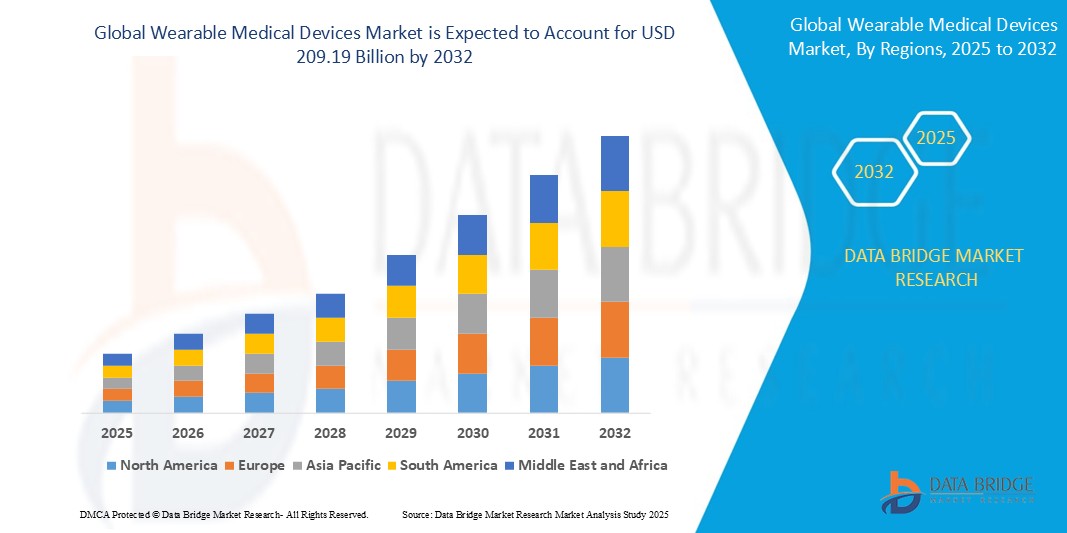
Wearable Medical Devices Market Size
- The global wearable medical devices market size was valued at USD 48.32 billion in 2024 and is expected to reach USD 209.19 billion by 2032, at a CAGR of 20.10 % during the forecast period
- This growth is driven by factors such as the increasing prevalence of chronic diseases, growing demand for remote patient monitoring, rising health awareness among consumers, and technological advancements in biosensors and wireless connectivity
Wearable Medical Devices Market Analysis
- The wearable medical devices market is experiencing significant growth, driven by advancements in sensor technology and the increasing demand for continuous health monitoring solutions. These devices enable real-time tracking of vital signs, facilitating proactive healthcare management and early detection of potential health issues
- The integration of artificial intelligence and machine learning algorithms into wearable medical devices enhances their diagnostic capabilities, allowing for more accurate data analysis and personalized health insights. This technological advancement contributes to improved patient outcomes and supports the shift towards preventive healthcare approaches
- North America is expected to dominate the Wearable Medical Devices market due to its advanced healthcare infrastructure, high adoption of innovative wearable technologies, and the presence of leading medical device manufacturers. In addition, favourable reimbursement policies and strong consumer demand for health monitoring devices contribute to the region's dominance
- Asia-Pacific is expected to be the fastest growing region in the Wearable Medical Devices market during the forecast period due to increasing healthcare awareness, the rise of digital health technologies, and government initiatives aimed at improving healthcare access. The region's growing middle class and the increasing prevalence of chronic diseases also drive demand for wearable medical devices
- The diagnostic devices segment is expected to dominate the Wearable Medical Devices market with the largest share of 74.3% in 2025 due to its ability to provide continuous, real-time monitoring of vital health parameters such as heart rate, glucose levels, and blood pressure.
Report Scope and Wearable Medical Devices Market Segmentation
|
Attributes |
Wearable Medical Devices Key Market Insights |
|
Segments Covered |
|
|
Countries Covered |
North America
Europe
Asia-Pacific
Middle East and Africa
South America
|
|
Key Market Players |
|
|
Market Opportunities |
|
|
Value Added Data Infosets |
In addition to the insights on market scenarios such as market value, growth rate, segmentation, geographical coverage, and major players, the market reports curated by the Data Bridge Market Research also include in-depth expert analysis, geographically represented company-wise production and capacity, network layouts of distributors and partners, detailed and updated price trend analysis and deficit analysis of supply chain and demand. |
Wearable Medical Devices Market Trends
“Integration of Artificial Intelligence in Wearable Medical Devices”
- Artificial intelligence is enhancing wearable medical devices by enabling real-time data analysis and predictive health insights
- For instance, Fitbit’s Sense device uses AI to detect stress patterns and alert users accordingly
- Machine learning algorithms process continuous data from sensors to detect early signs of health issues, facilitating timely interventions
- For instance, Apple Watch’s ability to identify irregular heart rhythms and notify users of potential atrial fibrillation
- AI integration allows for personalized health recommendations, improving patient engagement and adherence to treatment plans
- The combination of AI with wearable technology is transforming traditional healthcare models, shifting towards proactive and preventive care
- As AI technology advances, its role in wearable medical devices is expected to expand, offering more sophisticated health monitoring solutions
Wearable Medical Devices Market Dynamics
Driver
“Increasing Prevalence of Chronic Diseases and Aging Population”
- The wearable medical devices market is expanding rapidly due to the rising number of people affected by chronic conditions such as diabetes and cardiovascular diseases
- For instance, continuous glucose monitors help diabetic patients manage their blood sugar levels more effectively
- These conditions require ongoing health tracking, and wearable devices provide real-time data that supports early detection and timely intervention
- An aging global population is also contributing to market growth, as older adults need consistent health monitoring for conditions such as hypertension and respiratory issues
- Wearables enable remote monitoring, reducing the need for frequent in-person doctor visits and allowing healthcare providers to monitor patients from a distance
- This proactive healthcare approach gives individuals more control over their health and contributes to improved health outcomes and reduced hospital readmissions
Opportunity
“Integration with Artificial Intelligence and Internet of Things”
- The integration of wearable medical devices with artificial intelligence and the Internet of Things is creating new opportunities for market growth and healthcare innovation
- Artificial intelligence processes data from wearables to deliver personalized insights and predict potential health issues before they become critical
- For instance, some smartwatches now use AI to detect signs of atrial fibrillation and suggest timely checkups
- Healthcare providers can use these insights to develop more accurate and individualized treatment plans for patients, improving care outcomes
- The Internet of Things enables continuous data sharing between devices and health systems, making remote patient monitoring more seamless and responsive
- For instance, IoT-connected insulin pumps that adjust doses based on real-time glucose readings shared with doctors
- Together, AI and IoT are transforming traditional healthcare into a more proactive, data-driven, and accessible system for both patients and providers
Restraint/Challenge
“Data Security and Privacy Concerns”
- Data security and privacy remain major concerns in the wearable medical devices market despite ongoing technological advancements
- These devices handle sensitive health data such as heart rate, glucose levels, and blood pressure, which can be exposed to cyber threats and unauthorized access
- For instance, some healthcare apps have faced criticism over vague data-sharing policies that left users vulnerable to third-party misuse
- High-profile cases of data breaches and misuse have increased user skepticism, affected consumer confidence and slowed adoption of wearable technologies
- A survey highlighted that many patients are uneasy about potential inaccuracies in wearable readings and how securely their data is stored
- For instance, reports where incorrect device readings led users to make unnecessary emergency visits
- To address these issues, manufacturers and healthcare providers must implement strong encryption, follow strict data regulations, and maintain transparency in privacy practices to build and retain user trust
Wearable Medical Devices Market Scope
The market is segmented on the basis of type, site, device, and application.
|
Segmentation |
Sub-Segmentation |
|
By Type |
|
|
By Site |
|
|
By Device |
|
|
By Application |
|
In 2025, the diagnostic devices is projected to dominate the market with a largest share in type segment
The diagnostic devices segment is expected to dominate the wearable medical devices market with the largest share of 74.3% in 2025 due to its ability to provide continuous, real-time monitoring of vital health parameters such as heart rate, glucose levels, and blood pressure.
The wristwatch/wristband is expected to account for the largest share during the forecast period in device segment
In 2025, the wristwatch/wristband segment is expected to dominate the market with the largest market share of 47.3% due to its user-friendly design, convenience, and versatility. These devices offer real-time health monitoring and seamlessly integrate with mobile applications, allowing users to track their health metrics on-the-go.
Wearable Medical Devices Market Regional Analysis
“North America Holds the Largest Share in the Wearable Medical Devices Market”
- North America is projected to dominate the wearable medical devices market, with an estimated market share of 41.3%
- The region benefits from advanced healthcare infrastructure, which supports the integration of wearable devices into both healthcare systems and consumer routines
- The presence of leading medical device manufacturers in North America, such as Medtronic and Johnson & Johnson, further bolsters market growth
- Favorable reimbursement policies in the U.S. for digital health solutions have accelerated the adoption of wearable medical devices
- The well-established healthcare infrastructure and large patient population provide a fertile environment for new wearable technologies to thrive and gain popularity
“Asia-Pacific is Projected to Register the Highest CAGR in the Wearable Medical Devices Market”
- Asia Pacific is the fastest-growing region in the wearable medical devices market, with rapid adoption of these technologies across the region
- Countries such as China, South Korea, and India have shown increasing interest in wearable health devices for both personal use and healthcare monitoring
- Local manufacturers are making significant strides in the wearable market, offering cost-competitive solutions while maintaining quality
- Government support in the region for digital health technologies is encouraging the adoption of wearable medical devices, particularly in public health programs
- The growing middle class in countries such as India and China, combined with a vast unmet medical need, makes the region a promising market for wearable medical devices in the coming years
Wearable Medical Devices Market Share
The market competitive landscape provides details by competitor. Details included are company overview, company financials, revenue generated, market potential, investment in research and development, new market initiatives, global presence, production sites and facilities, production capacities, company strengths and weaknesses, product launch, product width and breadth, application dominance. The above data points provided are only related to the companies' focus related to market.
The Major Market Leaders Operating in the Market Are:
- SAMSUNG (South Korea)
- Garmin Ltd. (U.S.)
- Huawei Technologies Co., Ltd. (China)
- Apple Inc. (U.S.)
- Sony Corporation (Japan)
- HTC Corporation (Taiwan)
- Fitbit, Inc. (U.S.)
- Xiaomi Global Community (China)
- ADIDAS AG (Germany)
- Nike, Inc. (U.S.)
- LG Electronics. (South Korea)
- Motorola Solutions, Inc. (U.S.)
- Fossil Group, Inc. (U.S.)
- Google LLC (U.S.)
- Polar Electro (Finland)
- Withings (France)
- Michael Kors (U.S.)
- CASIO AMERICA, INC. (U.S.)
- TomTom International BV (Netherlands)
- ASUSTeK Computer Inc. (Taiwan)
Latest Developments in Global Wearable Medical Devices Market
- In April 2025, Samsung Electronics announced a collaboration with Stanford Medicine to enhance its Galaxy Watch's sleep apnea detection capabilities. This partnership aims to integrate advanced artificial intelligence into the existing obstructive sleep apnea (OSA) feature, which has already received De Novo authorization from the U.S. Food and Drug Administration. The initiative seeks to provide users with continuous monitoring and timely interventions for sleep health. The expanded feature is expected to be available in 29 markets globally, including Brazil, by late April 2025. This development positions Samsung at the forefront of wearable health technology, potentially transforming sleep apnea management and setting a new standard in digital health solutions.
- In April 2025, Somnology, in collaboration with Samsung, launched a hybrid sleep care model integrating telehealth services with asynchronous support. This innovative solution leverages Samsung's advanced wearable technology and Somnology's proprietary sleep reports to provide personalized, accessible sleep health management. The collaboration debuted at HLTH 2024 and was showcased at HIMSS 2025, introducing the 'sleepbox'—a comprehensive sleep solution combining AI-powered insights with FDA-cleared sleep apnea detection. By bridging gaps in traditional sleep care, this initiative aims to accelerate access to critical insights, enabling timely intervention and reducing the risk of untreated symptoms. The seamless integration with the Galaxy Watch 7 enhances user experience, making cutting-edge sleep health solutions more accessible worldwide
- In February 2025, VitalConnect secured USD 100 million in funding to accelerate the commercialization of its VitalPatch, a wearable cardiac monitoring device. Unlike traditional Holter monitors, the VitalPatch offers real-time monitoring of 21 cardiac arrhythmias, heart rate, respiratory rate, and other vital signs using artificial intelligence. The patch's Band-Aid-such as design enhances patient comfort and compliance. This investment, led by Ally Bridge Group with support from EW Healthcare Partners, MVM, and Revelation Partners, aims to expand VitalConnect's reach in both outpatient and inpatient settings, positioning the company to compete with established players such as iRhythm Technologies
- In January 2025, Smart Meter announced significant growth in its remote patient monitoring (RPM) services, achieving a 300% increase in sales since 2022 and quadrupling its commercial customer base. The company now serves over 350,000 patients daily through its cellular-enabled devices. To support this expansion, Smart Meter has relocated to a new 25,000-square-foot facility in Tampa, Florida, consolidating operations and enhancing service capabilities. In addition, the company has enhanced its SmartTouch patient engagement solutions, which have been shown to increase patient adherence and qualifying reimbursement by 52%. These developments position Smart Meter as a leader in the RPM industry, demonstrating its commitment to innovation and improved patient outcomes

- Interactive Data Analysis Dashboard
- Company Analysis Dashboard for high growth potential opportunities
- Research Analyst Access for customization & queries
- Competitor Analysis with Interactive dashboard
- Latest News, Updates & Trend analysis
- Harness the Power of Benchmark Analysis for Comprehensive Competitor Tracking
Global Wearable Medical Devices Market, Supply Chain Analysis and Ecosystem Framework
To support market growth and help clients navigate the impact of geopolitical shifts, DBMR has integrated in-depth supply chain analysis into its Global Wearable Medical Devices Market research reports. This addition empowers clients to respond effectively to global changes affecting their industries. The supply chain analysis section includes detailed insights such as Global Wearable Medical Devices Market consumption and production by country, price trend analysis, the impact of tariffs and geopolitical developments, and import and export trends by country and HSN code. It also highlights major suppliers with data on production capacity and company profiles, as well as key importers and exporters. In addition to research, DBMR offers specialized supply chain consulting services backed by over a decade of experience, providing solutions like supplier discovery, supplier risk assessment, price trend analysis, impact evaluation of inflation and trade route changes, and comprehensive market trend analysis.
Data collection and base year analysis are done using data collection modules with large sample sizes. The stage includes obtaining market information or related data through various sources and strategies. It includes examining and planning all the data acquired from the past in advance. It likewise envelops the examination of information inconsistencies seen across different information sources. The market data is analysed and estimated using market statistical and coherent models. Also, market share analysis and key trend analysis are the major success factors in the market report. To know more, please request an analyst call or drop down your inquiry.
The key research methodology used by DBMR research team is data triangulation which involves data mining, analysis of the impact of data variables on the market and primary (industry expert) validation. Data models include Vendor Positioning Grid, Market Time Line Analysis, Market Overview and Guide, Company Positioning Grid, Patent Analysis, Pricing Analysis, Company Market Share Analysis, Standards of Measurement, Global versus Regional and Vendor Share Analysis. To know more about the research methodology, drop in an inquiry to speak to our industry experts.
Data Bridge Market Research is a leader in advanced formative research. We take pride in servicing our existing and new customers with data and analysis that match and suits their goal. The report can be customized to include price trend analysis of target brands understanding the market for additional countries (ask for the list of countries), clinical trial results data, literature review, refurbished market and product base analysis. Market analysis of target competitors can be analyzed from technology-based analysis to market portfolio strategies. We can add as many competitors that you require data about in the format and data style you are looking for. Our team of analysts can also provide you data in crude raw excel files pivot tables (Fact book) or can assist you in creating presentations from the data sets available in the report.













