


What is the Wearable Soft Robotics Market Size and Growth Rate?
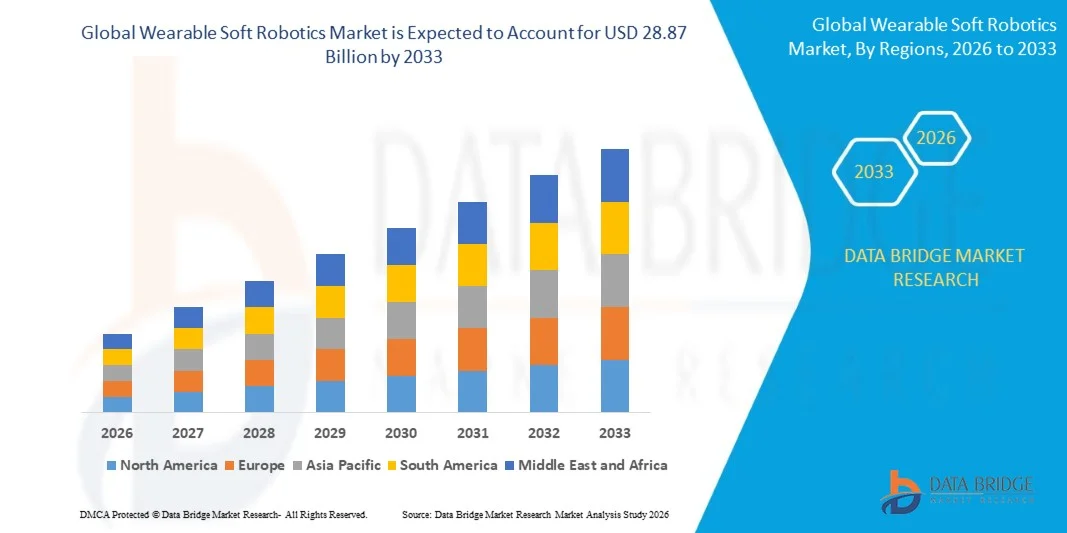
- As per Data Bridge Market Research analysis, the Wearable Soft Robotics market was valued at USD 2.05 billion in 2025 and is projected to reach USD 28.87 billion by 2033, growing at a CAGR of 39.20% from 2026 to 2033.
- The market is experiencing consistent growth driven by the increasing adoption of lightweight, flexible, and human-centered robotic technologies across healthcare, rehabilitation, industrial assistance, military applications, sports, and human-machine interaction. Advancements in soft actuators, flexible sensors, wearable exosuits, artificial intelligence, and control systems are improving the ability of wearable soft robots to provide movement assistance, physical support, and enhanced human performance.
- The growing need to support rehabilitation, reduce physical strain, improve worker safety, and enhance human mobility is compelling organizations to adopt wearable soft robotics solutions. Soft robotic systems are increasingly being integrated into medical and healthcare, logistics, automotive, advanced manufacturing, and other end-use applications, where their lightweight construction, flexibility, and ability to work alongside humans provide advantages over conventional rigid robotic systems.
Market Size & Forecast
- Global Market Value (2025): USD 2.05 Billion
- Expected Market Value (2033): USD 28.87 Billion
- Forecast CAGR (2026–2033): 39.20%
- Leading Region in 2025: North America
- Fastest Growing Region: Asia Pacific
What are the Major Takeaways of the Wearable Soft Robotics Market?
- North America dominated the wearable soft robotics market with the largest revenue share of 39.8% in 2025, supported by advanced healthcare infrastructure, substantial research and development investments, strong robotics capabilities, and increasing adoption of wearable robotic technologies across healthcare, industrial, and defense applications. Comparable wearable robotics data also places North America at approximately 39.85% of the market in 2025.
- Asia-Pacific is expected to be the fastest-growing region at a CAGR of 32.1% from 2026 to 2031, driven by expanding healthcare infrastructure, increasing industrial automation, rising investments in robotics, growing rehabilitation requirements, and increasing adoption of wearable robotic systems across manufacturing, logistics, and healthcare applications.
- The full body wearable soft robot segment led the type category with a 54.2% share in 2025, driven by increasing demand for comprehensive mobility assistance, rehabilitation support, physical augmentation, and applications requiring coordinated assistance across multiple body regions.
- The hardware segment dominated the component category with a 73.1% share in 2025, supported by increasing demand for soft actuators, sensors, wearable control systems, power units, and flexible mechanical components required for wearable robotic systems. Hardware accounted for 73.05% of the broader wearable robots and exoskeletons market in 2025.
- The healthcare segment dominated the application category with a 45.1% share in 2025, driven by the increasing use of wearable robotic systems for rehabilitation, mobility assistance, physical therapy, and support for individuals with movement limitations. Healthcare represented 45.10% of the broader wearable robots and exoskeletons market in 2025.
- The rehabilitation and wearable robots segment is the fastest-growing application category, projected to register a CAGR of 11.1%, supported by increasing demand for assistive mobility technologies, rehabilitation solutions, lightweight wearable systems, and technologies designed to improve patient mobility and recovery.
Report Scope and Wearable Soft Robotics Market Segmentation
|
Attributes |
Wearable Soft Robotics Key Market Insights |
|
Segments Covered |
|
|
Countries Covered |
North America
Europe
Asia-Pacific
Middle East and Africa
South America
|
|
Key Market Players |
|
|
Market Opportunities |
|
|
Value Added Data Infosets |
In addition to the insights on market scenarios such as market value, growth rate, segmentation, geographical coverage, and major players, the market reports curated by the Data Bridge Market Research also include in-depth expert analysis, geographically represented company-wise production and capacity, network layouts of distributors and partners, detailed and updated price trend analysis and deficit analysis of supply chain and demand. |
What is the Key Trend in the Wearable Soft Robotics Market?
- The integration of soft actuators, flexible sensors, real-time motion sensing, and adaptive control systems is becoming a key trend in the wearable soft robotics market, enabling wearable systems to provide assistance that responds to users’ movements across rehabilitation, healthcare, industrial, and human-machine interaction applications.
- For instance, in October 2024, Hyundai Motor Group highlighted the use of its X-ble MEX wearable rehabilitation robot at the Armed Forces Capital Hospital in South Korea. The system uses real-time actuator control to assist users with walking, sitting, standing, rotating, and stair-climbing movements during rehabilitation.
- The development of fully soft and lightweight robotic systems is gaining momentum as manufacturers and research organizations seek to improve flexibility, comfort, and adaptability compared with conventional rigid exoskeletons. Soft wearable systems can use flexible fabrics, inflatable structures, and artificial muscles to provide assistance while maintaining natural body movement.
- For instance, in March 2024, TWI announced the EU-funded SWAG project, which focuses on developing fully soft human-assistive exoskeletons using soft, inflatable structures rather than rigid materials. The project combines soft robotics, biomechanics, control systems, artificial intelligence, and ergonomics to develop wearable systems that adapt to human movement.
- The use of wearable robotics with embedded sensors and data analytics is also expanding in industrial environments, enabling companies to monitor movement patterns, identify ergonomic risks, and provide task-specific physical assistance to workers.
- For instance, in March 2024, Verve Motion introduced its Verve Logic software and data analytics platform, which works with its SafeLift soft exosuit. Sensors embedded in the exosuit collect three-dimensional motion and force data, allowing companies to analyze worker movements and identify ergonomic risks during lifting activities.
- As wearable soft robotics continues to combine flexible materials, sensing technologies, real-time control, artificial intelligence, and data analytics, the technology is increasingly moving toward personalized assistance for rehabilitation, industrial safety, mobility support, sports assistance, and other human-centered applications..
What are the Key Drivers of the Wearable Soft Robotics Market?
- The increasing need for mobility assistance and rehabilitation is driving demand for wearable soft robotics because these systems can provide controlled assistance while allowing users to maintain more natural movement during therapy and daily activities.
- For instance, in January 2024, researchers from Harvard John A. Paulson School of Engineering and Applied Sciences and Boston University demonstrated a soft wearable robotic garment designed to assist an individual with Parkinson’s disease. The garment used sensors, cable-driven actuators, and gait-phase algorithms to provide assistance during walking and helped eliminate gait-freezing episodes in the reported participant.
- The growing demand for safer and less physically demanding industrial work is supporting the adoption of wearable robotic systems across logistics, automotive, advanced manufacturing, and other physically intensive environments, where exosuits can assist workers with lifting and repetitive activities.
- For instance, in July 2024, Verve Motion reported results from a four-year study of its soft exosuits, covering their use in warehouse and fulfillment environments. The company reported that its exosuits had been used while workers lifted more than 500 million pounds and reported reductions in lower-back and hip injuries across participating sites.
- Increasing investment in lightweight multimodal wearable systems is supporting the development of solutions that combine soft robotics with electrical stimulation, sensing, feedback, and connected technologies, expanding their potential use in rehabilitation and medical applications.
- For instance, in December 2024, The Hong Kong Polytechnic University announced that its mobile ankle-foot exoneuromusculoskeleton had received a CES 2025 Innovation Award. The lightweight wearable system combines soft pneumatic muscles, neuromuscular electrical stimulation, vibrotactile feedback, IoT connectivity, and AI-enabled coaching for post-stroke rehabilitation.
- The growing need for personalized physical assistance, rehabilitation support, worker safety, and human-machine interaction is expected to expand adoption across medical and healthcare, logistics, automotive, advanced manufacturing, military applications, sports assistance, and other end-use environments..
Which Factors are Challenging the Growth of the Wearable Soft Robotics Market?
- The high development and manufacturing costs of wearable soft robotics remain a significant challenge because advanced actuators, flexible sensors, control systems, power sources, and customized wearable components can increase system costs and limit adoption, particularly in cost-sensitive applications.
- The need for extensive clinical validation, safety testing, and regulatory approval can also extend development timelines for medical and healthcare applications because wearable robotic devices must demonstrate appropriate safety, performance, durability, and usability before broader deployment.
- For instance, in March 2025, Lifeward announced FDA 510(k) clearance for its ReWalk 7 personal exoskeleton, demonstrating the regulatory requirements associated with commercializing wearable robotic systems for individuals with spinal cord injury.
- Battery capacity, power requirements, and system portability remain technical challenges, particularly for wearable robots intended for prolonged use outside controlled clinical environments. Increasing the operating duration while keeping the system lightweight and comfortable requires advances in actuators, batteries, and power management.
- For instance, in December 2024, The Hong Kong Polytechnic University reported that its mobile ankle-foot wearable system used a 9V rechargeable battery with up to four hours of continuous operation, illustrating the importance of balancing functionality, portability, and operating duration in wearable robotic designs.
- User comfort, durability, and human-robot interaction can further constrain adoption because wearable systems must provide effective assistance without restricting natural movement or creating excessive weight, pressure, heat, or discomfort during prolonged use.
- The combination of high development costs, regulatory requirements, power limitations, durability considerations, and the need for comfortable human-machine interaction continues to create challenges for the large-scale commercialization of wearable soft robotics across healthcare, industrial, military, and consumer applications.
How is the Wearable Soft Robotics Market Segmented?
The wearable soft robotics market is segmented on the basis of type, component, application, and end user.
- By Type
On the basis of type, the Wearable Soft Robotics market is segmented into full body wearable soft robot and localized wearable soft robot. The full body wearable soft robot segment dominated the market with a 56.4% share in 2025, supported by increasing demand for comprehensive mobility assistance, rehabilitation, physical augmentation, and wearable systems capable of supporting multiple body regions simultaneously. Full body wearable soft robots integrate flexible structures, soft actuators, sensors, control systems, and wearable interfaces to provide coordinated assistance while maintaining greater flexibility than conventional rigid robotic systems. Increasing adoption in rehabilitation, mobility assistance, military applications, industrial ergonomics, and physical augmentation is supporting demand for full body systems. Advances in lightweight materials, pneumatic actuation, artificial muscles, and real-time motion sensing are further improving system flexibility and user interaction. The segment is projected to grow at a CAGR of 40.1% during the forecast period, supported by increasing investment in human-centered robotics and the expansion of wearable assistance technologies.
The localized wearable soft robot segment is projected to witness the fastest growth at a CAGR of 38.0% during the forecast period, driven by increasing demand for lightweight robotic systems designed to assist specific body regions such as the hand, arm, shoulder, ankle, and lower limb. Localized systems require less physical infrastructure and can be customized for specific rehabilitation, medical, sports, and industrial requirements. Increasing development of soft actuators, flexible sensors, wearable interfaces, and compact control systems is improving the functionality of localized devices. Their ability to provide targeted assistance while maintaining natural movement is supporting adoption across rehabilitation, sports assistance, medical applications, and workplace ergonomics. Growing demand for task-specific wearable robotics and increasing emphasis on personalized human-machine interaction are expected to further strengthen the segment during the forecast period.
- By Component
On the basis of component, the Wearable Soft Robotics market is segmented into hardware and software. The hardware segment dominated the market with a 72.8% share in 2025, supported by the extensive requirement for soft actuators, flexible sensors, wearable structures, power systems, control components, and other physical elements required to operate wearable robotic devices. Hardware determines important performance characteristics such as flexibility, weight, responsiveness, durability, movement assistance, and user comfort. Manufacturers are increasingly developing pneumatic artificial muscles, soft elastomeric structures, flexible electronics, compact sensors, and lightweight power systems to improve wearable robotic performance. The increasing commercialization of rehabilitation devices, industrial exosuits, and assistive wearable robots is further supporting hardware demand.
The software segment is projected to witness the fastest growth at a CAGR of 41.1% during the forecast period, driven by increasing integration of artificial intelligence, machine learning, motion-control algorithms, sensor fusion, real-time data processing, and adaptive control technologies. Software enables wearable robotic systems to interpret movement patterns, process sensor information, regulate assistance levels, monitor user performance, and provide personalized support. Increasing use of intelligent control systems is improving the ability of wearable robots to respond dynamically to individual movement requirements. Integration of software with cloud platforms, digital health systems, industrial analytics, and human-machine interfaces is also expanding the range of applications. Growing demand for adaptive and personalized wearable robotics is therefore expected to accelerate software adoption throughout the forecast period.
- By Application
On the basis of application, the Wearable Soft Robotics market is segmented into healthcare, military application, sports assistance, human-machine interface and interaction, locomotion and exploration, manipulation, medical and surgical application, rehabilitation and wearable robots, and others. The healthcare segment dominated the market with a 24.6% share in 2025, supported by increasing adoption of wearable robotic technologies for mobility assistance, physical therapy, gait support, movement assistance, and rehabilitation. Wearable soft robots provide compliant and flexible assistance that can support natural human movement while reducing mechanical constraints associated with rigid robotic systems. Increasing development of wearable rehabilitation devices, soft exosuits, sensor-based movement monitoring, and adaptive assistance technologies is expanding healthcare applications. The growing need for mobility support and personalized rehabilitation solutions is further contributing to demand.
The rehabilitation and wearable robots segment is projected to witness the fastest growth at a CAGR of 40.8% during the forecast period, driven by increasing demand for personalized rehabilitation, gait training, mobility assistance, and wearable technologies supporting recovery from neurological and physical impairments. Soft robotic systems can combine flexible actuators, sensors, motion detection, and adaptive control technologies to provide assistance according to individual movement patterns. Increasing development of lightweight exosuits and wearable rehabilitation systems is improving comfort and usability, while advances in artificial intelligence and real-time control are enabling more responsive assistance. Growing investment in rehabilitation technologies and increasing demand for home-based and personalized therapy solutions are expected to support sustained expansion of this segment.
- By End User
On the basis of end user, the Wearable Soft Robotics market is segmented into medical and healthcare, logistics, automotive, food and beverages, advanced manufacturing, e-commerce and retail, and others. The medical and healthcare segment dominated the market with a 29.4% share in 2025, supported by increasing deployment of wearable robotic systems in hospitals, rehabilitation centers, clinical environments, and home-based care. These technologies are used for mobility assistance, gait rehabilitation, physical therapy, movement support, and recovery applications. The combination of soft materials, wearable sensors, and adaptive control allows robotic assistance to be delivered while maintaining greater flexibility and user comfort. Increasing demand for rehabilitation technologies and assistive devices is supporting adoption across healthcare environments.
The advanced manufacturing segment is projected to witness the fastest growth at a CAGR of 42.1% during the forecast period, driven by increasing demand for technologies that reduce worker fatigue, support repetitive activities, and improve ergonomics in physically demanding industrial environments. Wearable soft robots and exosuits can assist workers during lifting, handling, overhead activities, and repetitive movements while allowing users to maintain mobility. Increasing emphasis on workplace safety, ergonomic risk reduction, human-machine collaboration, and industrial productivity is encouraging manufacturers to evaluate wearable robotic assistance. Integration of wearable sensors and data analytics is also enabling organizations to identify movement patterns and ergonomic risks. Continued expansion of advanced manufacturing, logistics automation, and human-centered industrial technologies is expected to support strong growth in this segment.
Which Region Holds the Largest Share of the Wearable Soft Robotics Market?
- North America dominated the wearable soft robotics market with the largest revenue share of 39.8% in 2025, supported by advanced healthcare infrastructure, substantial research and development investments, strong robotics capabilities, and increasing adoption of wearable robotic technologies across healthcare, industrial, and defense applications.
- The region also benefits from the growing adoption of soft exosuits, wearable rehabilitation devices, assistive robotics, and human-machine interaction technologies. Strong investments in robotics research, healthcare innovation, and advanced materials, along with the presence of established technology and robotics companies, continue to strengthen North America's position in the global wearable soft robotics market.
U.S. Wearable Soft Robotics Market Insight
The U.S. wearable soft robotics market is witnessing strong growth due to rising investments in robotics, rehabilitation technologies, healthcare innovation, and advanced wearable systems. The country's developed healthcare ecosystem, strong research capabilities, and presence of robotics companies are supporting the development and adoption of soft robotic exosuits, rehabilitation devices, and mobility-assistance technologies. In addition, increasing demand for technologies that improve patient mobility, reduce physical strain, and support human-machine interaction is contributing to market expansion. Government funding, university research, and defense-related robotics programs are also supporting technological development in the U.S.
Asia-Pacific Wearable Soft Robotics Market Insight
The Asia-Pacific wearable soft robotics market is expected to witness rapid growth, driven by expanding robotics manufacturing, increasing healthcare technology adoption, and rising investments in automation across countries such as China, Japan, South Korea, and India. Growing demand for rehabilitation equipment, wearable assistive technologies, industrial automation, and advanced robotic systems is supporting regional expansion. In addition, increasing investments in robotics research, smart manufacturing, and healthcare infrastructure are accelerating the development and adoption of wearable soft robotic technologies across the region. Asia-Pacific is also identified as one of the fastest-growing regions within the broader soft robotics market..
Japan Wearable Soft Robotics Market Insight
The Japan wearable soft robotics market is witnessing consistent growth due to the country's advanced robotics ecosystem, aging population, and strong focus on healthcare and rehabilitation technologies. Robotics companies and research institutions are developing wearable systems designed to support mobility, physical rehabilitation, and human movement. Furthermore, Japan's expertise in automation, sensors, actuators, advanced materials, and human-robot interaction is supporting the development of lightweight and flexible wearable robotic systems. Increasing demand for assistive technologies and rehabilitation solutions is further contributing to market expansion.
China Wearable Soft Robotics Market Insight
The China wearable soft robotics market is growing rapidly, supported by expanding robotics manufacturing, increasing automation, and rising investments in advanced robotic technologies. Growing adoption of wearable robotic systems for healthcare, rehabilitation, industrial assistance, and mobility applications is creating new opportunities across the country. In addition, China's large manufacturing base, expanding research capabilities, and government emphasis on robotics and advanced manufacturing are supporting the development and commercialization of soft robotic technologies. China is also among the key Asia-Pacific countries covered in wearable soft robotics market analyses.
U.K. Wearable Soft Robotics Market Insight
The U.K. wearable soft robotics market is experiencing steady growth, supported by advancements in healthcare robotics, rehabilitation technologies, and academic research. Universities, healthcare organizations, and technology companies are increasingly developing wearable robotic systems for mobility assistance, rehabilitation, and human-machine interaction. Furthermore, the country's research ecosystem and focus on assistive technologies are supporting innovation in flexible actuators, sensors, exosuits, and wearable robotic devices. The U.K. is also identified as a key country within the European wearable soft robotics market.
Germany Wearable Soft Robotics Market Insight
The Germany wearable soft robotics market is expanding steadily due to the country's strong industrial automation capabilities, advanced manufacturing sector, and established robotics research ecosystem. Increasing use of robotic technologies in healthcare, manufacturing, rehabilitation, and industrial assistance is supporting demand for wearable soft robotic systems. Germany's focus on Industry 4.0, automation, human-machine collaboration, and advanced engineering is also encouraging the development of flexible robotic devices and wearable exoskeleton technologies. Germany remains one of the key European countries covered in wearable soft robotics market analyses.
Which are the Top Companies in Wearable Soft Robotics Market?
The Wearable Soft Robotics industry is primarily led by well-established companies, including:
- Soft Robotics Inc. (U.S.)
- Cyberdyne Inc. (Japan)
- Ekso Bionics Holdings, Inc. (U.S.)
- ReWalk Robotics Ltd. (Israel/U.S.)
- Ottobock SE & Co. KGaA (Germany)
- Hocoma AG (Switzerland)
- B-Temia Inc. (Canada)
- Myomo, Inc. (U.S.)
- Sarcos Technology and Robotics Corporation (U.S.)
- Panasonic Holdings Corporation (Japan)
- Honda Motor Co., Ltd. (Japan)
- Toyota Motor Corporation (Japan)
- Mitsubishi Electric Corporation (Japan)
- Stryker Corporation (U.S.)
- Zimmer Biomet Holdings, Inc. (U.S.)
What are Latest Developments in Wearable Soft Robotics Market?
- · In May 2025, German Bionic launched Exia, a new wearable exoskeleton designed with an augmented AI system that uses real-world motion data to anticipate users’ work requirements. The system is designed for applications across manufacturing, logistics, healthcare, retail, and other physically demanding environments, providing adaptive assistance based on movement patterns. The launch demonstrates the integration of AI, wearable robotics, and real-time motion data to improve physical assistance and worker ergonomics.
- In May 2025, Bioliberty launched Lifehub Clinic, a modular therapy platform designed around its portfolio of soft-robotic wearable devices. The system initially focuses on upper-extremity rehabilitation using Lifeglov, a pneumatic soft-robotic glove that provides controlled assistance for hand opening and supports repetitive, game-based therapy exercises. The development demonstrates the application of soft robotics and wearable technologies in neurological rehabilitation and personalized patient recovery.
- In April 2025, researchers at the University of Houston and TIRR Memorial Hermann introduced MyoStep, a lightweight wearable soft exoskeleton designed to assist children with cerebral palsy. The device uses smart materials and wearable technology to support walking and address motor impairments while being designed for integration into children's daily activities. The development highlights the growing application of soft wearable robotics for pediatric mobility assistance and rehabilitation.
- In January 2025, Harvard's Move Lab announced the development of Reachable, a soft wearable robotic device designed to assist arm and shoulder movement for stroke survivors. The lightweight system combines an inflatable underarm support with sensors that adapt assistance according to the user's progress and is being developed for potential at-home therapy. Supported by a USD 5 million NSF Convergence Accelerator grant, the project illustrates the movement of soft wearable robotics from laboratory research toward home-based rehabilitation applications.
- In March 2024, Verve Motion introduced Verve Logic, a software and data analytics platform integrated with its SafeLift wearable robotics exosuit. The platform uses motion data to identify potential injury risks and provide performance insights for industrial workers performing repetitive and heavy lifting tasks. SafeLift combines real-time motion sensing with adaptive robotic assistance, demonstrating the increasing integration of data analytics, sensing, and soft wearable robotics for workplace safety and ergonomic support.

- Interactive Data Analysis Dashboard
- Company Analysis Dashboard for high growth potential opportunities
- Research Analyst Access for customization & queries
- Competitor Analysis with Interactive dashboard
- Latest News, Updates & Trend analysis
- Harness the Power of Benchmark Analysis for Comprehensive Competitor Tracking
Global Wearable Soft Robotics Market, Supply Chain Analysis and Ecosystem Framework
To support market growth and help clients navigate the impact of geopolitical shifts, DBMR has integrated in-depth supply chain analysis into its Global Wearable Soft Robotics Market research reports. This addition empowers clients to respond effectively to global changes affecting their industries. The supply chain analysis section includes detailed insights such as Global Wearable Soft Robotics Market consumption and production by country, price trend analysis, the impact of tariffs and geopolitical developments, and import and export trends by country and HSN code. It also highlights major suppliers with data on production capacity and company profiles, as well as key importers and exporters. In addition to research, DBMR offers specialized supply chain consulting services backed by over a decade of experience, providing solutions like supplier discovery, supplier risk assessment, price trend analysis, impact evaluation of inflation and trade route changes, and comprehensive market trend analysis.
Data collection and base year analysis are done using data collection modules with large sample sizes. The stage includes obtaining market information or related data through various sources and strategies. It includes examining and planning all the data acquired from the past in advance. It likewise envelops the examination of information inconsistencies seen across different information sources. The market data is analysed and estimated using market statistical and coherent models. Also, market share analysis and key trend analysis are the major success factors in the market report. To know more, please request an analyst call or drop down your inquiry.
The key research methodology used by DBMR research team is data triangulation which involves data mining, analysis of the impact of data variables on the market and primary (industry expert) validation. Data models include Vendor Positioning Grid, Market Time Line Analysis, Market Overview and Guide, Company Positioning Grid, Patent Analysis, Pricing Analysis, Company Market Share Analysis, Standards of Measurement, Global versus Regional and Vendor Share Analysis. To know more about the research methodology, drop in an inquiry to speak to our industry experts.
Data Bridge Market Research is a leader in advanced formative research. We take pride in servicing our existing and new customers with data and analysis that match and suits their goal. The report can be customized to include price trend analysis of target brands understanding the market for additional countries (ask for the list of countries), clinical trial results data, literature review, refurbished market and product base analysis. Market analysis of target competitors can be analyzed from technology-based analysis to market portfolio strategies. We can add as many competitors that you require data about in the format and data style you are looking for. Our team of analysts can also provide you data in crude raw excel files pivot tables (Fact book) or can assist you in creating presentations from the data sets available in the report.













