What is the Web 2.0 Data Center Market Size and Growth Rate?
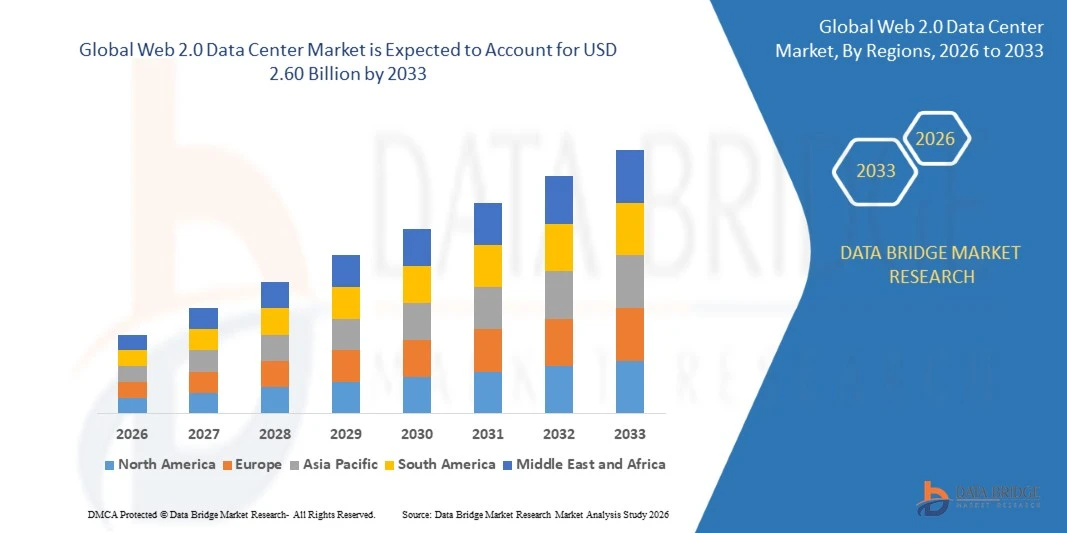
- As per Data Bridge Market Research analysis, the web 2.0 data center market was valued at USD 2.21 billion in 2025 and is projected to reach USD 2.60 billion by 2033, growing at a CAGR of 2.05% from 2026 to 2033.
- The market is experiencing consistent growth driven by increasing demand for web-based applications, expanding cloud computing services, rising internet usage, and growing investments in digital infrastructure to support online platforms and data-intensive operations.
- Growing demand for reliable data storage, faster data processing, improved network connectivity, and uninterrupted digital services is encouraging businesses to invest in Web 2.0 Data Center technologies. These facilities support web hosting, content delivery, cloud-based applications, and data management, driving wider adoption across IT and telecommunications, banking and financial services, retail and e-commerce, media and entertainment, and healthcare industries.
Market Size & Forecast
- Global Market Value (2025): USD 2.21 Billion
- Expected Market Value (2033): USD 2.60 Billion
- Forecast CAGR (2026–2033): 2.05%
- Leading Region in 2025: North America
- Fastest Growing Region: Asia Pacific
What are the Major Takeaways of the Web 2.0 Data Center Market?
- North America dominated the web 2.0 data center market with an estimated revenue share of 32.3% in 2025, supported by established digital infrastructure, strong cloud computing adoption, and the presence of major technology companies.
- Asia Pacific is expected to be the fastest-growing region, projected to register a CAGR of 3.4% from 2026 to 2033, driven by expanding internet penetration, increasing cloud adoption, and rising investments in digital infrastructure.
- The enterprise data centers segment led the market by type, accounting for an estimated 36.5% revenue share in 2025, supported by demand for dedicated infrastructure, secure data management, and reliable business applications.
- The large enterprise segment is expected to be among the fastest-growing categories, projected to register a CAGR of 3.8% from 2026 to 2033, driven by increasing digital transformation initiatives and growing demand for scalable computing infrastructure.
- The IT and telecommunications segment accounted for an estimated 28.6% share in 2025, supported by increasing data traffic, expanding cloud services, and rising demand for reliable network infrastructure.
- The networking equipment segment accounted for an estimated 24.2% share in 2025, driven by growing requirements for high-speed data transmission, efficient connectivity, and reliable data center operations.
- The cloud-based deployment segment is expected to register a CAGR of 4.1% from 2026 to 2033, supported by growing adoption of scalable computing resources, flexible data storage, and web-based applications.
Report Scope and Web 2.0 Data Center Market Segmentation
|
Attributes |
Web 2.0 Data Center Key Market Insights |
|
Segments Covered |
|
|
Countries Covered |
North America
Europe
Asia-Pacific
Middle East and Africa
South America
|
|
Key Market Players |
|
|
Market Opportunities |
|
|
Value Added Data Infosets |
In addition to the market insights such as market value, growth rate, market segments, geographical coverage, market players, and market scenario, the market report curated by the Data Bridge Market Research team includes in-depth expert analysis, import/export analysis, pricing analysis, production consumption analysis, and pestle analysis. |
What is the Key Trend in the Web 2.0 Data Center Market?
- Increasing adoption of advanced servers, storage systems, and networking equipment is improving data processing capacity, system reliability, and operational efficiency across modern data centers.
- The growing shift toward cloud computing and web-based applications is accelerating the development of scalable data center architectures that support real-time data access, online services, and digital collaboration.
- Data center operators are focusing on energy-efficient infrastructure, advanced cooling systems, and optimized resource utilization to improve performance while managing operational costs.
- Integration of Web 2.0 data center technologies with cloud platforms and content delivery networks is gaining momentum as businesses seek faster content distribution, improved user experiences, and reliable access to digital services.
- As digital transformation, e-commerce, and online communication continue to expand, technological innovation is expected to accelerate the adoption of Web 2.0 data center infrastructure across enterprises and service providers.
- For instance, in September 2025, Equinix announced the opening of its first International Business Exchange data center in Chennai, India, with an initial investment of USD 69 million. The facility includes AI-ready infrastructure and advanced cooling capabilities to support growing demand for cloud connectivity and compute-intensive workloads.
- Growing demand for reliable online services and low-latency data access is encouraging operators to expand data center infrastructure and improve connectivity between users, applications, and cloud environments.
- For instance, in October 2025, Google announced a USD 4 billion investment in Arkansas through 2027, including its first data center in the state, alongside cloud and AI infrastructure development.
- As organizations continue to invest in cloud computing, digital platforms, and data management capabilities, the adoption of advanced Web 2.0 data center solutions is expected to expand across multiple industries.
What are the Key Drivers of the Web 2.0 Data Center Market?
- The growing demand for cloud computing, web hosting, and online applications is increasing the need for scalable Web 2.0 data center infrastructure that supports efficient data storage, processing, and distribution.
- For instance, in January 2025, Microsoft announced plans to invest USD 3 billion in India over two years in cloud and AI infrastructure, including the establishment of new data centers, supporting the expansion of digital infrastructure and cloud computing capabilities.
- Rising adoption of e-commerce, digital communication, streaming services, and enterprise applications is encouraging organizations to invest in reliable data center facilities and advanced networking technologies.
- For instance, in November 2024, Equinix announced an initial investment of more than USD 260 million for its SG6 data center in Singapore. The facility was designed to support high-performance computing workloads, with advanced liquid cooling and a planned capacity of 20 MW when fully built.
- Increasing emphasis on data availability, system performance, and business continuity is driving investments in redundant infrastructure, improved storage systems, and high-speed network connectivity.
- As businesses continue to prioritize digital transformation and online service delivery, demand for efficient and scalable Web 2.0 data center technologies is expected to increase across multiple industries.
What Factors are Challenging the Growth of the Web 2.0 Data Center Market?
- Web 2.0 data center infrastructure involves high capital expenditure for servers, storage systems, networking equipment, facility construction, and maintenance, which can limit adoption among smaller organizations.
- Rising electricity consumption, cooling requirements, and operational expenses create challenges for data center operators seeking to maintain cost efficiency while supporting increasing workloads.
- Dependence on network connectivity, cloud platforms, and complex IT infrastructure introduces cybersecurity, data privacy, and service availability challenges, requiring continuous investment in security and disaster recovery solutions.
- Integrating new data center technologies with existing IT systems can require substantial infrastructure upgrades, technical expertise, and migration planning, increasing implementation complexity and deployment time.
- For instance, in November 2024, Equinix announced plans for its SG6 data center in Singapore, highlighting the investment required to develop high-performance infrastructure with advanced liquid cooling for compute-intensive workloads. The project illustrates the importance of balancing increasing computing capacity with energy efficiency and infrastructure costs.
- The combination of high infrastructure costs, increasing energy requirements, cybersecurity risks, and complex system integration continues to challenge the growth of the Web 2.0 data center market, particularly among smaller enterprises and organizations with limited IT budgets.
How is the Web 2.0 Data Center Market Segmented?
The web 2.0 data center market is segmented on the basis of component, data center type, deployment type, application, and end user.
- By Component
On the basis of component, the web 2.0 data center market is segmented into servers, storage systems, networking equipment, and other components. The servers segment is estimated to dominate the market with an estimated 38.5% share in 2025, driven by increasing demand for data processing, cloud computing, web hosting, and online applications. Servers provide the computing resources required to run websites, manage workloads, process user requests, and support enterprise applications. Growing digitalization and increasing volumes of online data are strengthening demand for high-performance server infrastructure. However, high hardware costs, energy consumption, and maintenance requirements remain important considerations.
The networking equipment segment is estimated to be among the fastest-growing component categories, registering an estimated CAGR of 8.2% from 2026 to 2033, as data center operators increasingly invest in high-speed data transmission, reliable connectivity, and efficient communication between servers, storage systems, and end users. Networking equipment, including switches, routers, and network interface devices, supports data transfer across data center infrastructure. The growing adoption of cloud-based applications, content delivery networks, and distributed computing environments is increasing the need for scalable networking solutions. However, network security requirements, infrastructure upgrade costs, and increasing bandwidth demands remain important challenges.
- By Data Center Type
On the basis of data center type, the web 2.0 data center market is segmented into enterprise data centers, colocation data centers, cloud data centers, and other data centers. The cloud data centers segment is estimated to dominate the market with an estimated 36.8% share in 2025, driven by increasing adoption of cloud computing, software-as-a-service platforms, and online business applications. Cloud data centers provide scalable computing, storage, and networking resources that enable organizations to manage workloads without maintaining all infrastructure on-premises. Growing demand for flexible IT resources, remote collaboration, and digital services is supporting segment growth. However, data security concerns, service availability requirements, and dependence on third-party providers remain important considerations.
The colocation data centers segment is estimated to register an estimated CAGR of 7.9% from 2026 to 2033, supported by increasing demand for shared infrastructure, reliable power supply, cooling systems, and network connectivity. Colocation facilities allow businesses to deploy their servers and networking equipment in professionally managed environments, reducing the need to develop and operate dedicated facilities. Increasing demand for interconnection, cloud access, and infrastructure flexibility is supporting adoption. However, rental expenses, power availability, and the need to meet data security and regulatory requirements can influence investment decisions.
- By Deployment Type
On the basis of deployment type, the web 2.0 data center market is segmented into on-premises and cloud-based. The cloud-based segment is estimated to dominate the market with an estimated 57.4% share in 2025, driven by increasing demand for scalable infrastructure, flexible resource allocation, and reduced dependence on physical IT facilities. Cloud-based deployment enables organizations to access computing, storage, and networking resources according to workload requirements. The growing adoption of digital platforms, e-commerce services, and web-based applications is further supporting demand. However, data privacy, ongoing subscription costs, and dependence on network connectivity remain important considerations.
The cloud-based segment is estimated to register an estimated CAGR of 8.5% from 2026 to 2033, as organizations increasingly migrate workloads to cloud infrastructure to improve scalability, deployment flexibility, and resource utilization. Cloud-based environments enable businesses to adjust computing capacity according to changing workloads while supporting online applications and digital services. Growing investments in cloud platforms and enterprise digital transformation are expected to support adoption. However, cybersecurity risks, regulatory compliance, service interruptions, and vendor dependency remain important challenges.
- By Application
On the basis of application, the web 2.0 data center market is segmented into web hosting, content delivery, data storage and management, online applications, and other applications. The web hosting segment is estimated to dominate the market with an estimated 29.6% share in 2025, driven by increasing demand for websites, business portals, e-commerce platforms, and digital publishing services. Data centers provide the servers, storage, and connectivity required to host websites and maintain their availability. Growing online business activity and the expansion of digital services are supporting demand for reliable hosting infrastructure. However, cybersecurity threats, service interruptions, and the need for continuous maintenance remain important challenges.
The content delivery segment is estimated to register an estimated CAGR of 8.7% from 2026 to 2033, supported by increasing consumption of video streaming, online media, interactive content, and other bandwidth-intensive digital services. Content delivery infrastructure helps distribute digital content through geographically distributed servers and network systems, reducing latency and improving access speeds. Increasing demand for responsive digital experiences and reliable delivery of online content is encouraging investments in content delivery networks and distributed data center infrastructure. However, bandwidth costs, network congestion, and the complexity of managing distributed infrastructure may affect deployment.
- By End User
On the basis of end user, the web 2.0 data center market is segmented into IT and telecommunications, banking, financial services and insurance, retail and e-commerce, media and entertainment, healthcare, and other end users. The IT and telecommunications segment is estimated to dominate the market with an estimated 32.7% share in 2025, driven by high data traffic, cloud service delivery, web hosting, and the expansion of digital communication platforms. Companies in this sector rely on data centers to manage network operations, support digital services, and maintain reliable connectivity. Increasing adoption of cloud computing and data-intensive applications is further supporting demand. However, infrastructure costs, cybersecurity risks, and energy requirements remain important challenges.
The retail and e-commerce segment is estimated to register an estimated CAGR of 8.1% from 2026 to 2033, supported by increasing online shopping activity, digital payment adoption, personalized customer experiences, and the expansion of omnichannel retail platforms. Retailers use data center infrastructure to host e-commerce websites, manage customer information, process transactions, and analyze purchasing behavior. Growing demand for uninterrupted online services and efficient handling of seasonal traffic is encouraging investment in scalable infrastructure. However, data privacy requirements, transaction security, and fluctuations in workload demand remain important considerations.
Which Region Holds the Largest Share of the Web 2.0 Data Center Market?
- · North America dominated the web 2.0 data center market with the largest revenue share of 32.3% in 2025 (illustrative estimate), supported by advanced data center infrastructure, strong cloud computing adoption, and increasing demand for data storage, processing, and online services.
- The region also benefits from significant investments in hyperscale data centers, artificial intelligence infrastructure, cloud platforms, and high-performance networking. Growing demand for digital services, enterprise cloud adoption, and reliable data processing is strengthening North America's position in the market.
U.S. Web 2.0 Data Center Market Insight
The U.S. web 2.0 data center market is witnessing strong growth due to rising adoption of cloud computing, increasing demand for artificial intelligence infrastructure, and growing use of online applications. The country's established technology ecosystem, presence of major cloud service providers, and investments in hyperscale data centers are driving demand for advanced computing, storage, and networking infrastructure. In addition, increasing enterprise digitalization and growing data volumes are accelerating the development of scalable data center facilities.
Asia-Pacific Web 2.0 Data Center Market Insight
The Asia Pacific web 2.0 data center market is expected to witness rapid growth, driven by expanding digital economies, rising cloud adoption, increasing internet usage, and growing demand for data storage and processing across countries such as China, Japan, and India. Investments in hyperscale facilities, colocation infrastructure, and high-performance computing are supporting regional expansion. In addition, increasing demand for e-commerce, digital payments, streaming services, and online applications is accelerating the development of data center infrastructure.
Japan Web 2.0 Data Center Market Insight
The Japan web 2.0 data center market is witnessing consistent growth due to rising investments in cloud computing, increasing enterprise digitalization, and growing demand for artificial intelligence and data-intensive applications. The country's advanced technology ecosystem, strong connectivity requirements, and increasing use of digital services are encouraging investments in data center facilities. Moreover, demand for reliable infrastructure, low-latency connectivity, and efficient data management is further contributing to market growth.
China Web 2.0 Data Center Market Insight
The China web 2.0 data center market is growing rapidly, driven by the expansion of cloud computing, e-commerce, digital platforms, and data-intensive enterprise applications. Increasing demand for online services, artificial intelligence computing, and high-speed connectivity is encouraging investment in data center facilities and supporting infrastructure. In addition, the country's extensive digital ecosystem and growing requirements for data processing and storage are creating opportunities for operators to expand capacity and improve computing efficiency.
U.K. Web 2.0 Data Center Market Insight
The U.K. web 2.0 data center market is experiencing steady growth, supported by increasing adoption of cloud computing, rising demand for artificial intelligence infrastructure, and growing use of digital services. The country's established financial services sector, technology ecosystem, and enterprise adoption of cloud platforms are driving demand for advanced data center facilities. Furthermore, investments in cloud services, high-performance computing, and reliable digital infrastructure are supporting market development.
Germany Web 2.0 Data Center Market Insight
The Germany web 2.0 data center market is expanding steadily due to increasing enterprise digitalization, growing adoption of cloud computing, and rising demand for artificial intelligence infrastructure. The country's strong industrial base, established technology ecosystem, and focus on secure data management are encouraging investment in data center facilities. Continuous advancements in cloud services, high-performance computing, and digital infrastructure are further driving market growth.
Which are the Top Companies in Web 2.0 Data Center Market?
The Web 2.0 Data Center industry is primarily led by well-established companies, including:
- IBM (U.S.)
- Huawei Technologies Co., Ltd. (China)
- Telefonaktiebolaget LM Ericsson (Sweden)
- Cisco Systems, Inc. (U.S.)
- NVIDIA Corporation (U.S.)
- Lenovo (Hong Kong)
- Marvell (U.S.)
- Quanta Services (U.S.)
- Broadcom (U.S.)
- Intel Corporation (U.S.)
- Zynga (U.S.)
- Yahoo! (U.S.)
- Equinix, Inc. (U.S.)
- Baidu, Inc. (China)
- Amazon.com, Inc. (U.S.)
- Avaya Inc. (U.S.)
- CafeX Communications Inc. (U.S.)
- Dialogic Corporation (U.S.)
- Microsoft (U.S.)
- Oracle (U.S.)
- SAP (Germany)
What are Latest Developments in Web 2.0 Data Center Market?
- In April 2026, Equinix announced the opening of its fourth International Business Exchange data center in Mumbai, India, with an initial investment of more than USD 95 million. The facility is designed to support high-performance workloads, hybrid multicloud deployments, and growing demand for AI infrastructure and digital services.
- In October 2025, Google announced a USD 15 billion investment in India over five years to establish its first AI hub in Visakhapatnam, Andhra Pradesh. The investment includes data center infrastructure, an international subsea gateway, and large-scale computing capacity to support cloud and AI services.
- In May 2025, Equinix inaugurated its first International Business Exchange data center in Jakarta, Indonesia, through a joint venture with PT Astra International. The facility provides connectivity to global and local network providers and supports growing demand for cloud computing, digital services, and AI infrastructure.
- In June 2025, Amazon announced plans to invest GBP 40 billion in the U.K. over three years, including continued investment in data centers and cloud infrastructure to support increasing demand for artificial intelligence and cloud computing services.
- In January 2025, Microsoft announced plans to invest USD 3 billion in India over two years to expand cloud and AI infrastructure, including the establishment of new data centers. The investment is intended to support increasing demand for computing capacity, digital applications, and AI services.
- In November 2024, Equinix announced an initial investment of USD 260 million in its SG6 data center in Singapore. The facility is designed to support compute-intensive workloads, including AI, and incorporates liquid cooling and renewable energy to improve infrastructure efficiency.
- In June 2024, Equinix announced an initial investment of USD 65 million to develop its CN1 data center in Chennai, India. The facility was planned to strengthen connectivity between Chennai and the company's existing Mumbai data centers while supporting enterprise, hyperscale, and AI infrastructure requirements.
- Interactive Data Analysis Dashboard
- Company Analysis Dashboard for high growth potential opportunities
- Research Analyst Access for customization & queries
- Competitor Analysis with Interactive dashboard
- Latest News, Updates & Trend analysis
- Harness the Power of Benchmark Analysis for Comprehensive Competitor Tracking
Data collection and base year analysis are done using data collection modules with large sample sizes. The stage includes obtaining market information or related data through various sources and strategies. It includes examining and planning all the data acquired from the past in advance. It likewise envelops the examination of information inconsistencies seen across different information sources. The market data is analysed and estimated using market statistical and coherent models. Also, market share analysis and key trend analysis are the major success factors in the market report. To know more, please request an analyst call or drop down your inquiry.
The key research methodology used by DBMR research team is data triangulation which involves data mining, analysis of the impact of data variables on the market and primary (industry expert) validation. Data models include Vendor Positioning Grid, Market Time Line Analysis, Market Overview and Guide, Company Positioning Grid, Patent Analysis, Pricing Analysis, Company Market Share Analysis, Standards of Measurement, Global versus Regional and Vendor Share Analysis. To know more about the research methodology, drop in an inquiry to speak to our industry experts.
Data Bridge Market Research is a leader in advanced formative research. We take pride in servicing our existing and new customers with data and analysis that match and suits their goal. The report can be customized to include price trend analysis of target brands understanding the market for additional countries (ask for the list of countries), clinical trial results data, literature review, refurbished market and product base analysis. Market analysis of target competitors can be analyzed from technology-based analysis to market portfolio strategies. We can add as many competitors that you require data about in the format and data style you are looking for. Our team of analysts can also provide you data in crude raw excel files pivot tables (Fact book) or can assist you in creating presentations from the data sets available in the report.