


Web Data Classification Market Size
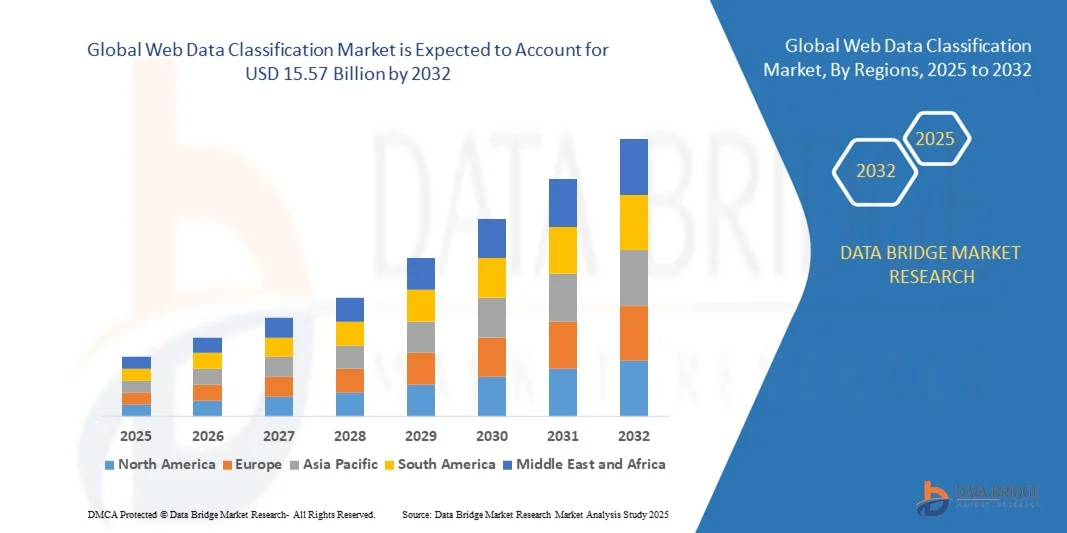
- The global web data classification market size was valued at USD 2.58 billion in 2024 and is expected to reach USD 15.57 billion by 2032, at a CAGR of 25.20% during the forecast period
- The market growth is largely fueled by the increasing adoption of AI, machine learning, and cloud-based solutions, enabling organizations to efficiently categorize and manage vast volumes of structured and unstructured data across industries
- Furthermore, rising demand for secure, accurate, and automated data classification solutions is driving enterprises to adopt advanced platforms that ensure regulatory compliance, data privacy, and enhanced decision-making capabilities. These factors are accelerating the uptake of web data classification solutions, significantly boosting market growth
Web Data Classification Market Analysis
- Web data classification involves the process of categorizing data based on content, context, or user behavior to improve data governance, security, and accessibility. Solutions leverage AI, semantic analysis, and machine learning to streamline data management, reduce manual effort, and enhance operational efficiency across sectors
- The escalating demand for web data classification is primarily driven by the surge in digital data generation, stringent data privacy regulations, and the growing need for organizations to derive actionable insights from unstructured information, thereby supporting informed business decisions and operational resilience
- North America dominated the web data classification market with a share of 33.3% in 2024, due to the growing adoption of cloud computing, advanced analytics, and stringent data privacy regulations such as the CCPA
- Asia-Pacific is expected to be the fastest growing region in the web data classification market during the forecast period due to increasing digitalization, expanding IT and telecom infrastructure, and growing awareness of data protection in countries such as China, Japan, and India
- Solutions segment dominated the market with a market share of 61.8% in 2024, due to the increasing deployment of advanced AI and machine learning-based classification tools that help organizations efficiently organize and manage massive volumes of unstructured and structured data. Solutions offer automated, scalable, and accurate classification capabilities, enabling businesses to improve data governance, compliance, and analytics. Enterprises across industries prioritize solutions for their ability to integrate seamlessly with existing IT infrastructures and cloud environments, thereby reducing manual effort and operational costs. The growing demand for real-time data insights and enhanced decision-making also supports the adoption of comprehensive solutions
Report Scope and Web Data Classification Market Segmentation
|
Attributes |
Web Data Classification Key Market Insights |
|
Segments Covered |
|
|
Countries Covered |
North America
Europe
Asia-Pacific
Middle East and Africa
South America
|
|
Key Market Players |
|
|
Market Opportunities |
|
|
Value Added Data Infosets |
In addition to the market insights such as market value, growth rate, market segments, geographical coverage, market players, and market scenario, the market report curated by the Data Bridge Market Research team includes in-depth expert analysis, import/export analysis, pricing analysis, production consumption analysis, and pestle analysis. |
Web Data Classification Market Trends
Rising Use of AI for Automated Data Classification
- The web data classification market is expanding rapidly due to the increasing adoption of artificial intelligence (AI) technologies for automating data categorization and labeling processes. Organizations dealing with vast amounts of online and enterprise web data are leveraging AI-driven algorithms to improve accuracy, reduce manual workloads, and accelerate decision-making
- For instance, IBM and Microsoft Azure have integrated machine learning-based classification engines into their cloud platforms, enabling automated tagging of sensitive information, customer data, and proprietary content in compliance with privacy regulations. Similarly, AWS Macie utilizes AI to identify and classify personal data within cloud storage environments, ensuring enhanced visibility and compliance control
- Automated classification systems powered by AI are capable of processing large datasets in real time, distinguishing between structured, semi-structured, and unstructured data efficiently. These solutions also adapt to evolving data models, enabling continuous improvement in accuracy through model training and reinforcement learning
- In addition, AI-driven classification improves operational efficiency in industries such as finance, healthcare, and retail by ensuring quick identification of critical data for analytics, compliance audits, and security protocols. Companies benefit from reduced human error, optimized workflows, and improved data governance
- The integration of natural language processing (NLP) and deep learning models into web classification tools is enhancing contextual understanding, enabling the accurate categorization of complex datasets such as customer reviews, legal documents, and multimedia content. This trend is expected to accelerate as enterprises expand digital transformation initiatives and require scalable, intelligent data management solutions
- As AI capabilities evolve, automated data classification will become a cornerstone of information governance, supporting faster, more secure processing of web data across global industries. This trend underscores the growing reliance on intelligent automation for large-scale digital asset management in regulatory and analytics-driven environments
Web Data Classification Market Dynamics
Driver
Increasing Regulatory Compliance and Secure Data Needs
- Tightening global regulations on data privacy and security are a primary driver of the web data classification market. Organizations must ensure compliance with frameworks such as GDPR, CCPA, HIPAA, and PCI DSS, which require accurate identification, tagging, and protection of sensitive information stored online and within internal systems
- For instance, Forcepoint and Symantec provide classification solutions that help companies detect and label confidential business data, personal information, and payment details to meet compliance obligations. These tools enable automated policy enforcement for secure data handling while reducing the risk of breaches and regulatory penalties
- The growing prevalence of cyber threats and ransomware attacks has heightened the need for precise classification of web data to implement effective access controls and encryption measures. By identifying sensitive and high-value information early in the data lifecycle, enterprises can strengthen security postures and improve incident response
- In addition, compliance audits increasingly require proof of data governance measures. Web data classification systems provide documented traceability and audit-ready reporting, making it easier for organizations to demonstrate adherence to legal and industry standards
- As organizations grapple with rising data volumes and increasing scrutiny of digital practices, the integration of classification tools into enterprise workflows is becoming an essential step in safeguarding business integrity and meeting evolving compliance requirements worldwide
Restraint/Challenge
Managing Rapid Growth of Unstructured Data
- One of the most significant challenges in the web data classification market is managing the exponential growth of unstructured data, such as emails, multimedia files, social media content, and customer communications. Unstructured datasets often lack consistent formatting, making them more difficult to analyze and classify accurately
- For instance, companies such as OpenText and Informatica face ongoing complexities in classifying large-scale unstructured archives while ensuring accuracy across languages, formats, and continually changing content structures. The dynamic nature of text, video, and image-based data requires advanced analytical models and continuous model refinement for effective classification
- The overwhelming volume of unstructured web data can also strain computational resources, resulting in higher processing costs and longer classification times. Enterprises often require substantial investment in AI infrastructure, cloud storage, and scalable computing power to manage such workloads efficiently
- In addition, inaccurate classification of unstructured data can lead to mismanagement of sensitive information, posing compliance risks and undermining security protocols. Ensuring precision in labeling requires high-quality training datasets, which can be costly and time-intensive to develop
- Although advancements in AI, NLP, and deep learning are improving capabilities, the unpredictable nature and sheer diversity of unstructured data remain persistent barriers. Overcoming these challenges will require innovations in adaptive classification models, hybrid data governance frameworks, and real-time processing tools to maintain accuracy while handling rapidly expanding data volumes
Web Data Classification Market Scope
The market is segmented on the basis of component, methodology, and vertical.
- By Component
On the basis of component, the web data classification market is segmented into solutions and services. The solutions segment dominated the largest market revenue share of 61.8% in 2024, driven by the increasing deployment of advanced AI and machine learning-based classification tools that help organizations efficiently organize and manage massive volumes of unstructured and structured data. Solutions offer automated, scalable, and accurate classification capabilities, enabling businesses to improve data governance, compliance, and analytics. Enterprises across industries prioritize solutions for their ability to integrate seamlessly with existing IT infrastructures and cloud environments, thereby reducing manual effort and operational costs. The growing demand for real-time data insights and enhanced decision-making also supports the adoption of comprehensive solutions.
The services segment is expected to witness the fastest growth rate from 2025 to 2032, fueled by increasing reliance on professional consulting, implementation, and managed services for data classification projects. Services provide customized solutions tailored to an organization’s specific data environment, ensuring higher accuracy and compliance with industry standards. Companies lacking in-house expertise prefer services for deployment, monitoring, and continuous optimization of classification frameworks. Moreover, managed services and subscription-based offerings make it cost-effective for small and medium enterprises to adopt advanced classification capabilities.
- By Methodology
On the basis of methodology, the web data classification market is segmented into content-based classification, context-based classification, and user-based classification. The content-based classification segment held the largest market revenue share in 2024, driven by its ability to analyze the intrinsic properties of data, including keywords, metadata, and document structures, to categorize and tag content accurately. This methodology is widely preferred by enterprises seeking automated, scalable classification solutions that minimize human intervention while ensuring compliance with regulatory standards. Its effectiveness across large datasets in BFSI, healthcare, and government sectors underpins its dominant position in the market.
The context-based classification segment is anticipated to witness the fastest CAGR from 2025 to 2032, fueled by growing demand for intelligent classification systems that consider the surrounding context, relationships, and semantic meaning of data. Context-based approaches enable organizations to derive deeper insights, improve personalization, and detect anomalies more efficiently. Enterprises handling complex datasets, such as financial transactions or patient records, increasingly adopt context-based methodologies to enhance accuracy, reduce errors, and optimize operational workflows.
- By Vertical
On the basis of vertical, the web data classification market is segmented into BFSI, healthcare and life sciences, government and defence, education, telecom, media and entertainment, and others. The BFSI vertical dominated the largest market revenue share in 2024, driven by the critical need for secure, compliant, and efficient handling of sensitive financial data. Banks, insurance companies, and investment firms increasingly leverage automated classification systems to streamline risk assessment, regulatory compliance, fraud detection, and customer analytics. The high volume of transactional and customer-generated data further strengthens the demand for advanced solutions in this sector.
The healthcare and life sciences vertical is expected to witness the fastest growth rate from 2025 to 2032, fueled by the increasing digitization of medical records, research data, and clinical trial information. Healthcare organizations adopt web data classification to improve patient data management, accelerate research, and ensure compliance with regulations such as HIPAA and GDPR. Advanced classification methodologies help in organizing unstructured medical records, facilitating real-time insights, predictive analytics, and personalized patient care. Growing adoption of AI and machine learning technologies across hospitals, laboratories, and pharmaceutical companies further accelerates growth in this vertical.
Web Data Classification Market Regional Analysis
- North America dominated the web data classification market with the largest revenue share of 33.3% in 2024, driven by the growing adoption of cloud computing, advanced analytics, and stringent data privacy regulations such as the CCPA
- Enterprises in the region are prioritizing data governance and compliance to address rising concerns over cyber threats and information misuse
- The strong presence of major technology providers, early adoption of AI-based data classification tools, and high investment in data security infrastructure further strengthen regional dominance
U.S. Web Data Classification Market Insight
The U.S. web data classification market captured the largest revenue share in 2024 within North America, propelled by the rapid implementation of digital transformation initiatives and increasing emphasis on regulatory compliance. The surge in unstructured data generation, coupled with expanding cloud deployments across enterprises, is driving market growth. Moreover, the presence of major technology firms and rising adoption in BFSI, healthcare, and government sectors continue to boost the market’s expansion.
Europe Web Data Classification Market Insight
The Europe web data classification market is projected to expand at a substantial CAGR throughout the forecast period, primarily driven by stringent data protection regulations such as GDPR and the rising focus on securing enterprise data. The increasing digitization across industries and the growing implementation of automated data management solutions are fostering adoption. European organizations are emphasizing AI-enabled classification systems to streamline compliance, enhance transparency, and mitigate data breach risks.
U.K. Web Data Classification Market Insight
The U.K. web data classification market is anticipated to grow at a noteworthy CAGR during the forecast period, driven by tightening data privacy laws and the expanding use of digital technologies across the financial, public, and healthcare sectors. The region’s increasing investment in data infrastructure, coupled with the growing demand for automated data handling and compliance tools, is propelling market growth.
Germany Web Data Classification Market Insight
The Germany web data classification market is expected to expand at a considerable CAGR during the forecast period, fueled by the country’s emphasis on cybersecurity, regulatory compliance, and industrial digitization. Enterprises across manufacturing and public sectors are adopting AI-based classification platforms to manage large data volumes efficiently. Germany’s strong focus on data sovereignty and innovation-driven IT policies continues to support steady market expansion.
Asia-Pacific Web Data Classification Market Insight
The Asia-Pacific web data classification market is poised to grow at the fastest CAGR from 2025 to 2032, driven by increasing digitalization, expanding IT and telecom infrastructure, and growing awareness of data protection in countries such as China, Japan, and India. Rapid growth in e-commerce and cloud services, along with government-led initiatives promoting digital governance, is accelerating adoption. The region’s large data volume and emerging AI capabilities are expected to sustain robust growth momentum.
China Web Data Classification Market Insight
The China web data classification market accounted for the largest market revenue share in Asia-Pacific in 2024, attributed to strong government data security mandates and rapid adoption across e-commerce, finance, and public sectors. China’s emphasis on building secure digital ecosystems, supported by domestic AI providers and cloud technology advancements, continues to propel market growth.
Japan Web Data Classification Market Insight
The Japan web data classification market is gaining momentum due to the country’s technological advancement, high regulatory compliance standards, and increasing adoption of AI and big data analytics. The rise in digital transformation initiatives across healthcare, BFSI, and government sectors, combined with the demand for secure and efficient data management, is fueling steady market growth.
Web Data Classification Market Share
The web data classification industry is primarily led by well-established companies, including:
- IBM Corporation (U.S.)
- Google (U.S.)
- Microsoft (U.S.)
- Amazon Web Services, Inc. (U.S.)
- Broadcom (U.S.)
- Open Text Corporation (Canada)
- BOLDON JAMES (U.K.)
- Varonis (U.S.)
- Innovative Routines International (IRI), Inc. (U.S.)
- MinerEye (Israel)
- PKWARE, Inc. (U.S.)
- Informatica Corporation (U.S.)
- Spirion, LLC (U.S.)
- Clearswift GmbH (Germany)
- SECLORE (India)
- Titus (Canada)
- Netwrix Corporation (U.S.)
- GTB Technologies, Inc. (U.S.)
- Forcepoint (U.S.)
- ConnectWise, LLC (U.S.)
- SoftWorks AI (U.S.)
- Janusnet Pty Limited (Australia)
Latest Developments in Global Web Data Classification Market
- In October 2025, Clarivate launched its Innography AI Classifier, offering patent classification capabilities with up to 97% first-pass accuracy. This advancement highlights the growing reliance on AI-driven classification systems to automate large-scale data categorization and enhance precision in enterprise decision-making. By reducing manual intervention and improving benchmarking efficiency, this innovation strengthens the integration of intelligent data classification into strategic business operations
- In September 2025, Squirro, a global leader in enterprise-grade Generative AI and knowledge graph solutions, announced the general availability of its latest platform update introducing the Squirro Classifier. The update enhances enterprise data management through automated classification aligned with organizational taxonomies, advanced PII detection, and masking for privacy compliance. These upgrades significantly bolster data accuracy, security, and contextual intelligence, enabling organizations to unlock deeper insights from unstructured data
- In June 2025, Zscaler unveiled new AI-powered data classification features designed to identify and categorize over 200 sensitive data types with human-like precision. This advancement underscores the accelerating integration of artificial intelligence into data security frameworks, enhancing contextual analysis and real-time classification efficiency. The feature expansion marks a major step toward enabling enterprises to handle massive volumes of sensitive information securely and intelligently
- In June 2025, Progress released an advanced update to its Semaphore platform, incorporating semantic AI capabilities that automate the extraction and classification of structured and unstructured data. This release demonstrates the ongoing convergence between knowledge management and data governance, empowering enterprises to manage, interpret, and protect data assets more efficiently. The semantic intelligence integration facilitates improved compliance, operational transparency, and insight generation
- In August 2024, Varonis introduced its AI-powered Data Discovery and Classification solution, enhancing enterprises’ ability to detect, monitor, and classify sensitive information across multiple storage environments. This development reflects the growing demand for intelligent automation in identifying high-risk data and enforcing protection protocols. By strengthening visibility and control over enterprise data, the solution contributes to improved regulatory compliance and security posture across industries

- Interactive Data Analysis Dashboard
- Company Analysis Dashboard for high growth potential opportunities
- Research Analyst Access for customization & queries
- Competitor Analysis with Interactive dashboard
- Latest News, Updates & Trend analysis
- Harness the Power of Benchmark Analysis for Comprehensive Competitor Tracking
Data collection and base year analysis are done using data collection modules with large sample sizes. The stage includes obtaining market information or related data through various sources and strategies. It includes examining and planning all the data acquired from the past in advance. It likewise envelops the examination of information inconsistencies seen across different information sources. The market data is analysed and estimated using market statistical and coherent models. Also, market share analysis and key trend analysis are the major success factors in the market report. To know more, please request an analyst call or drop down your inquiry.
The key research methodology used by DBMR research team is data triangulation which involves data mining, analysis of the impact of data variables on the market and primary (industry expert) validation. Data models include Vendor Positioning Grid, Market Time Line Analysis, Market Overview and Guide, Company Positioning Grid, Patent Analysis, Pricing Analysis, Company Market Share Analysis, Standards of Measurement, Global versus Regional and Vendor Share Analysis. To know more about the research methodology, drop in an inquiry to speak to our industry experts.
Data Bridge Market Research is a leader in advanced formative research. We take pride in servicing our existing and new customers with data and analysis that match and suits their goal. The report can be customized to include price trend analysis of target brands understanding the market for additional countries (ask for the list of countries), clinical trial results data, literature review, refurbished market and product base analysis. Market analysis of target competitors can be analyzed from technology-based analysis to market portfolio strategies. We can add as many competitors that you require data about in the format and data style you are looking for. Our team of analysts can also provide you data in crude raw excel files pivot tables (Fact book) or can assist you in creating presentations from the data sets available in the report.













